Most companies have stopped asking whether remote work survives. The real question is what each model costs and what it gives back. As of May 2026, Gallup’s tracking of US employees in remote-capable jobs puts 52% on a hybrid schedule, 26% fully remote and 22% fully on-site.
That shapes the decision. For most teams the comparison is not office versus fully remote. It is one hybrid schedule against another, or hybrid against a heavier office mandate.
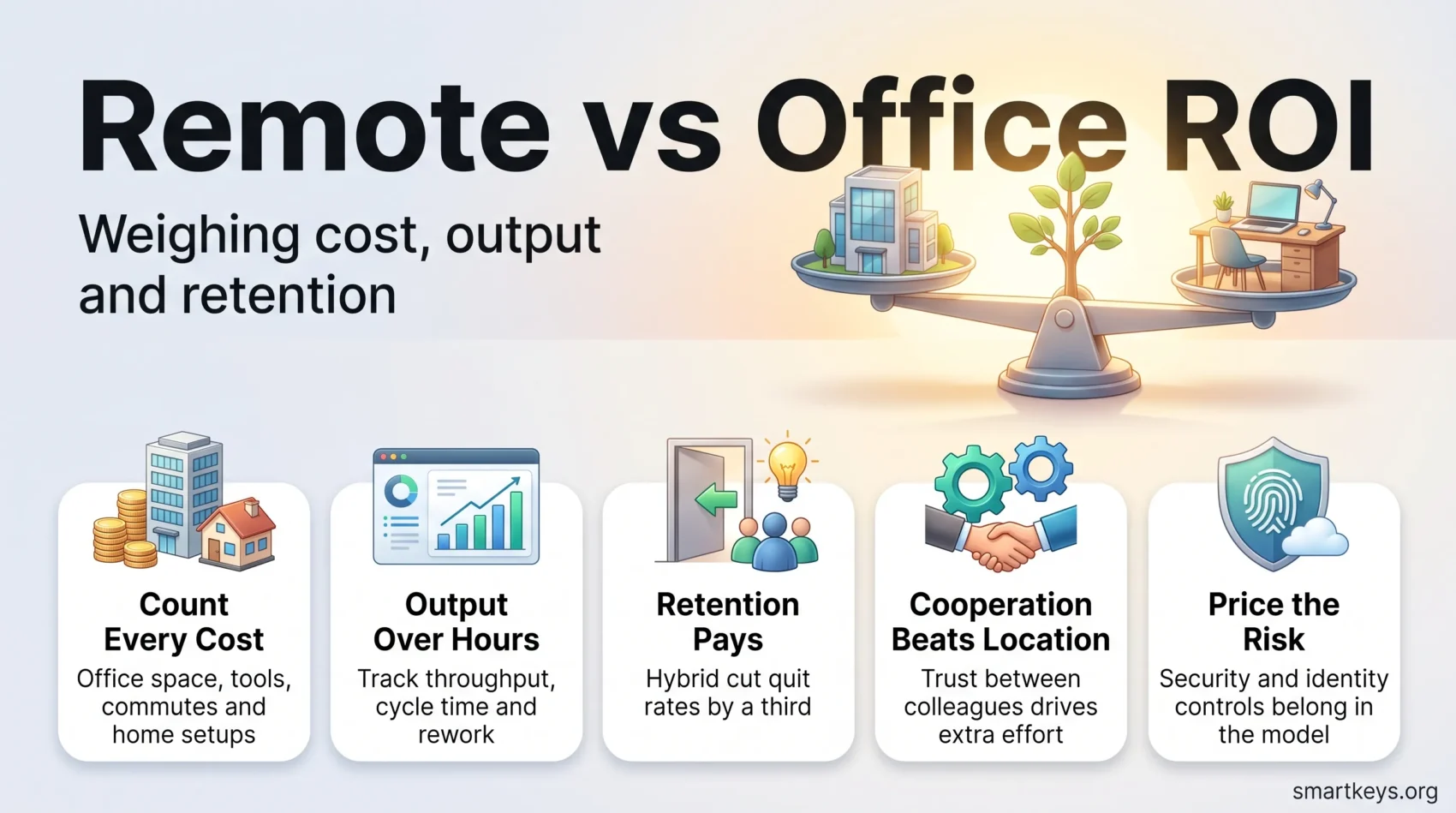
ROI simply means return on investment: what a work model costs you against what it delivers. It is not only rent. It also covers commuting time, how fast teams ship, whether good people stay, and what a security incident would cost.
This guide is a remote vs office cost comparison you can reuse: how to define those numbers, which cost lines companies routinely forget, and where hybrid models can outperform both fully remote and full-time office setups. If you still need to settle how hybrid should run day to day, our guide to running hybrid work well covers schedules, policy and leadership.
Key Takeaways
- Benchmark first: 52% of remote-capable US employees are hybrid, 26% fully remote (Gallup, May 2026).
- Measure productivity by output and cycle time, not by hours visible at a desk.
- Count the costs both sides carry: company facilities and tools, employee commute and home setup.
- Retention is part of the return. Hybrid cut quit rates by a third in the best controlled study we have.
- Use a repeatable framework, then revisit it each year as costs and headcount change.
Why ROI Looks Different Across Remote, Hybrid and Office
Changing where people work moves costs from one budget line to another, and it changes how teams perform. A full-time office keeps rent, utilities, cleaning and security high and predictable. A distributed model trades much of that for variable spending on software licences, equipment stipends and IT support.
The office side of that ledger has shifted. Moody’s Analytics put US office vacancy at 21% in the first quarter of 2026, a record in its tracked series and up from roughly 17% in 2020. Landlords have lost pricing power in many markets, which changes what a lease renegotiation is worth.
Output moves too, but not in one direction. Days at home tend to raise throughput on solo work such as writing, coding or analysis. Days together speed up messy problems: a design disagreement, a new hire finding their feet, a decision nobody wants to make over chat.
Commuting time is the clearest win for employees, and the easiest gain to lose. Without a boundary, the saved hour quietly becomes an extra hour of work, and the benefit shows up as burnout risk instead of balance.
- Costs differ in kind: fixed property spend versus variable tools, stipends and support.
- People outcomes differ: engagement, retention and hiring reach all move with the model.
- Fit beats fashion: the right answer varies by function, seniority and local labour market.
How to Define ROI for a Work Model
Pick a short, repeatable window. A quarter usually works. Then measure the same things across the models you actually run, so the comparison is like for like. Comparing a well-run hybrid team against a badly run remote one tells you nothing about location.
Direct and indirect costs to include
The obvious lines are easy: leases, utilities, cleaning, security, front-of-house services, software licences, travel and home-office stipends.
The indirect ones decide the result. Count slower onboarding, downtime while people wait on a decision, the cost of running the change programme, and time lost switching between tools and tasks. A team losing forty minutes a day to coordination overhead is expensive wherever it sits. Poor home office setups cost output rather than money, which is exactly why they get missed.
Productivity, output quality and time-to-value
Measure results, not hours. Useful metrics include throughput (how much finished work leaves the team), cycle time (how long a task takes from start to done), defect or rework rates, and time-to-value for the customer.
Pick two or three leading indicators managers can see weekly, such as tickets closed or pull requests merged, and tie them to something the business cares about: renewals, support satisfaction, revenue per head. An outcome-based approach to work keeps this honest, because it stops people optimising for looking busy.
People metrics: engagement, retention and hiring reach
Retention belongs in the model because replacing someone is expensive. So does hiring reach, because a wider candidate pool shortens time-to-fill.
There is good evidence that culture, not location, does the heavy lifting here. Great Place To Work found employees who believe they can count on colleagues to cooperate are 8.2 times more likely to put in extra effort. At the Fortune 100 Best Companies to Work For, 84% of employees say they can count on that cooperation, against 65% at a typical US workplace, and productivity runs nearly 42% higher.
Build a simple dashboard so managers see delivery and health signals side by side, and add a short recurring pulse survey. For wider context on where the market is heading, current remote work trends are a useful benchmark.
Cost Drivers: Home Office, Hybrid Footprints and Office Spend
Map fixed and variable costs separately. Fixed costs stay whether or not anyone shows up; variable costs scale with headcount and usage. Mixing them is how budgets end up wrong.
Company facilities cover rent, utilities, cleaning, security and reception. Full-time occupancy keeps all of it high. Hybrid lets you shrink the footprint, but it adds desk-booking systems and someone to plan utilisation. Coworking space can bridge the gap for small or scattered teams without a lease commitment.
Employee costs and savings run the other way. People save commuting time and fares, but may need a stipend, a decent chair, a second monitor and a headset that does not make every call harder. Stanford’s Survey of Working Arrangements and Attitudes found around a quarter of US paid days were worked from home in May 2026, and employer plans have sat at roughly 1.3 to 1.5 days a week since mid-2022. That stability is what makes a multi-year property decision possible.
Space strategy in hybrid models leans on hot-desking, team neighbourhoods and dedicated collaboration zones. Anchor days, meaning fixed days when a whole team is in, cut no-shows and empty rooms. A virtual office setup can carry the day-to-day coordination between those anchor days.
Tools and infrastructure covers collaboration platforms, endpoint protection, single sign-on, VPN access and IT support. Underspending here is a false economy: slow laptops and unreliable video cost more in lost hours than the hardware would. Our overview of desk and room booking software for hybrid offices shows what that layer costs and how its occupancy data feeds this calculation.
“Rightsize the space, standardise the tools, and stress-test your budget against the worst-case utilisation, not the average.”
Productivity and Time: What Actually Moves the Number
Where people sit matters less than whether they can rely on each other. That is the consistent finding across the workplace research, and it is the part leaders can influence directly.
Cooperation beats co-location
When people trust colleagues to deliver, work stops queueing. Fewer handoffs stall, approvals move faster, and less gets reworked because someone guessed instead of asking. You get more output without adding hours.
Note what the 8.2 times figure does not say. It does not claim remote teams cooperate better. It says cooperation predicts effort, and cooperation can be built or broken in either setting.
What leaders actually control
Clear goals and a predictable check-in rhythm cut confusion, which is the main source of wasted effort in distributed teams. Psychological safety, meaning people can raise a problem early without looking incompetent, shortens cycle time because blockers surface while they are still small.
Middle managers carry most of this. Give them shared dashboards and a habit of reviewing delivery data together, and you get coaching. Give them monitoring software and no training, and you get productivity paranoia. Remote leadership skills are a training line item, not a personality trait.
Hidden time costs and simple guardrails
Distributed work erodes boundaries unless something holds them: evening message-checking, meetings creeping into every slot, focus time disappearing into coordination.
Three guardrails do most of the work. Set anchor days for the work that genuinely needs a room. Protect focus time as recurring no-meeting hours. Default to asynchronous updates so people are not paying an attention tax just to stay informed.
“Track cooperation and delivery on the same dashboard. That is the only way to see whether trust is actually buying you speed.”
Talent, Retention and Wellbeing
The people side is where most of the measurable return sits, and it is the part cost models usually skip.
Engagement and wellbeing do not move together
Gallup’s State of the Global Workplace 2026 found exclusively remote employees the most engaged at 25%, with hybrid close behind at 24%. Remote-capable employees required to work fully on-site were the least engaged group at 17%.
Wellbeing tells a more complicated story. Remote and hybrid workers report thriving at 45%, against 32% for remote-capable staff kept on-site. Yet daily stress is higher for them at 46% against 39% on-site, and loneliness is level across all groups at 21% to 23%. High engagement does not mean a healthy team, which is why remote work and mental health deserves its own measurement.
Hiring reach and churn
Flexibility widens your candidate pool and usually shortens time-to-fill. It cuts both ways: your people can also change jobs without changing address.
The strongest evidence on the retention side comes from a randomised trial at Trip.com published in Nature in 2024. Employees assigned to two days a week at home quit at a rate roughly a third lower than the fully on-site control group, with no measurable damage to performance or promotion rates. A third fewer resignations is a large number once you price replacement and ramp-up time. Track offer acceptance and 90-day retention by model so you can see whether it holds in your business, and treat retention as a line in the ROI calculation rather than an HR footnote.
Fairness, seniority and career paths
Perceived unfairness costs more than most policies save. If senior staff quietly get flexibility that juniors do not, people notice and leave.
Proximity bias, the tendency to reward the people you happen to see, is the specific risk. It shows up in promotion decisions and stretch assignments. Fix it with written promotion criteria, structured sponsorship and deliberate attention to remote career advancement, not with a rule that everyone must be visible.
Collaboration, Culture and Operating Model Fit
Clear communication norms cut meeting load faster than any tool. Make the purpose of each channel explicit: chat for quick questions, documents for anything you will need again, tickets for tracked work. Set expected response windows so nobody feels obliged to answer instantly.
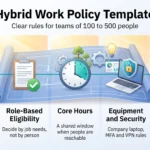
Treat flexibility as part of how the company operates, not as a perk you can withdraw. Teams that shape their own rhythm within clear guardrails generally deliver more than teams handed a uniform schedule. A written hybrid work policy is what keeps that from becoming a free-for-all.
- Anchor days: schedule shared days for complex, ambiguous work and protect deep-focus days for everything else.
- Inclusive meetings: shared agendas, equal airtime and recordings keep remote attendees from becoming spectators.
- Review with data: watch meeting load, response times and delivery metrics, then adjust the norms that are not working.
Risk and Compliance Costs That Belong in the Model
Once people work from several places, security shifts from defending a building to verifying an identity. That shift has a price, and leaving it out flatters your distributed model.
Home networks and personal devices widen the attack surface. The baseline is endpoint protection, multi-factor authentication, and single sign-on or VPN for anything sensitive. Offices are not automatically safer: badge tailgating and social engineering are older problems than home Wi-Fi. Guidance on cybersecurity for remote work and zero trust architecture covers the controls in practice.
Two costs get overlooked. The first is shadow IT, meaning unapproved tools people adopt because the sanctioned ones are slow. The second is employee data: monitoring software, badge logs and productivity analytics are regulated personal data in the EU and a growing list of US states, so check what workplace data privacy rules require before deploying anything that watches people.
- Write an incident response plan that covers lost devices and unsafe networks, not just office scenarios.
- Audit vendors, enforce least-privilege access, and run tabletop exercises that include both remote and on-site failure modes.
- Add expected breach cost and downtime to the model, so risk sits next to the savings rather than outside them.
Conclusion
You can test most of this within a single quarter.
Start by writing down what each model actually costs you, splitting company spending from employee spending and fixed lines from variable ones. Then pick three delivery metrics and two people metrics, and measure them the same way across teams.
Add the guardrails that protect the gains: meeting-light calendars, async-first updates and protected focus hours. Without them, saved commuting time turns into unpaid overtime and the return disappears.
Match the model to the work, not to a company-wide preference. Roles heavy on independent output tolerate distance well. Roles heavy on negotiation, apprenticeship or fast improvisation need more shared time. Run short experiments by function and let weekly indicators tell you what is happening.
Then write down what worked and publish it internally. Revisit it yearly, because lease terms, headcount and hybrid work practice keep moving. On the policy side, review how you handle flexible schedules so hiring, retention and culture stay aligned.
Found this useful?
Make SmartKeys a preferred source on Google, and our articles will surface more often in your Top Stories, AI Overviews, and AI Mode.
Add as Preferred Source