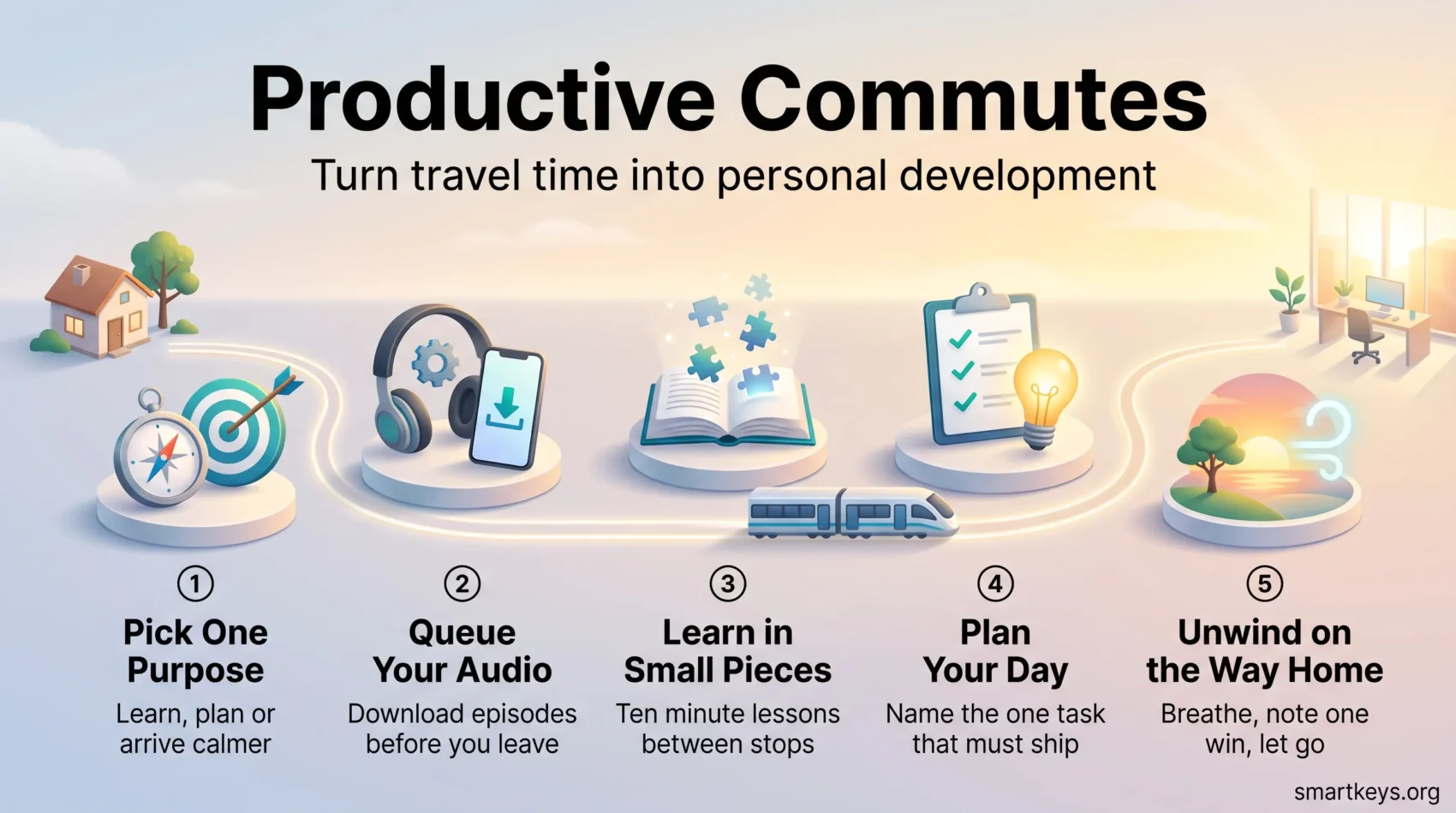
Your commute is already in your calendar. The only question is what you do with it.
The average one-way trip to work in the United States took 27.2 minutes in 2024, according to the Census Bureau’s American Community Survey. For someone who travels five days a week, that is roughly four and a half hours of round-trip time. Nobody plans that time, which is exactly why it disappears.
This guide shows you how to use it: which app to set up, when a short podcast beats a long book chapter, and how to arrive home without carrying the workday inside with you. None of it requires extra hours. It requires deciding in advance.
Key Takeaways
- Pick one purpose per trip. A commute with a goal is useful; a commute with three goals is just noise.
- Audio wins on almost every mode of travel, because it leaves your eyes and hands free.
- Download content before you leave so tunnels and dead zones do not end the session.
- Match the format to the length: short episodes for a 15-minute hop, an audiobook chapter for a longer ride.
- The ride home is worth protecting as a wind-down, not filled with more input.
Start here: a five-minute setup for your next trip
Most commute plans fail for a boring reason. You open your phone once you are already moving, and by the time you have chosen something, half the trip is gone. Decide before you leave instead.
Pick one aim for the trip: learn one thing, plan the day, or arrive calmer. One aim, not three.
Then set up one app you will actually open, and put two items in the queue so you can press play without browsing. That single step removes most of the friction.
Finally, attach the habit to a trigger you already have. Plugging in earbuds, starting the engine, or tapping the gate at the station all work. Linking a new behaviour to an existing one is the idea behind habit stacking, and it is what keeps a commute routine alive past week two.
- Safety comes first. In a car, everything is hands-free and set before you move.
- Check where you lose signal and download content for those stretches.
- Say your intention in one sentence before you set off, then note one small win at the end of the day.
Tip: if you want a broader system for planning your hours rather than just your commute, start with this guide to time management techniques.
Podcasts: build a queue you can just press play
Podcasts suit commuting better than almost any other format. Episodes are short, survive interruptions, and can be stopped mid-sentence without losing your place.
Pick an app that fits how you listen
Apple Podcasts and Spotify are the simplest starting points and both handle discovery well. Pocket Casts and Overcast add the controls regular listeners rely on: per-show playback speed, smarter downloads, and silence trimming.
One note on older advice. Stitcher, for years a standard recommendation, was shut down by SiriusXM in August 2023.
Build a “Listen First” queue
Create topic playlists for subjects you actually care about, then keep one short list called Listen First for the episodes you do not want to miss.
This is the part that saves you. Decision fatigue, the drop in decision quality that follows too many small choices in a row, hits hardest when you are tired and standing on a platform. A queue means there is nothing left to decide.
Downloads and playback speed
Download on Wi-Fi at home. Set playback between 1.2x and 1.5x; speech stays clear for most people at that range, and you can push higher on familiar voices.
Turn on volume normalisation so one loud advert does not blow your ears out, and use chapter markers to skip to the part you came for. Tidy the queue once a week and the rest takes care of itself.
- Mix one short daily show with one longer weekly episode so you always have something that fits the trip you are on.
- When an idea lands, record a quick voice note. Ideas you do not capture do not survive the walk from the car.
- If you carpool, build a shared playlist. Listening together beats negotiating every morning.
Audiobooks: for the trips longer than half an hour
Once a ride passes thirty minutes, an audiobook starts to make more sense than a podcast. You get continuity, and the progress adds up week after week.
Borrowing is the cheapest route. Libby, run by OverDrive, works with public library cards in most of the English-speaking world and lends audiobooks and ebooks for free. It is the app to install, because the separate OverDrive app was retired on 1 May 2023. Many library systems also offer Hoopla, often with instant borrows and no waiting list.
If you buy instead, understand Audible’s credit system before you stockpile. Credits roll over month to month, but expire twelve months after they are issued and disappear if you cancel. A pile of unused credits is not a savings account. Spotify Premium Individual also includes a monthly audiobook listening allowance, visible in your account settings.
- Match the book to the trip: short chapters for a 20-minute hop, a longer narrative for an uninterrupted hour.
- Keep two books going, one practical and one story-driven, so you have something for tired days.
- Download at home, set the speed to something comfortable (many people settle around 1.25x for nonfiction), and bookmark rather than trying to remember.
If reading is where you struggle rather than listening, text-to-speech tools are worth a look. Speechify and similar apps read documents, articles and PDFs aloud, which turns your own reading backlog into commute material.
Meditation and mindfulness on the move
A short practice between stops helps you shift out of whatever you were carrying and into the day ahead. It does not require silence or a cushion.
Headspace offers structured courses if you like step-by-step guidance. Calm has a wide range of session lengths, including very short resets. Insight Timer has a large free library and a plain timer if you would rather sit quietly than be talked to.
Pick one aim per session: steadier breathing, less tension, or a moment of gratitude. Trying all three does none of them. For what regular practice does and does not deliver, see our piece on meditation and productivity.
- Behind the wheel, stick to simple breathing techniques and keep your attention on the road. Guided sessions with closed eyes belong on a train, not in traffic.
- Build a small ritual: one steadying breath at the start, a body scan mid-ride, one thing you are glad about before you arrive.
- Keep the volume low and mute notifications so you are not jolted out of it.
If the pressure you carry is bigger than a five-minute reset, a commute practice will not fix it. Our guide to managing stress at work covers the parts that need a change in the job, not the journey.
Take an online course in ten-minute pieces
Courses feel like they need a desk and a free evening. Many do not. Coursera, LinkedIn Learning and Skillshare all offer mobile apps with offline downloads, and a lecture is often just audio with slides you can review later.
Break each module into ten or fifteen minute pieces so one piece fits between two stops. That adds up to an hour or two a week without ever finding a free evening.
Choose subjects that map onto your actual job: a language, a specific tool, an industry topic. If you are not sure where to aim, our overview of upskilling and reskilling in 2026 covers which skills employers are genuinely paying for.
“Turn coursework into audio and small slices of time start adding up to real progress.”
- Prefer courses with downloadable audio or transcripts you can listen to offline.
- After each lesson, capture one takeaway and one next action. Learning that never becomes behaviour is entertainment.
- Save quizzes and anything that needs typing for when you are stationary.
- Pair up with a colleague and compare notes weekly. Accountability does more than motivation.
Think out loud: capture ideas while you travel
A long drive is an unusually good place to think. No screen, no inbox, nobody interrupting. That combination is rare enough to use deliberately.
Set one prompt before you leave: a problem to solve, a decision to make, a project that is stuck. One prompt keeps your thinking from circling.
Record the raw thinking as a hands-free voice memo. The important step comes afterwards. Unprocessed voice notes pile up and become their own source of guilt. Build a habit of turning voice memos into usable notes, and use voice dictation to move the good parts into your task manager.
- Give the first five minutes to loose thinking, then spend the rest mapping actual steps.
- Assign a theme to each stretch of the route: leaving home for planning, mid-route for problems, the last few minutes for next actions.
- Keep an “idea parking lot” for thoughts that are not urgent and review it once a week.
When you are stuck, describe the outcome as though it already happened, then work backwards to the steps that got you there.
End every ride by putting one next step in your calendar. An idea with a time attached is the only kind that ships.
Calls and voice messages without the risk
A commute is a decent window for short check-ins, as long as safety comes first. In a car that means hands-free only: CarPlay, Android Auto or a Bluetooth headset, with key contacts programmed in before you set off. Handling a phone while driving is illegal in most places, and no call is worth it.
For anything that does not need a live conversation, asynchronous audio is better. Voxer and WhatsApp voice messages let the other person reply when it suits them, and both allow faster playback. You get the tone of a conversation without both of you being free at once.
One correction to older advice: Skype is gone. Microsoft retired the consumer service on 5 May 2025 and moved users to Teams. If you want a second number for client boundaries, pick a current VoIP provider instead.
- Batch your calls. Fixed days for family, mentors and friends turn good intentions into an actual routine.
- Keep each call to one question and one decision. Short and clear respects everyone’s time.
- Send a voice note to your team instead of typing. It is faster and it keeps the tone intact.
- Leave the last two minutes to log follow-ups so you arrive with a list rather than a vague feeling.
If the reason your evenings keep getting eaten is that work calls follow you home, the problem is not your commute. Our guide to setting boundaries around your personal time is the better place to start.
Music that sets the tone for your workday
Music is the lowest-effort option on this list, and it still changes how you arrive. A few deliberate tracks can lift the morning and take the edge off the evening.

Build a morning list and an evening list
Make two playlists: one with energy for the way in, one calmer for the way home. Keep each under an hour so you finish a run without repeats, and refresh them monthly before they go stale.
Keep a few reliable “instant reset” tracks for rough days. A shared list with friends or colleagues keeps new music arriving without effort.
Cut the interruptions
If you drive, set everything before you pull away. Ad-free options such as SiriusXM or a paid streaming tier stop the mood being broken every ten minutes by an advert.
- Instrumental tracks tend to suit concentration; lyrics tend to suit energy. Use each where it helps.
- Noise-cancelling or well-sealed earbuds let you listen at a lower volume on public transport, which protects your hearing.
- Pair a one-line intention with your first song. Something like “show up properly today” or “leave it at the office” is enough.
Music and focus is a genuinely mixed research area, and the honest answer depends on the task and the person. We went through what the studies actually support in music and work productivity.
Plan the day: turn minutes into momentum
Two minutes of planning at the start of a trip is often worth more than the other twenty-five.
Name the top three tasks for the day and, more importantly, the one thing that has to ship. Picking a single most important task is the core of the daily highlight technique, and it does more for a day than any long list.
If you would rather have a set method than a loose habit, the Ivy Lee method gives you six tasks in strict order and nothing else to think about.
- Anchor tasks to real moments at work: on arrival, mid-morning, before lunch. Plans tied to times survive interruptions better than plans tied to nothing.
- Group small items into one 30-minute block rather than letting them scatter across the day.
- Pick one thing to drop. Subtraction protects your day more reliably than better scheduling does.
Use a simple when/then rule to close the gap between planning and doing: when I park, then I send that one email. Writing the trigger into the plan makes it far more likely to happen.
Finish with one sentence that defines a good day. That way you can tell at 6pm whether you had one. If lists are where your system usually falls apart, our guide to using to-do lists effectively covers why most of them fail.
Decompress on the way home
The trip home is the only buffer most people get between work and everything else. Filling it with more input wastes it.
Build a short closing ritual: three slow breaths, one thing that went well, one honest sentence about the parts that did not. Naming a win is not self-congratulation. It stops the day’s problems from being the only thing you remember.
If thoughts keep looping, record a one-minute voice note and promise to look at it tomorrow. Getting it out of your head usually stops it following you inside.
- Keep one calming track or short mindfulness session ready so you can downshift without switching off entirely.
- Picture putting the work in a mental inbox that you will open at a set time tomorrow.
- On a hard day, sit in the car for one extra minute before you walk in. It costs nothing and it changes the first ten minutes at home.
“I did what I could today. I will come back to this with fresh energy tomorrow.”
Deliberate downtime is not wasted time. We make that case in our piece on structured downtime. The same logic applies to an evening routine that starts before you get home.
What works on each mode: car, train, subway
The right choice depends less on ambition than on how your journey actually behaves.
In a car, everything is audio and everything is set before you move. Navigation, playlist, downloaded lesson. Eyes on the road, hands on the wheel.
On trains and subways, expect noise and interruptions. Podcasts and audiobooks handle a sudden announcement better than a course module you have to follow closely. Underground stretches make offline downloads essential.
Walking or cycling suits listening but nothing that needs your hands. Keep the volume low enough to hear traffic.
Carry a small kit: earbuds, a battery pack, something to write on. An unexpected forty-minute delay is only useful if you are equipped for it.
- Have two options ready. A packed carriage or a cancelled train should not end the plan.
- For long car stretches, choose deeper material. For short hops with transfers, one small idea per segment.
- Adjust to the day. A calm morning suits demanding material; a chaotic one suits something lighter that still moves you forward.
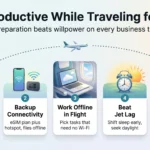
Longer journeys raise different problems. Our guide to staying productive while travelling for work covers the ones a daily commute never has to deal with.
Conclusion
None of this asks for extra hours. It asks you to decide in advance what a block of time you already spend is for.
Start small: one podcast queued, one playlist built, one course module downloaded. Press play and let the habit form before you try to optimise it.
Use the morning ride to set up the day and the evening ride to close it down. Keep it human, and keep it safe: hands-free in the car, eyes up on the platform.
And if the whole idea sits badly with you, that is a fair position. A quiet ride with nothing in your ears is a legitimate use of the time, and in a difficult week it may be the best one.
Found this useful?
Make SmartKeys a preferred source on Google, and our articles will surface more often in your Top Stories, AI Overviews, and AI Mode.
Add as Preferred Source