Usage-based pricing lets a customer pay only for what they use. This model is common in cloud platforms, telecom plans, and utilities. Now, many SaaS companies are adopting it to link cost with real product value.
Why it matters: the approach reduces barriers for new customers and supports growth as teams expand usage. Public firms that embrace this model often report stronger net dollar retention and faster revenue expansion driven by land-and-expand motion.
In this article, you’ll learn how the model changes your sales and billing, how to measure meaningful data like API calls or storage, and how to avoid common risks such as bill shock. Expect clear examples from leading software vendors and a practical roadmap to test and roll out a pay-per-use strategy in your business.
Key Takeaways
- The pay-per-use model ties cost to real product value and can lower adoption friction.
- SaaS companies using this approach often see improved revenue expansion and NDR.
- You’ll need solid metering, billing, and forecasting to make it predictable.
- Hybrid plans can balance flexibility with contract predictability for customers.
- Start with a pilot that measures usage metrics that map directly to value.
What usage-based pricing is and why it matters right now
The simplest way to describe it: customers pay based on how much product they consume, not a flat fee. This usage-based pricing approach bills for measured activity — transactions, API calls, data stored, or compute time — so cost tracks real value.
That consumption focus lowers the barrier to start. You can try the software with low risk and scale costs as you get value. For many buyers, that feels fair and modern.
Definition in plain terms
In practice, you meter what matters: API calls, gigabytes of data, or compute minutes. Billing reflects actual usage, so customers pay only for what they use. That clarity helps both sides map price to benefit.
Why it’s accelerating in SaaS today
Automation and AI cut manual tasks, making seat counts less relevant. API-led products deliver value without a human UI, so per-user fees feel out of step.
- More adoption: lower start cost drives trials and organic growth.
- Better signals: granular usage data improves forecasting and product decisions.
- Aligned value: customers pay as value accrues, reducing friction for expansion.
Bottom line: when your product’s core value is measurable, this model gives you a fair, scalable way to capture it while meeting buyer expectations today.
Usage-based pricing vs. traditional subscription models
Choosing between a fixed subscription and a meter-based fee changes how your finance team forecasts and how customers plan their spend.
Predictability favors traditional subscription plans. A flat fee gives steady costs that make budgeting simple and revenue reliable for your business.
Flexibility is where a consumption approach shines. When usage varies a lot, customers pay for real use and avoid wasted capacity.
Operationally, subscriptions simplify billing and approval. Metered models require accurate metering, rating, and dispute handling — more complexity, but also better alignment to value.
“Hybrid models — a base subscription plus variable overage — often strike the best balance for finance and customers.”
- Subscriptions win when needs are steady and budgeting certainty matters.
- Consumption models win when usage scales with value or fluctuates widely.
- Hybrid approaches reduce bill shock and preserve predictable revenue.
When you choose, weigh forecasting, customer expectations, and the operational work needed to support your chosen pricing strategy.
The business value metric: pricing on the value your customers actually use
Define one clear meter that links product use to measurable business outcomes. That single metric becomes the backbone of your pricing model and the story you sell to customers.
Choosing the right usage metric
Pick a metric that mirrors how customers extract value. Common choices include API calls, gigabytes of data stored, compute hours, or messages sent. Each maps to a different product workflow and buyer mindset.
Compare options by asking: does this metric feel fair? Is it auditable and easy to explain? Avoid vanity meters that inflate bills without reflecting outcomes.
Linking metrics to adoption, revenue, and retention
When your meter aligns with adoption milestones, you get better signals for expansion and net dollar retention. Public companies that match price to real use report stronger revenue growth and easier land-and-expand motion.
- Transparency: make the meter auditable so customers trust bills.
- Forecasting: capture usage data to predict ramp and sustainability.
- Guardrails: set thresholds and controls to prevent accidental overages.
- Dashboards: show customers live metrics so they can manage spend.
Bottom line: document how your value metric supports your pricing strategy and growth model. A clear, fair meter reduces friction and aligns your product with customer outcomes.
Core benefits you can expect from a usage-based pricing model
Lower friction at sign-up helps more users discover value and fuels organic growth inside accounts. Letting customers start small reduces risk and speeds time-to-value.
Lower barrier to entry and faster adoption: You’ll see how small commitments let teams test features quickly. More users try the product, uncover new use cases, and invite colleagues.
Direct alignment of price with value and TAM expansion
Fairness matters. When cost tracks actual use, customers trust you more. That trust makes it easier to win accounts outside your core ICP and expands your total addressable market without costly sales outreach.
Superior CAC payback and net dollar retention potential
Conversion from trial to paying customers improves because buyers face less upfront risk. As adoption grows inside accounts, natural consumption increases revenue and boosts net dollar retention.
- Faster adoption: starts small, grows quickly.
- Aligned value: price mirrors outcomes.
- Better metrics: improved CAC payback and retention.
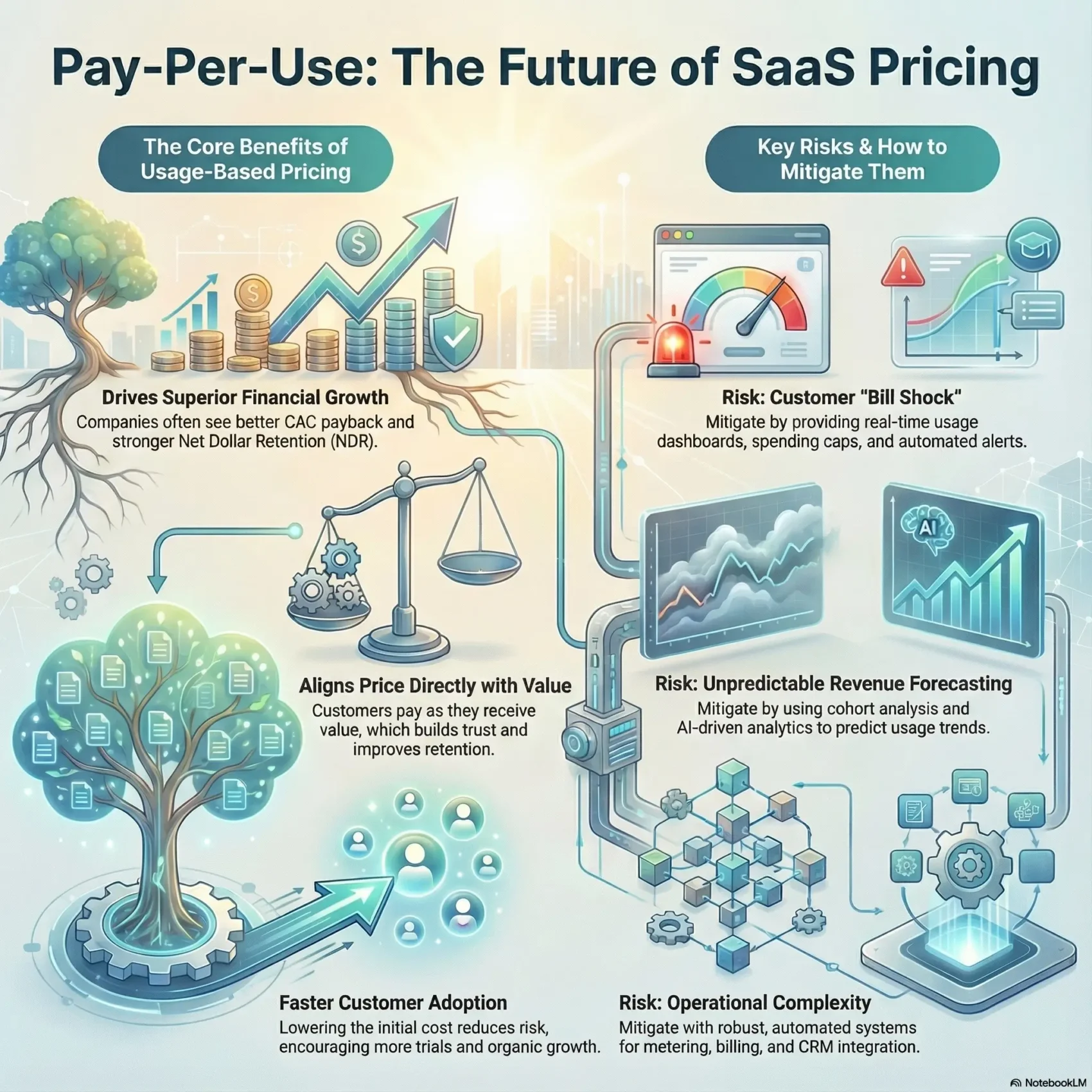
Common risks and how to mitigate them
Before you flip the switch, it helps to map the sharp edges of a consumption model so you can protect customers and your forecasts.
Customer bill shock and variable bills
Bill surprise is the top customer risk. Variable bills can erode trust and cause churn.
Prevent it with real-time alerts, soft limits, and pre-set budgets that notify users before costs spike.
Show projected month-end charges on dashboards so customers see trends and can act early.
PO creation, cash collection, and admin overhead
Many finance teams wait for invoices, which delays POs and collections. That increases your cash cycle and admin work.
Smooth the process with drawdowns, prepaid credits, or short-term allocations finance can approve quickly.
Automate metering, rating, invoicing, and collections to cut manual tasks and billing disputes.
Revenue forecasting and predictability challenges
Forecasting gets harder when revenue follows consumption. You must model cohorts, seasonality, and leading indicators.
Use dashboards and AI-driven analytics to predict usage and flag anomalies early.
- Set guardrails: rate caps, throttling, and overage discounts to limit runaway costs.
- Align finance, sales, and CS on true-up processes and dispute workflows.
- Document how usage is measured and priced to reduce confusion.
For more on predictive models that improve forecast accuracy, see predictive analytics for business. With these steps, you can preserve flexibility while keeping bill surprises and revenue risk under control.
Types of usage-based pricing models you can adopt
There are distinct charge structures—from strict per-unit to credit drawdowns—that trade simplicity for control. Pick the model that matches how your product is used and how your customers want to manage costs.
Pay-as-you-go and per-unit
Pay-as-you-go bills strictly per unit consumed. It’s transparent and works well for simple meters and early-stage adoption.
When to use it: variable demand, clear unit metrics, and self-serve buyers who value low friction.
Overage and drawdown models
Overage adds a threshold with per-unit charges above an included amount. Higher volume often earns discounted rates.
Drawdown lets customers pre-buy credits to spend over time. Datadog uses drawdowns to balance predictability with flexibility, helping finance teams issue POs and manage budgets.
Tiered, volume, and stair-step consumption
Tiered and volume structures reduce per-unit costs as usage grows. They reward scale without capping your upside.
Stair-step pricing sets fixed bands with a price per band to simplify bills while keeping costs aligned with ranges.
- Design tip: build clear rate cards and examples so customers know what they’ll pay as usage grows.
- Flexibility: allow switches between models as accounts mature, and combine approaches to serve both self-serve and enterprise buyers.
- Match it: align your model to consumption patterns and customer expectations to reduce surprises and ease adoption.
Industries and use cases where usage-based pricing thrives
Some markets naturally map value to measured use. That makes meter-based charges feel fair and predictable to buyers. Below are the sectors where this approach works best and why.
Cloud infrastructure and data platforms
Cloud providers like AWS and Azure bill for compute hours, storage GB, and data egress. This ties costs directly to the resources customers consume.
Why it fits: teams only pay for actual compute and transfer, so scaling stays aligned with demand and business value.
Telecommunications and utilities
Telcos mix base plans with overages for data, and utilities meter electricity and water with peak rates. These sectors already expect metered bills.
Operational note: blending allowances and caps prevents surprises and makes procurement easier for enterprise buyers.
SaaS features: APIs, storage, and messaging
Many software companies charge per API call, gigabyte stored, or message sent. This maps product value to measurable outcomes for customers.
“When meter and value match, customers scale confidently and you reduce churn.”
- You’ll see cloud platforms price compute, storage, and egress to match resources consumed.
- Telecoms blend base allocations with overage to keep plans flexible.
- SaaS meters APIs, storage, and messaging so costs grow with real usage.
Takeaway: study these patterns to set expectations with buyers, design clear bills, and tailor your model by sector so customers trust the approach.
Is usage-based pricing right for your business?
Ask whether your product’s value grows when customers use it more — that single question helps you decide if this model fits your market and your margins.
Assessing variability and cost alignment
First, check how variable your customers’ needs are month to month. If demand swings, a flat plan can leave buyers paying for unused capacity.
Next, confirm whether your costs rise with consumption. When your costs scale with use, the model improves margin alignment.
Operational readiness: metering, billing, and support
Metering must be accurate and auditable. You need reliable usage data, clear billing, and a process for disputes.
Also verify that product, finance, and support can handle the change. Procurement preferences like POs and budgets matter for adoption.
- Pilot small: start with a segment or SKU to learn fast.
- Define metrics: success signals and predictability targets.
- Revisit often: update assumptions as customer data arrives.
How to implement usage-based pricing without breaking your business
Begin with a simple map of the customer lifecycle to find the exact moments you must meter and report.
Map the customer journey and define metering points
Trace from first signup to full adoption and mark every action that creates value. Meter where usage aligns to outcomes so your bills reflect real benefit.
Design your rate cards, discounts, and guardrails
Create clear rate cards with examples that show how charges grow as customers scale. Add alerts, caps, and throttles to prevent bill shock.
Pilot, iterate, and roll out with a clear change plan
Start with a contained cohort, measure usage and sentiment, then refine the model. Update contracts, order forms, billing systems, pricing pages, and enablement in sync.
- Prepare teams: train sales, CS, finance, and support before launch.
- Set discounts: reward committed volume without capping upside.
- Measure impact: use usage data to tie changes to revenue and customer satisfaction.
Algolia took under a year to transition—discipline on timing and updates matters.
Company-wide alignment: product, marketing, sales, CS, and finance
Company-level buy-in makes the change repeatable. Aligning teams around a single value metric turns the new pricing model into a predictable revenue engine.
Product
Invest in adoption-driving features and build telemetry that shows deployment time, ramp rate, and sustainability.
Marketing
Educate buyers on the value metric and foster a community that shares use cases and best practices.
Sales
Shift comp to reward consumption growth. That motivates reps to sell for long-term revenue, not just a single contract.
Customer success
Use live usage data and health signals to coach customers earlier. Proactive outreach prevents churn and accelerates expansion.
Finance
Update revenue recognition, forecasting, and dashboards so finance can model cohorts and report predictable revenue trends.
- Define cross-functional processes to catch issues early and scale wins.
- Train teams to speak a common language about value, usage, and outcomes.
- Operationalize a PLG motion where revenue follows customer success.
Usage-based pricing technology stack and must-have features
Accurate metering is the invisible backbone that keeps customers happy and finance sane. Metering and rating must be auditable so bills feel fair and disputes stay rare.
Metering, rating, and billing with CPQ and CRM integration
Integrate CPQ, CRM, and billing on a single platform so quotes flow to invoices without manual handoffs.
Rule-based deal management lets sales tailor offers inside policy and pushes clean orders to order management and accounting.
Real-time usage dashboards for customers and internal teams
Give customers live dashboards so they track usage and projected charges. That visibility reduces surprise bills and churn.
Internal teams get the same usage data, improving support, product decisions, and resource planning.
AI-powered analytics for forecasting and anomaly detection
AI models predict demand, seasonality, and likely anomalies so you can set alerts and improve predictability.
Outcome: fewer billing errors, lower admin time, and revenue forecasts that reflect real consumption trends.
- You’ll align infrastructure and resources to actual use.
- You’ll unify data across order, billing, and accounting.
- You’ll automate end-to-end workflows to reduce errors and speed collections.
Hybrid pricing models that blend predictability and flexibility
Many companies now pair a flat subscription with metered consumption to balance control and growth. This hybrid approach gives finance a clear baseline while preserving upside as teams expand use.

Usage-based subscriptions, pooling, virtual currency, and minimums
Usage-based subscriptions add a predictable base with variable overage. That structure reduces bill shock and keeps revenue more forecastable.
Pooling lets teams share allocations so departments avoid wasted spend and admins simplify chargebacks.
Virtual currency or credits simplify complex consumption across features and make procurement easier for enterprise buyers.
Minimums unlock discounts while leaving room for expansion. Set them so discounts scale with commitment without capping your upside.
Discounts tied to commitments without capping upside
Design fair discounts: link reduced rates to clear commitments and expected adoption. That rewards the customer and keeps growth incentives intact.
- Match discounts to volume bands and term length.
- Create self-serve calculators so customers see cost scenarios and avoid confusion.
- Limit plan complexity to prevent choice paralysis while offering enough options for enterprise procurement.
“Hybrid plans can deliver the best of both worlds: budget certainty for procurement and flexibility for teams that scale.”
Track how hybrid models affect your revenue mix and customer satisfaction. Monitor adoption, renewal rates, and average revenue per account so you can iterate the approach fast.
usage-based pricing adoption: real-world examples and outcomes
Real company rollouts show how careful design and cross-team work turns a meter model into predictable growth. These examples highlight tactics you can copy and pitfalls to avoid.
Algolia: developer-first return
Algolia moved back to a meter model in under a year. They rewired service orders, billing, and training with a developer-centric focus. The company prioritized clear docs and self-serve flows so customers could adopt quickly.
Datadog: drawdowns that reduce friction
Datadog used drawdown credits to give predictability and flexibility. That easing of procurement friction helped reduce sales resistance and sped time-to-value.
New Relic, Cypress, and Landbot: outcomes
New Relic tied sales comp to consumption and saw data ingestion and account reacceleration. Cypress used feedback loops and OKR alignment to launch smoothly.
Landbot ran research sprints to tune tiers and value metrics, lifting NRR by 26%.
- Takeaways: don’t rush the change; align product, sales, and finance.
- Frame the move to build trust and limit churn.
- Use pilot data to forecast revenue and signal real benefits to customers.
Pricing strategy, metrics, and forecasting you should track
Turn early signals into predictable revenue. Start with a few simple measures that show when customers begin to get value. These help you tune your pricing strategy and improve forecast accuracy.
Leading indicators: deployment time, ramp, and sustainability
Track deployment time to first meaningful usage as a core leading indicator. That tells you how long it takes for a customer to start seeing value.
Model ramp curves for the first quarter and the first year so you can set realistic revenue expectations. Compare actual ramps to targets to spot weak starts early.
Measure whether usage sustains after onboarding. If activity drops, the model and the customer experience need work.
Usage cohorts, net retention, and revenue multiple impacts
Cohort your customers by start date and use case to reveal expansion patterns. Monitor net dollar retention as the clearest signal of model health.
- Connect usage trends to revenue: map consumption to churn, renewals, and pipeline velocity.
- Refine your strategy: use elasticity and willingness-to-pay data to adjust rates and offers.
- Inform operations: feed usage data into capacity planning and margin management.
- Benchmark: compare growth and revenue multiples to market peers to calibrate success.
“Public companies that align price with usage often trade at a meaningful multiple premium, reflecting investor confidence.”
Messaging your rollout to minimize churn and maximize trust
Begin messaging with the customer outcomes you expect to improve, not the billing mechanics. Lead with clear examples that show how the move makes it easier for teams to get value and avoid wasted spend.
Positioning this change as customer-friendly value alignment
Open every message by explaining why the approach helps your customers. Say how customers pay only for real use and how that ties cost to benefit.
Be explicit: show scenarios—small teams trialing features, growing teams paying as they scale, or departments pooling credits to avoid waste.
Segmented communications for existing vs. new customers
Treat prospects and current accounts differently. New customers get straightforward product-plus-cost examples and calculators. Existing customers need migration paths, grace periods, and credits so they don’t feel forced.
Test messages with A/B experiments, and share tested scripts with sales and CS so every conversation is consistent.
- Tools: publish cost-estimate calculators and sample invoices to boost predictability.
- Support: provide FAQs, objection-handling guides, and migration timelines to assist sales and CS.
- Transparency: explain metering rules, alerts, and spend controls so customers keep control.
“Predict usage, reduce surprises, and be generous during migration—small concessions today keep retention high tomorrow.”
Conclusion
, You can move forward with confidence if you start small and measure what matters.
Decide by testing a clear meter, building strong telemetry, and using AI-driven forecasts to reduce surprises. Hybrid models help you balance certainty and upside so procurement and teams both win.
When companies commit to a clear value metric and align product, sales, CS, and finance, the model drives adoption, retention, and revenue growth. Design guardrails, show live dashboards, and roll out with transparency so customers trust the change.
In short: try a pilot, learn fast, and iterate. With the right tech stack and company-wide alignment, usage-based pricing can become a durable growth strategy you and your customers can scale with.