Tools
Tools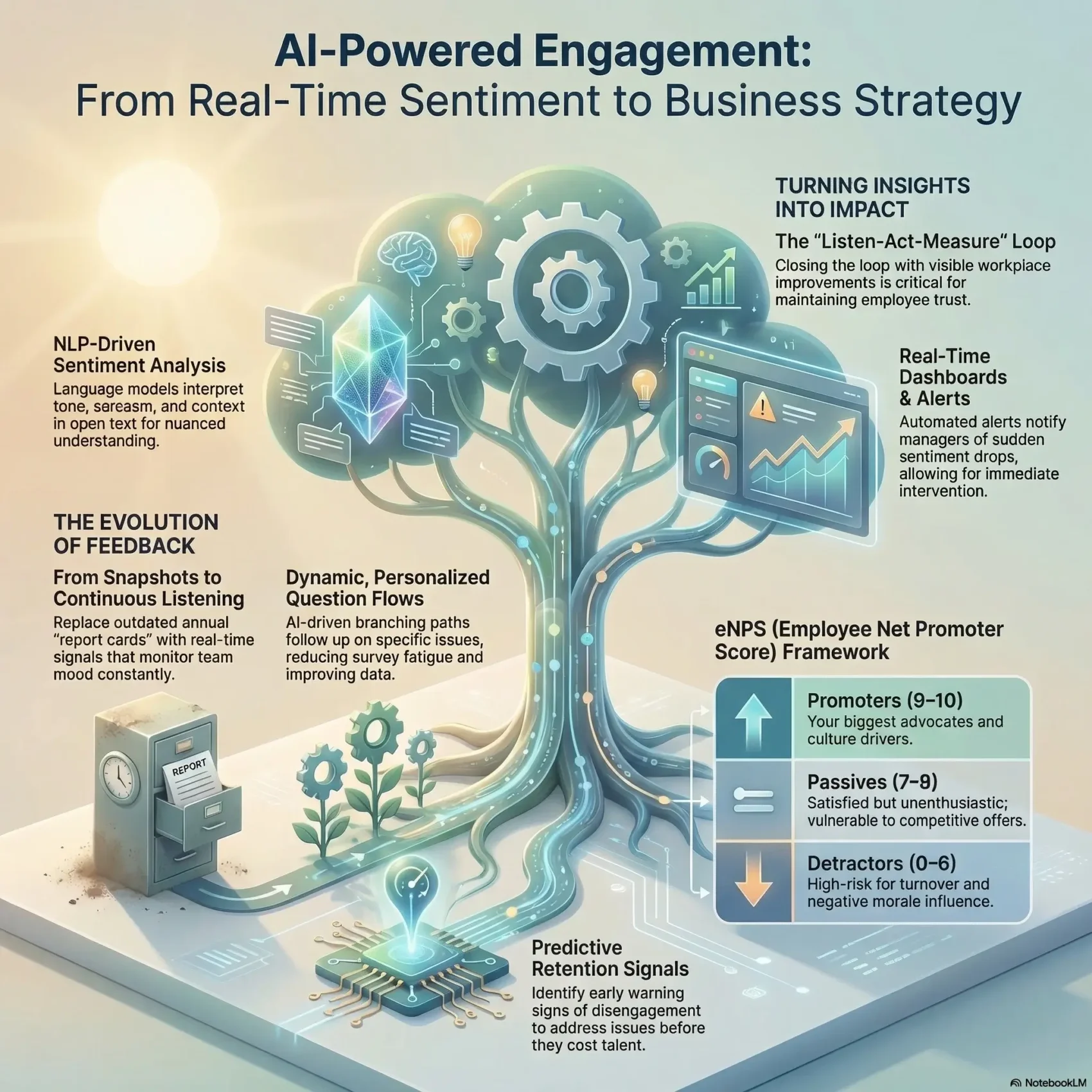
Turn static report cards into a living system that listens and responds to your workforce in real time. You’ll see how artificial intelligence reads tone, context, and patterns in employee feedback to surface real emotions and sentiment shifts.
This approach cuts manual analysis time and gives you faster, actionable insights so managers can act before small problems grow. Dynamic question flows and smart analytics help capture richer data from open text and responses.
The result is a clearer link between what employees say and the actions you take. You’ll learn which tools improve data quality, how analytics reveal trends, and how to connect feedback to measurable results in your workplace.
Key Takeaways
- Shift from one-off snapshots to continuous listening for better employee engagement.
- Automated analysis surfaces sentiment signals you can address quickly.
- Design choices and tools matter for higher-quality feedback and data.
- Faster insights reduce bias and speed decision-making across organizations.
- Clear dashboards and alerts turn responses into visible workplace improvements.
Why AI engagement surveys now: aligning to today’s workforce and your business goals
Today’s leaders need real-time signals that connect team mood to measurable business results. Continuous listening turns isolated responses into clear links between worker sentiment and KPIs like retention and productivity.
Mapping engagement to outcomes: retention, productivity, and performance metrics
You connect employee engagement to business metrics by mapping signals to retention, productivity, and performance outcomes leadership already tracks. Use predictive understanding to spot dips early and plan targeted interventions.
From static snapshots to continuous listening in the present workplace
Replace point-in-time cycles with continuous monitoring that watches sentiment and trends as they appear. That reduces manual reporting time and gives faster insights you can act on.
“Early warnings let you address issues before they erode trust or cost talent.”
- Quantify benefits: faster time to insight and clearer performance linkages.
- Support teams: position technology as assistive, not managerial.
- Center employees: timely questions and follow-ups increase satisfaction and participation.
What AI-powered engagement surveys are and how they differ from traditional surveys
Modern platforms move beyond fixed forms to deliver personalized, conversational question flows that change with each employee’s answers.
Dynamic flows guide employees through relevant questions, reducing fatigue and improving data quality. These platforms process thousands of responses fast, surfacing patterns and trends that manual review often misses.
From generic questionnaires to personalized, dynamic flows
Rather than one-size-fits-all questionnaires, you get branching paths that follow up on issues that matter to each person. Completion rates rise and the signals you collect become clearer for teams and leaders.
Turning employee feedback into actionable insights with NLP and analytics
Natural language processing interprets open text with nuance, spotting sarcasm and context rather than just keywords. Combined with analytics, this produces rapid summaries and targeted findings so managers can act in days, not weeks.
“Faster summaries and consistent analysis help you prioritize where to intervene.”
- Standardized analysis reduces bias and scales across thousands of employees.
- Secure platform integrations move data into HR systems for timely action plans.
- Predictive signals highlight retention risks and other benefits for your teams.
Planning your program: foundations for trust, transparency, and participation
Build your program on clear rules so employees know what to expect and why their input matters. A concise plan helps you align objectives, owners, timelines, and success metrics so the effort delivers real value.
Set clear objectives, owners, and success metrics
Define success up front — name owners, set timelines, and pick metrics that map to retention, productivity, or satisfaction. When you measure the right things, the team sees outcomes and trust grows.
Communicate the “contract” with employees: what you collect, why, and how you’ll act
Be transparent about the feedback you collect, how long data is kept, and the actions you’ll take. Share plain-language privacy rules and follow a regular cadence for reporting back to employees.
Choose secure, adaptable platforms that integrate with existing HR systems
Pick platforms that connect to HRIS and collaboration tools to reduce manual work and improve data flow. Prioritize privacy by design, GDPR/CCPA compliance, strict access controls, and options for anonymity.
- Publish governance rules, bias checks, and escalation paths.
- Train managers to read dashboards responsibly and act with context.
- Align leadership funding and team responsibilities so insights turn into visible actions.
“Clear rules and visible follow-up are the difference between noise and meaningful change.”
Designing smarter surveys: question strategy, personalization at scale, and cadence
Personalized question sets reduce fatigue and surface the signals that matter most to teams. Start with clear goals so each question ties to a metric or action you can take.
Use targeted questions by role, team, and trend
Generate questions that match roles and current trends so employees see relevance. Tailored prompts raise completion and improve the quality of the data you collect.
Mix formats to unlock deeper insights
Combine multiple choice, sliders, and open text. That gives structured analytics and nuanced context from free text.
Right-size frequency: pulse, quarterly, event-triggered
Pulse checks give quick sentiment signals. Quarterly scans add depth. Event-triggered questions catch moments that matter.
Close the loop fast to convert feedback into visible actions
Set SLAs for manager follow-up and configure alerts for critical responses. When employees see fast action, trust and satisfaction rise.
- Pilot new questions with small groups and iterate.
- Maintain a question library tagged by theme for consistent analysis.
- Include role-specific drill-downs so managers can act on team-level issues.
Real-time insights to action: dashboards, alerts, and predictive analytics
Live dashboards turn raw responses into clear, time-sensitive signals you can act on. Visual views update as feedback arrives so leaders spot drops in participation or spikes in negative sentiment fast.
Live dashboards and automated alerts for engagement shifts
Set up dashboards that refresh continuously and surface the metrics you care about. Configure automated alerts for rapid drops in scores or sudden sentiment swings so managers get notified immediately.
Segmentation and benchmarking to pinpoint team-level issues
Use segmentation by team, role, or demographics to find where problems are concentrated. Benchmark results against internal groups or industry standards to add context and avoid false alarms.
Predictive signals for proactive retention strategies
Turn trends into forecasts so you can flag retention risks before they escalate. Combine predictive analytics with short playbooks and clear owners to ensure fast, consistent responses.
- Integrate dashboards into daily tools so teams see signals where they work.
- Align alerts with escalation paths and confidentiality rules.
- Measure lag from signal to manager action and improve your response time.
“Prioritized actions with assigned owners make insights operational, not just observational.”
Ethical guardrails and data privacy for AI-powered employee feedback
Your program must guard privacy and fairness so people trust the process and share honestly.
Privacy by design means opt-in consent, anonymization, strict access controls, and secure storage that meet GDPR and CCPA expectations.
Bias monitoring and audits
Regular model checks and audits help you find skewed results and make corrections. Monitor sentiment and outcomes across groups so employees with different identities get fair treatment.
Human-in-the-loop decisions
Keep people involved for sensitive cases. Automation should speed analysis, but managers must add context and empathy before acting on insights.
- Create clear documentation on retention, minimization, and who can access data.
- Offer channels where employees can raise concerns and request review.
- Evaluate vendors for privacy posture, auditability, and bias-mitigation tools.
“Transparent rules and trained managers build trust and increase honest participation.”
Improving accuracy with AI: sentiment, context, and trend analysis
When you pair text understanding with smart cleaning, feedback turns into reliable direction. This section shows how language models and strict validation make your results dependable.
NLP for open-text interpretation and theme detection
NLP deciphers open-text responses to extract themes, entities, and tone. You’ll uncover deeper insights beyond scores by tagging topics and grouping comments.
Sentiment analysis and contextual understanding over time
Sentiment models read history and topic context, so the same phrase can mean different things depending on timing and past responses. Track sentiment over time to see if actions moved the needle.
Data cleansing, validation, and consistent evaluation at scale
Clean data first: deduplicate entries, handle outliers, and normalize fields so analytics remain trustworthy. Standardize evaluation criteria so employee feedback is scored consistently across teams and time.
- Configure adaptive questions to clarify vague responses in the moment.
- Use statistical analytics to find correlations and trends manual review misses.
- Set quality checks that compare automated summaries with human review.
“Translate analysis into actionable insights managers can use immediately.”
From insights to impact: playbook to act on results and sustain engagement
Convert feedback into targeted plans that teams can test, measure, and scale. Start small: pick two priority themes, name owners, and set short deadlines so actions are visible fast.
Translate findings into targeted leadership and team actions
Map each insight to an owner, a timeline, and a success metric. Use platforms that recommend actions tied to themes like communication, workload, and recognition so managers move quickly.
Measure outcomes, iterate questions, and refine strategies
Track results against retention, performance, and employee satisfaction. Measure the impact, tweak question wording, and rerun targeted checks to validate improvements.
Case-in-point momentum: increasing participation and trust with visible wins
Sojern’s monthly program reached nearly 100% responses by acting on fast wins and sharing what we heard, what we did. That visible loop grew trust and participation.
- Publish a simple cadence of results and actions so employees see progress.
- Anonymize and summarize comments for managers to protect privacy while elevating themes.
- Keep a playbook of proven solutions by role to scale improvements across the workplace.
“When feedback becomes a visible chain of actions and outcomes, trust and participation follow.”
For deeper methods and tools that help translate sentiment into practical steps, review this resource: emotion analysis and action.
Conclusion
Finish strong: convert fast signals and clear data into measurable steps for teams. Use live dashboards, alerts, and trend analysis so leadership spots shifts in sentiment and acts quickly.
Design smarter question sets and tools that make employee feedback easy to give and simple to read. Close the loop with visible actions so employees see results and satisfaction grows.
Keep ethics first: protect privacy, audit for bias, and keep people in control of decisions. Repeat the cycle—listen, analyze, act, measure—so improvements compound and support retention, performance, and productivity across your workforce.