Tools
Tools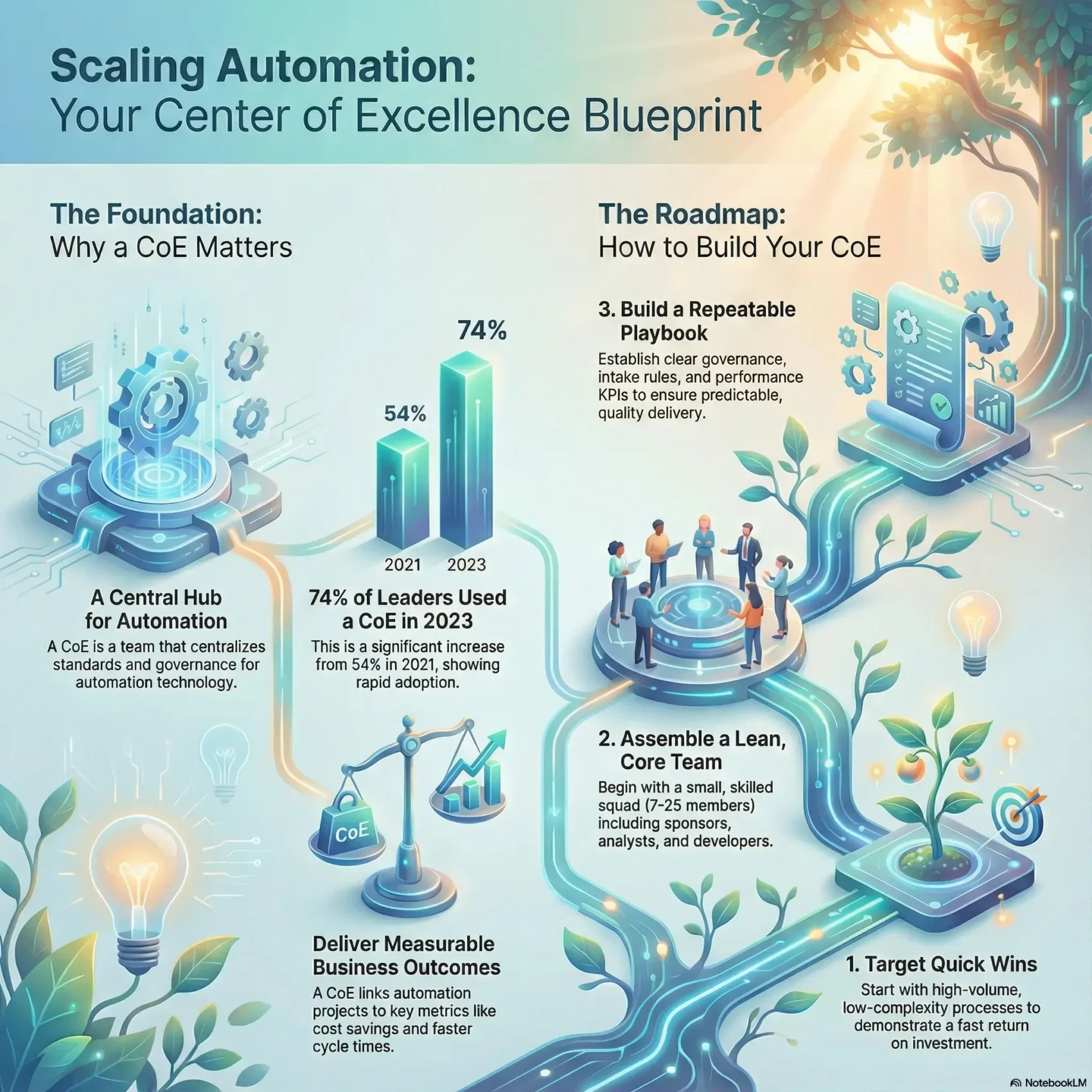
Last Updated on January 3, 2026
You need a clear map to turn isolated wins into an enterprise program that compounds value. A well-run automation CoE sets standards, governance, and repeatable processes so your teams move from pilots to scale.
This hub prioritizes high-volume tasks for ROI and evangelizes adoption across the business. It brings experts together, captures knowledge, and defines the strategy that keeps your organization aligned as capabilities evolve.
We’ll show how to pick the first roles, choose the right processes to start, and link efforts to measurable outcomes like time saved and cost avoided. You’ll get a practical path to build a self-sustaining team that turns scattered efforts into coordinated enterprise value.
Key Takeaways
- Centralize standards and governance to scale process automation reliably.
- Start with high-impact processes that show quick ROI.
- Staff adaptable experts who can grow with your organization.
- Link strategy to measured outcomes to secure funding and support.
- Use pilots to manage risk and build momentum before broad rollout.
The state of automation today and why a CoE matters
Today’s landscape favors practical wins: companies need clear rules and repeatable projects to turn experiments into measurable value. McKinsey reports fewer than 20% of firms have used workflow tools to gain a real edge. That gap often comes from resistance, weak governance, and mounting technical debt.
From excitement to maturity: what “present” means for your strategy
Gartner notes the market has shifted from hype to maturity. Growth in RPA slowed as buyers focus on fit-for-purpose tools and durable practices.
IBM found roughly 42% of enterprises used AI in 2023, showing uptake but also signaling the need to pair technology with strong process and data discipline.
Linking digital transformation goals to enterprise-wide automation
The Intelligent Automation Network shows 74% of leaders ran an automation CoE in 2023, up from 54% in 2021. That trend proves structured approaches help tie work to business strategy.
- Focus on outcomes: map projects to cycle time, accuracy, cost-to-serve, and customer experience.
- Use data: let pilot metrics prove value and guide scaling decisions.
- Standardize decisions: a central playbook reduces risk and speeds delivery across your organization.
To see practical examples and a checklist for repetitive process candidates, review this guide on repetitive tasks automation. It shows how to move from pilots to repeatable wins and keep leaders backing your strategy.
What is an automation center of excellence?
Think of the CoE as your internal operations studio that sets rules, builds reusable assets, and helps teams deliver faster with higher quality.
Defining the CoE: the CoE is a centralized, self-sustaining team that runs and maintains software robots, sets organization-wide standards, and enforces governance to scale process automation across the enterprise.
Defining the CoE: centralized standards, governance, and enablement
The group curates knowledge, playbooks, and reusable components so your people don’t reinvent solutions. It clarifies roles—from sponsors to developers—and the structure evolves as demand grows.
RPA to intelligent automation: expanding beyond robots to AI and data
Modern CoEs move past rule-based RPA to intelligent systems that blend AI and machine learning. This lets processes handle complex decisions and real-time data while keeping compliance and quality intact.
- Partnering with IT and business: manage environments, security, and change without slowing delivery.
- Governance as a feature: quality, maintainability, and risk control scale with coverage.
For guidance on how roles and job change, see the job automation adaptation resource.
Proving value fast: benefits and business outcomes your leaders care about
Delivering quick, visible wins turns skeptical leaders into active supporters. Start with a clear target: pick high-volume, time-consuming workflows that show returns quickly. This helps you prove value while you build governance and patterns for repeatable work.
Time and cost savings through prioritized, high-volume processes
You’ll quantify value fast by automating repetitive processes first. That compresses cycle times and frees staff to do higher-value tasks.
You’ll also show cost reductions by cutting rework and errors, lowering the cost-to-serve across finance, healthcare, and supply chain functions.
Quality, compliance, and reduced technical debt with strong governance
Governance matters: auditable workflows, consistent logging, and controlled change cut error rates.
Design standards and reuse reduce technical debt so new automation projects are robust and maintainable.
Faster, safer scaling across your organization
- You’ll scale quicker using proven patterns and a release process that balances speed with risk controls.
- You’ll map benefits to trusted metrics like cost avoidance, SLA adherence, and customer experience KPIs.
- You’ll embed operations feedback loops so each rollout improves the next and increases enterprise value.
Inside the team: roles, structure, and sponsorship that make a CoE work
Successful teams pair executive backing with a small, skilled squad that can iterate quickly. You need sponsors who align budget and ROI with delivery. Typical backers include the CIO, CTO, or CFO.
A compact core lets you move fast while you prove value. Many groups start with seven members and grow to 25–35 as demand rises. That lean start keeps priorities clear and handoffs simple.
Core roles and responsibilities
- Sponsors and leaders: set strategy, fund initiatives, and remove roadblocks.
- Business analysts: map candidates and define clear process requirements.
- Developers and operations: build, test, and keep run-state reliable.
You’ll hire for mindset as much as skill. Seek curious experts who adapt fast, solve problems, and work with business partners. Validate contributors with pilots or hackathons rather than only resumes.
Design the structure so you balance business proximity and technical rigor. Pair junior and senior staff to spread expertise and cut single-point risk. Adopt a blameless culture that surfaces issues early and speeds learning.
Automation center of excellence governance and best practices
Strong governance turns scattered pilots into predictable, measurable programs that the whole business trusts. You’ll set clear goals, intake rules, and delivery standards so projects move from idea to production with fewer delays.
Standards, intake, and KPIs: creating a repeatable operating model
Start with a simple operating model. Define intake, triage, design standards, testing, and release steps so delivery is predictable.
- You’ll track KPIs for throughput, quality, cost savings, and error reduction to prove impact.
- Embed compliance and risk controls in each stage to avoid audit surprises and rework.
- Operationalize knowledge with pattern libraries, code repos, and playbooks to speed repeatable work.
Change management and evangelism to reduce organizational resistance
You’ll run training, communications, and incentive programs to boost adoption. Appoint champions and publish wins to build momentum.
Clarify roles and RACI so members in IT and business know who decides, who executes, and who signs off. Review projects regularly to retire low-value work and fix technical debt.
“Use KPIs and clear intake to keep work aligned with strategy and budgets.”
Your build roadmap: from first candidates to scale
Begin with clear needs: map current workflows, collect operations data, and build a prioritized opportunity pipeline. This turns opinions into a ranked list of work that matters.
Start with needs, not wants
Analyze existing work and already-deployed solutions. Talk with R&D, IT, and users to validate pain points. That gives you a real pipeline — not a wish list.
Picking the first process
Score candidates on ROI, complexity, and scope. Ask: how much time and money will this save? What error rates drop? How many decision points exist?
Hackathons and pilots
Run a short hackathon on one complex, high-priority candidate to expose constraints. Then pilot with tight measurement loops. Use learnings to shape your long-term architecture.
Managing expectations
Keep stakeholders informed with transparent roadmaps, KPIs, and trade-off discussions. Structure solutions as modular components so they are easy to support and reuse across the enterprise.
- Start with needs by analyzing data and pain points.
- Score processes by ROI and complexity to pick a fast win.
- Use hackathons to de-risk complex work early.
- Pilot, measure, iterate, and reuse components.
- Give your team clear decision rights and escalation paths.
“A modular, needs-led roadmap lets you scale automation projects while keeping teams productive.”
Tools and technologies: RPA, AI, and platforms that power your CoE
Pick tools that let your team ship repeatable workflows fast while keeping compliance and observability in place. Choose RPA suites that offer deployment pipelines, role-based controls, and monitoring so non-technical users can safely contribute.
Leading platforms like UiPath speed rollouts with built-in governance, logging, and scalability. Partners such as qBotica and implementers like Northstar Digital Solutions show how mature practice turns email requests and other manual work into streamlined solutions.
GenAI complements developers and business users by drafting documentation, generating test data, and helping map exceptions. Use it under strict guardrails so outputs stay compliant and predictable.
- Standardize environments and connectors to lower integration risk across your organization.
- Instrument automations with metrics and alerts for continuous improvement.
- Build reusable components for intake, validation, and reconciliation to raise throughput.
- Plan capacity, runbooks, and support rotations to keep enterprise solutions reliable.
“Tap partners and ecosystems to accelerate complex builds and transfer knowledge to your team.”
Conclusion
You can convert scattered wins into sustained enterprise impact by tying each project to clear KPIs and a needs-first selection process.
Data shows formal programs are rising fast: 74% reported active CoEs in 2023, up from 54% in 2021, proving strategy and governance matter.
Staff a focused automation coe, start with the right process, and grow a pipeline of repeatable patterns that prove value quickly. Balance delivery speed with observability, security, and maintainability so your business trusts each rollout.
Measure time saved, errors avoided, and cost reductions. Manage adoption with training and champions, then feed results back into the roadmap so your center excellence approach compounds durable competitive value across the organization.