Tools
Tools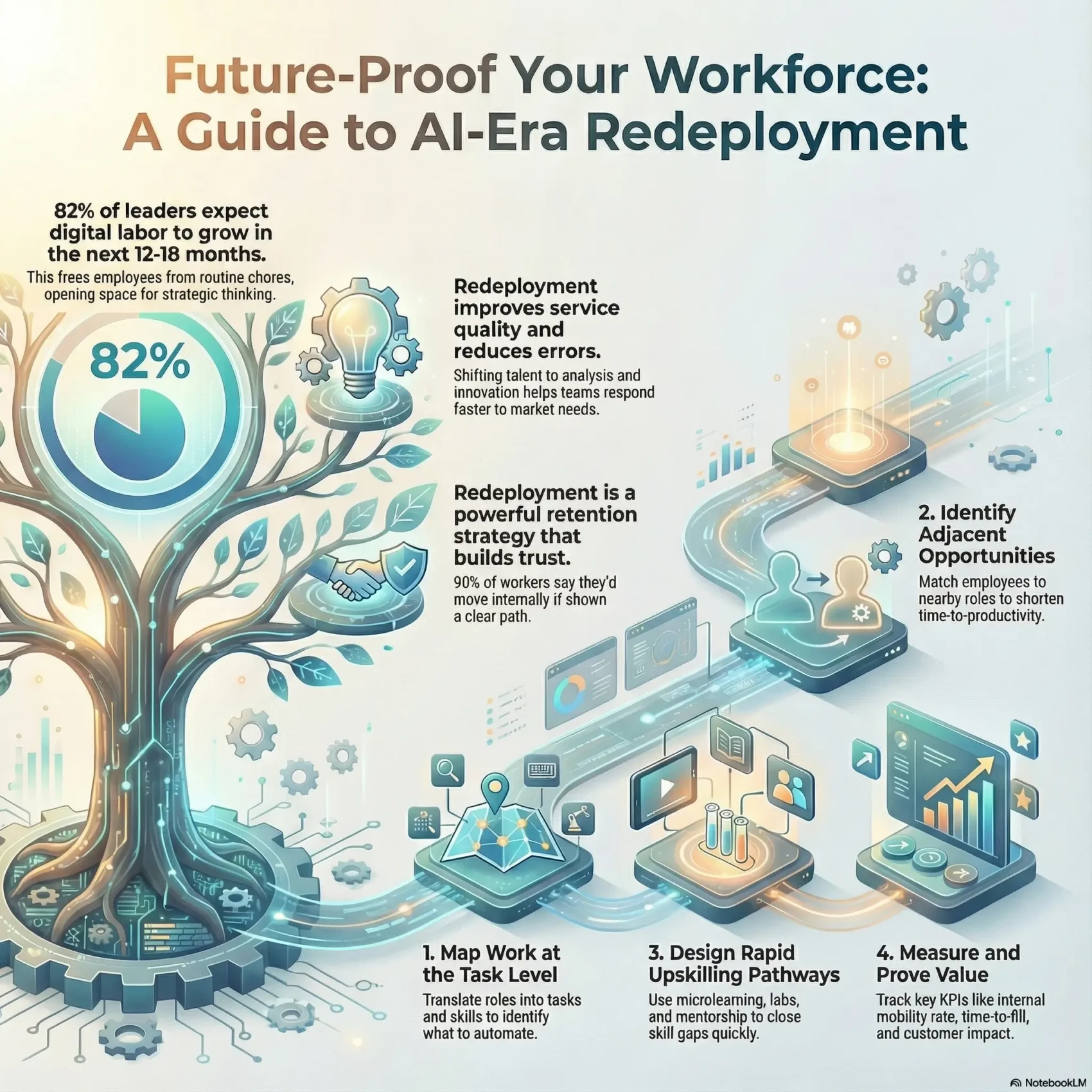
Last Updated on December 13, 2025
You face a clear choice today: guide how work changes or watch the market set expectations for your company. A structured automation redeployment program moves employees from repetitive tasks into roles that deliver more value for the business and the client.
When you shift talent from routine execution to analysis, customer strategy, and innovation, you lower error rates and speed up service. That shift helps your teams respond faster to market needs and builds stronger cross-functional collaboration.
This is a strategy that protects your value by keeping employees inside the company and aligning their skills with evolving priorities. The result is better service quality, more resilient operations, and a workplace where people see opportunity instead of uncertainty.
Key Takeaways
- You can lead change by creating a clear plan to move employees into higher-impact roles.
- Redeploying talent improves service quality and reduces repetitive errors.
- The program increases agility and helps your business meet client expectations.
- Employees gain new career paths, boosting satisfaction and trust.
- A stepwise approach makes it measurable and repeatable for long-term value.
Why redeploy talent now: the inevitability of automation and the new rules of retention
Digital labor is changing how people spend their workday, freeing them from repetitive chores and opening space for strategic thinking. This shift is not theoretical — 82% of leaders expect digital labor to grow in the next 12–18 months, and Accenture finds 44% of U.S. work hours are in scope for change.
What this means for you: when routine tasks move off desks, your employees gain hours to test hypotheses, solve customer problems, and design better services. That shift reduces risk and raises value for clients.
From static roles to internal mobility
Internal movement becomes a business strategy. Companies that treat internal mobility as normal keep high-potential staff and cut costly turnover. Seventy-seven percent of employers plan upskilling programs, and 90% of workers say they’d move internally if shown a path.
Market signals you can’t ignore
“Clients expect vendors to use tech to cut errors and shift work toward higher-cognition tasks.”
- Redeployment preserves institutional knowledge and speeds adaptation.
- Teams that reassign work earn an advantage with customers.
- You can detect impact early and act before service suffers — that’s how smart companies win.
For a practical guide on designing that path, see job adaptation and internal mobility strategies.
How automation redeployment works: a step-by-step program you can run
Start with a clear map of daily work so you can spot where people add the most value and where processes change. This living view ties roles to discrete tasks, skills, and outcomes so you can simulate moves before you act.
Map work at the task level
Translate each role into tasks. List skills, time spent, and error risk. That lets you see which tasks should shift and which need human judgment.
Identify adjacent roles and opportunities
Use the task map to spot overlapping capabilities and internal opportunities. Matching employees to nearby roles shortens time-to-productivity and reduces outside hiring.
Design rapid upskilling pathways
Create microlearning, labs, and mentorships that close gaps fast while people stay in meaningful work. Focus on targeted skills so employees move into high-impact opportunities sooner.
Communicate the path and set governance
Be transparent. Publish timelines, goals, and role coverage so every employee sees what’s possible. Set a cross-functional steering team, simple intake rules, and an operating cadence to keep progress measurable.
“Simulate scenarios, weigh training time, and test alternatives before you commit.”
- Map tasks and skills
- Maintain a dynamic skills inventory
- Match people to adjacent roles and opportunities
- Run short upskilling waves and measure outcomes
- Use data to refine each cycle
For guidance on moving repetitive tasks, see repetitive tasks.
Tools and tech to operationalize redeployment without the risk
Smart tools let you run talent scenarios in minutes and choose moves that protect service and morale. Use AI-powered workforce intelligence to create a unified, dynamic view of roles, skills, and tasks. This view helps you simulate talent flows and surface best-fit matches in real time.
AI-powered workforce intelligence: simulate scenarios and surface matches
Create transparent opportunities by connecting a skills graph to your HR systems. Integrations with Workday or SAP let you publish openings, track applications, and confirm placements while staying compliant.
Borrow from robotics: test, simulate, and iterate before go-live
Borrow the test-simulate-iterate pattern from robotics. Just as factories simulate collisions and copy programs across workcells, you should sandbox organizational moves to cut downtime and reduce delivery risk.
“Simulate changes before you apply them to reduce surprises and keep the product line running.”
- Simulate scenarios and surface matches
- Refine role definitions and training in a sandbox
- Standardize the process, templates, and playbooks for repeatable waves
Result: faster cycles from posting to placement, higher employee participation, and a repeatable process that helps your team move people into meaningful work without service gaps.
Proving value: metrics, billing models, and risk management for sustained growth
Show results in numbers. You’ll define simple KPIs so your business can see progress fast. Track time-to-fill for internal roles, internal mobility rate, engagement, and customer impact.
KPIs that matter
Keep metrics tight and visible. Use a dashboard that shows internal hiring, training completion, and outcomes for clients. That lets leaders course-correct quickly.
Shifting time, not headcount
Rather than cut roles, move hours from low-value tasks to strategic work. This preserves budgets and keeps billable hours while improving service.
De-risking change
Pilot redeployment waves in one unit first. Simulate moves, apply collision-avoidance checks, and document process controls to reduce risk and downtime.
- What you measure: time-to-fill, mobility, engagement, customer impact.
- How you prove value: link faster internal hiring to lower external hiring costs and better retention.
- Governance: review metrics at a regular cadence and publish trends so the core of the business can see growth.
Conclusion
Redeployment isn’t just policy — it’s the practical path that helps teams adapt fast and keeps employees engaged.
Make this your strategy: map work and skills, spot adjacent roles, run short upskilling waves, communicate timelines, and set clear governance so teams feel supported.
For your people, the promise is simple — less routine tasks, more strategic roles and visible opportunities that match career goals.
Invest in tools and simulation tech to test moves, reduce risk, and decide with data. Use repeatable processes and regular reviews to learn and improve each wave.
Start now: form a cross‑functional team, define the first wave’s goal and scope, and launch a pilot. A well-run redeployment program keeps your company resilient, accelerates growth, and makes your people central to shaping the future.