Tools
Tools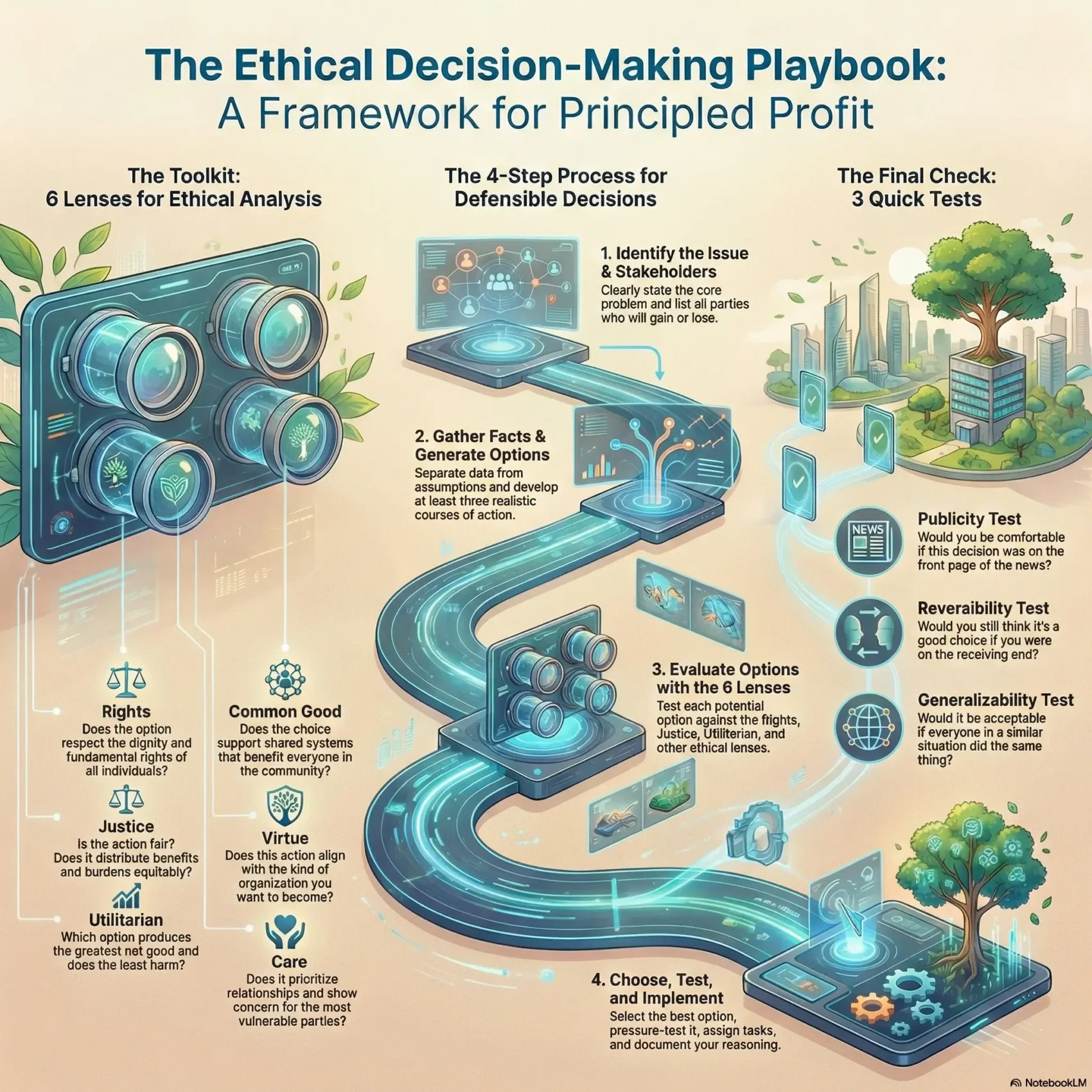
Last Updated on February 20, 2026
You want a practical way to turn values into clearer decisions and measurable results. This introduction gives you a short, usable map that ties ethics to success and trust without guesswork.
Start with simple steps: spot the issue, gather facts and stakeholders, and test options using six ethical lenses. Then choose, try the choice against publicity and reversibility, and act while you reflect.
We show a repeatable approach that links values to stronger performance and better stakeholder relationships. You’ll see how aligned practices and responsibility commitments cut risk and save time.
For a practical, operational view of an ethical approach to growth, check a related guide at ethical approach to growth. By the end of this guide, you’ll have a clear way to pressure-test choices and put principles into action on Monday morning.
Key Takeaways
- You’ll get a usable business ethics framework to connect principles to profit and trust.
- Learn the six lenses and how to test choices before you act.
- See how ethical practices support performance, success, and risk reduction.
- Find a simple action plan to involve stakeholders and align teams.
- Understand why responsibility saves time and prevents costly missteps.
Why Your Business Ethics Framework Matters for Real-World Decisions
Good decision rules stop rationalizations and keep teams focused on performance and reputation.
You face trade-offs every day. Each choice can respect or break rules, affect stakeholders, and shape how people see your management and teams.
The link between ethics, trust, and performance
Clear standards make promises believable. When people trust your words, customers and staff stay, and measurable performance improves.
How ethical standards shape behavior, reputation, and risk
Standards reduce gray areas. Teams follow shared rules instead of shortcuts, which lowers rework, turnover, and compliance cost.
- Translate values into actions: Management can turn vague ideals into everyday choices that protect reputation.
- Use quick tests — Publicity, Reversibility, Generalizability — to pressure-test risky options before they harm stakeholders.
- When one lapse is visible, impact multiplies. A proactive set of rules prevents that damage and builds compound trust.
- Clear expectations guide behavior and speed decisions, helping organizations cut risk and boost long-run results.
Ethics, Not Just Feelings or Laws: What You’re Actually Working With
You need a steady way to tell what counts as right when feelings and laws point different ways. Ethics means clear standards and everyday practices that guide how people ought to act in roles at work. It depends on character, learned skills, and repeatable habits.
What ethics is — and isn’t
Ethics is not the same as law, religion, cultural norms, or science. Laws set minimums and change slowly. Customs can include unfair practices. Science can inform facts but cannot tell you what you ought to do.
Standards, character, and habits that guide action
Good ethical standards help teams turn vague intentions into clear action. You build this by training, shared language, and regular reflection that checks assumptions about others and society.
“Law may permit, but strong standards ask what aligns with your values.”
- Define shared practices so people act consistently under pressure.
- Use reasoning, not only feeling, to test options when rules are silent.
- Update standards as new issues arise, from data use to AI.
Six Proven Lenses You Can Use to Analyze Ethical Dilemmas
Turn confusion into clarity by applying six proven viewpoints to your toughest decisions. Each lens reveals a different angle on duty, outcome, or character. Use them together to create stronger, defensible choices that align with your values and goals.
Rights
Ask whether the option respects dignity and duty. Treat people as ends, not means. This protects core moral claims and individual rights.
Justice
Weigh fairness and what people are due. Consider different types of justice—distributive, corrective, and restorative—when assigning benefits or harms.
Utilitarian
Estimate consequences across stakeholders and choose the option that yields the greatest net good. Use cost‑benefit thinking while noting limits of simple sums.
Common Good, Virtue, and Care
- Common good: Does the choice support shared systems like public safety and a healthy environment?
- Virtue: What kind of leader or organization do you become through this action? Test for integrity.
- Care: Who is most affected? Show concern and prioritize relationships in context.
Combine these lenses to expose trade‑offs, stakeholders’ interests, and the deeper reasoning behind a decision. Then map the insights to real actions—supplier checks, environmental choices, or stakeholder engagement—and document why you chose the path you did.
Build Your Business Ethics Framework Step by Step
Start by turning the biggest unknowns into clear, answerable questions. Verify facts with independent data, spot missing information, and name the people and interests affected. This makes analysis repeatable and reduces guesswork.
Clarify what you know
Confirm key facts, check for bias, and review parallel cases. Map stakeholders and their stakes so you see whose interests rise or fall.
Set your decision process
Decide who has authority, whom to include, and how decisions will be documented. That helps employees and management act consistently.
Standards of conduct
Ask whether an option breaks legal duties, human rights, or firm policies. Check public exposure and consistency with societal standards.
Character and virtue
Center integrity. Ask what traits you want to reinforce, how communication shapes outcomes, and what you can live with long term.
Clarify consequences
Rank purposes, spot likely harms, and assess effectiveness. Use three quick checks—Publicity, Reversibility, Generalizability—to avoid rationalization.
- Confirm facts with independent sources.
- Map stakeholders and prioritize interests.
- Document roles, obligations, and review steps.
- Link this work to risk reviews and memos for adoption.
“Good questions force clearer answers and steadier judgment.”
Put It Into Action: A Practical Method for Ethical Decision-Making
Make clear, defendable choices by following a short, practical routine for handling real-world ethical dilemmas.
Identify the issue and who’s impacted
First, name the core issue in one sentence and list who gains or loses. Note if the choice pits goods against goods or creates uneven benefits.
Get the facts and generate options
Separate assumptions from data. Consult affected people, gather missing facts, and sketch at least three realistic options.
Evaluate with the six lenses
Use Rights, Justice, Utilitarian, Common Good, Virtue, and Care to test each option. Ask which choice respects rights, is fair, does the most good, and preserves relationships.
Choose, test, and implement
Select the option that best balances trade‑offs. Then apply Publicity, Reversibility, and Generalizability to catch blind spots.
- Practical steps: assign tasks, set timelines, and name who is accountable.
- Record the reasoning: save the questions and the data used so the decision is defensible.
Reflect and improve over time
After implementation, review outcomes, update the process, and train teams so ethical decision-making becomes muscle memory.
ethical decision-making tools can help you spot patterns and refine this way of working.
From Policy to Practice: Governance, Compliance, and Culture
Good governance joins rules, training, and everyday routines so your teams can act with confidence.
Codes of conduct must be clear, owned, and documented. Name who decides, how to record choices, and when to escalate. Give managers formal authority and informal backing so decisions get implemented quickly.
Codes of conduct, documented guidance, and organizational backing
Link written standards to real roles. Specify who reviews vendor deals, who signs approvals, and which teams must be consulted. That clarity reduces delays and confusion.
Training managers to speak the language of ethics
Train leaders to use Publicity, Reversibility, and Generalizability tests so they spot weak reasoning early. Teach the language of values alongside accounting and risk so conversations are practical.
Integrating with finance, marketing, data, and risk management
Embed the business ethics framework into approvals and onboarding. Make compliance proactive by explaining why rules exist to employees and showing how standards protect people and trust.
- Align conduct with ownership and documented guidance.
- Equip management to flag issues and act with confidence.
- Integrate practices into daily approval, marketing, and vendor flows.
“When policy meets practice, your organization moves faster and protects its reputation.”
Linking Ethics to CSR and Sustainability for Stakeholder Value
Connecting shared purpose to practical initiatives makes social responsibility a source of real impact.
Corporate social responsibility and the common good
The common good approach focuses on systems everyone relies on: clean air, water, public services, and education. It asks whether your actions strengthen those shared resources.
Corporate social responsibility then becomes a way to protect the environment and society while delivering value to customers and employees.
“Sustainability wins when it protects shared systems and supports the most vulnerable.”
Aspire, Adapt, Amplify: embedding values to scale impact
Use three simple steps to turn goals into repeatable practice. Aspire to higher standards. Adapt tools and targets to local needs. Amplify what works so results spread.
- You’ll align corporate social responsibility with your business ethics framework so priorities and metrics match across teams.
- You’ll design initiatives that respect the environment and boost stakeholder value for customers, staff, and communities.
- You’ll choose projects using the six lenses, balancing impact with fairness and care, then document stakeholder analysis.
- You’ll define success with near‑term wins and long‑run resilience to prove social responsibility lowers risk and builds brand success.
- You’ll standardize practices so lessons scale—what you learn in one market can be adapted elsewhere.
Conclusion
Wrap up by turning principles into actions that managers and employees can follow every day. , Use the business ethics framework as a short playbook: identify the issue, gather facts, test options with multiple lenses, and record your reasoning.
Keep standards and training tied to compliance and management routines so conduct matches intent. This helps you weigh fairness, integrity, and consequences, resolve ethical dilemmas faster, and protect reputation and performance.
Document the approach, train teams, and run a pilot this quarter. Doing so links corporate social responsibility and social responsibility goals to real practices that benefit the environment, communities, and your long‑term success.