Tools
Tools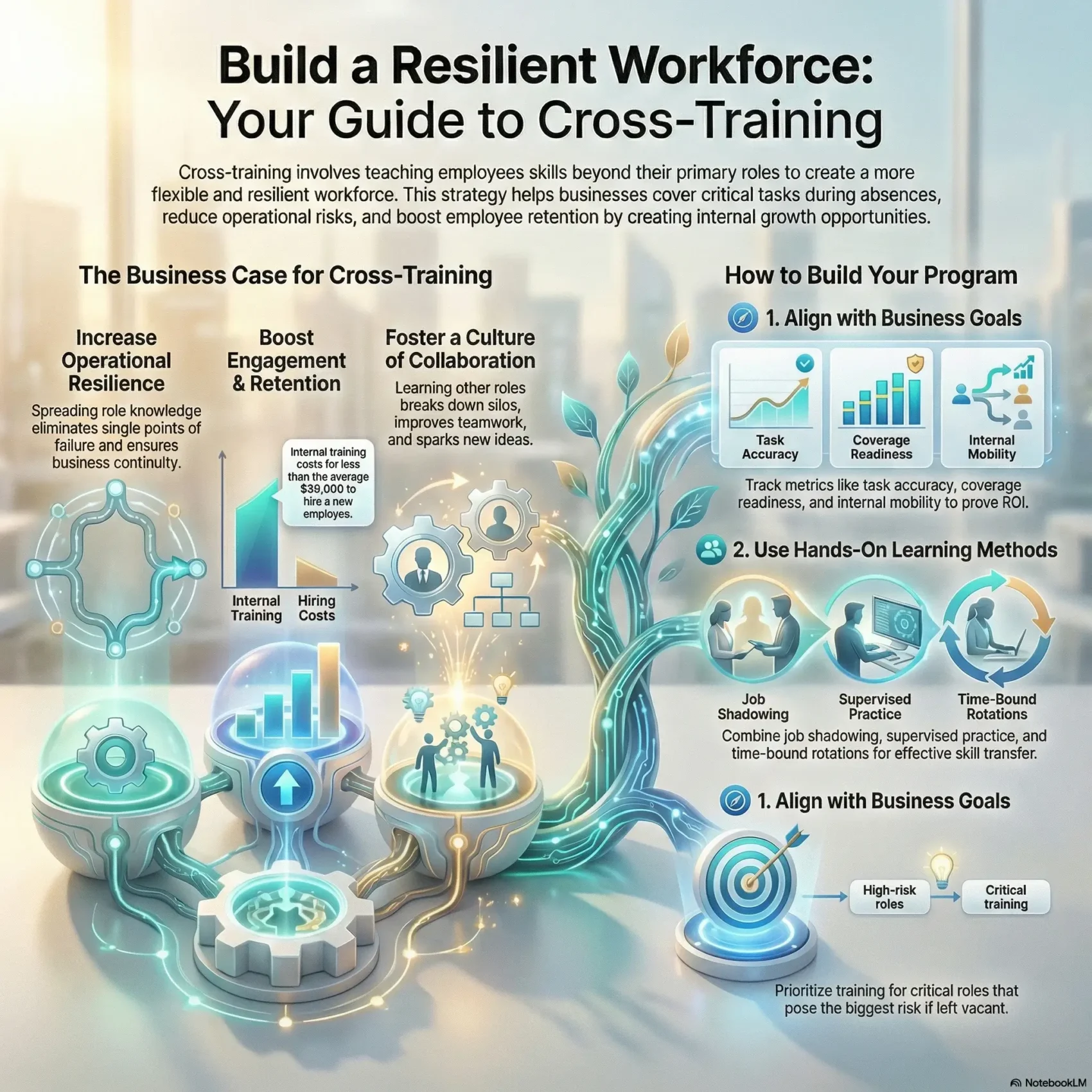
Last Updated on February 6, 2026
You want a workforce that adapts, learns, and keeps operations running when things change.
Cross-training teaches an employee skills beyond their main role so teams cover key work without dropping quality. Companies like IDEO build T-shaped people who pair deep expertise with broad knowledge to spark collaboration and fresh ideas.
Studies and practitioner insight show this approach boosts agility, internal mobility, and retention. The cost math helps the case: hiring a new person can run near $30,000, while ongoing training often costs far less and delivers clear ROI.
Facebook and Microsoft emphasize empathy in hiring to strengthen teamwork — a trait that grows when people learn each other’s roles. In this article you’ll get practical goals, a simple program outline, and measurable ways to prove the benefits for your business.
Key Takeaways
- Broaden skills: Training across roles reduces single points of failure and increases resilience.
- Align goals: Tie learning plans to measurable outcomes for your organization.
- Build culture: Practical, everyday learning grows empathy and collaboration.
- Prove impact: Track mobility, performance, and retention to show ROI.
- Start simple: Use a repeatable program template to scale adoption.
Why Cross-Training Matters Right Now
When people can cover each other’s work, your business weathers absences and turnover with less disruption.
Spread role knowledge so your workforce stays stable when someone is sick, resigns, or demand spikes. With more employees who know adjacent tasks, backups are ready and work keeps moving.
You also gain better performance and fewer silos. Exposure to adjacent roles lets people surface process improvements and share ideas that lift the whole organization.
- You boost engagement when employee learning links to mobility and growth, lowering the risk of feeling stuck in a job.
- You build practical agility by having more people who can step into critical tasks as plans shift.
- You respond faster to market changes because teams understand more of the business and coordinate quicker.
Make programs easy to prioritize: keep learning hands-on and tied to daily work. For examples of modern training tech that supports this, see VR employee training.
What Cross-Training Is and How It Benefits Your Organization
Preparing workers to step into nearby roles keeps critical work moving during disruptions.
Definition: Cross-training means teaching an employee to perform tasks from another role while they keep their core work. You expand role exposure so people can cover key operations when needed.
How it helps
There are clear business benefits: more agility during absences, faster problem solving, and better internal mobility for succession. IDEO’s T-shaped people are a good example — they combine depth with broad knowledge to spark innovation and improve culture.
Common drawbacks and fixes
Risks include overload, loss of focus, and negative perceptions. Mitigate these with transparent communication, realistic schedules, and time-limited rotations.
- Pick core roles first: Train on tasks that keep operations running.
- Use learning-by-doing: Employee training that pairs practice with clear goals speeds knowledge transfer.
- Measure ROI: Ongoing development often costs far less than hiring and improves retention.
How to Build an Effective cross-training strategy from the Ground Up
Start by linking learning goals to clear business outcomes so every training minute serves a need.
Align goals with business priorities. Map gaps that create risk if someone leaves. Focus the plan on coverage, capability, and measurable outcomes tied to your business goals.
Prioritize departments and roles by operational criticality. Pick areas that would cause the biggest disruption and train on the tasks that keep essential processes running.
Find motivated employees and match opportunities. Use performance data plus coaching conversations to pair interest with need. One hour a week of practice compounds.
Prepare trainers and build a coaching culture. Choose people with patience and delegation skills. Give them a simple process to capture scope, milestones, and expected knowledge at each stage.
- Use small, regular blocks to respect workload and reduce disruption.
- Set clear milestones so employees and trainers know what success looks like.
- Weave coaching into daily work to reinforce learning and speed progress across departments.
Designing Your Cross-Training Program for Real-World Performance
Designing a practical program turns learning goals into repeatable on-the-job skills your team can use tomorrow.
Document standard operating procedures so trainers and trainees share one source of truth. SOPs reduce variation and make quality consistent across -training programs.
Use job rotation to expand skills without losing specialization
Apply time-bound rotations to expose employees to adjacent roles. This preserves core responsibilities while broadening capability.
Blend hands-on learning with clear process and role shadowing
Start with shadowing, then have the employee perform tasks under supervision. Use checklists and quick-reference guides to support each step.
Foster empathy and collaboration across teams
Build collaboration touchpoints so team members swap context and tips. When people see how others work, culture and teamwork improve.
- Document SOPs for trainers to teach consistent steps and standards.
- Translate key responsibilities into task checklists for trainees.
- Combine shadowing with staged practice until the employee is independent.
- Use job aids and regular touchpoints to keep learning close to real work.
Using a Cross-Training Plan Template to Scale Learning Within the Organization
A light, repeatable plan helps you scale learning across teams without extra admin.
Build the template in Excel or a similar tool. Include candidate info (interests, goals), roles and responsibilities broken into discrete tasks, assigned trainers, and clear goals that align to business priorities.
For each goal, add 1–3 metrics. Use measures like customer satisfaction, time to resolve tickets, or trainer feedback. Track both technical skills and process skills knowledge so you see progress.
- You standardize the plan so every employee and trainer knows roles, tasks, goals, and metrics for the training program.
- Capture employee interests and skills need to match people to the right opportunity within organization constraints.
- Assign a trainer with set touchpoints, practice sessions, and timely feedback to keep learning on track.
- Keep the template lightweight so teams adopt it quickly and maintain it in daily tools.
Example: Create a resilient backup for payroll. Define the role, list tasks (time entry validation, payroll run, exception handling), assign a trainer, schedule shadowing and practice runs, and track on-time completion and zero-error rates.
Measuring Outcomes and Sustaining an Effective Cross-Training Program
Start by tracking simple, outcome-focused numbers so you can see learning turn into dependable coverage.
Define practical metrics for skills, performance, and mobility
Pick a few clear goals that map to daily tasks: task accuracy, time to complete, and coverage readiness.
Validate knowledge transfer by confirming a backup can do critical steps independently. Measure both individual mastery and workforce-level improvements.
Leverage performance reviews, coaching feedback, and recognition
Embed regular feedback loops so employees and trainers share progress. Use performance conversations to capture aspirations and align opportunities.
Recognize achievements in reviews to keep engagement high and show the business benefits of the program.
Iterate with employee feedback to improve programs over time
Compare results across -training programs to find what works best. Use participation rates, survey sentiment, and coaching notes to refine SOPs and schedules.
- Define metrics tied to your goals and mobility indicators.
- Capture consistent feedback from employee and trainer touchpoints.
- Keep the plan simple and repeatable so teams sustain progress within organization norms.
Conclusion
Wrap up by focusing on simple, measurable steps that keep work running and skills growing.
Use a lightweight plan so employees learn new skills while daily work stays protected. Document roles responsibilities and keep practice short and regular.
Track a few clear metrics to show how employees perform as backups. Recognize progress to reinforce culture and engagement.
You’ll spread knowledge across departments and create more career opportunities that retain talent. For ideas on developing leadership and future-ready skills, see future leadership skills.
Start small, measure results, repeat. That simple loop delivers resilience for your workforce and clear benefits for the business.