Tools
Tools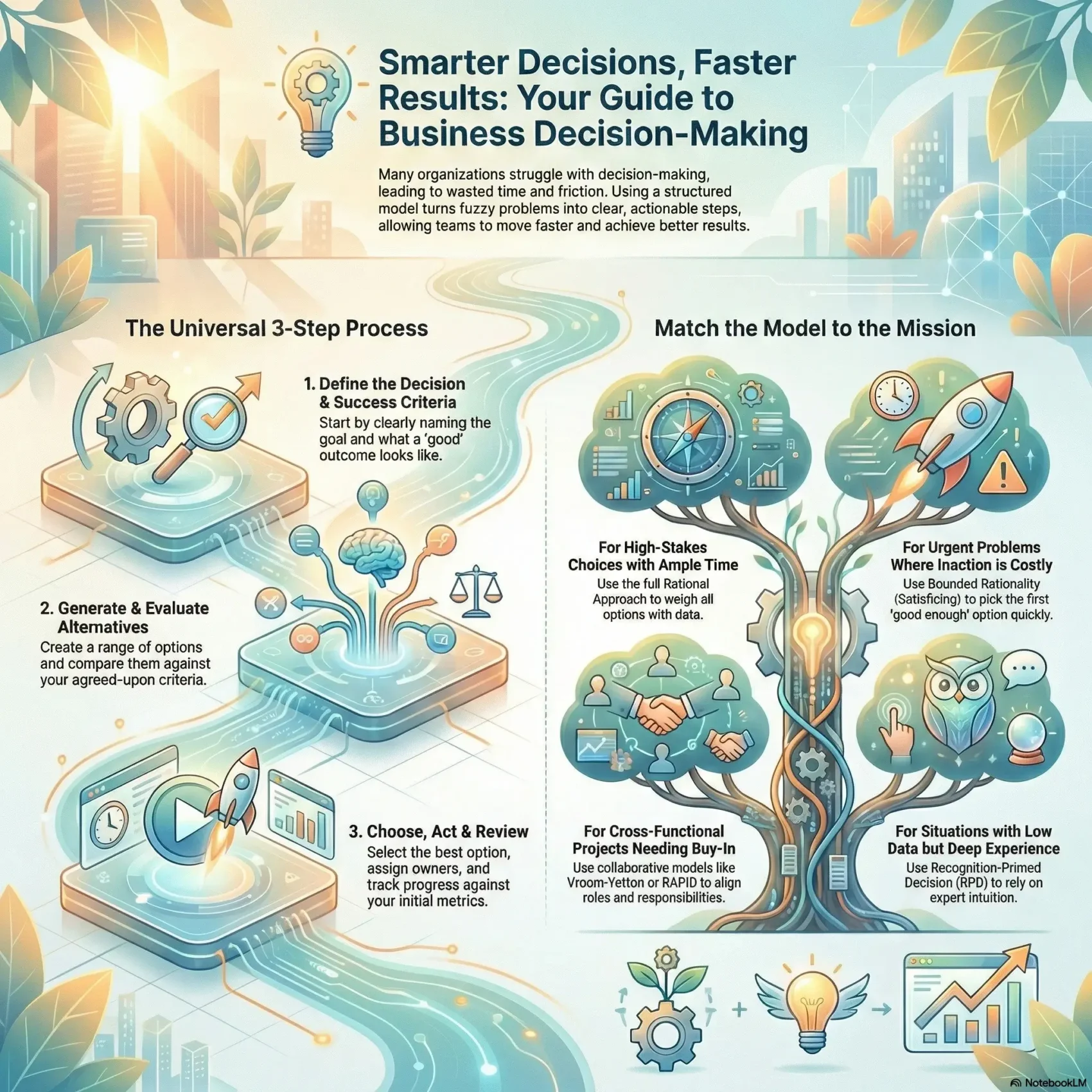
Last Updated on February 15, 2026
You rarely have unlimited time or perfect information when a big choice lands on your desk. Structured approaches move you past gut feel so your team can act with more clarity and less friction.
In this Ultimate Guide you’ll see how a short, repeatable process helps you define criteria, weigh alternatives, and review results. The seven- to eight-step rational path works when you can list options. Bounded rationality helps when time is tight and satisficing is smarter.
We’ll also preview collaborative routes like Vroom-Yetton and tools such as RACI, RAPID, Pugh Matrix, and BRAIN. You’ll learn how intuitive and recognition-primed ways pull from experience when data is sparse.
Biases matter: naming confirmation, anchoring, availability, survivorship, and the halo effect keeps your choices cleaner. This guide connects practical steps to management routines so you can make better decisions with the same resources.
Key Takeaways
- Structured approaches turn fuzzy problems into clear choices for your team.
- Pick a rational path when you have time; use bounded rationality under pressure.
- Collaborative frameworks help you match style to context and stakeholders.
- Experience-based methods work when data is limited or speed is essential.
- Spotting common biases up front improves outcomes with the same information.
- Practical tools and short processes make success easier to repeat.
Why decision-making models matter for your business today
A consistent method for choosing among alternatives turns messy debates into actionable steps. Your team spends less energy rehashing choices and more time delivering results. With only about 20% of people saying their organization excels at organizational decision-making, many companies miss faster paths to success.
Structured approaches help you gather internal history and external research. They reconcile stakeholder needs when information sits in different tools or across time zones. When a problem spans departments, a clear process saves time and reduces meetings.
Put simply: documented choices protect momentum. Capturing criteria, rationale, and ownership prevents backtracking when new people join the project.
- Better outcomes: faster speed to market, lower costs, and happier customers.
- Less friction: fewer status meetings, clearer ownership, and every stakeholder having a voice.
- Single source of truth: work management tools capture context so one choice isn’t lost in ten channels.
Match the type of approach to the scale of the problem—from quick operational choices to cross-functional moves. Adopting one clear decision-making model helps your team make better decisions consistently, even under pressure.
What is a decision-making model? Definitions, types, and when you need one
A clear framework tells you how to move from problem to solution without wasting time. At its core, a decision-making model is a way to analyze options and pick the best choice for your context.
From simple to complex to novel problems: matching approach to situation
Simple problems need light structure: one person, a clear option, and quick action. Complex problems require data, multiple alternatives, and more people. Novel problems lean on experience and recognition-primed approaches when information is scarce.
Individual vs. team decisions: aligning approach with collaboration needs
If stakes are low and time is tight, you can often rely on fast, experience-driven choices. When alignment matters, use collaborative trees like Vroom-Yetton to guide who should decide and when to gather input.
- Use questions about stakes, reversibility, and time to pick how much structure you need.
- Generate at least two alternatives even if one option feels obvious; it exposes blind spots.
- Balance speed and quality by limiting options when appropriate and reviewing outcomes later — see a primer on managing choice and fatigue here.
The decision-making process: the seven essential steps you can follow
Follow a clear seven-step process to turn a fuzzy problem into a tracked, measurable outcome.
Identify the decision and success criteria
Start by naming the decision and the goal you want to reach. Define measurable success criteria so everyone knows what “good” looks like.
Gather relevant information (internal and external)
Collect data from your systems, past projects, and outside research. Good information reduces assumptions and speeds analysis.
Generate alternatives and set evaluation criteria
Create a range of options that reflect stakeholder needs. Agree on evaluation criteria before you compare alternatives.
Weigh the evidence, choose, act, and review
Use simple tools—scoring, pros/cons, or lightweight analysis—to weigh trade-offs. Choose an option or blend two, assign owners, and take action.
- Track progress against success metrics.
- Hold a short review cadence and capture lessons learned.
- Keep the process light when speed matters and rigorous when stakes are high.
Tip: Use templates and tools to document each step so your team can revisit the rationale without reopening the whole discussion.
Core decision-making models you can rely on
Different problems call for different playbooks—choose one that fits time, information, and team input.
Rational approach: clear steps for complex choices
Use this when you have time and many options. Define the problem, set criteria, weight them, create alternatives, score each option, choose, implement, and evaluate.
This stepwise analysis gives a transparent, defensible solution for things like vendor selection or feature prioritization.
Bounded rationality (satisficing) under pressure
When speed matters more than perfection, limit options and pick the first choice that meets minimum thresholds.
This saves time and avoids paralysis during urgent incidents or short deadlines.
Vroom-Yetton for collaborative choices
Use its short decision tree to pick a style—autocratic, consultative, or group-based—based on stakeholders and urgency.
This helps you balance participation and speed without guessing who should be involved.
Intuitive and recognition-primed approaches
When data is scarce, rely on experience and mental rehearsal to spot familiar patterns and test likely outcomes.
RPD adds brief simulation—run a quick “what if” in your head before you act.
- Rational works best for many options and measurable criteria.
- Satisficing is smarter when inaction costs more than imperfection.
- Vroom-Yetton guides who to involve, and RPD speeds choices when you have deep experience.
Tip: Right-size the approach to avoid overanalysis. Document the chosen steps and rationale so the team stays aligned after you act.
Team-focused frameworks: RACI, RAPID, Pugh Matrix, and BRAIN
When people and stakes collide, lightweight frameworks keep responsibility visible and progress steady.
RACI clarifies who is Responsible, Accountable, Consulted, and Informed. Use it to prevent handoffs from falling through and to speed execution.
RAPID names who Recommends, who Agrees, who Provides input, who Decides, and who Performs. It works well for complex choices with many stakeholders.
Pugh Matrix helps you score options against a baseline. Pick clear criteria, then mark +1/0/−1 to get an objective ranking of alternatives.
BRAIN prompts quick trade-off checks: Benefits, Risks, Alternatives, Intuition, and Nothing. It’s fast and useful under urgency when you need to act.
- You’ll use RACI to remove ownership gaps so decisions move to action without extra meetings.
- Apply RAPID to set accountabilities and keep the right people involved at each step.
- Run a Pugh Matrix to compare options against agreed criteria and pick a clear solution.
- Use BRAIN to surface benefits and risks, test alternatives, and honor intuition when time is short.
Tip: Combine frameworks—evaluate alternatives with a Pugh Matrix, then assign roles with RAPID. These tools pair well with your management platforms so the whole team stays aligned.
Avoiding traps: decision-making biases that derail good choices
Hidden biases often nudge a clear path toward the wrong outcome without you noticing. You can have solid information and still head off course if cognitive shortcuts distort how you weigh evidence.
Watch for five common traps:
- Confirmation bias: favoring data that fits what you already believe.
- Availability bias: overweighting vivid or recent examples over broader data.
- Anchoring: fixating on the first number or option you see.
- Survivorship bias: ignoring failures when you only study winners.
- Halo effect: letting one strong trait make an entire choice seem better.
Practical checks to reduce bias in your process
Start by defining success criteria before you look at options. Clear criteria force you to judge each choice against the same yardstick.
Ask structured questions that hunt for disconfirming evidence. Encourage people to play a red-team role or run a quick pre-mortem to surface hidden risks.
Use baselines and simple scoring so anchors and halos lose weight. Track expected versus actual outcomes in short reviews to sharpen future analysis.
Tip: Build a culture where people can name bias out loud without penalty. That small habit preserves time and raises the quality of your decisions.
For a practical guide on improving speed and clarity in your process, see this short primer on productivity and choices: decision-making productivity.
How to choose the best decision-making model for your situation
Use a quick context check—time, data, and people—to pick the approach that actually fits the problem. Start by noting how much time you have, the quality of information, how reversible the choice is, and who must be involved.
Time, information, stakes, and team dynamics as selection criteria
Time: If you have days or weeks, use a rigorous path. If minutes matter, favor satisficing.
Information: Rich data supports scoring and analysis. Sparse facts favor expert intuition or RPD.
Stakes and reversibility: High-impact, irreversible choices deserve more rigor and review.
Team dynamics: Cross-functional work needs inclusive styles and clear accountabilities.
Quick selector: map scenarios to recommended models
- High stakes + ample time + good information → rational approach and scoring for a clear solution.
- Urgent problem where inaction costs more → bounded rationality (satisficing) to act fast.
- Cross-functional choices needing buy-in → Vroom-Yetton plus RAPID or RACI to align roles.
- Low data but deep experience available → RPD or intuitive approaches to make a solid call.
- Many alternatives and trade-offs → use Pugh Matrix to compare, then assign owners with RAPID.
Practical tip: match the amount of process to the cost of being wrong. Capture the criteria and course of action you used so future teams can reuse what worked.
Decision-making model implementation: tools, templates, and remote workflows
Make documentation the default: when roles, inputs, and criteria live in one shared place, your team moves faster and avoids repeated context checks.
Documenting roles, inputs, and criteria for transparency
Use RACI or RAPID templates to name who owns each task, who provides input, and when reviews are due. Capture the criteria and the data sources next to each option so reviewers can judge consistently.
Asynchronous collaboration: keeping momentum across time zones
Centralize links, spreadsheets, and notes in a single work management tool. Run Pugh scoring in shared sheets and collect BRAIN notes in a collaborative doc. Automate reminders for owners so action items do not stall.
- Pick templates for criteria, scoring, and decision records so you can plug in and move quickly.
- Document roles and due dates to keep decisions flowing across time zones.
- Track outcomes alongside original criteria to learn and refine future solutions.
decision-making model examples in action
Practical case studies help you see how to apply a clear process to hiring and product trade-offs.
Hiring with a rational model: define core criteria—skills, cultural fit, and impact—then assign weights. Score each candidate, choose the top option, hire, and review success after onboarding. This example shows how clear criteria reduce bias and let you track outcomes.
Satisficing under time pressure: when you must fill a role fast, set minimum thresholds and pick the first candidate who meets them. That prevents long interview cycles and lessens downtime. Use a short review after 30–60 days to confirm the hire or iterate.
Cross-functional product choice
Use Vroom-Yetton to select a consultative or group style, then apply RAPID to name who recommends, who agrees, who provides input, who decides, and who performs. Run a Pugh Matrix to compare feature alternatives against a baseline with agreed criteria.
- Set criteria and weights.
- Score options in the Pugh Matrix.
- Assign RAPID roles and handoffs into action.
Note: document the rationale and exact handoffs—who performs what by when—so decisions translate into shipped work. Experience should inform quick calls when time or data are limited, but record that intuition so future teams can learn what worked.
Conclusion
A short playbook that fits the problem is the fastest way to turn options into results.
Choose and right-size a model to help you make better decisions consistently. Align your pick with the goal, available information, time, and who must act.
Document criteria, alternatives, and the chosen course of action so your team executes without rehashing. Keep bias checks simple and repeatable; small reviews sharpen future choices.
Use collaborative frameworks to turn a choice into action with clear roles and timelines. Carry a one-page playbook that shows the step, owner, and expected outcome.
Do this each week: pick the right approach, act, review results, and reuse what works — momentum turns clarity into success.