Tools
Tools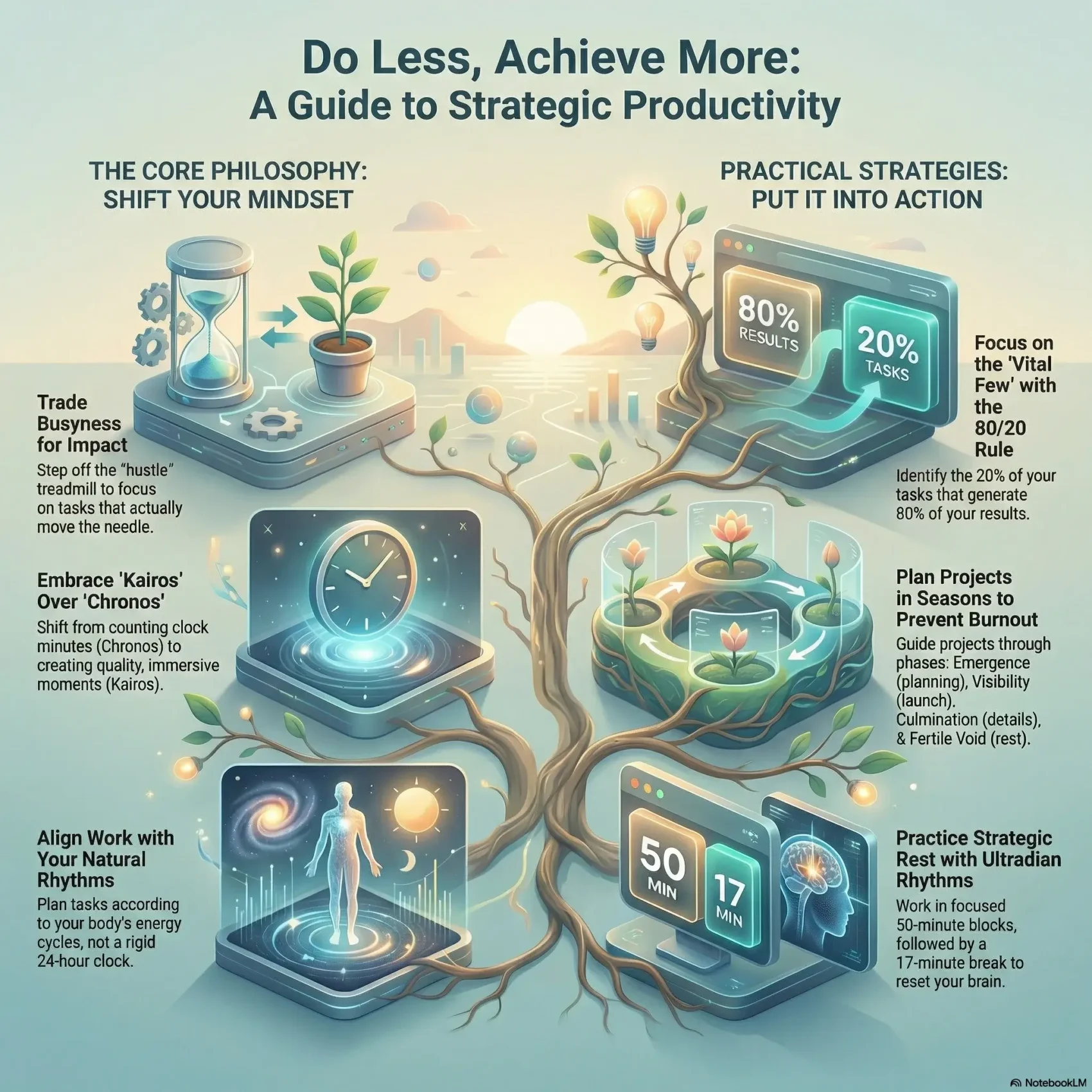
Last Updated on February 23, 2026
Kate Northrup wrote a clear, friendly book that asks you to shift how you spend your time and energy. The author frames doing fewer tasks as a practical strategy, not guilt or laziness.
This short introduction outlines the core idea: when you focus on fewer priorities, you gain more time, energy, and enthusiasm for what matters. You’ll see how cyclical living and simple experiments help you test the approach in real life.
You’ll get practical steps for weekly planning, time energy management, and 80/20 thinking. This summary shows how trimming commitments boosts your productivity without burning out. Expect clear examples and small rituals to try this week.
Key Takeaways
- Focusing on fewer priorities restores time and energy in daily life.
- The book offers 14 experiments to test the ideas in your routine.
- Simple planning tools help you apply time energy management this week.
- Doing fewer things lets you do them better and feel more present.
- Kate Northrup reframes this method as strategic life and energy management.
Why “Do Less” Resonates Now: Your Path Out of Hustle Culture
A cultural shift is underway. People are turning away from relentless busyness and toward a calmer way to spend their time. Reviewers call it escaping an addiction to stress and choosing presence over motion.
What you gain when you release busyness
You step off the treadmill of hustle culture and into a steadier day. Your attention lands on tasks that actually move the needle.
Reviewers report more energy, deeper presence, and greater satisfaction in life. You build margin to respond instead of react, which eases stress and improves relationships.
How this summary helps you apply the ideas today
This short guide gives you practical shifts to try now so you can feel the change by evening. It points to simple rituals, weekly questions, and pacing that honor your natural rhythm.
- Use quick experiments to protect your best time.
- Trim tasks that create busywork and reclaim attention.
- Adopt small boundaries that make room for rest and clear action.
Kate Northrup’s book offers a friendly approach to living with more meaning. This section is your shortcut to begin practicing a sustainable, productive way of living.
About the Book and Author: Kate Northrup’s Revolutionary Approach to Time and Energy
Kate Northrup is the author who reframes productivity with a time-and-energy lens that feels practical for ambitious women and others juggling many roles.
The book pairs concise storytelling with a clear method: cyclical living plus 14 experiments you can test fast. Each experiment helps you see how your energy maps to real tasks and when to shift pace.
What this means for your work: you get an approach that treats time as flexible and invites simple boundary-based management. Reviewers note overlap with other guides, but value Northrup’s cycles and personal stories.
- Meet the author and her cycle-first lens for ambitious women.
- Try short experiments from the book to test what fits your week.
- See how this model fits among other time management titles and helps steady results.
“Small tests change how you spend hours and protect energy for what matters.”
If you want a practical guide, read book notes and try one experiment this week to feel the shift.
The Core Promise: Doing Less to Do More of What Matters
When you shrink your task list, you free up room for clearer choices and better energy. This is the heart of the book‘s approach: pick the vital few and let the trivial many fall away.
Benefits you feel: energy, presence, faster results
You’ll notice more energy and immediate presence in daily moments. Your nervous system calms, and your intuition gets louder.
Focusing on fewer things gives you time to finish what matters, which improves productivity and satisfaction in life. Your body feels lighter when pressure drops.
- Energy and presence: You feel better and work better.
- More time for priority work: Narrowing scope speeds outcomes.
- Clearer thinking: Calmer nerves and stronger intuition guide your next move.
- A simple filter: Invest time where payoff is highest; let nonessentials fall away.
“Focus on the vital few and measure success by what truly matters.”
This approach time tool is a permission slip for ambitious women who want gentle, effective energy management. Use it as a practical way to protect your time and reshape your life.
Time-Bending 101: From Chronos to Kairos so you feel time-rich
Reclaiming how you use minutes can make your entire day feel abundant. Chronos measures hours and schedules; Kairos invites you into a rich, immersive moment. Northrup’s book asks you to shift from counting to inhabiting, which changes your experience of every day.
Chronos vs. Kairos: quantity versus quality
Chronos is linear, scarce, and driven by the clock. Kairos is qualitative — fully inhabiting a moment so it feels larger than its length.
Understanding both helps you choose when to speed up and when to savor.
Rituals and mantras that create Kairos
Pick small anchors: a sunrise stretch, mindful coffee, or an evening walk. Pause at transitions and breathe to reset attention.
Try a mantra like “I am the source of time.” It shifts scarcity into sufficiency and protects your focus.
See time as circular to reduce scarcity
Imagine your day as a loop where beginnings return again. This view eases urgency and invites gentle restarts.
“When you stop racing the clock, you find more room to think and create.”
- Grasp: the difference between clock hours and immersive time.
- Practice: not rushing when you most want to, so each experience widens.
- Anchor: build daily rituals that tap Kairos and protect your time energy.
Cyclical Living Overview: Align your work with natural cycles
Cyclical living asks you to plan with your natural rhythm, not against it. Many ambitious women find a strict 24-hour template clashes with real energy swings across the month.
The book suggests mapping tasks to biological and environmental rhythms — menstrual phases, the lunar cycle, and the seasons. This simple shift makes planning more humane and effective.
- You’ll see why a one-size daily schedule often causes burnout for women who don’t operate the same way every day.
- Choose options: track a cycle, follow the moon, or use seasonal cues to guide your week.
- Start small: notice when you have focus versus social energy, then schedule tough work accordingly.
Cycle-aware planning connects directly to time energy management and helps you protect capacity. You don’t need perfect alignment to feel benefits; one observation this week can change your day and ease your life.
The Four Phases Explained: Match tasks to your body and the moon
You’ll get a clear, usable map for matching tasks to natural energy. This four-phase cheat sheet pairs menstrual phases with the lunar cycle and seasons so you can plan by pattern instead of pressure.
Menstrual / New Moon / Winter — Rest, reflect, recharge
Use this phase for deep rest and review. Schedule reflection, strategy reviews, and gentle planning. Avoid forcing visible output.
Follicular / Waxing / Spring — Brainstorm, plan, initiate
This is your idea and planning window. Start projects, draft outlines, and run short creative sprints when energy feels fresh.
Ovulation / Full / Summer — Communicate, pitch, collaborate
Reserve calls, pitches, and launches for this social, high-energy phase. Use your clarity to share work and build momentum.
Luteal / Waning / Autumn — Details, focus, complete
Protect time for editing, analytics, and finishing work. You’ll do best with focused blocks and fewer interruptions.
- Tailor the mapping to your body even if you track days or the moon.
- Place key tasks in the phase where they feel easiest across your cycle.
- Notice steadier output across days when you honor these cues.
The Upward Cycle of Success: Seasonality of projects without burnout
Map your project to seasons to make momentum predictable instead of frantic. Kate Northrup frames progress as four natural seasons so your energy matches each phase of work.
Emergence, Visibility, Culmination, Fertile Void
Use Emergence for research and planning. This is where ideas form and rough blueprints live.
Move to Visibility to launch, share, and connect. Show your work while energy is high.
Protect Culmination for details and analytics. Finish cleanly and fix what matters.
Then schedule a true Fertile Void: a pause for reflection and quiet rest so your next Emergence is wiser.
Why “longer runways” prevent rework and stress
Longer runways mean you avoid rushing from idea to launch. When you skip Culmination or the Fertile Void, you pay later in rework and exhaustion.
- You’ll place tasks in the season they belong to cut last-minute scrambles.
- You’ll protect Culmination time to capture crucial details and review analytics.
- You’ll plan rest and reflection so cycles repeat with steady momentum.
“Treat projects like living rhythms; season them and they will sustain you.”
Rest as a Strategy: Build recovery into your days and seasons
When you treat recovery as part of the system, your workdays stop draining you and start fueling you. Make short, planned pauses a nonnegotiable element of your weekly rhythm so your energy lasts across projects and weeks.
Ultradian rhythm breaks: 50 minutes on, 17 minutes off
The book cites data supporting a 50-minute work burst followed by a 17-minute break to boost focus and sustain energy through the day.
Try one cycle: focus deeply for 50 minutes, then step away for 17. Walk, sip water, or close your eyes to let your brain reset.
Yoga Nidra: a shortcut to deep restoration
Yoga Nidra sessions of 15–30 minutes act like a powerful micro-sleep. Many people report a restoration comparable to several hours of sleep.
Use apps like Insight Timer for guided practice. One guided session this week can reveal how quickly your energy returns.
- Protect recovery as a core strategy, not an afterthought, so your energy lasts across days and projects.
- Try the 50/17 ultradian rhythm to focus hard, then fully rest so your brain stays sharp.
- Add one Yoga Nidra session this week to feel deep restoration without a long nap.
- Stack micro-rests—short walks, water breaks, eyes-closed breathing—between focus blocks.
- Experiment for a few days and track what helps your energy; use rest to return to priorities with clarity.
“Protecting pause time is an investment in better work and steadier momentum.”
Focus on the Vital Few: Apply the 80/20 rule to your to-do list
Begin with a simple drawing: wins on one side, tasks on the other, then connect the dots. This quick 80/20 framing helps you spot the small set of actions that create big returns for your productivity.
The book suggests you write your biggest wins on the right and daily tasks on the left. Draw lines from each task to the wins it supported. Tasks with the most lines are your vital few.
- Use the wins-to-tasks line exercise to find the few things that drive the largest results.
- Double down on high-leverage tasks and stop scattering your attention across low-impact items.
- Trim your list by eliminating, delegating, or deferring items that don’t connect to clear wins.
- Set a weekly checkpoint so your calendar reflects the vital few, not the trivial many.
- Measure your time against outcomes, not effort, and capture the details that matter for the result.
“Prioritize the tasks that map to real wins; that’s how work becomes simpler and more effective.”
Weekly Planning that Honors Your Cycles and Priorities
A weekly rhythm gives you room to honor your body while moving projects forward.
Body first, business second: start your week by scheduling essentials — sleep, movement, meals, nature, and one personal night. Put these items on a master list and block them on the calendar before any other tasks. This protects your capacity so you can prove up solid focus during peak hours.
Top three priorities and boundary questions: pick three nonnegotiable priorities for the week and give each a generous block. Before adding more, run three quick questions: Does it need to be done at all? By me? Right now? Use those answers to eliminate, delegate, or defer.
Using project seasons to place tasks in the right week
Map each task to a project season — Emergence, Visibility, Culmination, or Fertile Void — so work lands where it belongs. That way, planning becomes strategic time management, not random busywork.
- You’ll plan weekly, not daily, to see the big picture and allow space for the unexpected.
- Align focus work with your strongest day energy and reserve lighter tasks for low-energy moments.
- Keep one master list, then map items to specific days with realistic time budgets.
- End the week with a short review: capture details, celebrate wins, and set a clear list for the next cycle.
For practical templates and deeper time energy management strategies, consider the linked guide on structured planning in the book’s approach: time energy management.
“Schedule your body first so your priorities can thrive.”
do less in practice: asking for help early, often, and kindly
Learning to reach out before a crisis is one of the clearest experiments in this book. It reframes asking as a routine skill that protects your time and preserves energy for what matters in life.
Ask early: make requests when people have bandwidth, not in the middle of a fire drill. Early timing means helpers can actually support you and outcomes improve.
Ask often: practicing the habit builds reciprocity with family, team, or community. Small requests become normal so you avoid piling work into a few frantic days.
Ask kindly: use clear scripts so your ask lands with respect. Try: “Could you take X by Friday? It would free me to finish Y. I appreciate your help.”
- Clarify outcome, deadline, and context so helpers know the exact request.
- Run a quick experiment: start with one light lift this week and note the result.
- Connect each ask to your values — it supports your health and the quality of your contributions.
You’ll normalize asking as a tools for smart management and for ambitious women who juggle many roles. Use short experiments to test timing and phrasing, and watch how shared work smooths your days and creates steadier progress.
“Could you take X by Friday? It would free me to finish Y. I appreciate your help.”
For practical boundary language and routines that help you protect focus, pair this habit with weekly planning and the occasional guide on saying no, such as say no productivity.
What Critics Say: Privilege, practicality, and the lunar link
Some readers question whether the book’s suggestions fit people with tight schedules or limited funds. Reviewers note that parts of the book reflect the author’s flexible life as a business owner and her prior work in multi-level marketing.
Critics raise two main concerns: some ideas assume freedom to delegate or pause, and the lunar‑menstrual link feels unorthodox to many. That doesn’t erase the value, but it does ask you to pick what fits your reality.
Adapting the ideas if you’re on rigid schedules or tight budgets
Use your own signals. Let your calendar and daily energy guide changes, not a rulebook. Track small shifts for a week and keep what helps your time and stress levels.
- Swap costly delegation for low-cost swaps: templates, batch cooking, shared chores, or time trades with friends.
- Apply cycle-aware planning as gentle nudges—notice patterns and tweak your week rather than follow strict rules.
- Try micro-rituals that take minutes so energy management ambitious people with packed days can still benefit.
In short: read the book with a critical lens, respect the author’s revolutionary approach where it helps, and step right back from parts that don’t match your work or budget.
“Test changes for a week; keep what saves time or reduces stress—data over dogma.”
Conclusion
Choose one idea and run a seven-day experiment. Try time-bending, a cycle-aware tweak, or the 80/20 filter and watch how your week changes. The book frames this as ongoing practice, not a rigid rule.
Pay attention to your best windows for deep work, collaboration, and recovery. Protect those blocks and honor your natural cycles so your energy lasts.
Keep testing small changes. Keep what saves time and energy, skip what creates clutter, and protect space for the things that matter. Start today with one promise to yourself and let steady improvements reshape your life.