Tools
Tools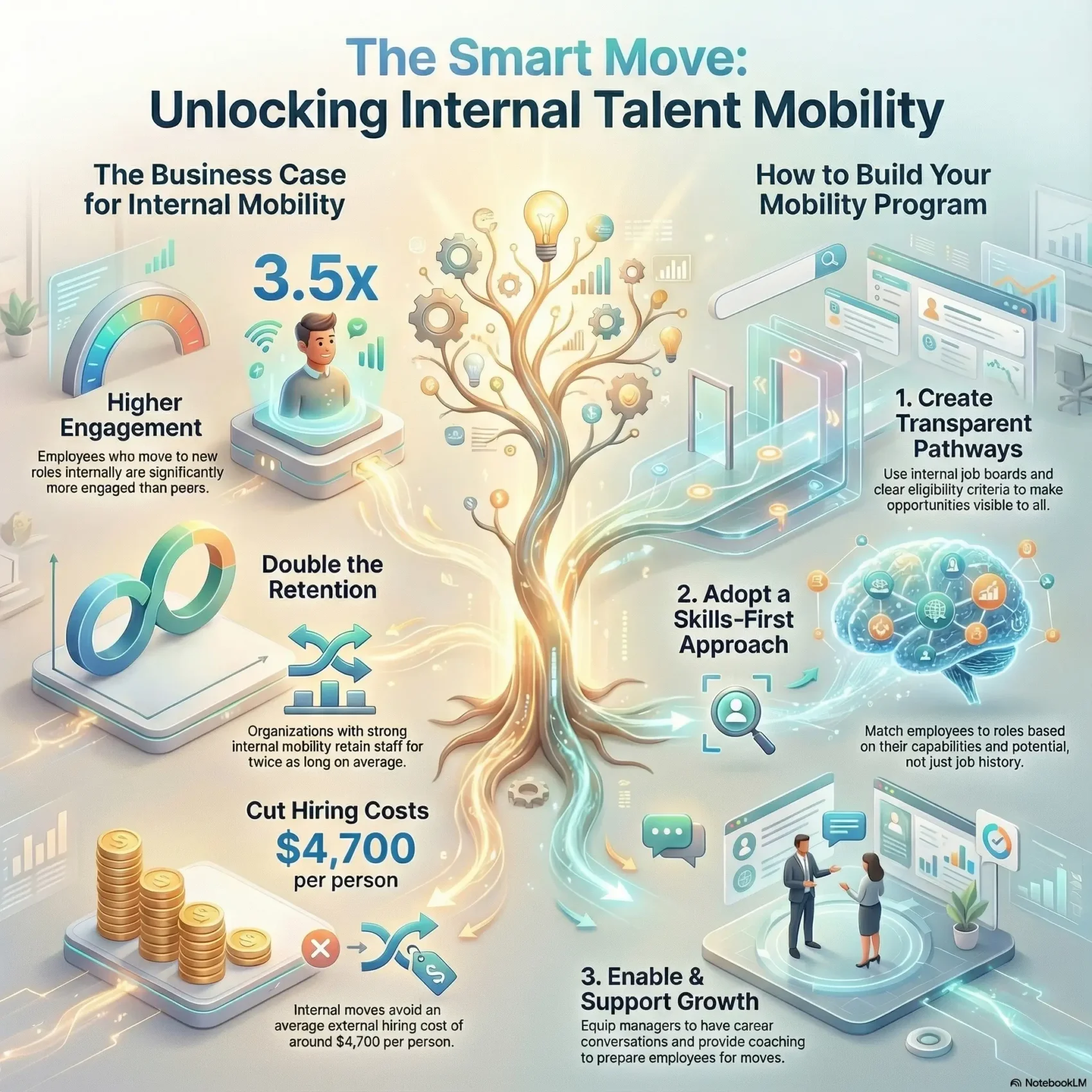
Last Updated on December 1, 2025
Internal hiring helps you move people into the right roles at the right time. A clear internal mobility program aligns personal goals with business outcomes and cuts hiring costs that can average around $4,700 per external hire.
You’ll learn why formal pathways matter in a remote-first world and how transparent processes boost retention and engagement. Companies that prioritize internal moves retain staff longer, and those who change roles internally are about 3.5x more engaged.
This guide shows how to make role changes fair, timely, and tied to skills development. It covers lateral moves, promotions, project-based shifts, and the logistics of relocation in a remote era.
Practical steps tie your program to learning, manager readiness, and workforce planning so your company keeps talent, speeds time-to-productivity, and future-proofs the business.
Key Takeaways
- Formal internal mobility reduces turnover and hiring costs while boosting engagement.
- Transparent pathways make moves fair and easier to navigate for your workforce.
- Include lateral, diagonal, and project moves in your program for real career growth.
- Tie relocation and remote transitions to coaching, learning, and manager support.
- Measure results so your organization can prove faster productivity and savings.
Why mobility matters now: remote work, retention, and business resilience
When work is remote, your ability to redeploy talent inside the company becomes a core resilience skill. Internal mobility shortens onboarding, raises productivity, and keeps your workforce agile as markets shift.
Data backs this up. People who move internally are 3.5x more likely to be engaged. Organizations strong in internal mobility retain staff twice as long. Promotions within three years link to a 70% chance of staying versus 45% without promotion, and lateral moves show a 62% retention rate.
“Companies that build visible paths for career growth cut turnover and boost discretionary effort.”
- Stop talent loss: visible opportunities reduce job hunting and quiet quitting.
- Boost resilience: redeploy skills quickly when headcount freezes or priorities change.
- Improve performance: shorter time-to-productivity than hiring externally.
With U.S. engagement at about 32%, making internal moves easier is one of the most practical strategies you can use to meet current challenges and build a sustainable talent pipeline.
Employee mobility vs. internal mobility: what you’re solving for
When you classify different types of moves, you can match opportunities to business needs and skills gaps.
Internal mobility covers promotions, lateral shifts, cross-department transfers, short-term projects, job swaps, mentorships, and gigs. These paths boost engagement, speed learning, and reduce time-to-productivity.
Types of moves to map
- Vertical — promotions that reward skill growth and readiness.
- Lateral — horizontal moves that broaden experience without title change.
- Diagonal — a department change with a higher-level role, combining growth and exposure.
- Project-based — short assignments or gigs that act as trials for new roles.
Cross-department transfers and job swaps accelerate collaboration and business acumen. Mentorships and projects let people qualify for a new role without immediate headcount changes.
External moves are hiring out to another company. Global moves mean geographic relocation to retain key contributors. As jobs demand about 10% more skills year-over-year, flexible, skills-first pathways become essential.
“Define each path clearly so people know how to qualify and managers can support growth.”
The business case for a mobility program
A clear mobility program turns talent moves into measurable business outcomes and lower hiring costs. Use data to make the argument: people promoted within three years have a 70% chance of staying, versus 45% without promotion. Lateral moves show a 62% retention rate, and those who shift internally are about 3.5x more engaged.
Retention, engagement, and faster ramp
Internal mobility shortens time-to-productivity because you already know performance, fit, and skills. That context reduces onboarding friction and hiring risk.
Cost efficiency vs. external hiring
External hires cost about $4,700 on average and can total 3x–4x salary in full costs. Internal moves avoid many recruiting fees and lengthy interview cycles, saving money and time.
“A structured program turns career moves into predictable workforce planning and continuity for critical roles.”
- Quantify wins: retention rates and engagement lift to win leaders.
- Shorter ramps: faster productivity from known performers.
- Lower cost: cut recruiting spend and reduce vacancy risk.
- Skills leverage: use existing performance data to close gaps faster.
How to design your employee mobility policy
Start by mapping who can move where and under what conditions so your program runs smoothly. Define scope first so everyone knows which roles, departments, and locations are in play. Include clear eligibility rules, such as minimum tenure and performance thresholds.
Set transparent processes
Publish a simple process for posting openings, applying, and evaluation. Use SLAs for each step so applicants and hiring managers can track timelines.
Create support mechanisms
Embed training, mentorship, and coaching to prepare candidates for new jobs. A skills inventory and updated profiles speed matching and reduce bias.
Governance and ownership
HR should own the framework and enablement. Managers must back moves with career conversations and clear backfill plans. Cross-functional partners remove blockers.
- Spell out scope: roles, departments, locations, and eligibility.
- Define fair evaluation methods that value potential and learning agility.
- Recommend an internal job board to surface opportunities and simplify applying.
“Transparent processes and supportive programs make internal moves fair and fast.”
Skills-first mobility: closing skill gaps while growing careers
A skills-first approach lines up real capabilities with real openings, so moves happen based on readiness—not guesswork.
Dynamic skills inventories help you find internal candidates fast. Since 2017, required skills per job have risen about 10% yearly. Today, roughly 58% of the workforce needs new skills to do their jobs.
Build clear inventories that employees and managers update. Tie each capability to a career path and competency level. This makes opportunities transparent and measurable.
- Assess skills with performance data, peer feedback, and small practical tests.
- Design short learning and training plans aimed at the destination job.
- Use mentorships, project assignments, and job swaps for hands-on readiness.
Adopt a skills-first evaluation model that values foundational capability and potential. Then fund targeted development after a move so growth continues on the job.
“Publish the skills and levels expected for every path so people know exactly how to progress.”
Technology that powers talent mobility
Smart tools let your teams find qualified candidates inside the company in minutes, not weeks. A modern stack—job boards, marketplaces, and AI—makes opportunities visible and searchable.
Internal job boards and talent marketplaces for visibility
Set up an internal job board and talent marketplace so people can discover roles and projects that match their skills. This raises internal application volume and speeds fills.
AI-driven matching and attribute search
AI can analyze enriched profiles and signals from GitHub, Stack Overflow, and research sites to surface candidates by verified capabilities.
Learning platforms and skills analytics
Link learning and training data to profiles. Skills analytics flag gaps and recommend targeted learning so readiness improves quickly.
Automation for workflows and experience
Automate alerts, approvals, and interview steps to shorten cycles and improve the candidate experience. Then track fill speed, internal hires, and satisfaction to tune your mobility program.
“Unify sourcing and govern data so your tools stay secure, accurate, and useful.”
Manager enablement and change management
Regular, focused 1:1s are where career intent becomes action and plans turn into moves. You must give managers clear steps, templates, and talking points so those conversations stay practical and consistent.
Career conversations in 1:1s and growth plans
Coach managers to link aspirations to real openings and skills gaps. Use simple growth plans that map short learning sprints to the next job or stretch assignment.
One-on-ones should capture readiness, timelines, and concrete next steps so employees see progress and managers track development.
Preventing talent hoarding with incentives and SLAs
Talent hoarding blocks internal mobility. Set SLAs for releasing people and reward leaders who develop and export top talent.
- Create playbooks for quick backfills to ease team anxiety.
- Offer bonuses or recognition for managers who place team members in lateral or higher roles.
- Require transparent posting norms so all employees can apply.
“Leadership endorsement and visible success stories make change stick.”
Align performance goals with people development and supply managers with enablement tools. This reduces friction and helps your organization scale its mobility programs.
Inclusive mobility: expanding opportunities within your organization
When access is equal and transparent, underrepresented groups gain real pathways to leadership and long-term advancement. Make inclusion a practical design goal for your internal mobility and hiring tools.
DEI-aware frameworks focus on skills and potential, not biased signals. Build clear criteria tied to competencies so selection is fair and measurable.
DEI-aware frameworks and transparent criteria
Publish career frameworks that show required steps for each role. Use structured rubrics for interviews and scorecards so managers evaluate consistently.
Showcasing success stories to broaden participation
Spotlight diverse success stories—like companies that raised female leadership via internal moves—to inspire broader participation.
- Standardize how opportunities are announced with open boards, not private channels.
- Offer sponsorship and mentorship to help underrepresented employees navigate growth.
- Track access and outcomes by demographic to prove the program drives equitable progress.
- Partner with ERGs and DEI leaders to continuously improve access and experience.
“Transparent career maps and visible openings make it easier for all talent to see and seize the next job.”
Relocation and global mobility in a remote era
Relocating top talent across borders demands a clear playbook that balances compliance with a human-first approach.
Remote-first relocations: policy, support, and compliance
Define eligibility, tax and legal steps, and the support you will provide so everyone knows the rules. Include stipends, housing assistance, immigration counsel, and family support to limit productivity dips.
Tip: Use a checklist for approvals, timelines, and communications so managers and employees see each step.
Cultural adjustment, family logistics, and employee experience
Prepare people with video-based training on local norms, workplace etiquette, and practical logistics like childcare and housing.
- Coordinate HR, Legal, Finance, and IT to manage risk and consistency.
- Share success stories and incentives to overcome manager resistance.
- Create transition plans with knowledge transfer and role expectations.
“Clear processes and strong support make moves faster and keep your people productive.”
Measure the experience before, during, and after the move to refine your program and support long-term growth.
Measuring success and iterating your mobility strategy
Build a dashboard that ties internal transfers to learning outcomes, cost savings, and manager behavior. This lets you see what works and where to improve.
Core KPIs to track
- Internal fill rate, internal vs external time-to-fill, and time-to-productivity.
- Retention and retention rates for people who moved, plus quality-of-hire metrics.
- Cost comparison: recruiter hours, manager time, and external hire expense.
Engagement, satisfaction, and learning
Track applicant and mover satisfaction, completion of learning paths, and reskilling progress. Link learning completion to move success to spot which programs predict strong outcomes.
Feedback loops and governance
- Use surveys, focus groups, and manager reviews to capture gaps and wins.
- Monitor equity: access to postings, interview and offer rates by group.
- Publish a quarterly mobility program report and update processes on a set cadence.
“Measure, iterate, and publish results so your organization learns fast and scales what works.”
For inclusive design ideas and DEI alignment, see diversity and inclusion work.
Conclusion
Prioritizing internal growth helps you hold top talent, cut hiring cost, and fill new roles faster.
, A focused internal mobility approach—backed by transparent processes and inclusive access—creates scalable opportunities within your organization. ServiceNow’s internal fills and other case studies show how this raises engagement and retention while lowering external hire expense.
Use a skills-first model, quick learning paths, and tech like marketplaces and AI matching to make internal moves faster and fairer. Ask leaders to sponsor moves and set release SLAs so teams can plan.
Next step: assemble a cross-functional working group to pilot priority workflows, finalize the framework, and launch your first wave of postings. For guidance on culture and remote transitions, see the remote company culture guide.