Tools
Tools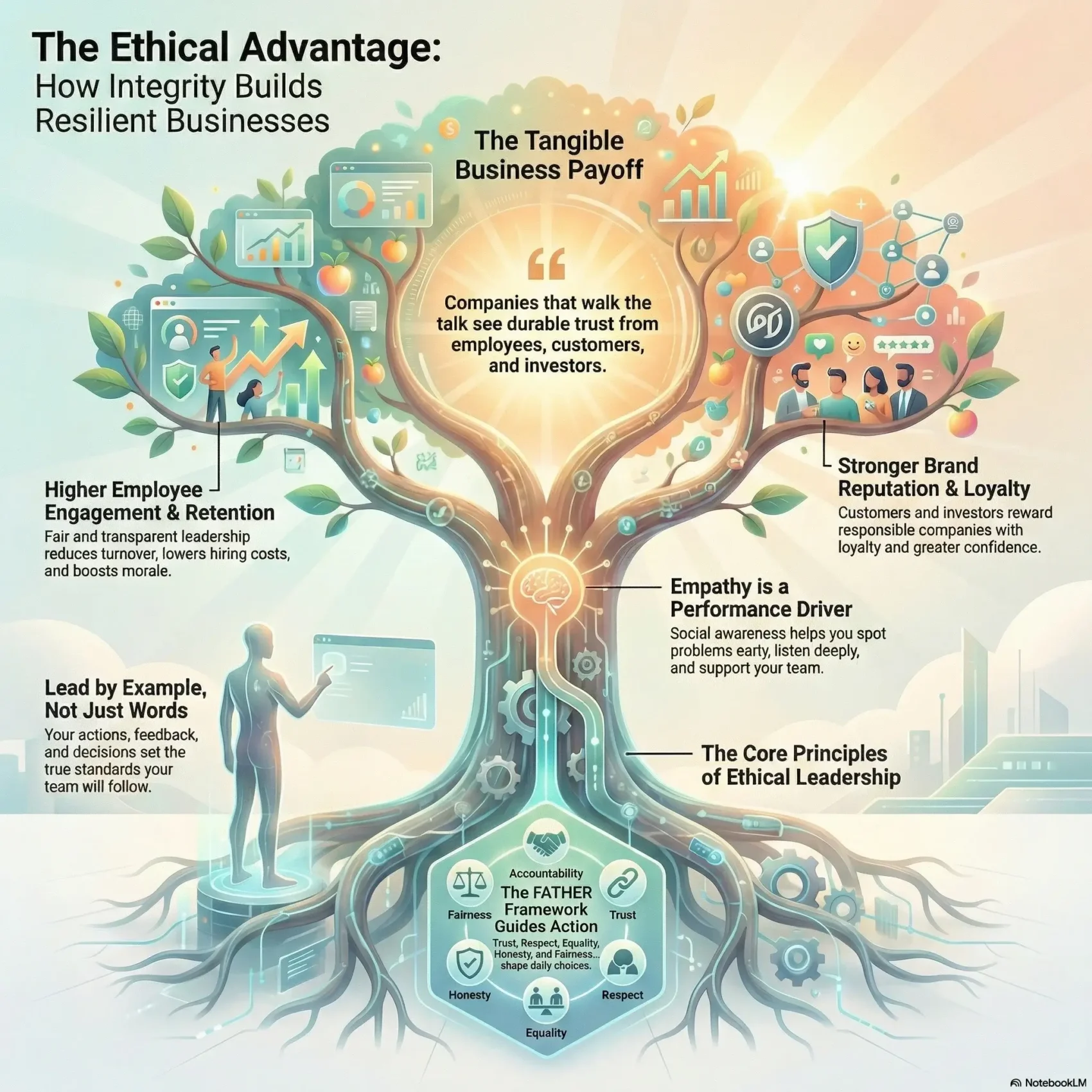
Last Updated on March 2, 2026
You set the tone when you lead with clear values. Ethical leadership means you model honesty, respect, fairness, and accountability so trust grows across your team.
When your choices match your words, the whole organization sees faster engagement and better morale. That clarity creates customer loyalty and stronger financial results over time.
Real companies such as Patagonia, Dick’s Sporting Goods, WD-40 under Gary Ridge, and Procter & Gamble show how values-based choices build brand strength and long-term success.
In this article you’ll get practical frameworks—from FATHER to social learning—that you can apply right away. You’ll also find how transparent communication and owning mistakes make your business more resilient.
Explore how a firm ethical stance helps you navigate complex markets and signals the standards everyone can follow. For a deeper look at culture and inclusion, visit diversity and inclusion work.
Key Takeaways
- You’ll learn how acting with integrity builds trust across your organization.
- Your behavior shapes culture as much as any strategy.
- Practical frameworks are provided for immediate application.
- Values-based choices strengthen brand reputation and market resilience.
- Transparent communication and accountability drive long-term success.
Ethical leadership: definition, scope, and why it matters today
Your conduct and choices shape the norms people follow every day at work. That influence goes beyond talk: actions, feedback, and decisions set clear expectations.
What you’ll learn in this ultimate guide
This guide defines how leaders model behavior and embed values across operations. You’ll see how simple habits become culture and how consistent rules reduce risk.
- Clear definition: how your actions and two-way communication set team standards.
- Scope: from daily conduct to major strategy, and why it belongs in modern management.
- Core principles: empathy, courage, fairness, respect, integrity, and accountability in practice.
- Alignment: matching personal values with company mission to guide tough calls.
- Tools & outcomes: frameworks, checklists, and habits that raise business ethics and responsibility.
By the end, you’ll have practical steps to act consistently, earn trust, and steer teams with purpose.
The business case for ethics-driven leadership in the present landscape
A clear values-driven approach turns everyday decisions into competitive advantage for your business.
Internal results: When leaders model fair problem-solving, employees report higher well-being, job satisfaction, and engagement. That improved morale supports productivity and better performance over time.
Fair treatment and transparent choices reduce turnover. You keep talent, lower hiring costs, and preserve institutional knowledge. In short, this approach improves retention and builds stronger teams.
External results: reputation, customers, and investors
Clear standards protect your product and your brand. Customers reward companies that act responsibly, which boosts loyalty and repeat sales.
Investors increasingly favor organizations that show consistent conduct and transparency. Trust from stakeholders reduces volatility and can raise valuation in tight markets.
“Companies that walk the talk see durable trust from employees, customers, and investors.”
- Quantified upside: more engagement and trust lift productivity and results.
- Retention link: fair, transparent decisions make people want to stay and contribute.
- External payoff: stronger reputation, lasting loyalty, and investor confidence over time.
Core traits and values of ethical leaders
Small, consistent acts of fairness and candor build trust faster than grand statements. You show what you value by what you do, not only by what you say.
Integrity, fairness, respect, and accountability in practice
You take responsibility for outcomes and admit mistakes. That directness teaches employees how to respond under pressure.
Values matter when you set clear standards. Your behavior becomes a practical example others copy.
Emotional intelligence and empathy as performance drivers
Use social awareness to spot problems early. Listen deeply, ask honest questions, and support people through hard conversations.
- Daily signals: simple habits that show integrity and respect so everyone knows what good looks like.
- EI in action: notice risks, listen, and respond with empathy to improve outcomes.
- Modeling: own errors, communicate clearly, and set consistent principles that guide teams.
Frameworks that guide ethical leadership in organizations
Practical frameworks help you move from good intentions to consistent behavior across teams. Use models to make values visible, teach standards, and measure progress.
FATHER principles
FATHER stands for Fairness, Accountability, Trust, Honesty, Equality, Respect. You can operationalize this core set to shape daily choices and conversations.
Social learning theory
People learn by watching role models. When you act visibly and reinforce good conduct, your example becomes the standard others copy.
Leader–Member Exchange (LMX)
LMX focuses on the dyad between leaders and members. High-quality ties built on trust and reciprocity improve information flow, task meaning, and influence.
- Operationalize FATHER: translate principles into scripts for onboarding and reviews.
- Amplify your example: use visible actions to set clear standards.
- Invest in LMX: map where relationships need more trust-building to strengthen the organization.
“High-quality relationships, supported by trust and fair standards, predict better outcomes.”
Shaping culture: from mission statements to everyday behaviors
Make your vision tangible by mapping values to clear behaviors people can follow each day.
Senior leaders set the foundation with mission and vision, but you turn words into practice by naming the actions you expect. Keep those actions visible: rituals, check-ins, and role examples help the whole team learn what counts.
Rewarding ethics-aligned actions matters. Align guidelines and recognition so fairness, honesty, and respect become default practices rather than occasional gestures.
- Translate mission into observable behaviors and daily rituals.
- Use storytelling, shout-outs, and feedback loops to reinforce standards.
- Provide safe channels so people can raise concerns without fear.
- Audit where posters on the wall don’t match actions in the hall.
- Equip managers to coach in-the-moment practices across teams.
“Culture is created by what people do every day, not by what you write on a slide.”
When you close the gap between intent and action, organizations build trust faster. Make shaping culture a team effort: everyone’s choices reinforce the norms you want to keep.
Trust, communication, and psychological safety on your team
Open, two-way dialogue is the backbone of a safe, productive team. Two-way communication and transparent information sharing promote psychological safety and guide ethical conduct in daily work.
Two-way communication and transparent information sharing
Trust grows when you act consistently and share context. When leaders disclose relevant information, employees feel informed and more willing to give candid feedback.
Research shows leader behavior and personality shape how employees perceive fairness and the broader culture. That perception directly affects collaboration and the leader–member relationship.
- You’ll build trust deliberately by keeping communication clear and involving members in decisions.
- You’ll create psychological safety by inviting candid input, acknowledging concerns, and closing the loop on what you heard.
- You’ll structure information flows so employees have what they need and can flag risks early.
- You’ll model vulnerability—sharing context and constraints—so leaders and teams normalize honest dialogue.
- You’ll use rhythms (standups, office hours, retros) to keep communication consistent without overload.
“When you share information openly, people feel safer to speak up and solve problems together.”
Measure trust and safety signals and act quickly. That reinforces your leadership and helps the team do its best work.
Ethical decision-making under pressure
When time runs short, a clear moral map helps you choose speed without sacrificing care.
A clear moral framework for ambiguous situations
Use simple rules that translate values into action. Outline the trade-offs you’ll accept, and list which consequences are non-negotiable.
Documenting the steps you took makes your reasoning transparent and helps others learn from the outcome.
Aligning personal values with company goals and policies
Match your private values to company goals so choices stay consistent when stakes rise. Map each core value to a policy or a behavior you can point to in the moment.
- Adopt a practical decision framework to handle high-pressure situations without losing integrity.
- Evaluate stakeholder impacts, fairness, and short‑ vs. long‑term risks before finalizing important decisions.
- Set escalation and consultation norms so a leader never carries heavy ethical calls alone.
- Debrief key decisions and keep a record so your team understands how and why you chose a path.
For a deeper view of decision processes and AI-supported judgement, see AI decision-making guidance.
“Clear frameworks let you act quickly while explaining why the choice honors your values and goals.”
Navigating the bottom-line mentality without sacrificing ethics
A single-minded focus on quarterly targets can hide real costs and weaken trust across your teams. Bottom-line mentality (BLM) pushes people to prize immediate results while downplaying other duties and relationships.
Recognizing BLM risks: misaligned incentives and social undermining
Watch for incentives that reward short-term wins at the expense of long-term value. Supervisors under pressure may unintentionally foster rivalry and social undermining among employees.
Research links task design and supervisor attitudes to higher rates of undermining. That hurts morale and long-term performance.
Balancing results, responsibility, and respect for people
Redesign goals and rewards so responsibility and respect for people sit beside financial targets. Coach supervisors to model fair choices and to clarify expectations under stress.
- Spot warning signs like misaligned incentives and aggressive competition.
- Build guardrails: checkpoints, peer reviews, and escalation steps that protect sustainable performance.
- Partner with senior leadership to align strategy with these guardrails so success never requires compromising people.
“Reducing top-level BLM often improves profit by protecting well-being and consistent conduct.”
Common ethical dilemmas leaders face—and how you can respond
Leaders regularly face choices where outcomes pull in different directions, and clear processes help you act with confidence.
Fairness in pay, promotions, and company resources
Apply consistent criteria and document decisions so pay and promotions are defensible. Use written rubrics, calibration meetings, and review records to limit bias.
Conflicts of interest, truth in communication, and handling misconduct
Require disclosure when personal ties could affect choices. When misconduct appears, act quickly: investigate, communicate facts, and preserve dignity.
Whistleblowing, confidentiality, and clashing cultures
Give employees clear, safe channels to raise concerns and protect confidentiality. Recognize cultural differences that create tensions and use mediation to align expectations.
- You’ll use structured guides to weigh harm, fairness, and precedent before finalizing decisions.
- You’ll manage conflicts by disclosing, recusing, or redesigning work to keep objectivity.
- You’ll ensure the organization responds consistently and fairly across situations.
“Many dilemmas are subtle and rooted in competing interests; clear policies and leader modeling make resolution consistent.”
Leading by example: real-world cases and outcomes
Real-world company choices show how values translate into measurable business outcomes. These four cases give practical examples you can study and adapt to your own work.
Dick’s Sporting Goods
Example: After major shootings, Dick’s removed firearm sales. The move drew early backlash but later coincided with stronger product performance and rising share value.
Patagonia
Patagonia donates at least 1% of sales or 10% of profit to environmental groups. Under Rose Marcario, the brand pushed repairs, exchanges, and activism, building deeper customer loyalty while sustaining success.
WD-40 under Gary Ridge
CEO Gary Ridge framed mistakes as learning moments. That culture of trust raised retention to about 90% and supported steady shareholder value growth.
Procter & Gamble
P&G’s “We See Equal” program reformed recruitment and reduced gender bias. The initiative changed culture and expanded opportunities for women in senior roles.
- You’ll see how values-based choices strengthened performance and brand credibility.
- You’ll learn patterns—clear principles, transparent communication, and consistent follow-through—that you can apply.
- You’ll translate these cases into steps that balance courage, stakeholder expectations, and long-term success.
“Values-driven action can protect your product, deepen loyalty, and sustain performance.”
Building your ethical leadership program
Create a systematic pathway so top performers gain the skills they need to manage others. Start by defining fair criteria to spot high-potential talent and map equitable development paths for employees across roles.
Identifying and developing high-potential leaders
You’ll use clear markers—performance, curiosity, and influence—to nominate people for education tracks. Pair classroom learning with on-the-job projects so emerging leaders practice real work challenges.
Training pillars: EI, communication, decision-making, and team dynamics
Build a concise training roadmap focused on emotional intelligence, communication, practical decision-making, and team building. Use short modules that fit manager time limits and drive immediate behavior change.
Reinforcing standards through coaching and role modeling
Coaching turns theory into habit. Equip managers with coaching prompts and scenario labs so daily moments become teachable opportunities. Track retention and productivity to show how education investments pay off.
- You’ll define criteria and fair paths for employees across your organization.
- You’ll design experiential labs, role-plays, and dilemma simulations tied to real work.
- You’ll measure results and refine the program with feedback loops.
“Investing in people signals their value and boosts culture and productivity.”
Policies, standards, and consistent practice
A concise code of conduct makes responsibility visible and consistent across roles. Clear written standards turn abstract values into simple actions people can follow every day.
Codes of conduct, escalation paths, and zero-tolerance guidelines
Formal codes define expectations, responsibilities, and consequences so everyone in your company knows what behavior is required.
Escalation paths make sure unresolved matters move fast to compliance, HR, or legal counsel with the right information to act. Map roles, timelines, and required documentation so responses are prompt and traceable.
Zero-tolerance guidelines must state clear outcomes for serious violations. Apply these rules consistently so enforcement feels fair and protects your culture.
- You’ll formalize a code of conduct that spells out duties and consequences across the organization.
- You’ll map escalation paths so issues reach the right owners with full information and context.
- You’ll apply zero-tolerance rules uniformly so similar cases get similar outcomes.
- You’ll align policies with your culture and everyday practices to reduce mixed signals.
- You’ll reinforce policies through training and refreshers so business ethics stay top of mind for management and teams.
- You’ll document and track cases to support transparency, learning, and continuous improvement in how organizations handle concerns.
“Consistent practice and clear processes protect people, reputation, and long-term performance.”
Measuring what matters: KPIs and leading indicators
Early signals from people and customers help you catch problems before they escalate. Track a small set of metrics that link behavior to outcomes so you can act fast and keep your goals on course.
Engagement, satisfaction, incident trends, and loyalty
Use engagement and satisfaction surveys as pulse checks to gauge internal climate. Monitor ethics incident trends to spot emerging risk, not just one-off problems.
Customer loyalty metrics—repeat purchases, net promoter scores, churn—reflect how your decisions shape external reputation and results.
Trust and LMX quality as predictors of performance
Trust and the quality of ties between leaders and members predict access to information, discretionary effort, and autonomy. Measure these with short pulse surveys and manager assessments.
- You’ll define a balanced KPI set—engagement, satisfaction, incident trends, and loyalty—that reflects organizational health and outcomes.
- You’ll measure trust and LMX quality with pulse checks to understand how relationships drive team performance.
- You’ll design dashboards that integrate qualitative and quantitative information for timely, value-based decisions.
- You’ll set goals and thresholds that trigger action when early signals show declining trust or rising risk.
- You’ll analyze patterns to tell isolated events from systemic issues needing organization-wide response.
- You’ll close the loop by sharing insights with teams and adjusting behaviors to improve results.
“Leading indicators let you anticipate outcomes and shape better decisions aligned with your goals.”
Tools and resources to sustain ethical leadership
Routine refreshers and clear resources turn values into everyday work practices. Ongoing education, targeted assessments, and structured development keep your team prepared for tough calls.
Education should be continuous: courses, workshops, and coaching that map to real scenarios make skills stick. Use short modules so busy managers and teams can apply ideas right away.
Education, assessments, and ongoing development
Assessments such as emotional intelligence tools help you tailor training and guide daily practices. Personal development plans based on data close skill gaps fast.
- You’ll curate education pathways—courses, workshops, and coaching—that keep skills sharp over time.
- You’ll use assessments (e.g., EI) to personalize plans for leaders and teams and to guide work practices.
- You’ll adopt a simple framework for selecting tools so resources match your management needs and maturity.
- You’ll enable knowledge sharing with libraries, office hours, and playbooks so information is easy to find and use.
- You’ll build communities of practice so teams trade real-world solutions and hold each other accountable.
- You’ll plan refresh cycles so training stays relevant as risks and the workforce evolve.
“Consistent education and clear tools reduce risk, protect reputation, and strengthen partnerships.”
Pitfalls to avoid on your ethical leadership journey
Some missteps look small but can hollow out credibility across your organization. You want your words and actions to match so trust stays intact.
Performative ethics, inconsistent enforcement, and misaligned incentives
Performative ethics erode credibility when public statements don’t match everyday actions. People notice the gap and quickly stop trusting promises.
Inconsistent enforcement creates unfairness. When similar issues get different outcomes, your culture sends the wrong message and repeat violations rise.
Misaligned incentives reward short-term wins and can push teams toward a bottom-line mentality. That often leads to social undermining and diluted responsibility.
- You’ll avoid performative ethics by aligning promises, metrics, and actions so people see real commitment.
- You’ll ensure consistent enforcement so similar issues get similar responses, regardless of role or results.
- You’ll audit incentives that push the wrong behaviors and redesign them to reinforce fairness and responsibility.
- You’ll prepare managers to communicate tough calls clearly, using examples that show standards are nonnegotiable.
- You’ll build routines—reviews, retrospectives, audits—that surface blind spots before they grow.
- You’ll model humility by acknowledging missteps and correcting quickly, which strengthens trust in your leadership.
“Clarity and consistent action beat optics every time.”
Conclusion
Small systems—like checklists, feedback loops, and visible role modeling—lock good conduct into daily work.
You’ll see how ethical leadership delivers layered benefits: higher employee engagement and satisfaction, stronger customer loyalty, better reputation, and more resilient financial outcomes for your company.
Clear frameworks, consistent policies, and visible role modeling create a practical roadmap you can use right away. Set immediate actions: measure trust and incidents, run short trainings, and tighten communication rhythms so the team learns fast.
Real-world cases show that principled choices can drive both purpose and performance. Use those examples to tailor steps that fit your business and move toward lasting success.