Tools
Tools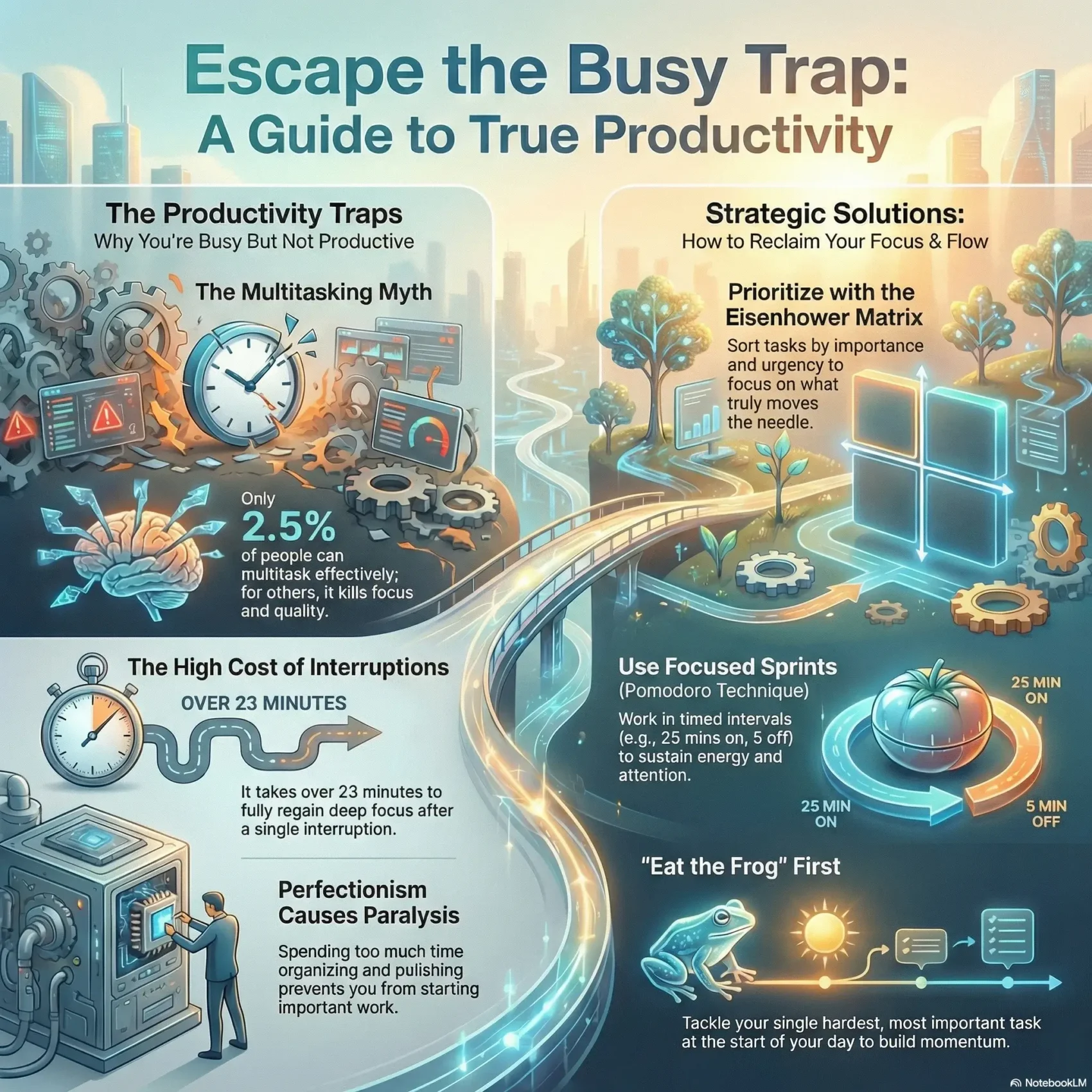
Last Updated on March 23, 2026
You’ve probably seen days slip away while you tweak lists and move tasks around. That loop wastes time and momentum more than you think. Multitasking helps only about 2.5% of people, and too many meetings or saying “yes” constantly drains focus.
Instead of perfect planning, try simple systems that work. Use the Pomodoro Technique, sort tasks with the Eisenhower Matrix, and schedule peak-hour work to match your best hours. Reclaim attention from social media, email, and casual browsing to boost output.
Organize your workspace, keep devices updated, and adopt small changes that stack over days. Act first, refine later so you move toward your goals and see clearer progress at your job. These steps help you turn intention into results in the modern work world.
Key Takeaways
- Stop over-organizing and spend more minutes doing focused work today.
- Simple routines like Pomodoro and peak-hour planning increase your ability to deliver.
- Cut unnecessary meetings and learn to say no to protect attention.
- Batch communications and update tools to reduce lost minutes.
- Pick one high-impact change now to build immediate momentum.
What “productivity pitfalls” look like in today’s workday
Some workdays look busy but leave you with little real progress. You feel active, yet the most important work never moves forward. That gap often comes from small, repeated patterns you can learn to spot.
From busywork to burnout: spotting the patterns that steal your time
Regaining focus after an interruption can take about 23 minutes and 15 seconds. Constant email and social media checks leave attention residue and reduce output quality. Marathon meetings without agendas eat hours you could use on real work.
- You fill your day with tasks that feel like progress but don’t move outcomes forward.
- Small distractions fragment attention and the minutes lost to refocus add up into wasted time.
- People pull you into meetings with no owner, turning five-minute decisions into hours.
- You organize lists to avoid the one hard thing that would change your results.
- Toggle between chat, media, and email leaves a drag on work quality and energy.
Spot these signs early and measure days by outcomes shipped, not by how many things you touched. Say no more often and reclaim focused blocks to protect deep work.
Get clear on goals before you touch your to‑do list
Before you touch a single item on your list, decide what success looks like for the day. Naming a specific outcome keeps you from spinning on low-value tasks and keeps your attention on real results.
Define specific, measurable goals so every task serves a result
Write goals in plain, measurable language. Say what finish looks like and when it must be done.
Break big outcomes into small, same‑day tasks. Small wins reduce friction and make progress visible.
Before you start, state one success metric. That stops endless polishing and protects your time.
Prioritize with the Eisenhower Matrix to separate urgency from importance
Use the Matrix to sort tasks by urgency and importance so loud items don’t crowd out critical work.
- Do: important and urgent tasks first.
- Schedule: block time for important-but-not-urgent work each week.
- Delete/Delegate: capture tasks that don’t map to goals and remove them.
Pick simple tools — a calendar plus a lightweight app — that match your rhythm. Add a quick weekly analysis to review results and decide what to double down on next week.
Time management that actually moves the needle
If you align tough tasks with your mental highs, the rest of the day flows easier. Use a few simple rules to protect focus and turn small windows of time into meaningful progress.
Work with your peak hours, not against them
Identify the two hours when you think clearest and plan your hardest work there. The first two hours of the day often deliver the biggest wins.
Block those hours on your calendar and treat them like nonnegotiable appointments with your best work.
Use the Pomodoro Technique to protect focus and energy
Run focused intervals (for example, 25 minutes on, 5 minutes off) to sustain attention and manage energy across the day.
Reserve short minutes between cycles to stand, stretch, and reset. That pause helps you sustain deep work longer.
“Eat the frog” to win the day before distractions hit
Start each morning by doing the single hardest thing tied to your goals. Finishing that one thing early prevents procrastination from spreading.
- Stack shallow tasks into lower-energy hours so peak time stays for creative or analytical work.
- Keep a capture pad nearby to park stray thoughts and avoid context switching.
- Finish focus blocks with a quick summary of the next steps so you can restart fast.
End the day by picking tomorrow’s frog and prepping materials so you can begin immediately in your next peak block.
Multitasking is a focus killer—switch to single‑tasking
Switching between several tasks at once often feels efficient, but it quietly steals your best minutes.
Only about 2.5% of people truly benefit from multitasking. Every context switch leaves attention residue, raises error rates, and drags down final quality.
The hidden costs: attention residue, errors, and lost minutes
When you switch, studies show you need roughly 23 minutes and 15 seconds to regain full focus. That adds up to hours each week.
Analysis shows more mistakes, slower delivery, and growing fatigue when you fragment your work. Avoid analysis paralysis by deciding the next action before you begin.
Time‑block one task at a time for higher quality results
- Make one clear definition of done for the current thing.
- Block the calendar so one task has your undivided attention and decline new inputs during that block.
- Close unrelated tabs and mute distractions to protect your focus.
- Use short, named blocks (e.g., “Draft intro”) and track how long common tasks take.
Tip: Read a quick primer on single‑tasking and research-backed methods at single‑tasking research. Celebrate completing a block to make this way of working your default.
“You do better work when you give one thing your full attention.”
Perfectionism and analysis paralysis: stop stalling, start shipping
Perfectionism quietly turns small decisions into full stop moments. When that happens, your mind freezes and the work waits. That analysis paralysis delays action, raises stress, and keeps you from seeing real results.
Reduce decisions to reduce paralysis
Simplify choices so your mind can move faster. Limit options, batch similar calls, and set short decision timeboxes. These steps shrink paralysis and help you finish the task at hand.
Adopt “done is better than perfect” to beat procrastination
Set a clear, good enough standard tied to your goals. Break big things into micro-steps so starting feels easy. Cap revision rounds and use templates to stop endless polishing.
- Define a narrow scope for the current job so you don’t solve every problem at once.
- Subtract nonessential work that won’t advance your goals.
- Log lessons learned after shipping so improvement becomes systematic.
“Imperfect action beats perfect intention when speed to feedback matters.”
Tame digital distractions: social media, email, and the open internet
Digital noise steals minutes faster than you notice, and it quietly reshapes your day. You can take back control with small, repeatable habits that stop reactive checking and protect your attention.
Batch email and social media instead of constant checking
Pick two or three windows daily for email and social media. When messages arrive, use a quick inbox triage: delete, delegate, do, defer. That keeps tasks from spreading across your whole day.
Use website blockers and app limits to guard your attention
Install blockers and set app limits as simple tools that remove temptation during deep work. Move chat apps off your home screen and keep your phone out of reach for focus blocks.
Silence notifications and practice quick mindfulness resets
Mute nonessential alerts and set VIP filters so only true urgencies break through. When you feel pulled into the online world, try a two-minute reset: close your eyes, breathe, and stretch. It helps you recover focus fast.
- Prune follows and subscriptions so feeds serve your goals rather than cluttering your mind.
- Bundle quick online tasks—research, replies—into single blocks to reduce ramp-up costs.
- End sessions by closing unrelated tabs so you restart clean for the next block.
“Limit the number of places attention can scatter and you’ll find extra time to do the real work.”
Meetings and the urge to say yes: reclaim your hours
Meeting requests can quietly eat whole chunks of your schedule if you let them. You’ll feel busy, but real work and important tasks slip away.
Polite ways to say no and protect your priorities
Start with a gentle default: decline low-urgency asks so your time stays open for high-value work. Offer one clear alternative, like a short async update or a single question answered over chat.
- Default to no for requests that lack a goal or owner.
- Propose an async summary when a meeting won’t move things done.
- Set boundaries by protecting a daily deep-work block from scattered invites.
Run lean meetings: clear agenda, owner, and timebox
Only accept meetings that include an agenda, a named owner, and a decision goal. Timebox every session and plan to end early by design.
- Prepare one page of inputs so the meeting runs on rails and delivers success quickly.
- Bundle stakeholder reviews into one session to cut repeated context switching across the day.
- Capture next steps with one accountable owner and follow up with crisp notes and deadlines.
“Train people to respect your boundaries by responding consistently and offering helpful alternatives.”
Match tasks to energy: breaks aren’t a luxury, they’re strategy
Track your natural highs and lows for a few days so you know when your focus is strongest. Use that data to plan important work during high‑clarity windows and routine items when your energy dips.
Schedule deep work when your mind is freshest
Block the best hours for deep work and protect them. When you schedule hard tasks at the right times, you cut errors and finish faster.
- Map energy: note peak times each day and assign creative tasks to those windows.
- Short resets: take brief movement or breathing breaks to restore focus and reduce fatigue.
- Right fit: move administrative tasks to lower‑energy hours to protect your ability to deliver peak results.
- Daily review: end the day by noting what energized you and refine tomorrow’s plan.
Keep water and a small snack nearby. Protect sleep and regular breaks so your mind and body can sustain steady results over time.
Optimize your environment: workspace and devices that help, not hurt
When your space and tools are ready, you remove tiny frictions that add up across the day.
Declutter and reset your desk daily. Clear surfaces at the end of each day so tomorrow’s work starts fast. Standardize where things live—charger here, notebook there—to save minutes hunting for basics.
Keep only the tools you use within reach. Remove visual noise that pulls your attention and reduces quality. Put rarely used items out of sight so your desk supports focus, not distractions.
Speed up devices: updates, file hygiene, and right‑fit tools
Run regular updates, prune unused apps, and free storage so devices stay snappy. Organize files with consistent names so you find what you need in seconds in the digital world.
Choose tools that match how you work — for example, a minimal notes app if you move fast, or a robust suite when you collaborate. Use website blockers when the open internet or social media and other media tempt you, and whitelist only essentials.
- Create separate browser profiles for deep work and general browsing to avoid cross‑contamination.
- Build a five-minute shutdown ritual: close loops, plan the first task, and lock in priorities for tomorrow.
- Test small environment tweaks weekly and keep what measurably improves speed and quality.
“Small, repeatable habits in your space and devices buy back real time.”
Delegate to do more of the work only you can do
Letting others own clear pieces of work multiplies what you can accomplish. When you move routine tasks off your plate, you reclaim time for the high-impact things only you should handle.
Simple delegation steps: define outcome, pick owner, give feedback
- Select the right expert. Match the task to the person with the right skills so handoffs start well.
- Define what and when. State the desired outcome, deadline, and any constraints so there is no guesswork.
- Plan together. Align expectations and confirm how progress will be shared.
- Set measurable success. Give clear criteria so results are easy to evaluate.
- Give regular feedback. Use lightweight check-ins to keep momentum without micromanaging.
- Review and capture lessons. Close the loop fast and document steps to turn a one-off into a repeatable process.
Do less of what anyone can do and more of what only you can. Track the capacity you reclaim, redirect it to prioritized projects, and count the extra results that appear. Delegation is a simple way to get a lot more things done and improve team success while saving you real time.
Conclusion
Decide on a single action now that will make your next workday noticeably better. Pick one high-impact change — eat the frog, protect a deep-work block, or cancel a low-value meeting — and try it today.
Align your goals to clear tasks, guard peak hours, and batch social media and email so interruptions don’t steal your time. Remember the fact that refocusing after an interruption can cost over 23 minutes and that multitasking is a focus killer for most people.
Small steps add up. Delegate routine work, optimize your space and devices, and single-task on the most important thing first. Treat each win as an example of compounding change and measure progress by things done, not by how busy your day felt.