Tools
Tools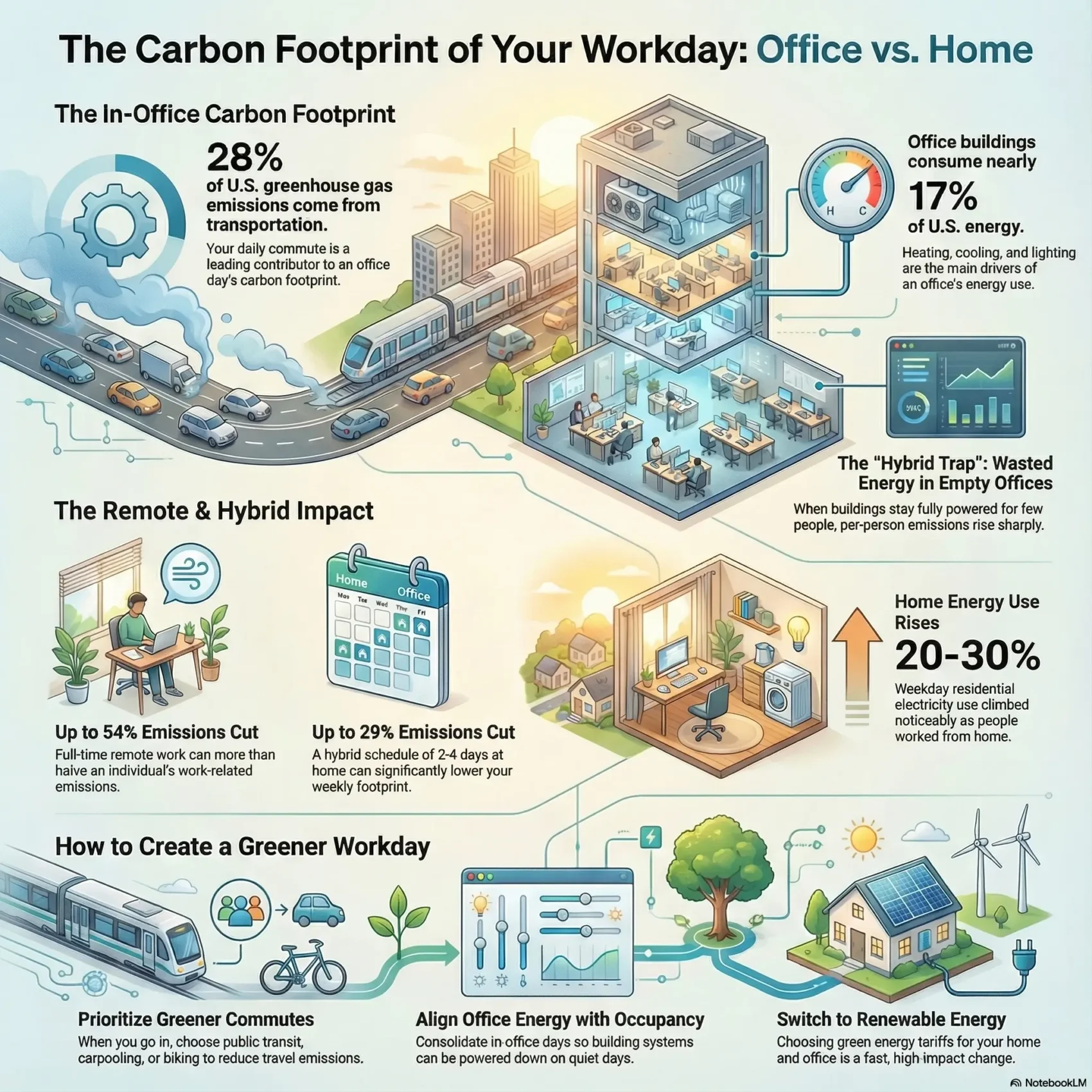
You likely wonder whether swapping commutes for home days really trims your climate footprint. The shift from perk to default since COVID-19 changed how people and teams think about where they do their best work.
Data matters: in 2023 about 12.7% of U.S. full-time employees worked fully from home and 28.2% were hybrid. Forecasts suggest roughly 22% may be fully remote by 2025.
Transportation drives about 28% of U.S. greenhouse gas totals, while offices use nearly 17% of national energy for heating, cooling, and lighting. Full-time home days can cut individual emissions by up to 54% versus on-site, but home energy use rose noticeably during the pandemic.
In this article you’ll get a clear, data-led view so you can decide how your setup can lower your carbon footprint without losing productivity. You’ll see where commuting, building systems, and home habits matter most and what actions give the biggest payoff.
Key Takeaways
- Commuting and office systems still drive large shares of emissions.
- Full home days can cut individual emissions substantially, but gains vary by location and home size.
- Home electricity rose early in the pandemic, so appliance and heating choices matter.
- Small ICT uses add little compared with travel and building energy.
- Practical steps—renewables, efficient heating, and lighting—deliver the biggest savings.
Why you’re seeing the remote work carbon impact debate right now
The shift from occasional home days to a common schedule has put your daily emissions choices in the spotlight. In 2023 about 12.7% of U.S. full-time employees worked fully remote work and another 28.2% were hybrid. Projections point to roughly 22% fully remote work by 2025.
“When an option becomes ordinary, its environmental trade-offs become a regular business question.”
What changed since the pandemic: from perk to default
What was a perk for a few is now a norm for many people. That makes commute choices and building energy use a weekly policy question for teams.
Informational intent: what you want to know to act today
You need quick ways to weigh the commute you avoid against the extra energy at home on any given day. You also want to know which actions actually cut emissions so you don’t waste effort.
- Check commute distance versus home heating needs per week.
- Target big wins like HVAC and lighting, not tiny gadget fixes.
- Create a simple checklist for each day you’re working, whether you commute or stay home.
Remote work carbon impact: what the latest data says
The latest analyses separate travel, building energy, and devices so you can see which actions matter most for emissions.
Commuting eliminated: big cuts for full-time remote workers
Full-time remote workers can cut emissions by up to 54% versus on-site roles. That saving comes mainly from eliminated daily travel and lower per-person office energy.
Home energy use rises on weekdays
Weekday residential electricity climbed about 20–30% in parts of the U.S. during lockdowns. The U.K. saw ~15% increases early on.
You should expect higher energy use at home when heating, cooling, or devices run longer.
ICT is a smaller slice; rebound behavior matters
Analyses using large employer data show ICT’s share of individual emissions is relatively small next to travel and heating.
“Small errands and extra deliveries can erase some of your gains.”
- Target commute elimination first, then optimize home energy use.
- Batch errands and plan deliveries to reduce hidden travel emissions.
- Use smart thermostats and efficient gear to lower office energy carried into your home.
Office work’s footprint in the U.S.: commuting, building energy, and waste
Most of the environmental cost of an office day comes from how you get there and how the building is run. That mix—transportation plus building energy—drives the bulk of an office footprint.
Transportation emissions context: commuting’s outsized share
Transportation accounts for about 28% of U.S. greenhouse gas emissions. That makes your commute a leading slice of an office day’s total.
How far you travel and the mode you choose can double or halve that share in a single day.
Office energy use drivers: heating, cooling, lighting in office buildings
Commercial buildings, including offices, consume nearly 17% of U.S. energy. Heating, cooling, and lighting are the main culprits.
Poor controls, old HVAC, and always-on lighting inflate usage and push per-person energy up, especially on partially occupied floors.
Daily carbon footprint benchmarks for office days
Use simple benchmarks to compare choices. An average office day is roughly 6.6 kgCO2e/day. With a five-day commute, that adds to about 33.02 kgCO2e per week.
Industry guidance (CIBSE TM46) gives a baseline office energy near 3.5 kgCO2e/day per person, or about 0.44 kgCO2e/hour at the desk.
“Lighting schedules, after-hours conditioning, and plug loads add up even when you aren’t at your desk.”
- Compare your commute emissions against building-related energy to spot big wins.
- Ask facilities about heating setpoints, lighting controls, and occupancy sensors.
- Remember: occupancy density and equipment age shift the office energy per person fast.
Hybrid patterns: how many days per week tip the balance
A hybrid pattern can cut your weekly footprint, but only if buildings and teams adjust to the new rhythm. Small schedule changes make a big difference when energy systems and attendance align.
Two to four days can reduce emissions up to 29%
Research shows shifting two to four days week away from the office can lower an individual’s emissions by up to 29% compared with full on-site schedules.
You gain most when your commute is long or car-dependent. Use the 29% figure as a directional target while you adjust for your specific commute and building efficiency.
When hybrid underperforms: fully lit floors and underused space
If office spaces stay fully lit and conditioned for a few people, expected savings evaporate. Building operations determine whether hybrid actually reduces energy per person.
“Consolidate presence so whole floors can be turned off rather than keeping systems running for sparse occupancy.”
- Coordinate schedules: hybrid workers who sync in-office days boost density and lower wasted space.
- Ask facilities: request setbacks and lighting controls so office energy scales with occupancy.
- Plan collaboration days: concentrate meetings to make in-office time more efficient per week.
- Map greener choices: weigh weather, travel, and building status to decide when to stay home or commute.
For broader trends and actionable scheduling tips, see hybrid trends that help teams reduce emissions and optimize office usage.
From averages to your day: variables that shift your carbon footprint
Small daily choices — from how you get to the office to which room you heat — change whether a day raises or lowers your footprint.
Commute distance and mode
Your commute often outweighs home energy used for a day. In the UK most people travel under 10 km one way and 45.1% drive.
If you drive solo, that short trip can still beat hours of home device usage. Compare fuel-based commuting with transit, biking, or walking to see the real trade-off.
Home versus office space and heating
DEFRA’s hourly factor for homeworking (0.33378 kgCO2e/hour/person) helps you estimate day-level usage from equipment and lighting.
A small, well-insulated room with efficient heating will usually keep your home footprint low, especially outside extreme temperatures.
Occupancy density and office energy per person
Office baseline energy near 3.5 kgCO2e/day/person assumes mid-range density. When floors are underfilled, per-person office energy use rises fast.
“Time your in-office days to when more people are present so building systems work efficiently.”
- Weigh your commute versus running HVAC at home for the day.
- Check which buildings and space practices cut per-person usage.
- Target the biggest loads at home: heating, then lighting and equipment.
How you reduce carbon now at home and in the office
Start with small changes at home and in the office to lock in big emissions savings fast. Pick three practical moves and make them routine so you see lower bills and a smaller carbon footprint.
Switch to renewable electricity
Choose green tariffs for your household and push your office to buy renewable power. This is one of the fastest ways to reduce carbon footprint without changing daily habits.
Cut energy usage with smarter gear
Swap to LEDs, install smart thermostats, and use advanced power strips so devices actually turn off overnight. These steps reduce energy usage and lower energy consumption at both your desk and in shared spaces.
Greener commuting choices
When you head into the office, favor public transit, carpooling, biking, or walking. These options shrink travel emissions and make in-office days greener.
Right-size space and tune building systems
Ask facilities to align HVAC, lighting, and schedules with actual occupancy so office energy use tracks attendance. Consolidate floors and compress schedules to avoid half-empty areas.
“Small, consistent changes add up faster than rare grand gestures.”
- Enroll in renewables and green tariffs.
- Use LEDs, smart thermostats, and power-down rules.
- Choose low-emission transit and plan trips carefully.
- Support people working home with stipends for efficient gear.
- Measure your carbon footprint quarterly and follow a simple daily checklist.
What’s next: sustainability trends shaping where you work
You’ll see design and technology steer how office days and home days add up for the planet and your budget.
Smart systems, efficient gear, and better collaboration tools are making it easier to cut energy consumption while keeping teams connected.
Greener buildings and smart systems in office spaces
Sensors and analytics let office buildings scale HVAC, lighting, and plug loads to real occupancy. That reduces wasted electricity and lowers overall energy use.
New office buildings favor daylighting, low-energy systems, and materials that reduce operational energy. These choices shrink the building’s annual demand and make hybrid schedules more effective.
Eco-friendly home offices and better collaboration tech
Your working home setup can use efficient monitors, laptops, and task lighting to cut electricity and heat waste. Sustainable furniture and materials help too.
Collaboration platforms reduce the need to travel while keeping people productive. When teams combine flexible schedules with smarter spaces, energy use aligns better with actual presence.
- Sensors that adjust systems in real time.
- Efficient home equipment and low-energy lighting.
- Flexible space strategies that shrink or expand by need.
- Policy metrics that track energy and emissions quarterly.
“Early pandemic changes showed how travel and building activity shift emissions — a reminder that collective shifts can move the needle fast.”
Conclusion
Small scheduling shifts plus simple home fixes can add up to real reductions in your weekly emissions.
Full-time remote options can cut individual emissions by as much as 54%, while a hybrid rhythm of two to four days often trims about 29% per week. Use those benchmarks to guide your choices.
Prioritize the big levers: your commute and how buildings run, then dial in home energy use with smart thermostats, LEDs, and good habits. Consolidate office days so building systems match occupancy and avoid wasted energy.
Track results by the day and month so you see how changes move your carbon footprint. Small, steady steps make the biggest difference for your home, your office, and your weekly totals.