Tools
Tools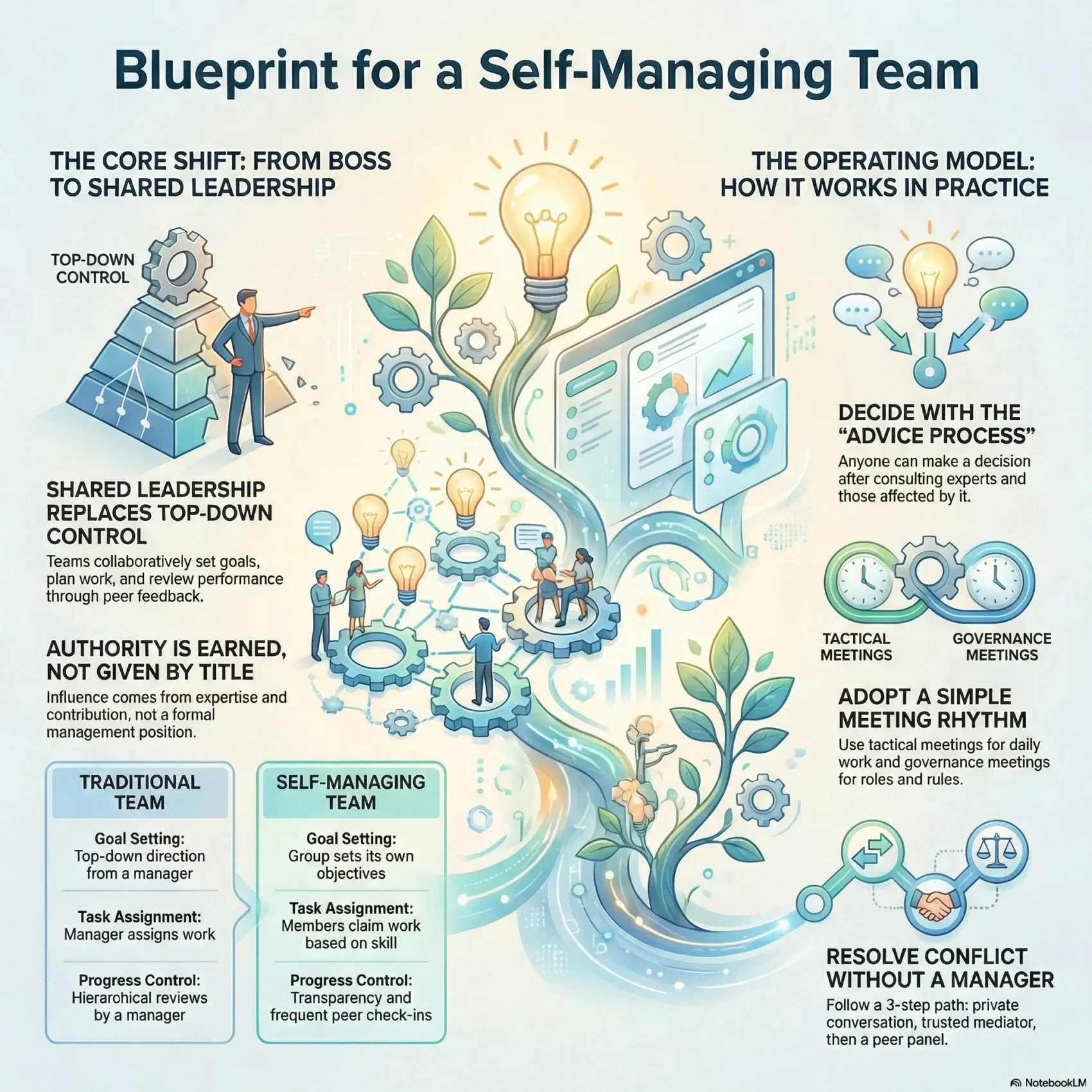
Last Updated on March 16, 2026
You’ll learn a clear, practical way to move from top-down control to shared leadership without losing focus. This introduction shows how a self-organizing team spreads leadership, rotates roles, and holds one another accountable for results.
Clear goals, open communication, and trust are the backbone of this approach. Companies like Morning Star and Buurtzorg prove that this structure helps a team move faster, adapt quicker, and improve outcomes without adding management layers.
The model relies on transparent information, agreed processes, and peer reviews for performance. Your employees get more ownership of goals and decisions, and your company keeps customer value front and center.
Later sections will map the operating model, meeting rhythms, and simple guardrails that prevent chaos and boost clarity. If you want a practical blueprint to pilot this way of work, you’re in the right place.
Key Takeaways
- Shared leadership replaces top-down control while keeping goals clear.
- Real-world examples show faster adaptation and better outcomes.
- Transparency, agreed processes, and accountability are essential.
- Employees gain motivation through ownership of work and goals.
- The operating model and meeting rhythms make manager-free work practical.
What You’ll Learn in This Ultimate Guide to Self-Managing Teams
You’ll get a road map to build groups that share leadership, decide quickly, and keep goals front and center. This section shows who benefits most and how to use the tools at work.
Who this guide is for and how you’ll use it at work
This guide targets founders, operational leaders, HR partners, and product leads who want a team able to make decisions and move work forward without constant direction.
Use it to frame objectives, set clearly defined roles, and establish meeting rhythms so members know how to collaborate and make decisions day to day.
Your outcomes: higher autonomy, clearer roles, stronger performance
You’ll learn practical steps to set shared goals, align objectives, and measure outcomes that matter to customers rather than just task completion.
“Peer accountability and rotating responsibilities help the group match work to skills and sustain performance.”
- Assess current skills, map responsibilities, and fill gaps so the right people step up.
- Adopt a decision method you can run tomorrow to help members make decisions confidently with peer input.
- Use templates for rotating roles and reviewing outcomes to keep change clear and actionable.
For help turning delegation theory into practice, see this brief on delegating work that aligns with these methods.
Self-Managing Teams, Defined: How They Work Today
Modern groups trade a single boss for shared decision rights and clear routines. That change keeps work close to people who do it. It also preserves control through simple rules, not layers of approval.
From “no bosses” to clearly defined processes and peer accountability
What this looks like: members rotate roles, plan work together, and run performance reviews by peer feedback. Authority is earned through contribution and expertise, not title.
Peer accountability means people give direct feedback and hold commitments. This replaces manager oversight with active group care.
Key differences vs. a traditional team structure
- Goal setting: the group sets its own objectives instead of waiting for top-down direction.
- Task assignment: members claim work based on skill and interest rather than manager assignment.
- Progress control: transparency and frequent check-ins replace hierarchical reviews.
Levels of autonomy
- Fully autonomous — cross-trained, long-term, no direct supervision.
- Limited supervision — manager provides guidance when needed.
- Temporary/problem-solving — short-lived groups formed for specific issues.
“Projects like Linux contributions or Valve’s model show how distributed authority can scale while keeping quality and speed.”
Core Characteristics That Make Teams Truly Self-Managing
When authority shifts to the people doing the work, choices are faster and more informed. In practice, earned authority means the person with the best expertise leads a decision at the moment it matters.
Autonomy, earned authority, and clear responsibility
You’ll see how ownership replaces positional power: team members claim responsibility and are trusted to deliver.
That trust is earned through consistent contributions and visible results, not title alone.
Cross-functional skills, rotating roles, and tidy handoffs
Members bring varied skills and rotate roles so tasks match capability and interest. This keeps work flexible without losing clarity.
Collaborative decisions, peer control, and shared accountability
Simple decision norms balance speed with input. Peer control ensures quality and keeps everyone aligned on outcomes.
Transparent info, lightweight processes, and goal focus
Open data and clear processes make it easy to act with context. Goals link daily tasks to customer value and reduce friction in handoffs.
“Clarity around who does what speeds handoffs and builds trust across functions.”
- Earned authority guides quick, expert-led choices.
- Rotating roles preserve skills and adaptability.
- Transparency and clear processes keep focus on goals.
Operating Model: How Self-Managing Teams Make Decisions, Plan, and Review Performance
Designing how you plan, decide, and review makes distributed work reliable instead of chaotic. You’ll get a compact operating model that explains who can act, how to consult others, and how to track outcomes.
The advice process lets any person make decisions after seeking input from experts and those affected. Seek expertise, consult impacted members, then proceed—no hierarchy or full consensus required.
The meeting rhythm
Split meetings into two types. Tactical meetings focus on priorities, timelines, and blockers. Governance meetings handle norms, roles, and structural changes.
Rotate the facilitator so everyone learns to guide discussions, surface tensions, and record clear owners for follow-up.
Budgeting and resource guardrails
Keep budgeting and forecasting lightweight. Share clear financial guardrails across the company so plans stay lean and flexible.
- Make constraints visible so people allocate resources responsibly.
- Prefer short forecasts that you revise often versus long, rigid plans.
- When something needs more resources, propose it in governance and test the change.
Performance, feedback, and reviews
Replace manager-led evaluations with regular peer feedback, public metrics, and collective reviews. Use simple trackers to show commitments, dependencies, and results.
“Peer-based reviews and transparent progress make performance conversations concrete and timely.”
- Make progress visible with shared trackers.
- Hold short, frequent reviews tied to outcomes—not just tasks.
- Rotate responsibilities so assessment is based on contribution, not title.
Benefits You Can Expect: Productivity, Engagement, and Speed
When people own results, you’ll see faster choices and clearer links between daily work and customer outcomes. Ownership changes how people prioritize. It also shapes behavior toward improvement.
Ownership drives motivation, innovation, and customer focus. Autonomy raises motivation via Total Motivation (ToMo). Rotating responsibilities stretches skills and speeds learning. As a result, your team becomes more adaptable and creative.
Ownership drives motivation, innovation, and customer focus
You’ll notice employees act with more care when they control commitments. That boost improves performance and produces better outcomes for customers.
Faster conflict resolution and adaptability when priorities shift
Without managerial bottlenecks, decisions happen faster and time is used on value-generating work. Clear norms let teams surface issues early and resolve them constructively.
- Ownership raises motivation and customer focus.
- Role rotation accelerates skill growth and resilience.
- Proximity to customers lets you implement improvements faster.
- Reduce delays caused by managerial approvals.
- Keep innovation aligned with business strategy through simple guardrails.
- Improve engagement as employees feel heard and trusted.
“Continuous, small improvements add up to measurable gains in performance.”
Common Challenges and How You’ll Mitigate Them
To keep autonomy useful, you need a few precise rules and regular alignment. That balance prevents loose structure from turning into chaos.
Avoiding chaos with minimal guardrails
Set minimal viable policies that give just enough control to align work with strategy.
Make constraints visible so your team knows limits and can act fast within them.
Stopping role drift and toxic dynamics
Define clear objectives and boundaries for each role. Revisit them in governance meetings when priorities shift.
Use agreed behavior norms and rapid peer-based processes to surface and fix toxic patterns before they spread.
Equity, reviews, and trust
Make compensation, career paths, and feedback transparent. Publish simple review criteria so employees see how decisions are made.
Design light escalation paths for issues that need coordination beyond a single group. Invest in training and trust-building so people feel safe raising conflict and proposing improvements.
“Light, clear rules and regular alignment keep autonomy productive and fair.”
Conflict Resolution That Works Without Managers
A predictable path for disputes helps people focus on outcomes, not blame. Use clear steps so members know how to raise issues early and get help fast.
Train everyone in facilitation, mediation, and principled objections
Provide basic training in facilitation and mediation skills so each employee can guide tough chats. Teach how to separate positions from interests and how to use principled objections.
Principled objections prevent vetoes based on preference. An objection only blocks a decision when it violates mission or values.
Three-step path: private resolution, trusted mediator, relevant panel
Use a short, ordered process to resolve conflict:
- Private resolution — try a direct, respectful conversation first.
- Trusted mediator — bring in a neutral person both parties accept.
- Relevant panel — convene a small panel of affected members if needed.
Run meetings with a facilitator to keep discussions focused, ensure equal voice, and record agreed next steps. Document outcomes lightly so everyone knows who owns the follow-up and why the decision was made.
- Assume positive intent and test assumptions to reduce misunderstanding.
- Equip every employee with language and tools to surface tensions early.
- Review what worked and adapt the process to build trust over time.
“Lightweight, practiced processes turn conflict into a source of improvement rather than disruption.”
How to Get Started: A Practical Playbook to Build Your First Self-Managing Team
Begin with a compact pilot so a small group can prove the approach quickly. Pick clear goals and a simple cadence so wins are visible and repeatable.
Start small with advocates and clear goals
Choose a pilot with a few champions who can show progress in weeks. Keep objectives tight and measurable so the pilot proves value fast.
Pick the right people and define roles
Select team members with strong communication, time management, and self-motivation. Agree roles, responsibility areas, and who can make decisions upfront.
Provide training and feedback loops
Offer short training in the advice process, conflict resolution, and feedback delivery. Set lightweight reviews and visible trackers to capture progress and risks.
Supply resources and governance
Ensure the pilot has the tools and budget it needs. Schedule regular governance check-ins to tune roles and capture lessons for the next group.
When you get started, use early wins to expand. For practical templates and a short checklist for complex projects, see project checklists.
Real-World Examples and Structures You Can Borrow
You can borrow proven practices from open projects and forward-looking firms to shape how your group makes decisions and owns outcomes.
Open-source and product examples
The Linux community is a clear example of a global team responsible for a complex product. Volunteers and professionals coordinate online to track issues, assign tasks, and ship releases.
Valve offers another useful example: employees pick projects and self-organize around delivery. That model shows how autonomy pairs with high accountability.
Company-wide models to study
- Zappos: holacracy distributes decision rights across roles so a company keeps coherence without a traditional team hierarchy.
- W.L. Gore: a decentralized business model where small groups form around opportunities and commit to outcomes.
- Morning Star, Buurtzorg, FAVI: each offers patterns—peer commitments, nurse-led units, and rapid, employee-led decisions—that make authority practical at scale.
“Study what fits: copy decision rules, role clarity, or compensation norms—not whole systems wholesale.”
Map which elements you can adopt—decision-making flows, who is responsible for tasks, role definitions, and pay norms. Then pilot the changes with one team to see what works for your business.
Conclusion
Practical guardrails let groups make daily decisions while the business holds broader strategy and resources.
You’ll rely on transparent data, the advice process, and rotating facilitators so members can act fast and stay aligned. Use lightweight budgets and clear objectives to protect company strategy while giving employees room to move.
Invest in training for facilitation, feedback, and conflict resolution so team members have the skills to resolve tension and keep performance high. Run peer reviews and public trackers to measure progress by outcomes, not presence.
Start small, support the trust group with resources, and scale what works. Do this and management becomes a shared capability; employees grow, ownership deepens, and your company gains speed without losing control.