Tools
Tools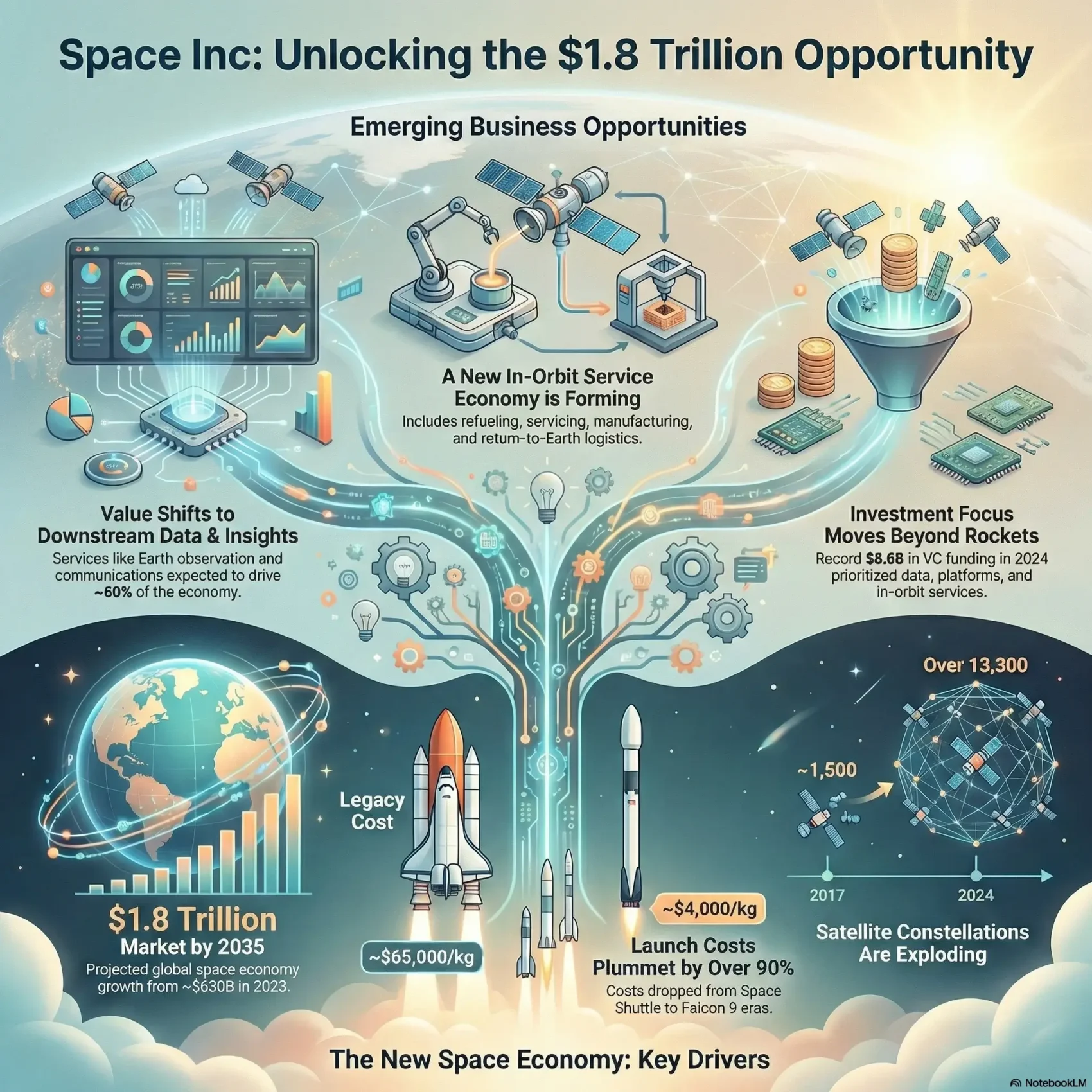
Last Updated on January 31, 2026
You’re at a real inflection point in the private space era. The global space economy has grown fast, driven by reusable rockets, miniaturized satellites, and record startup funding.
Today the market is shifting from pure exploration toward scalable business models. You’ll see how data, platforms, and services now lead value creation and how that opens practical opportunities for your company.
This report gives clear context: credible projections point to sustained growth, with downstream applications capturing most value. You’ll get concise insights on where to compete and how to monetize tech quickly.
We highlight real companies, funding milestones, and the trends that compress time from prototype to revenue. Use these notes to decide whether to build, partner, or invest—and to spot near-term paths to cash flow in the commercial space market.
Key Takeaways
- The private space industry is moving toward data and services as primary value drivers.
- Projected growth suggests the space economy may scale substantially over the next decade.
- Reusable launch and small sats shorten time to market and lower costs.
- Private capital now funds platforms and missions that enable enterprise use cases.
- Practical choices—build, partner, or invest—depend on risk appetite and desired speed to revenue.
Executive snapshot: where the commercial space economy stands now
A new phase in the space industry centers on persistent data flows and lower-cost access to orbit. You can see the shift in plain numbers: the space economy was about $600–$630 billion in 2023 and follows a path toward roughly $1.8 trillion by 2035 at about a 9% CAGR.
Why this matters: launch cost declines and scale in satellites are the engines. Shuttle-era costs near $65,000/kg have fallen to roughly $4,000/kg on Falcon 9. Starship aims below $100/kg long term, which changes mission economics.
Key metrics and drivers
- Satellite base: ~1,500 in 2017 → ~13,300 by late 2024, with 20,000–30,000 forecast by 2030.
- VC and investment: record $8.6B in 2024, shifting from launch to platforms, data, and in-orbit services.
- Downstream value: by 2035, communications, PNT, and Earth observation could drive ~60% of the economy.
Those trends mean you should watch where intelligence and analytics replace hardware margins. For companies and researchers, the window in the next few years is prime to test data products, partner on platforms, or enter services that scale.
SpaceTech commercialization: the shift from exploration to scalable infrastructure
The private space era now pivots from one-off missions to repeatable, product-driven infrastructure.
From launch-first to data, platforms, and services: reusable rockets and rideshare options dropped launch costs dramatically—from roughly $65,000/kg to about $4,000/kg on Falcon 9. That shift opened room for companies to focus on downstream value: cloud-native mission software, turnkey missions, and analytics platforms.
Cost curves and time-to-market advantages: miniaturized buses cut satellite build cost to near $100,000 for average LEO craft. Starship’s long-term target below $100/kg could halve costs again and speed development cycles.
- You can now monetize space through data products and managed services without building rockets.
- API-first platforms virtualize the satellite lifecycle and shorten procurement from months to repeatable workflows.
- Rideshares and in-orbit depots create logistics options that extend asset life and improve ROI.
Start by testing space-enabled products with small pilots, then scale to hosted missions as demand and unit economics prove out. For more on startup playbooks and trends, see startup trends.
Market map and company landscape across the commercial space stack
You can view today’s space ecosystem as a practical map of services, platforms, and mission enablers. Below we group players by function so you can spot where to partner, pilot, or buy services.
Logistics, servicing, and in-orbit manufacturing platforms
Key players: Catalyx runs autonomous space labs and re-entry capsules for small-batch manufacturing. Spaceium builds in-space refueling stations to extend mission life.
Ecosmic’s SAFE engine automates collision avoidance, lowering operational risk and false alerts.
Remote sensing, spatial intelligence, and satellite-data applications
Data-first solutions: Array Labs deploys a distributed radar cluster for 3D Earth imagery. Map My Crop blends satellites, drones, and IoT for actionable agronomy.
Open Cosmos packages end-to-end missions and delivers data platforms so you buy insights, not raw pixels.
Connectivity, ground infrastructure, and MicroGEO
Astranis focuses on MicroGEO broadband satellites for dedicated communications. Northwood and Skynopy scale phased-array ground networks to create real-time links.
Hubble experiments with direct-to-satellite connectivity from commodity Bluetooth chips for low-cost telemetry and IoT uplinks.
Mission software, propulsion, and modular systems
Antaris virtualizes design-to-ops workflows to compress development timelines. Pale Blue and Letara advance greener thrusters with water and hybrid propellants.
Reditus builds reusable return platforms, while Arkisys assembles “The Port” for on-orbit assembly and servicing—modular systems that tie the stack together.
- How to use this map: shortlist vendors by function, structure pilots under SLAs, and integrate APIs to scale without extra headcount.
- Where activity is strongest: agriculture, energy, finance, insurance, and defense are already buying integrated products from this stack.
Economics of access: how falling launch and satellite costs unlock growth
Falling launch prices and cheaper satellites are rewriting the math behind every mission. You can now treat space projects like product cycles instead of multiyear one-offs.
Falcon 9 cut LEO prices to roughly ~$4,000/kg from the Space Shuttle’s ~$65,000/kg. Starship aims below $100/kg long term. That shift moves budgets from prohibitive to practical and lets you run more frequent tests.
Rideshare lowers your per-kilogram cost and increases manifest cadence. Shared launches shorten schedules and give you more windows to iterate payloads and hardware.
Miniaturization, manufacturing, and cloud-native operations
Average LEO satellite manufacturing costs have fallen near ~$100,000 and may halve again by 2030. Smaller satellites let you prototype faster and refresh capabilities more often.
Cloud delivery, direct-to-cloud downlink, and on-orbit processing cut storage and distribution expenses. Your teams receive actionable data streams instead of raw files, improving time-to-insight and reducing egress cost.
- Practical playbook: start with rideshare or hosted payloads, validate revenue, then scale to dedicated capacity or partner-operated missions.
- Tech choices matter: pick buses, radios, and sensors that optimize total cost of ownership, including ground infrastructure and automation.
- Where to reinvest: higher cadence testing, improved analytics, or expanded services so falling costs drive durable market growth.
Investment flows and funding dynamics shaping your opportunity set
Capital flows into the private space sector have shifted from speculative bets to customer-backed rounds that reward revenue and contracts.
Private VC and PE funding surged, with startups raising a record $8.6B in 2024. After the 2021–22 reset, valuations normalized and diligence tightened.
From boom-bust to disciplined capital
What this means for you: investors now prioritize demonstrable revenue, letters of intent, and government awards over pure hype.
Dual-use momentum and government demand
Q1 2025 data shows infrastructure funding at about $1.7B, applications roughly $2.6B (largely defense-related), and distribution near $100M.
Programs like the NATO Innovation Fund (€1B) and eased FDI in India (up to 74% for satellite manufacturing) are driving durable demand.
IPO and M&A signals: maturation ahead
Exits reached ~$4.5B in Q1 2025, led by acquisitions. Voyager Space’s ~$382M IPO in June 2025 signaled renewed investor appetite for government-backed ventures.
- Where money is going: large infrastructure rounds, plus faster growth in defense-tied data and applications.
- New investor mix: specialist VCs, institutional funds, and corporate venture arms offering capital plus market access.
- Fundraising tips: package pilot revenues, LOIs, and milestone-based contracts to shorten due diligence.
Actionable checklist: prioritize customer contracts, pursue dual-use pilots, engage corporate partners for scaling, and use venture debt carefully to extend runway.
Segment deep-dive: data, EO, and PNT applications turning space into insights
Geospatial signals from orbit are shifting how industries make daily decisions. Operators now push analysis-ready products and direct-to-cloud pipelines so you get usable intelligence fast.
Geospatial AI, analysis-ready data, and on-orbit computing
Why it matters: platforms like Planet’s ARPS harmonize daily imagery for ML workflows, and on-orbit computing trims raw downlink to actionable alerts.
Result: you receive insights instead of bulky files, lowering latency and cost-to-insight.
High-impact use cases in agriculture, energy, finance, and insurance
Practical applications are real today. Map My Crop blends satellite, drone, and IoT feeds to surface crop-health and water-stress actions.
In energy, methane and grid monitoring find leaks and outages. Finance uses location signals for portfolio risk and credit scoring. Insurance consumes peril analytics for faster claims.
“Adoption remains early—Planet estimates EO impact captured is about 1% today.”
- Blend optical, SAR, hyperspectral, and thermal to improve detection and revisit.
- PNT upgrades (cm-level) unlock autonomy, precision ag, and resilient timing for communications and trading systems.
- Start with existing satellites and platforms like Open Cosmos, then scale to custom constellations if ROI proves out.
Bottom line: you can build differentiated services now by packaging data as APIs, dashboards, and alerts mapped to your KPIs. Early adopters gain durable advantages as these technologies and missions mature.
Segment deep-dive: orbital infrastructure, logistics, and return-to-Earth capability
Orbital logistics are forming the backbone that lets missions run longer and return valuable payloads to Earth.
Depots and ports: in-space refueling stations from Spaceium and Arkisys’ “The Port” enable on-orbit assembly and servicing. These nodes reduce replacement cycles and make larger missions practical by turning single-use satellites into long-lived systems.
Depots, ports, and reusable re-entry platforms
Return-to-Earth capability matters: Varda’s re-entry capsules and Reditus’ ENOS reusable platforms close the manufacturing loop by bringing materials and samples back for testing and commercialization.
Servicing, traffic management, and automated collision avoidance
Ecosmic’s SAFE software automates collision-avoidance to cut false alerts and protect uptime. Better traffic management lowers operational burden and helps you run higher-cadence missions with confidence.
Power, propulsion, and green thruster technologies
Pale Blue’s water-propellant thrusters and Letara’s hybrid systems offer safer, greener options for small satellites and stages. Star Catcher’s space-to-space power beaming shows how energy transfer may relieve tight power budgets.
- You’ll map infrastructure that extends mission life, refuels assets, assembles on orbit, and returns payloads to Earth.
- Combine refuel + service + return to raise utilization and unlock new revenue from manufacturing in microgravity.
- Expect commercial SLAs, integration support, and co-development deals to de-risk first deployments.
“Stitching refuel, servicing, and return creates a lifecycle that turns missions into repeatable services.”
Strategic considerations: risks, regulation, and how you build for resilience
You must plan for rules, risks, and redundancy before you scale a mission into persistent service.
Regulation and permit paths shape timelines: spectrum coordination, licensing, and export controls (ITAR/EAR) are tasks you must budget for up front.
Policy shifts open options and add complexity. India’s 74% FDI change and NATO’s €1B Innovation Fund show rising dual-use momentum and new partner routes.
SSA/STM, spectrum, and export controls you need to navigate
Space situational awareness (SSA) and traffic management (STM) compliance are controllable operational risks.
Tools like Ecosmic’s automated SSA reduce collision risk and cut ops burden, while diversified ground networks and redundant communications paths protect uptime.
- Procurement reality: firm-fixed-price contracts favor on-time delivery and tight cost control—your program management must be disciplined.
- Dual-use balance: screen partners for compliance, apply strict data governance, and document export control reviews for sensitive research and tech.
- Re-entry and downmass: align with insurers and authorities early if you plan returns; certification paths speed approvals.
Use market signals—Q1 2025 exits and investor activity—to time raises and M&A, keeping optionality while you scale.
“Embed resilience with SSA-native operations, redundant links, and documented compliance to keep service continuous when conditions shift.”
Resilience checklist: test failover, maintain backups, budget for licensing and legal reviews, and run certification-ready R&D cycles.
Conclusion
Now is the moment, as lower costs, more satellites, and cloud-native delivery turn orbital work into practical business. You can use platforms and services to capture value without owning every technical piece.
Actionable next steps: pick a pilot use case, shortlist platform partners, define clear success metrics, and secure executive and compliance buy-in early. EO and PNT applications, connectivity-backed services, and in-orbit manufacturing tied to return-to-Earth workflows offer near-term opportunities supported by disciplined capital and public exits like the Voyager Space IPO.
Use these insights to shape your roadmap. Build small, learn fast, and position your business to benefit from the next decade of growth in the space economy and the broader industry.