Tools
Tools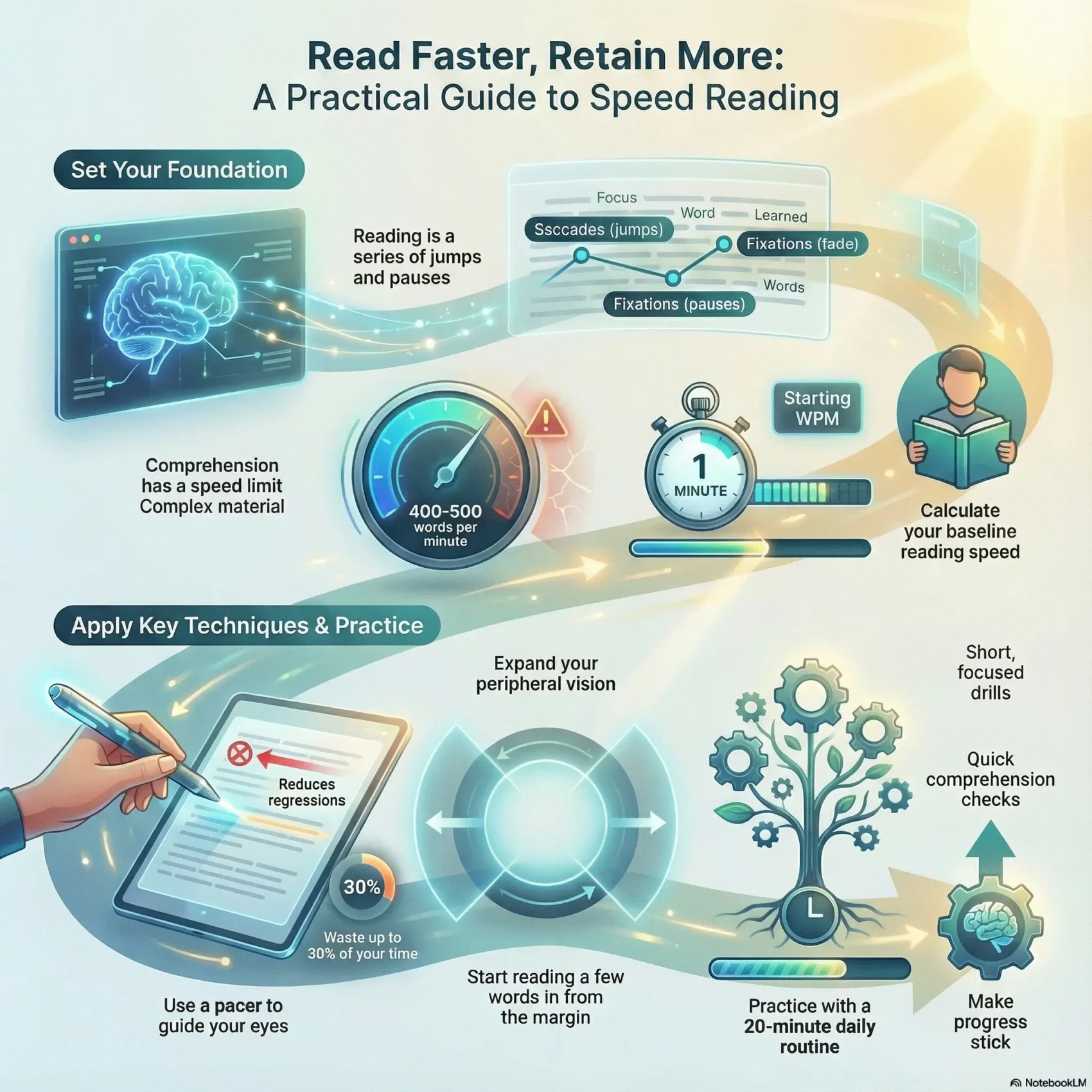
Last Updated on January 25, 2026
You’ll get a practical, step-by-step guide that helps you read faster while keeping what matters. This short introduction shows what works, what doesn’t, and where research sets limits.
Many methods—from chunking to limiting subvocalization—are taught in books, videos, and seminars. Be realistic: cognitive scientists warn that claims of 1,000+ words per minute are often exaggerated. Comprehension tends to fall off beyond about 400–500 wpm, especially with complex or new material.
In this article you’ll learn how your eyes and brain move across text and why small changes, like using a pen to pace lines, can reduce fixations and lower mental load. You’ll set a baseline in words per minute, practice proven drills, and adopt a short daily routine that fits your schedule. By the end, you’ll have a clear plan to read faster and keep comprehension high.
Key Takeaways
- You can boost rate without wrecking comprehension, but limits exist.
- Simple tools like meta-guiding improve focus and reduce regressions.
- Skimming is useful for locating facts; deep reading needs slower pace.
- Track baseline words per minute to measure real progress.
- Use short daily practice and quick comprehension checks.
How Speed Reading Works: Eyes, Brain, and the Reading Process
Your eyes don’t sweep smoothly across text; they jump and pause in tiny bursts that shape how you absorb information. These jumps are called saccades and the pauses are fixations. Typical fixations last about 0.25–0.5 seconds and set the pace for how many words your brain can process.
Saccades move your gaze along a line, and each fixation is where visual input is sent to the brain. Too many fixations slow you down; fewer, broader fixations improve flow. Research shows comprehension drops sharply past ~400–500 wpm, especially with complex text.
Saccades, fixations, and the eye’s jumps
Fixations let the brain decode words. If your eyes bounce back often, you lose time and clarity. Training to limit regressions helps your process.
Skimming vs. scanning
Skimming samples starts and ends of paragraphs to get the gist fast. It can exceed 700 wpm but cuts comprehension for dense material. Scanning targets specific facts after a quick skim.
Finger tracing and meta-guiding
Using a finger or pen to guide your gaze reduces cognitive load, steadies your place on a line, and cuts unnecessary fixations. This simple technique helps many readers on paper and on a screen.
- Understand fixations per line to improve your pace.
- Choose skimming for gist, scanning for facts.
- Use meta-guiding to steady eyes and reduce regressions.
Set Your Baseline Reading Speed in WPM
A reliable baseline begins with counting words on a page and timing one full minute at your usual pace. This gives you a solid starting number to measure progress.
Calculate words per line and words per page: Count words in five lines and divide by five to get average words per line. Count lines on five pages and divide by five to get average lines per page. Multiply those two averages to find words per page.
Time a one-minute read
Set a timer for one minute and read at your normal pace for comprehension. Multiply the lines you read by your average words per line to get your words-per-minute (wpm).
- Work with real numbers so your rate is accurate for any book or text.
- Log each trial with the minute, title, and conditions to spot patterns.
- Repeat with different material to compare reading speed across genres.
When you have a baseline, you can test techniques and track true improvement. For short practice methods, see short learning bursts.
Speed Reading Techniques you can practice today
Make a few small changes and you’ll see real gains. These drills focus on eye guidance, fewer regressions, and larger perceptual spans. They are simple, repeatable, and work with books or screens.
Use trackers and pacers
Hold a pen in your dominant hand and slide the cap under each line. Keep your fixation just above the tip so your eyes follow the guide. This method trains a steady line pace and cuts hesitation.
Eliminate regressions and back-skipping
Back-skips can steal up to 30% of your time. Let the pen set the rhythm and resist the urge to jump back. Over short drills you’ll reduce needless returns and protect comprehension when you switch back to normal reading.
Perceptual expansion and 3x practice pace
Start 1–3 words in and stop a few words before the margin. That avoids empty-space scanning and increases useful words per glance. For drills, aim for about three times your target wpm. Use a timer and pages-per-minute goals to push your process and help you read faster.
- Keep the pen flat and light so you don’t mark the page.
- Work one-second lines, then 0.5-second lines for brief sets.
- Move drills to a cursor or highlight bar for on-screen practice.
Train for Speed Without Losing Comprehension
Use staged reading steps to collect structure, target facts, and then secure what matters. This layered approach helps you keep comprehension steady while you raise your pace.
Layered reading: skim, scan, then reread strategically
First, skim to map headings, topic sentences, and the flow of the text. That gives you a quick sense of structure and main ideas.
Next, scan for specific names, dates, or facts you need. Finally, reread key paragraphs to lock in details and connect information.
Quick comprehension checks: main idea, key details, self-questions
After each chunk, ask: What is the main point? Name two key details. Pose two self-questions you should be able to answer from memory.
Answering those questions aloud or in one sentence strengthens recall and makes your study time efficient.
Know when to slow down: complex or unfamiliar material
Slow down on technical passages, dense arguments, or new language. Research shows comprehension drops when you push beyond comfortable words per minute.
Calibrate your pace by tracking comprehension alongside wpm so you keep gains that matter.
- Pair a light meta-guide on the line with short pauses to summarize.
- Use brief retrieval practice after sections to cement learning.
- Highlight only goal-related information to save time.
Your 20-Minute Practice Routine and Weekly Plan
Commit to one crisp 20-minute session that mixes pacing drills and a fast one-minute reassessment. This focused block trains eye movement, solidifies motor timing, and gives quick feedback on progress.
PX-style drills: one-second lines, half-second lines, then reassess
Warm up for 2 minutes at one second per line using a pen pacer to steady your gaze.
Move to 3 minutes at 0.5 seconds per line to condition faster saccades and cut regressions.
Add perceptual expansion sets: start 1–3 words in from each margin so you cover more useful words per glance.
Progression: sessions, targets, and tracking improvements in WPM
Practice at about three times your target rate for short bursts so your normal pace feels easier. Then read for exactly one minute at your best comprehension pace and compute wpm to reassess.
- Keep a simple log: date, reading time, page counts, wpm, and one-line notes on what felt smooth or sticky.
- Set weekly targets—shave seconds off a page or raise your wpm by small increments.
- Schedule 3–5 sessions per week so the pacing method becomes automatic without burnout.
- Adjust drills by text: light material for speed days, dense text for comprehension days.
- Check fixation drift during sets; a short pause and a quick summary helps memory and control.
Keep it simple. Short, consistent practice beats long, irregular sessions. Track small wins so students and professionals alike stay motivated while they increase speed and improve their page rate.
Tools, Apps, and What Research Says Right Now
On-screen tools aim to pace your gaze, yet they differ in how well they help you learn. Many apps use line highlighting or RSVP (Rapid Serial Visual Presentation) to move your eyes or flash single words at a fixed spot.
On-screen trainers highlight lines or words to enforce a steady per minute rate. RSVP tools can boost raw words per minute for simple material. But transfer to plain text pages often needs extra practice.
If you find visual-only RSVP tools too intense, consider a multimodal approach. In our Speechify Review, we explored how syncing text-to-speech with word-by-word highlighting acts as a ‘digital pacer.’ This combination not only guides your eyes to reduce regressions but also helps maintain a steady 400–500 WPM pace without the eye strain associated with rapid visual serial presentation.
Evidence and limits
Current research finds no magic shortcut that multiplies reading speed without trade-offs in comprehension. Reviews show comprehension tends to fall past about 400–500 wpm for many readers when material is complex.
- Compare line-highlighting overlays with RSVP flash tools to see what fits your goals.
- Measure wpm and comprehension on the same material before and after app use.
- Remember vocabulary, background knowledge, and language familiarity shape gains more than any single program.
Choose tools that match your aim: use browser extensions, timers, or highlight bars and combine them with paced practice to protect understanding of the information you care about.
Conclusion
End sessions by recording a simple metric: pages, wpm, and one quick recall question. This habit turns a number into useful feedback you can act on.
You’ve learned a practical method that uses a baseline, paced drills with a pen pacer, and perceptual expansion to increase speed without losing comprehension. Apply layered steps—skim, scan, then reread key parts—for tougher material.
Pick one book this week and run the 20-minute routine three times. Log reading time, words per minute, and two short questions after each set to check retention. Over several weeks you’ll notice real gains in rate and study efficiency.
Keep expectations realistic: steady practice beats flashy promises. Use this process across articles and books, and let the brain adapt at a healthy pace.