Tools
Tools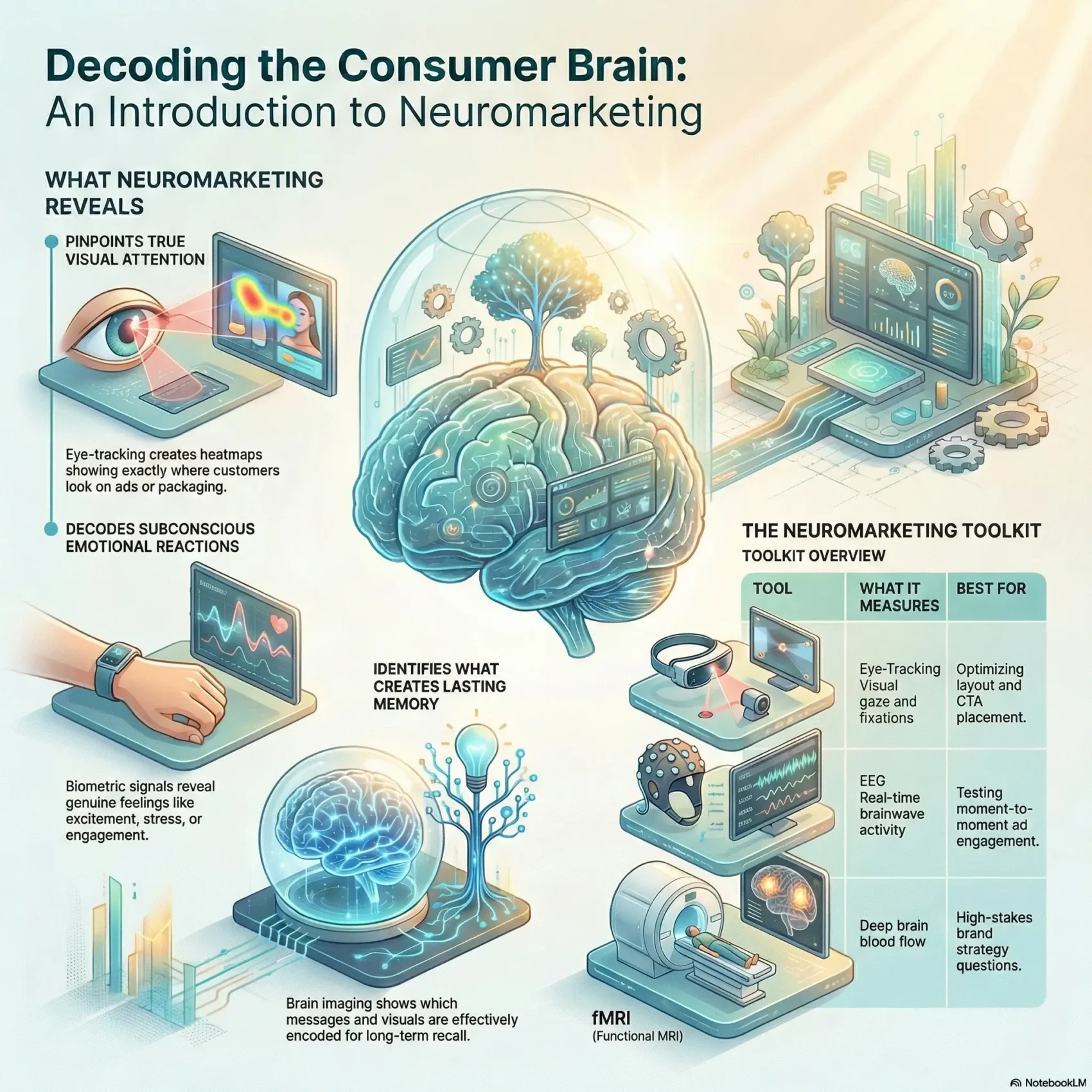
Last Updated on March 17, 2026
Neuromarketing applies neuroscience to marketing so you can read brain and body signals that reveal real choices. You’ll learn how tools like fMRI, EEG, and eye-tracking turn physiological responses into actionable insights for ads, product design, and user experience.
Big brands such as Coca-Cola, TikTok, and McDonald’s use these methods to test preference, sharpen creative, and boost in-store and digital results. This field grew as fMRI and EEG matured in the early 2000s, with landmark studies that changed how teams think about subconscious decision-making.
In this guide, you’ll get clear definitions and practical steps. You’ll see where brain-based research fits the funnel, what each tool answers, and when AI platforms can scale lab-grade work. Expect a balanced view of benefits, costs, and ethics so your team adopts these methods responsibly.
Key Takeaways
- You’ll get a simple definition of neuromarketing and how it maps signals to action.
- Brain measures reveal hidden drivers of consumer behavior beyond surveys.
- Tools like eye-tracking, EEG, and fMRI answer different research questions.
- Brands use these insights to improve advertising, packaging, and UX.
- AI platforms can scale studies, but you should weigh cost, speed, and ethics.
- Use a stepwise roadmap to test, learn, and scale brain-science decisions.
What Is Neuromarketing? Definition, Origins, and Why It Matters
This section explains how brain science became a practical tool for marketers and what it reveals about choice.
Definition: Neuromarketing applies neuroscience and physiological measures to marketing so you can decode why people choose one product over another. It links attention, emotion, and memory to real-world behavior and campaign outcomes.
Origins and early milestones: The term appeared around 2002 as firms like Brighthouse and SalesBrain commercialized cognitive methods. Read Montague’s 2003 Pepsi paradox fMRI work (published 2004) showed brand context changed prefrontal activation. Martin Lindstrom’s 2008 book Buyology reported surprising neural reactions to warnings, icons, and design cues.
The 2007 CMU/Stanford/MIT fMRI study tracked valuation and the pain-of-paying circuits and could predict purchases. These studies show why measuring the brain often forecasts behavior better than stated opinions.
“Measuring physiological signals gives you a more honest read on preference than surveys alone.”
- Practical definition and why it complements classic research
- Key historical studies that shifted how brands test creative
- What to trust: mature tools versus hype
Neuromarketing vs Consumer Neuroscience
Understanding how academic labs and commercial teams approach the same brain tools helps you pick the right path for your project.
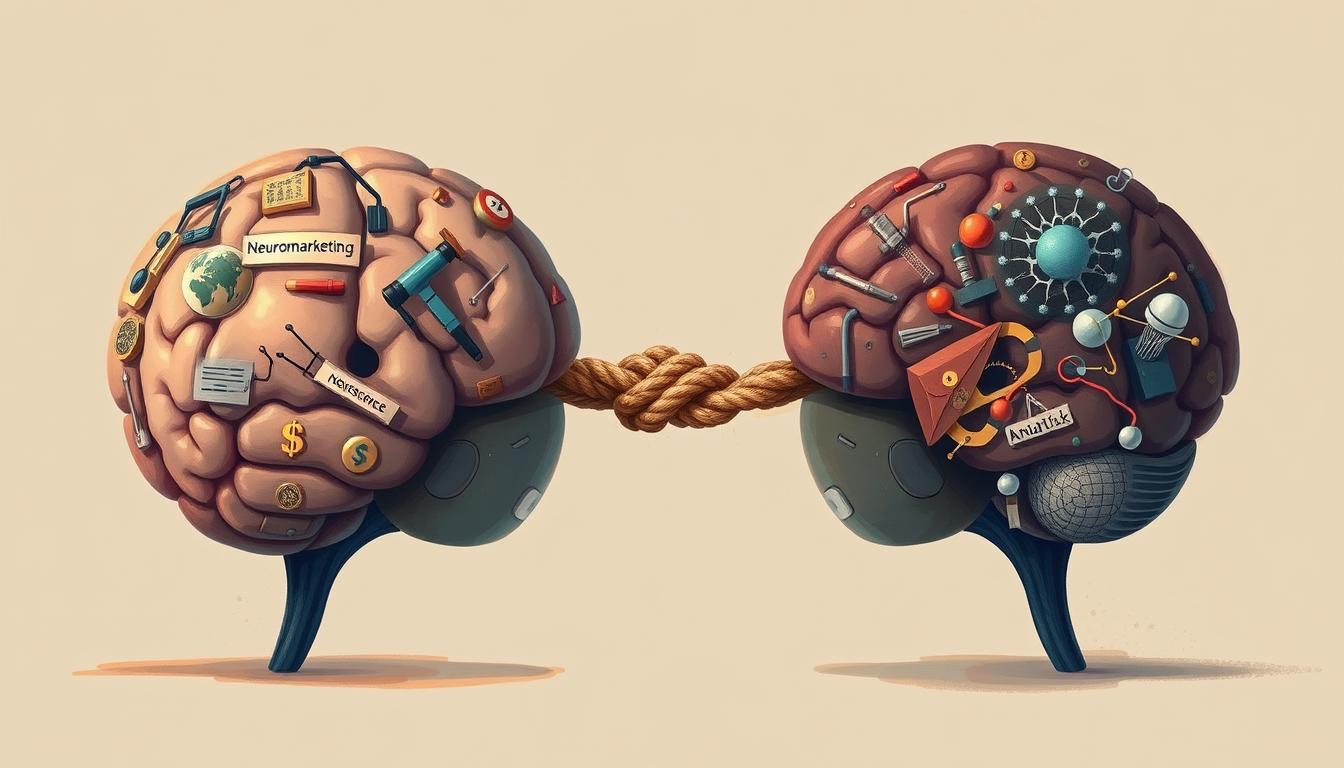
Consumer neuroscience is an academic pursuit. Labs publish peer-reviewed studies that explain neural mechanisms behind decisions using fMRI, EEG, and eye-tracking. These studies build theory and test why people behave a certain way.
Commercial neuromarketing applies those findings to real campaigns. Teams measure attention, emotion, and memory to improve ads, packaging, and UX. The goal is faster, actionable results you can test in market.
What to expect from each
- Rigor vs speed: Academic research aims for peer review; commercial work prioritizes speed-to-insight.
- Output: Papers and models versus dashboards, creative recommendations, and conversion lifts.
- Shared toolkit: fMRI, EEG, eye-tracking, and biometrics, but different protocols and sample rules.
You should use literature for theory (motivation systems, memory) and commission neuromarketing research for specific assets. Validate quality controls, sample definitions, and signal processing so your data and insights stay trustworthy.
“Both streams inform smarter marketing research and decisions at different stages of your pipeline.”
Neuromarketing vs Traditional Marketing
Traditional surveys tell you what customers say; brain and body measures tell you what they actually feel and do. That contrast matters when you need reliable, moment-by-moment information about ads, packaging, or UX.
From self-report to physiological signals
Surveys and focus groups are great for concept screening and rich context. They reveal motives and language that help shape strategy.
But measures of brain activity and biometrics capture subconscious reactions. Eye-tracking shows fixation patterns. EEG tracks engagement, valence, and cognitive load.
GSR, pupil size, heart rate, and respiration add arousal and stress signals. These signals often predict ad effectiveness better than stated preference.
How to blend methods for higher value
- Start wide with traditional market research to prioritize ideas.
- Refine and test with biometric tools to find moment-by-moment problems.
- Translate attention maps and workload peaks into concrete fixes for your customer flows.
“Combine classic and brain-based tests so your team reduces guesswork and gains data tied to real uplift.”
When you use both, you get richer marketing evidence, clearer prioritization, and more actionable data for improving customer outcomes.
What Neuromarketing Reveals About Consumer Behavior
You can unpack exactly what drives buyers by watching where attention lands and which cues trigger action. Measured signals show which parts of your creative win a glance, cause confusion, or stick in memory.
Attention: where eyes land and what truly stands out
Eye-tracking pinpoints gaze, fixations, and heatmaps so you place logos, offers, and CTAs where people actually look. Use gaze data to reduce clutter and boost the elements that draw focus.
Cognition and comprehension: are your messages clear and easy to process?
EEG and load metrics reveal cognitive friction and reading effort. Simplify copy and hierarchy when signals show high workload and drops in engagement.
Emotions and feelings: decoding subconscious reactions to stimuli
Biometrics and facial coding capture emotional responses and arousal patterns. Positive valence and steady engagement usually predict better ad performance and more favorable responses.
Memory: what sticks and drives brand recall over time
Recall tasks and neuroimaging show what gets encoded. Strong narratives, distinctive assets, and clear messages improve long-term recall and drive repeat behavior.
- Use data to compare creative versions and choose visuals or words that improve attention and comprehension.
- Map response traces to find narrative peaks and lulls so you can tune pacing and stimuli order.
- Translate brain activity and peripheral responses into edits—contrast, hierarchy, and white space—that make your messages easier to process.

Neuromarketing Techniques and Methods: Your Toolkit
Different techniques answer different questions. Start by naming the outcome you need—attention, comprehension, emotion, or memory—and then pick the method that measures that signal.
Eye-tracking
Eye-tracking uses infrared cameras to capture fixations, saccades, AOIs, and heatmaps. You get clear maps of where people look and for how long.
EEG
EEG sensors on the scalp record engagement, valence, and cognitive workload at millisecond resolution. It tracks fast changes in brain activity but has lower spatial precision than imaging.
fMRI and MEG
fMRI images deep structures via the BOLD signal, giving strong spatial detail at slower timescales. MEG maps magnetic fields with millisecond timing and better spatial precision than EEG, but both methods are costly.
Facial coding and implicit measures
Facial coding infers microexpressions and can illustrate emotional responses, though its scientific validity is debated. Implicit measures and physiological proxies (GSR, pupil dilation, heart rate, respiration) reveal automatic bias and arousal that surveys miss.
Cost, access, and AI tools
Weigh trade-offs: speed vs spatial detail, sample size, and budget. Use EEG for rapid iteration and fMRI for high-stakes deep dives. AI platforms can predict attention and recall at scale, letting you test more creative ideas for less money.
- What you get: heatmaps, engagement indices, BOLD contrasts, and behavioral predictors.
- How to choose: match the tool to your metric and timeline.
- Practical tip: pair facial coding with stronger signals to validate emotional claims.
Eye-Tracking and Visual Attention in Advertising
Small layout changes can steer gaze toward your logo, offer, or CTA in under two seconds. Eye-tracking reveals where viewers look first and how long they fixate. That data tells you if your brand and call-to-action are seen when it matters most.
Design creatives to guide visual pathways. Use contrast, faces, motion, and gaze cues to route attention to brand marks and offers without creating clutter.
Designing creatives that guide gaze to your brand, offer, and call to action
Set clear areas of interest (AOIs) for logo, offer, and CTA. Map fixation sequences to confirm hierarchy matches your business goals.
Quick tips:
- Place the brand mark where first fixations land; ensure CTAs are high-contrast and above the fold.
- Use faces and directional cues to pull eyes toward offers rather than away from them.
- Test contrast and motion sparingly so stimuli guide attention without distraction.
Real-world examples: packaging, websites, and in-store optimization
Brands use AOI heatmaps to tune shelf layouts and package claims. McDonald’s applies eye-tracking to improve menu boards and signage under real-world stimuli.
Online, follow natural scan paths like F-patterns and add sticky CTAs to lift conversions. Then run another test to confirm better attention allocation and fewer missed elements.
For more on scaling research with AI, see AI marketing tools.
EEG, fMRI, and MEG: Measuring Brain Activity
Not all brain methods do the same work—some catch split-second changes, others map deep structures. Pick the modality that fits your question, timeline, and budget so results drive clear decisions.
EEG: strengths, limitations, and when it outperforms surveys
EEG records electrical activity across the scalp at millisecond resolution. That timing makes it ideal for fast, iterative creative tests where moment-to-moment engagement and cognitive load matter more than exact location.
EEG has limited spatial precision, so it won’t pinpoint deep structures. Still, it often beats surveys when you need to detect attention lapses, effort spikes, or immediate valence shifts during an ad.
fMRI: mapping emotions and motivation in subcortical regions
Functional magnetic resonance measures the BOLD signal to localize activity in deep brain areas tied to valuation and affect. Use fMRI for high-stakes work where knowing which subcortical circuits respond guides big branding or storytelling choices.
Expect higher cost, longer setup, and slower timing than EEG. The trade-off is detailed spatial maps that link neural signals to long-term preference signals.
MEG: combining spatial and temporal insights for complex tasks
MEG detects magnetic fields generated by neuronal activity and offers excellent temporal detail with better spatial resolution than EEG. It still struggles with subcortical coverage and is costly.
Teams often pair MEG with fMRI to get both timing and localization. That combo answers complex sequence-of-processing questions you can’t solve with a single tool.
- When to pick EEG: rapid tests of engagement, fatigue, and creative pacing.
- When to pick fMRI: mapping valuation, motivation, and brand-related deep signals.
- When to pick MEG: timing-sensitive tasks where you also need improved localization.
Physiological and Implicit Measures: Arousal, Bias, and Response
Measuring skin, eyes, heart, and breath lets you map emotional arcs across an ad or UX flow. These peripheral signals show how responses change moment by moment when people see your stimuli.
Galvanic skin response (GSR)
GSR/EDA reflects the intensity of arousal to ads and experiences. Higher peaks mean stronger emotional impact and clearer moments of engagement.
This method helps you read arousal curves and spot exact moments that land—or fall flat.
Pupil dilation
Pupil size signals interest, attention, and cognitive effort. It acts as a covert tool that validates which visuals or words sustain focus without asking viewers to explain.
Heart rate and variability
Heart rate and HRV reveal stress, excitement, and narrative peaks. Watch changes in cardiac activity to map emotional cadence and align your storytelling with brand cues.
Respiration
Breathing rate signals tension or relaxation. Faster respiration often matches anticipation or stress; slower breaths link to comfort and trust when your stimuli soothe viewers.
- You’ll combine signals to triangulate a robust response profile and reduce false positives.
- You’ll turn this data into edits—tightening slow segments and strengthening hooks.
- Add implicit tests to uncover automatic preferences and biases that shape choices under real-world stimuli.
Applications Across Advertising, Branding, UX, and Product Design
Apply brain-backed testing across channels to turn creative guesses into measurable sales gains.
Digital marketing: social video, influencer content, email, and A/B testing
Run short tests on social video hooks and influencer cadence to see what holds attention. Use A/B tests and AI tools like Neurons to scale insight without full lab costs.
Result: better opens, clicks, and faster path to sales.
Branding and storytelling: logos, taglines, and narrative arcs
Test logos, color systems, and taglines to find versions that stick in memory. Coca‑Cola and TikTok use brain and gaze data to refine visuals and messaging before large campaigns.
User experience and web design: layouts, colors, and interaction patterns
Use eye-tracking and load metrics to simplify navigation and reduce drop-off. Small layout changes often lift conversion rates and improve how customers move through a page.
Product and packaging: form, function, and sensory cues that sell
Measure how shoppers notice and prefer a product on shelf or online. McDonald’s and other brands apply gaze and biometric tests to tune menus, packaging, and in-store cues.
- Improve digital marketing by testing hooks in social video, influencer spots, and emails to boost conversions.
- Refine brand identity so logos and taglines are emotionally resonant for your customers.
- Apply UX insights to layouts, contrast, and timing so flows feel effortless.
- Shape product and packaging so shoppers find and choose your product faster.
“Prototype, measure, iterate: a repeatable process that compounds wins and accelerates sales impact.”
Benefits, Criticisms, and Ethics You Should Weigh
Look past the hype: understand what these methods truly add and where they risk overreach.
The upside: you get granular insight and honest feedback that reduces self-report bias. Moment-by-moment measures often predict behavior better than recall alone. That added value helps you make clearer creative and media decisions.
The critiques to consider
Some fear manipulation or label the work pseudoscience. Critics also argue it offers no new information beyond intuition.
- You’ll respond by showing incremental gains in prediction and conversion.
- Separate robust methods from hype with open protocols and peer review.
- Acknowledge fear and set limits on use so stakeholders stay confident.
Ethics and privacy
Adopt explicit consent, anonymization, and data minimization. Document how findings shaped your decisions and avoid overstating certainty.
“The goal is to understand customer relationships, not to manipulate beyond practical possibility.”
The Future of Neuromarketing
The next wave mixes VR headsets, embedded eye trackers, and scalp EEG to create realistic tests you can run at scale.
VR, eye tracking, and EEG integrations: immersive research at scale
Emerging setups let you measure gaze, engagement, and neural signals while people interact with lifelike stores or apps. This reduces lab overhead and shortens testing time.
AI-driven insights: faster, cheaper, and more accessible for marketers
AI models turn historical signals into rapid insights. What once took weeks now often completes in hours, so your team iterates faster and tests more ideas.
What this means for your team, your customers, and your ROI in the present
Your team can adopt modest tools first and scale as benchmarks stabilize. People behave differently in immersive settings, so calibrate comparisons over time.
- Prioritize pilot projects that prove ROI within a quarter.
- Choose a mix of low-cost tools and one higher-fidelity test to validate results.
- Use AI to compress analysis and deliver actionable insights quickly.
“Start small, build skills, and measure impact each cycle to turn future capability into present-day wins.”
Conclusion
Start with small pilots that turn brain measures into business signals. Use eye-tracking, EEG, fMRI, MEG, and biometrics to decode attention, emotion, and memory so you get decision-ready research fast.
You’ll see practical wins from brands like Coca‑Cola, TikTok, and McDonald’s and learn how AI platforms make insights more accessible and cost-effective.
Commit to ethics: require consent, anonymize results, and document how data shaped choices.
You’ll leave with a clear view of how neuromarketing deepens your understanding of consumer behavior, which methods to use, and a test-and-learn plan that fits your resources.
Next step: pick one high-impact experiment, track results, and use those insights to scale better marketing and stronger customer experiences.