Does music help you get more done at work, or does it just make a dull hour feel shorter? Both answers show up in the research, and which one applies to you depends less on genre than most advice suggests. It depends on what you are doing, who you are, and whether you picked the track yourself.
This guide sorts the evidence on music and productivity from the myths. It covers what background music reliably does to mood, where it quietly costs you accuracy, and how to choose music for concentration, or steady non-musical sound, that fits the task in front of you rather than a generic “focus” playlist.
Key Takeaways
- Averaged across studies, background music has close to no overall effect on performance. The interesting effects are specific, not general.
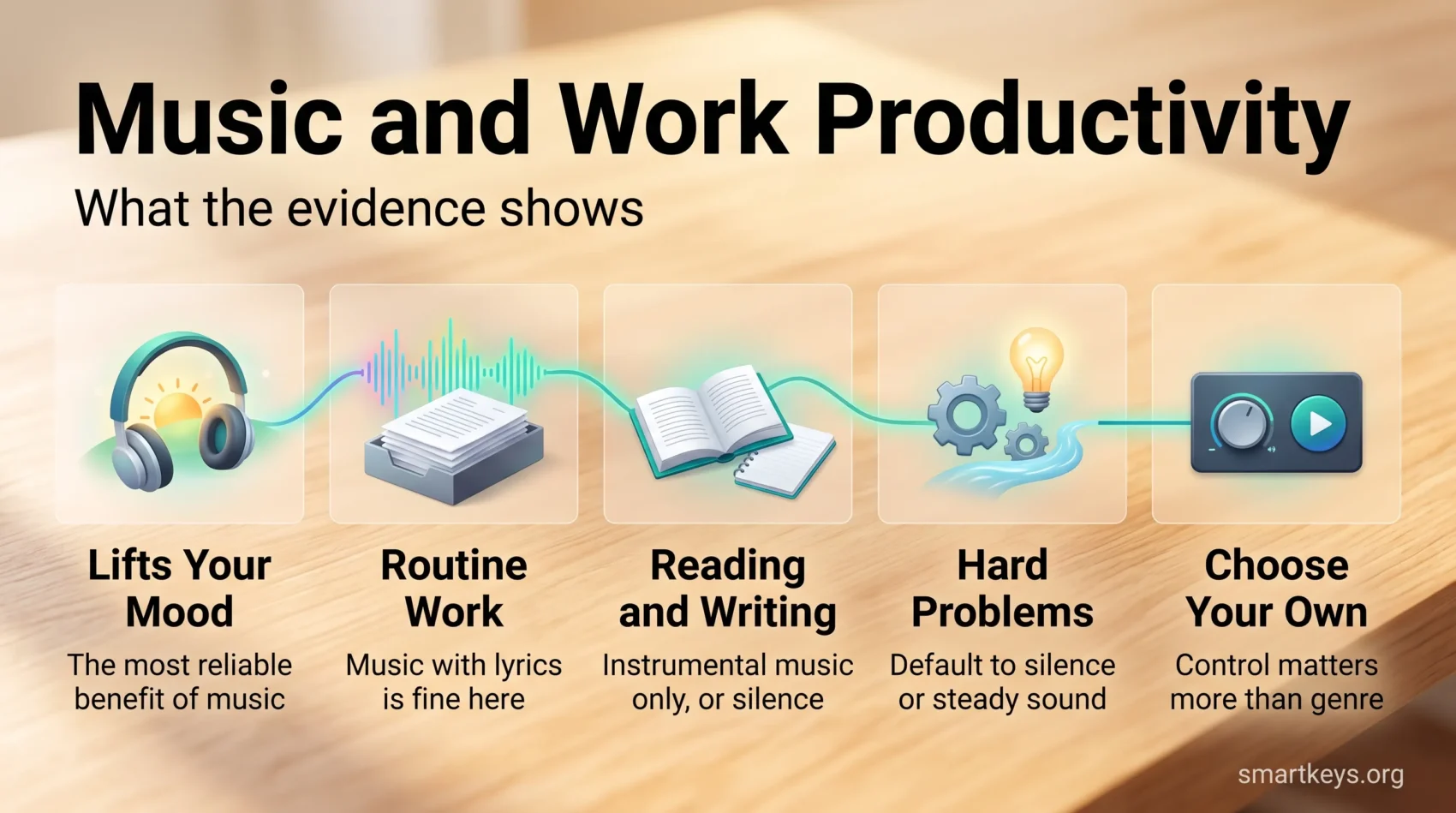
- Music reliably lifts mood. That alone can make a long or repetitive shift easier to sustain.
- Reading and memorising are the tasks music most often disrupts, especially music with lyrics.
- The harder the task, the more likely music is to cost you accuracy.
- Choosing your own music matters more than the genre. Music imposed on you, and badly matched to you, drains focus.
- The “Mozart effect” does not hold up. Classical music is not a shortcut to a higher IQ.
- Steady sound without melody, such as café hum or flowing water, is a useful alternative when music gets in the way.
What the Research Actually Says
Start with the broadest picture. In 2011, Juliane Kämpfe, Peter Sedlmeier and Frank Renkewitz pooled decades of experiments in a meta-analysis in Psychology of Music. A meta-analysis combines many separate studies to see what survives when individual quirks cancel out.
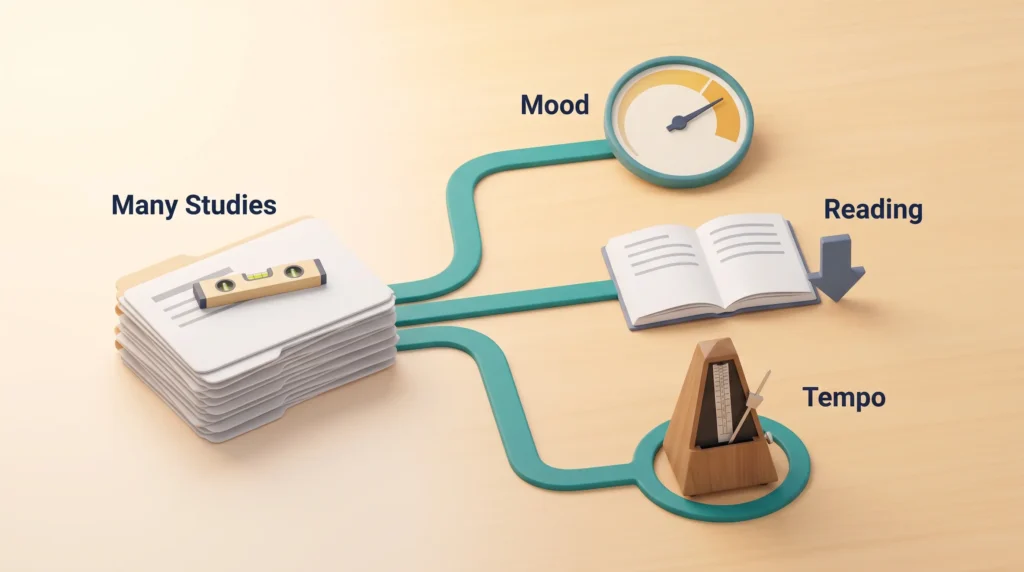
Their headline result was a null effect. Averaged across all tasks and listeners, background music neither helped nor hurt. That sounds disappointing, but it is the most useful finding in the field. It tells you to stop asking whether music “works” and start asking when, for whom and on what.
Underneath that flat average, the same analysis found three consistent patterns.
Music Lifts Mood
Background music had a positive effect on emotional reactions. This is the most dependable benefit in the literature, and it is not a small one. Work that feels less tedious is work you are more willing to keep doing.
Teresa Lesiuk documented this in a real workplace. In a 2005 study in Psychology of Music, she followed 56 software developers at four Canadian companies over five weeks. Quality of work and positive mood were both lowest in the week when music was removed. Time spent on each task was longest that same week.
Reading and Memorising Suffer
The same meta-analysis found that background music disturbs reading and produces small detrimental effects on memory. If your afternoon is a contract review or anything you will need to recall later, music is working against you.
The mechanism is competition for the same mental channel. Lyrics are language, and so is the report you are reading. Instrumental tracks avoid the worst of that clash, which is why the practical rule is simple: no words during word-heavy work.
Tempo Sets Your Pace
One finding is more practical than it looks. The tempo of the music influences the tempo of the activity performed alongside it. Fast music tends to speed up the rhythm of what you are doing.
That helps when sorting an inbox or clearing a queue of small tickets. It is a liability when the work rewards care rather than speed. Matching tempo to the pace the task needs beats hunting for a magic beats-per-minute number.
Task Complexity Decides More Than Genre
The clearest predictor of whether music helps is how demanding the task is.
Cristina Gonzalez and John Aiello tested this directly in a 2019 study in the Journal of Experimental Psychology: Applied. On a demanding word-pair task, music impaired performance compared with silence. On a simple visual search task, complex music helped some people. The direction of the effect flipped with task difficulty.
In practice this gives you a simple sorting rule. Music is a reasonable companion for routine work: data entry, expense reports, file cleanup, invoicing, formatting a deck. It is a poor companion for work that fills your working memory: writing, coding a tricky function, modelling a budget, learning something new. For that second category, silence or steady non-musical sound is usually the better call, and the structure of a Pomodoro session or a protected block of deep work does more for you than any playlist.
Who You Are Changes the Answer
The same study found that individual differences pull in different directions. People who crave external stimulation did worse on the complex task with music playing. Without music, that same trait predicted better performance. Adding music removed the advantage.
So the familiar shorthand about extroverts thriving on background noise and introverts hating it is too crude to act on. People differ, the differences are large, and the only reliable way to find your own pattern is to test it.
Control Matters More Than Genre
If you take one practical point from the recent research, take this one: who chooses the music matters more than what the music is.

A 2025 study in the Journal of Applied Psychology, led by Kathleen Keeler of Ohio State University and Harshad Puranik of the University of Illinois Chicago, examined what the authors call music misfit. That is the gap between the music playing and what a worker actually needs at that moment in volume, speed, complexity and emotional intensity.
The team ran two studies: an online experiment with 166 full-time workers on a creativity task, and a three-week daily diary study with 68 employees in healthcare offices, retail stores and dining halls. On days when the music did not fit, workers reported worse moods and more cognitive depletion, the feeling of mental exhaustion that makes concentration hard. They also worked more slowly, spoke more negatively about work and helped colleagues less.
The effect was strongest for people the researchers call non-screeners: those who cannot easily filter out background sensory input. If you have ever been unable to think through a shop playlist nobody else seems to notice, that is you.
The management takeaway is cheap to act on. Let people choose their own audio, or let them opt out. A fixed office playlist bets that one setting suits everyone, and this study is good evidence that it does not.
The Mozart Effect Was Never Real
The most persistent myth in this area is the idea that listening to Mozart makes you smarter. It came from a small 1993 experiment that reported a brief improvement on a spatial reasoning task.
Jakob Pietschnig, Martin Voracek and Anton Formann settled it in 2010 in the journal Intelligence. They pooled roughly 40 studies covering more than 3,000 participants, including unpublished theses that would otherwise skew the picture. They found no support for gains in spatial ability caused specifically by listening to Mozart.
That does not make classical music a bad choice. It means the benefit, where there is one, comes from mood and enjoyment rather than a special property of the composer. Music you like beats music someone called scientifically optimal.
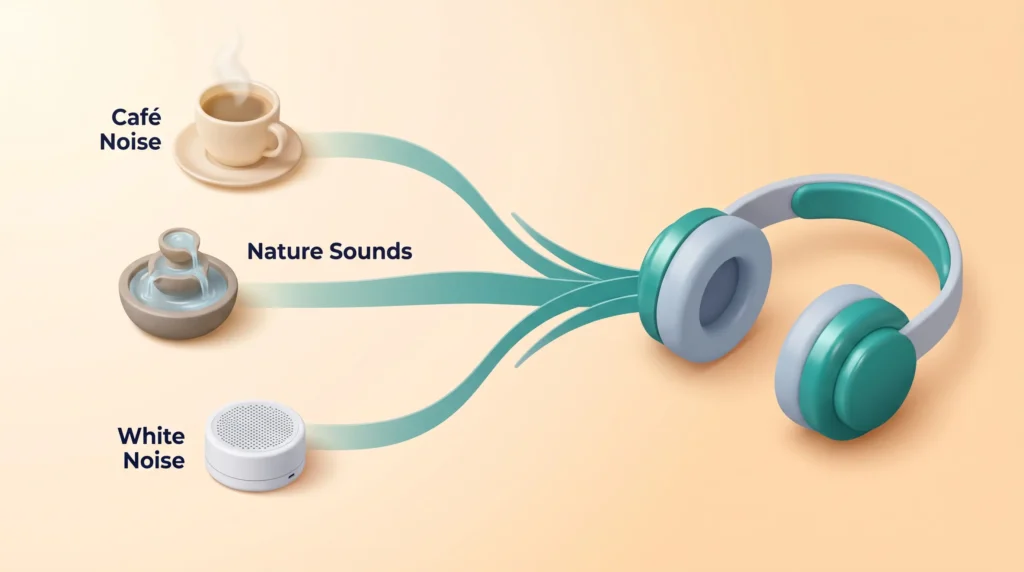
Alternatives to Music: Café Noise, Nature Sounds and White Noise
If music competes with demanding work, the next question is whether sound without melody or lyrics does better. The research here is smaller and less settled than the music literature. Still, it points in a useful direction: steady, predictable sound tends to pull less attention than music, and it can cover the sudden noises that really break concentration.
The Coffee Shop Effect
Many people say they think better in a busy café. A 2012 set of experiments by Ravi Mehta and colleagues in the Journal of Consumer Research offers a partial explanation. Moderate ambient noise of around 70 decibels, similar to a lively café, improved performance on creative tasks compared with quieter conditions. At 85 decibels, roughly the level of heavy traffic, creativity dropped again.
The researchers explain the effect as mild distraction that nudges people toward broader, more abstract thinking. That helps when you are brainstorming campaign ideas or naming a product. It is not a reason to play café noise during a spreadsheet audit, where precision matters more than fresh ideas. Café ambience recordings let you test the effect at home.
Nature Sounds
Natural sounds have better evidence for mood and stress than for output. A 2021 review in PNAS, led by Rachel Buxton of Carleton University, brought together earlier studies on natural sounds and health. Listening to nature sounds was linked to lower stress, better mood and improved cognitive performance. Bird sounds were most associated with less stress and annoyance, and water sounds with positive feelings such as calm.
Flowing water also has a practical advantage at a desk. Its steady but slightly random texture helps mask nearby conversation without drawing attention to itself, which makes it a sensible choice in a shared office.
White and Pink Noise
White noise contains all audible frequencies at equal intensity and sounds like a hiss. Pink noise shifts the balance toward lower frequencies, so it sounds softer, closer to steady rain. Both are sold as focus aids, but the evidence is narrower than the marketing.
The most useful evidence comes from a 2024 meta-analysis led by Joel Nigg of Oregon Health & Science University. Published in the Journal of the American Academy of Child and Adolescent Psychiatry, it pooled 13 studies with 335 children and young adults. White and pink noise gave a small performance benefit to participants with ADHD (attention deficit hyperactivity disorder) or elevated attention problems. For participants with typical attention, the same noise slightly reduced performance.
So if you often struggle to hold attention, noise is worth a careful test alongside ADHD-friendly work systems. If you do not, it is unlikely to give you an edge. Either way, keep the volume low to protect your hearing.
A Short History of Music at Work
Piping music into a workplace is not a modern idea. From 23 June 1940 to 29 September 1967, the BBC broadcast Music While You Work, built on the theory that steady, familiar, upbeat music would help factory workers produce more.
The rules were strict. Nothing slow or melancholy. Consistent volume. No heavy drumming, which could be mistaken for gunfire. Some songs were banned outright over concerns that workers would sing along instead of watching the machinery.
What the programme never produced was solid evidence that output rose. It is a useful reminder that “everyone knows music helps at work” has been an assumption far longer than it has been a finding.
How to Choose Music for the Task
The practical question is not which playlist is best, but which playlist suits what you are about to do. Sort your work into three rough buckets and pick accordingly.
Match the Music to the Work
- Routine, repetitive work. Inbox triage, data entry, expense claims. Music with words is fine here, and a slightly faster tempo can carry you through. This is where the mood benefit does the most good.
- Reading, writing and learning. Contracts, reports, anything you need to remember. Instrumental only, or silence. The 2011 meta-analysis is clear that reading is where music does the most damage.
- Hard problem solving. Debugging, financial modelling, complex analysis. Default to silence or steady non-musical sound, and treat music as the exception you test rather than the setting you assume.
Rules That Are Worth Testing
- Use familiar tracks for concentration and save new releases for breaks. New music invites you to listen to it.
- Keep the volume low enough that you notice someone saying your name. Loud music narrows attention in a way that is hard to control.
- Build one short playlist per work mode instead of one long one. Choosing tracks mid-task is itself an interruption, and the cost of that task switching adds up.
- Treat silence as a real option, not a failure. If you have never worked a full week without audio, you do not know your own baseline.
- Consider what you are actually trying to fix. If the goal is blocking colleagues rather than lifting your mood, the problem may be open-plan noise, and headphones with steady non-musical sound will do the job with less cognitive cost.
When Music Is the Wrong Tool
Music gets asked to fix problems it cannot fix. If your day is broken into fragments, no playlist will hold it together. The cause is usually interruption rather than boredom, and the remedies are structural: tighter notification settings, agreed no-meeting hours, a site blocker during a focus block, or time blocking so the hard work has a slot at all.
Similarly, if you reach for loud music every afternoon just to stay awake, that is an energy problem rather than an audio problem. A short movement break, a brief nap where that is possible, or fixing your workspace lighting addresses the cause instead of masking it.
It is also worth checking the room before blaming your playlist. A badly set up desk, a screen at the wrong height or a chair that quietly hurts will cost you more attention than any track will give back, which is why work ergonomics and a considered workspace setup tend to pay off faster. And when the real obstacle is starting at all, an approach to procrastination will move you further than a new album.
How People Actually Use Music at Work
One more distinction explains why survey results on this topic look so contradictory.
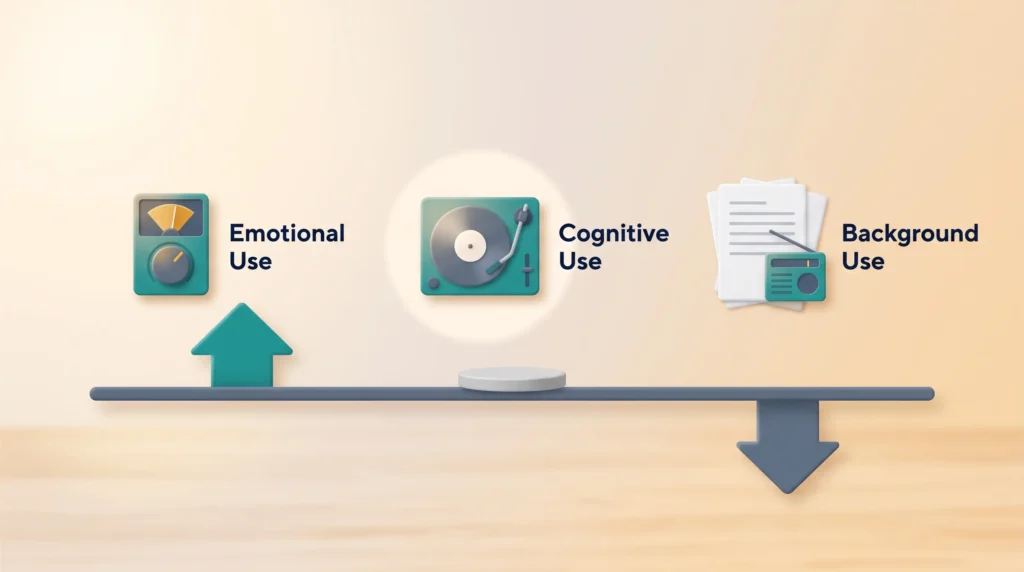
Sanseverino, Caputo, Cortese and Ghislieri surveyed 244 workers who listen to music on the job, in a 2023 paper in Behavioral Sciences. They separated three uses. Emotional use means putting music on deliberately to change how you feel. Cognitive use means listening with attention to the music itself. Background use means having something on without thinking about it.
Only emotional use was linked to better performance, and it worked through job satisfaction. Cognitive use showed no relationship to either. Background use was linked to lower job satisfaction, which the authors suggest may reflect people using music to cope with work they are not enjoying.
The lesson is that music helps most when you use it on purpose. Putting on a track to lift a flat mood before a boring hour is a different act from letting a playlist run because the silence felt odd.
The Bottom Line
Music is not a productivity tool in the way a calendar or a task list is. It is a mood tool, and mood affects how long you stay with work you would rather avoid.
Treat it accordingly. Use it where the work is routine and the enemy is tedium. Turn it off where the work is hard and the enemy is distraction, or swap it for quiet, steady sound such as flowing water. Choose it yourself, keep it familiar and keep it quiet. Then check the results over a couple of weeks rather than trusting the feeling, because feeling that music helps is not the same as evidence that it does.
Found this useful?
Make SmartKeys a preferred source on Google, and our articles will surface more often in your Top Stories, AI Overviews, and AI Mode.
Add as Preferred Source