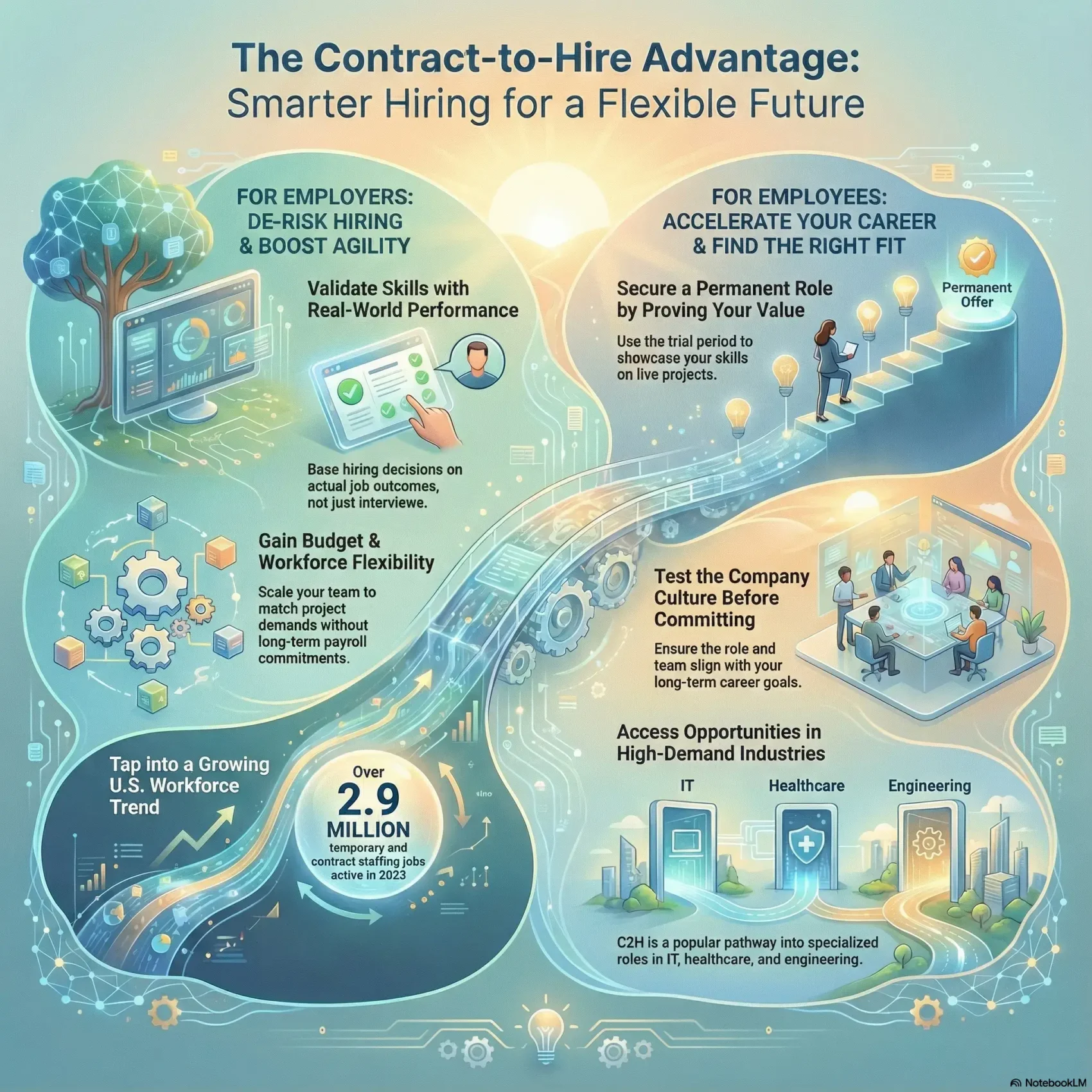
You need a clear, practical view of how the contract-to-hire trend fits today’s hiring landscape. This model lets a company test a candidate on a real project before offering a permanent role.
The approach suits niche expertise and short timelines. It helps businesses reduce early risk while validating skills on the job.
Remote work and globalization have widened the talent pool, but they can complicate culture and team flow. Using a short contract gives both workers and companies time to confirm fit.
Expect practical benefits: faster access to specialized talent, clearer workforce planning, and more flexible arrangements that match urgent needs.
Later sections will walk you through process steps, market signals, and best practices so you can turn this approach into a reliable path from contract work to stable employment.
Key Takeaways
- Use short contracts to validate a candidate’s skills on a real project.
- This model lowers early risk for your company and employees.
- It matches specialized talent to time-bound needs quickly.
- Remote and global hiring broaden options but affect culture.
- Plan team workflows and conversion steps ahead of time.
Executive Snapshot: Why You’re Seeing Contract-to-Hire Everywhere Right Now
Companies are turning to short evaluation contracts to move faster and cut early risk. You get practical proof of fit because candidates perform real work before a permanent job decision.
Labor pressure and rapid technology change mean employers compress hiring time. ASA data (about 2.9 million temporary and contract staffing jobs in 2023) shows flexible staffing is now a regular part of the U.S. workforce.
What this means for you: faster access to specialized talent, clearer validation of skills, and room to scale headcount as demand shifts. Remote and nearshore options widen access to candidates without relocation.
“You see performance on live work quickly, and employees get a real shot at a long-term role.”
- Speed to fill positions.
- Lower upfront risk for companies.
- Better alignment between recruitment and staffing strategy.
What Contract-to-Hire Means—and How It Works in Practice
Start by picturing a short, evaluated engagement where the role is real work and the outcome decides long-term employment. You bring someone on for a defined period so both sides can test fit on live deliverables.
Definition and how it differs from other approaches
This model differs from traditional hiring because the initial focus is performance on the job, not just interview answers. It also differs from typical temp work because there’s an explicit conversion path rather than an expected end date.
The trial period: timelines and conversion clauses
Most companies set a 3–12 month period. During that window you measure KPIs, communication, and skills on real tasks. Use clear conversion clauses that list timelines, role expectations, and the metrics that lead to permanent employment.
Pay, benefits, and the employer of record
During the period a staffing vendor often acts as employer of record. That vendor handles payroll, tax withholdings, and sometimes limited benefits for employees. When you convert, you switch the person to your payroll and full benefits, ending the vendor arrangement.
- Define the role and scope up front.
- Document conversion criteria so expectations are clear.
- Use the trial to reduce risk and verify fit before full employment.
For more on how this process shapes the future of contract work, see contract work and conversion best practices.
Why the contract-to-hire trend Is Accelerating in the Present Job Market
Rapid change in tools and platforms means you can no longer wait months to fill critical roles.
Market drivers are clear: technology advances, fast skills turnover, and greater workforce flexibility. Companies face tight windows to deliver and need people who can start contributing quickly.
Market drivers: fast tech change, skills turnover, and workforce flexibility
Skills now shift faster than traditional training cycles. Gaps in AI/ML, cybersecurity, and cloud tooling make it hard to predict the exact mix you need.
Flexibility matters: short evaluation periods let you adapt headcount to demand without committing to full packages or long onboarding.
Speed to hire and reduced risk compared with direct full-time recruitment
You shorten time-to-start by simplifying early steps and letting workers show value on live projects.
“You can confirm performance in real contexts while reducing risk versus immediately bringing someone on as a permanent employee.”
- Secure talent for a role faster.
- Validate skills on the job before offering full benefits.
- Scale workforce size with more flexibility as demand changes.
U.S. Market Signals and Adoption You Should Know
You can see the shift in national indicators — flexible staffing is moving from niche use into mainstream workforce planning.
Data snapshot: contingent workforce growth and ASA/BLS indicators
ASA reported about 2.9 million temporary and contract staffing jobs in the U.S. in 2023. BLS shows continued growth in contingent and alternative employment arrangements.
That data suggests the labor market is relying more on evaluated engagements to deploy skills fast.
Industry hotspots: IT, healthcare, and engineering leading adoption
IT, healthcare, and engineering top the list for these arrangements. These sectors need specialized roles and clear compliance, so companies prefer on-the-job evaluation before full employment.
For candidates, that means clearer pathways from short assignments to permanent positions through performance on real work.
“Market signals point to broader access to talent and faster matching when the cost of a mis-hire is high.”
- Why this matters: staffing partners streamline sourcing and conversion in high-volume categories.
- Where to invest: focus recruitment channels that reach specialized pools and speed the process.
- Expectation: steady adoption across the U.S., not just in major tech hubs.
Remote, Global, and Nearshore Dynamics Reshaping Your Access to Talent
When you open your roles to remote pools, time-zone gaps and culture shifts become practical problems to solve. Remote work gives your company broad access to skilled workers, but success depends on planning how people collaborate across time.
Time zones, collaboration, and cross-cultural readiness
Set overlapping hours and clear meeting windows so teams can sync reliably. Document norms for communication, decision making, and handoffs. Use short check-ins and shared calendars to avoid late-night work for any single region.
Wider talent pools, specialized skills, and nearshore advantages
Nearshore arrangements give you overlapping time and cultural alignment without full relocation. That improves speed, lowers labor friction, and boosts productivity when you need niche skills fast.
- Pilot remote teams with short contracts to test your tool stack and cadence.
- Prepare cross-cultural readiness with clear channels and shared documentation.
- Assess infrastructure and compliance before expanding the workforce permanently.
With the right work arrangements and habits, global access becomes a strategic lever—not a communication headache.
Specialization and Niche Skills: Matching Roles to Rapidly Evolving Needs
Specialized technical gaps force you to design short, outcome-focused engagements that prove capability fast. In AI/ML, cybersecurity, data, DevOps, and cloud, the bar is practical work, not just resumes.
You can use a short contract to secure hard-to-find expertise without locking into long commitments. This approach helps you test a candidate on a focused project and measure real outputs.
Where focused trials work best
High-demand areas like AI/ML, Kubernetes/DevOps, security hardening, and cloud migrations need demonstrable deliverables.
- You verify expertise through deployments, pipelines, or security tests.
- Scope the job tightly and set clear success metrics up front.
- Measure throughput, reliability, and maintainability during the trial.
- Workers who solve tangible problems often convert faster to longer roles.
Companies benefit by aligning budgets to outcomes and cutting hiring risk. Over time you build a bench of proven specialists who know your stack and can jump in when demand spikes.
Employer View: Benefits, Risks, and When You Should Use Contract-to-Hire
Employers choose short evaluation engagements when they need fast, measurable results without long-term commitment. This approach gives your company flexibility to match staffing to immediate needs while you verify real performance on the job.
Benefits
Real-time performance validation: You see how a worker performs on live tasks, so recruitment decisions rest on outcomes, not just interviews.
Budget agility and lower costs: Use short contracts to scale up or down without full payroll commitments, and avoid downstream costs from mis-hires.
Lower turnover after conversion: Employers often find converted team members stay longer because they already fit the role and culture.
Risks
Team integration can suffer if you treat short-term people like outsiders. Onboard them with the same care you give permanent staff.
Security and stability matter: limit sensitive access and avoid putting vital custodial tasks solely with temporary contributors.
Candidate perceptions matter too. Be transparent about timelines and conversion criteria to reduce anxiety and build trust.
Best-use scenarios
- Pilot projects where the final scope is still evolving.
- Short-term spikes in demand that require immediate coverage.
- Specialized initiatives needing niche skills you want to vet on real outputs.
“Set clear conversion milestones and measure agreed metrics so moving someone to full-time is a clear, confident next step.”
Employee View: How You Weigh Opportunities Against Trade-Offs
You face a choice: use short evaluated positions to accelerate your career or prioritize stability while you search for the right fit.
Pathways to permanent roles and career acceleration through C2H
Use the contract period to showcase results. Focus on clear deliverables and visible wins so candidates see a path to full employment.
Ask for milestones, feedback loops, and mentorship so you can level up quickly and prove you belong in permanent roles.
Compensation, limited benefits at first, and what success looks like
Expect hourly pay during the trial and limited benefits until conversion. Some vendors offer partial options, but full benefits usually start after you move to payroll.
Track your contributions and share measured outcomes. Clear metrics on performance and collaboration help you negotiate faster conversion and better compensation.
- You can test company culture and decide if the job fits your longer-term goals.
- Flexibility is a plus, but weigh it against short-term stability and benefits gaps.
- If you want variety, pure contract positions may suit you better than conversion paths.
“Show impact early, ask for clarity, and treat the period as an interview on real work.”
Financial Implications and Budget Strategy for Your Staffing Mix
A smart staffing mix treats evaluated placements as a variable-cost tool that protects core salary budgets. You defer long-term salary and benefits while the person proves value on a real project. That reduces the immediate impact of a bad hire on payroll.
Direct costs you defer and how C2H protects against bad hires
You postpone full compensation and employment commitments until you confirm fit. This shields your company from prolonged salary, benefits, and onboarding costs for poor matches.
Expect agency markups during the trial and sometimes a conversion fee if you bring someone onto payroll. Build those fees into your forecast so they don’t surprise finance.
Hidden costs: agency markups, overlap, and long ramp-up considerations
Hidden costs matter. Overlap during handoffs can double-paying labor for a period. Longer ramp-up times also reduce realized savings if the job needs deep institutional knowledge.
- Model agency fees and one-time conversion charges up front.
- Plan for overlap during transitions and include that in monthly burn rates.
- Use timeboxed trials and strict conversion gates to keep costs predictable.
- Blend evaluated placements with direct hiring for mission-critical roles to preserve continuity.
“Align finance to delivery milestones so staffing spend maps to outcomes, not just headcount.”
Bottom line: this approach lets you move fast on staffing while keeping overall costs and risk under control. Use it where project value is clear and measurable, and protect long-term roles with direct recruitment.
Legal and Compliance Essentials You Can’t Ignore
Clear legal guardrails make the evaluation period predictable for both parties. You need airtight classification, wage-and-hour practices, and accurate records so your employment posture stays defensible.
Classification, wage and hour, and documentation requirements
Proper classification is critical to avoid misclassification penalties. During the period, confirm who is the employer of record and what obligations they hold.
Track hours, wages, and benefits carefully. Keep signed agreements, tax forms, and job descriptions so you can withstand audits and protect both employees and workers.
Structuring the transition to full-time: clear criteria and timelines
Spell out the evaluation period and conversion criteria in the initial agreement. Define metrics, decision dates, and who approves extensions.
Include a conversion checklist: background docs, compensation alignment, benefits eligibility, and IP and confidentiality assignments. This reduces ambiguity and future costs.
Cross-border and nearshore compliance considerations
When talent is remote or nearshore, review local labor rules, wage and hour requirements, and social contributions. Work with qualified partners to align taxation and leave policies.
Small compliance gaps can create outsized costs. Track time accurately, document exceptions, and confirm the staffing partner’s obligations so your company stays protected.
“Getting compliance right up front is cheaper than fixing it later.”
- Define security, confidentiality, and IP assignment from day one.
- Confirm employer-of-record duties during the trial.
- Maintain clear records and time tracking to support audits.
- Build conversion timelines and approval rules into the agreement.
Working with Staffing Agencies and Intermediaries to Streamline Hiring
A trusted intermediary can turn weeks of sourcing into days of qualified candidates in your pipeline. Use a partner to compress the recruitment timeline and reduce administrative burden so your team focuses on work that matters.
How the process works: sourcing, screening, payroll, and conversion
Staffing firms source and pre-screen a vetted pool of talent, shortlisting candidates that match your roles. They coordinate background checks, schedule interviews, and deliver profiles ready for quick decision making.
During the trial period, agencies often act as employer of record and handle payroll, tax withholdings, and limited benefits. That simplifies employment logistics while you evaluate performance on the job.
When you decide to convert, the partner manages conversion paperwork and transition steps so employees move smoothly to your payroll.
Choosing partners: speed, quality, reputation, and transparency
Pick agencies that balance speed with candidate quality. Look for clear SLAs, transparent fees, and references that show successful conversions to permanent positions.
- Share success criteria and timelines up front so candidates meet expectations.
- Ask about remote and nearshore capabilities to widen your options.
- Align on metrics and data flow so you can track progress during evaluation.
“A good staffing partner becomes an extension of your company, improving recruitment outcomes and keeping delivery on track.”
The Role of AI in Contract-to-Hire: Faster Pipelines and Better Matches
AI is reshaping how you find, vet, and schedule talent for short evaluation periods. You can free recruiters from routine tasks and focus their time on final interviews and team fit.
Automated sourcing, screening, and scheduling to cut time-to-hire
Use automation to pull candidates, screen resumes, and set interviews. This slashes the recruitment process and shortens the time between posting and placement.
Technical signal gathering from GitHub, Kaggle, and code reviews
AI can aggregate signals from GitHub, LeetCode, and Kaggle to score real-world skills. Code reviews and public contributions give objective data on candidate performance.
Using C2H to build AI-capable teams while you validate business needs
Pair AI shortlists with a contract trial so you validate the role in live work. You refine the job scope while seeing who converts to lasting value.
- Speed: Capita cut seasonal cycles from weeks to hours by automating ~200 tasks.
- Quality: AI shortlists reduce false negatives for rare skills.
- Learning: Feedback from trials trains your models to predict conversion and long-term fit.
Governance matters: control which data sources you use, document model decisions, and monitor bias so the system stays fair. Done right, AI becomes a force multiplier for smarter staffing and better outcomes.
Conclusion
Short, focused trials let you balance immediate delivery needs with careful long-term staffing decisions. Use them to test a job fit, confirm a role’s scope, and adapt to changing needs in your workforce.
When companies open evaluated periods, workers and employees both gain clarity. This model adds flexibility to hiring and recruitment while protecting your team and budget.
With clear criteria, strong partners, and thoughtful process design, you expand access to a broader talent pool and keep costs predictable. AI and data speed the match without lowering standards.
Make this approach part of your staffing mix so your company meets market demands, reduces labor risk, and turns short trials into lasting opportunities and stable employment.
Found this useful?
Make SmartKeys a preferred source on Google, and our articles will surface more often in your Top Stories, AI Overviews, and AI Mode.
Add as Preferred Source