Quick, clear routines win the day. You can use a simple six-item to-do list to shape your work and cut decision fatigue. This approach taught executives at Bethlehem Steel in 1918 helped leaders focus on what matters most.
Here’s the core idea: each evening, pick six high-value tasks for the next day, rank them, and work one task at a time until it’s done. That small limit forces you to choose fewer things and boosts long-term productivity.
The routine trims low-value work, frees up time for deep work, and gives you a repeatable habit that compounds results. You’ll learn how to build the daily list, handle shifting priorities mid-day, and stay on track when urgent requests pop up.
Start small, stick with it, and you’ll notice clearer focus and smoother days. This method proved useful for industrial leaders a century ago and still fits modern workloads you face now.
Key Takeaways
- Pick six high-value tasks for the next day and rank them.
- Work on one task at a time to reduce switching and maintain focus.
- Keep the list short to trim low-impact things and protect deep work time.
- Adjust priorities mid-day but return to the ranked list when possible.
- Use the routine daily to build momentum and measurable gains.
Why this simple How-To can transform your workday
When you decide the top tasks before you start, you remove the morning guesswork and save precious minutes that add up through the week.
The real power is the constraint: a fixed number of tasks focuses your attention and limits competing priorities. That makes it easier to protect deep blocks of time and regain momentum after interruptions.
Work on one item at a time and you cut context switching. This improves your focus and speeds up visible progress on important deliverables.
The approach is light to maintain. Many people quit complex systems, but this simple method stays usable when your day gets noisy.
- Pick six tasks the night before to speed up getting started.
- Rank that small number so you always know what to do next.
- Return to the list quickly after any distraction to keep outcomes aligned with your work.
What is the Ivy Lee method?
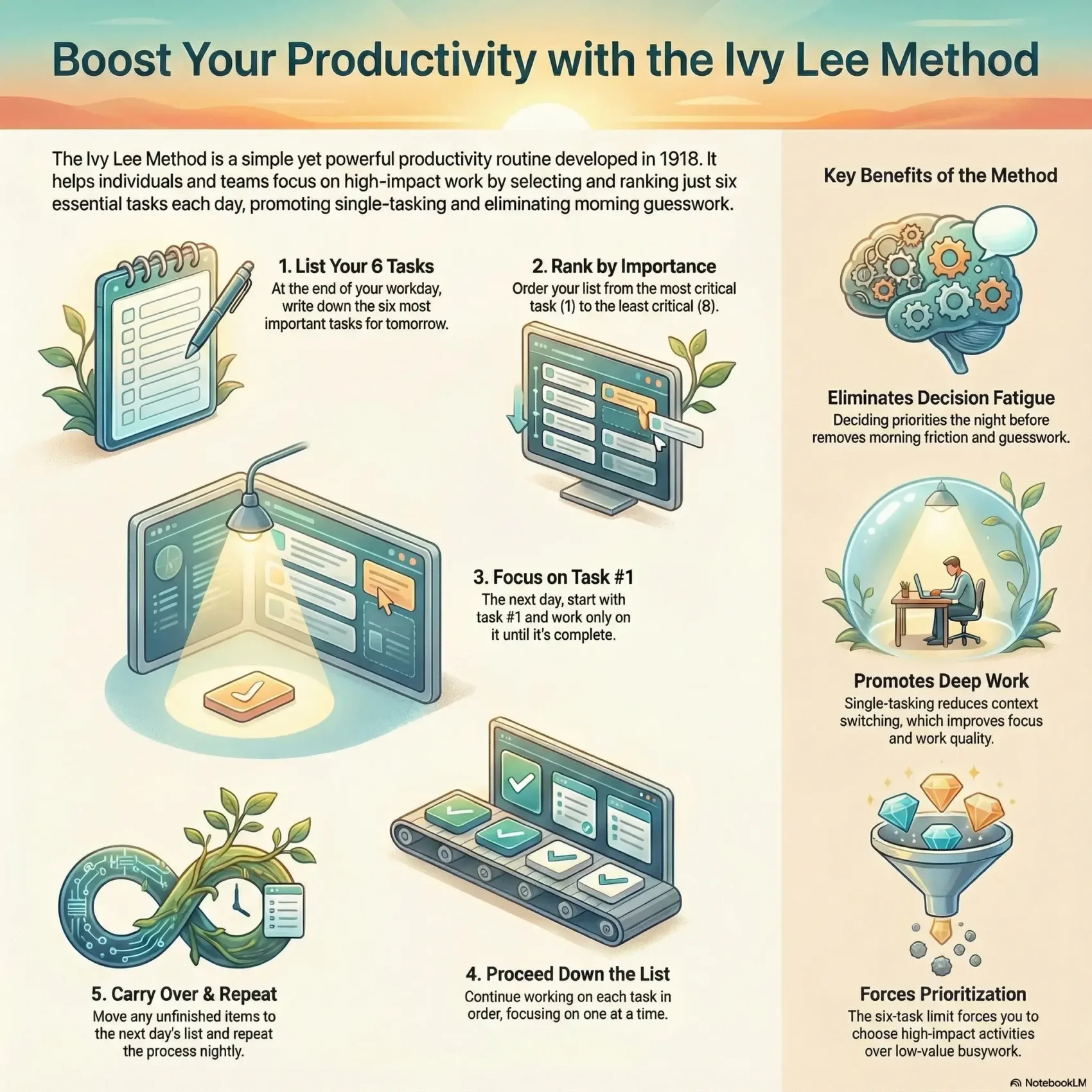
A fifteen-minute meeting in 1918 changed how leaders organized work. Charles M. Schwab, president of Bethlehem Steel, asked for a better way to manage daily output. The consultant taught each executive to write six critical tasks, rank them, and then complete items in order.
The result was practical and fast. Executives spent minutes deciding priorities instead of hours dithering. Unfinished tasks moved to the next day, creating a simple carryover that tracked progress across weeks and months.
The 1918 Charles Schwab story at Bethlehem Steel
At the steel company, a few minutes of coaching produced measurable results. After months Schwab rewarded the consultant with a large check, a sign that a small routine can deliver big business outcomes.
Why it works: simplicity, focus, and removing startup friction
The core advantage is order. When you decide tasks before the day starts, you remove the friction of getting started and protect chunks of one task time for deep work.
Single-tasking over multitasking for real gains
Committing to one task at a time reduces context switching and increases throughput. Try this simple daily rule and you’ll see consistent results in your work flow.
- Write six tasks each evening.
- Rank them by importance.
- Complete in order and carry unfinished items forward.
For a practical guide to prioritize your six key items and boost sustained productivity, see prioritization and productivity tips.
“A short, repeatable order beat complex plans in a noisy world.”
How to use the Ivy Lee method step by step
End your workday with a short habit that hands you a clear starting point for tomorrow. A quick, repeatable routine makes the transition from one day to the next simple and calm.
End of day: list your six most important tasks for tomorrow
At the end of day, write a single to-do list and list six items you will tackle tomorrow. Keep entries crisp so your morning is friction-free.
Order of importance: rank tasks and commit to the first task
Rank each task by order importance. Mark the first task and commit to starting there. Choosing by outcome beats choosing by urgency.
Next day execution: focus on one task at a time without distractions
On the next day, begin the first task and give it one task time — your full attention. Finish tasks in order and avoid jumping ahead.
Unfinished tasks: carry them to the following day and repeat the process
If you finish the day with unfinished tasks, move them to the following day and keep their priority. Refill the remaining slots and repeat the process nightly.
- Write six tasks each evening so tomorrow starts fast.
- Rank them and pick the first task to begin with.
- Work in one task time blocks and carry unfinished tasks forward.
Prioritize your six important tasks like a pro
Choosing what truly matters first gives your day shape and leaves room for meaningful progress.
Use the Eisenhower Matrix to favor important-but-not-urgent work. Slot most of your six important items into the important/non-urgent quadrant so you protect time for strategic work that compounds.
Try a Value vs. Effort matrix
Map each task by impact and cost. Pick high-value, low-effort items first to build momentum.
Adopt a 1-2-3 mix
Set the number pattern: one big task, two medium tasks, three small tasks. This mix keeps your to-do list realistic and steady.
- Keep order importance visible: mark 1–6 so you never debate what comes next.
- Ask this test: does the task move quarterly goals or customer outcomes?
- Review progress: move unfinished things forward and ensure at least one meaningful deliverable each day.
“Prioritize impact over busyness to sustain real productivity.”
Tools, tips, and common pitfalls when using the Ivy Lee method
When tools are simple, you spend more time doing work and less time managing tasks. Choose a format you’ll actually use so the process helps, not hinders.
Keep it analog or digital: paper index cards, a simple calendar, or a lightweight app all work. Pick one and stick with it so your evening list becomes habit.
Guardrails for interruptions
Expect emergencies and brief distractions. Handle what’s urgent and then return to your ranked tasks to resume steady progress.
Five-minute evening ritual
Set a five-minute block each night to pick your six items for the next day. This short time investment saves you minutes each morning and reduces start-up friction.
- Keep the list visible at your desk or home screen so people respect your focus blocks.
- Batch messages between tasks to shield deep work from repeated distractions.
- Track things that derail you and add simple guardrails like calendar holds or Do Not Disturb windows.
“A minimal process that you use beats a perfect system you ignore.”
- Choose a low-friction list format you will maintain.
- Use a five-minute ritual to set tomorrow’s tasks.
- Review weekly and adjust scope so you finish more consistently.
Conclusion
Conclusion
Finish each day with a short ritual and you give tomorrow a running start. Write six ordered priorities, then follow that list the next morning. This small habit keeps your focus tight and helps you finish more important tasks.
The ivy lee method distills prioritization into a repeatable practice. By committing to the lee method you channel energy into one task at a time, avoid overload, and protect deep work. Carry unfinished items forward and refill the remaining slots so momentum compounds over months.
Keep the list visible, plan in five minutes, and add simple guardrails. When the day ends, close the loop and let a clear list shape your next day for better productivity and calmer work.