Brain-computer interfaces (BCIs) connect your brain’s electrical signals to external devices, so you can move a cursor, type or control software without using your hands. The research goes back to the 1970s. In 2026, Neuralink, Synchron, Precision Neuroscience and Paradromics all have devices inside human patients.
Updated September 2026. For employers, two changes matter more than any single implant milestone. First, Apple made neural input a recognized input type, so BCI control now runs through standard accessibility settings instead of custom lab setups. Second, four U.S. states now treat brain data as sensitive personal data. If you pilot a brain-sensing headset, you are handling a regulated category of data.
This guide explains in plain language what these systems do, what you can realistically test this year, and where the legal and ethical limits sit.
Key Takeaways
- BCIs turn brain signals into commands, which enables hands-free control and new accessibility options.
- The technology ranges from consumer headsets worn on the head to devices implanted by surgeons. Several implant makers are in active human trials.
- No permanently implanted BCI for movement or communication has full FDA approval in the U.S. as of September 2026. Every such implant is still investigational.
- Non-invasive headsets are the only realistic workplace pilot today, and even those come with compliance duties.
- California, Colorado, Montana and Connecticut classify neural data as sensitive. In the EU, AI that infers emotions at work is banned. Plan governance before you buy hardware.
- For related systems that read emotional signals, see emotion AI at work.
What changed for BCIs in 2026
If you last looked at this field in 2024, five developments reset the picture.
- More patients, not just demos. Neuralink said in January 2026 that 21 people were enrolled in its trials across the U.S., U.K., Canada and the UAE. Related studies target robotic-arm control and speech.
- Safety data arrived. Synchron’s COMMAND study followed six U.S. patients for 12 months. All met the primary safety goal, with no device-related serious adverse events.
- Speech moved into a new trial. In September 2026, Paradromics reported that the first participant in its FDA-approved Connect-One study produced real-time speech and text, including a live phone call with family.
- Neural input became a standard. Apple’s BCI Human Interface Device (BCI HID) protocol treats a brain implant like any other input device, next to touch, voice and keyboard.
- Brain data became regulated data. Connecticut’s neural data rules took effect on 1 July 2026, joining California, Colorado and Montana.
What a brain-computer interface actually is
A brain-computer interface is a direct communication path between the brain’s electrical activity and a piece of software or hardware. It skips the muscles you would normally use to type, speak or click.

Why it matters at work
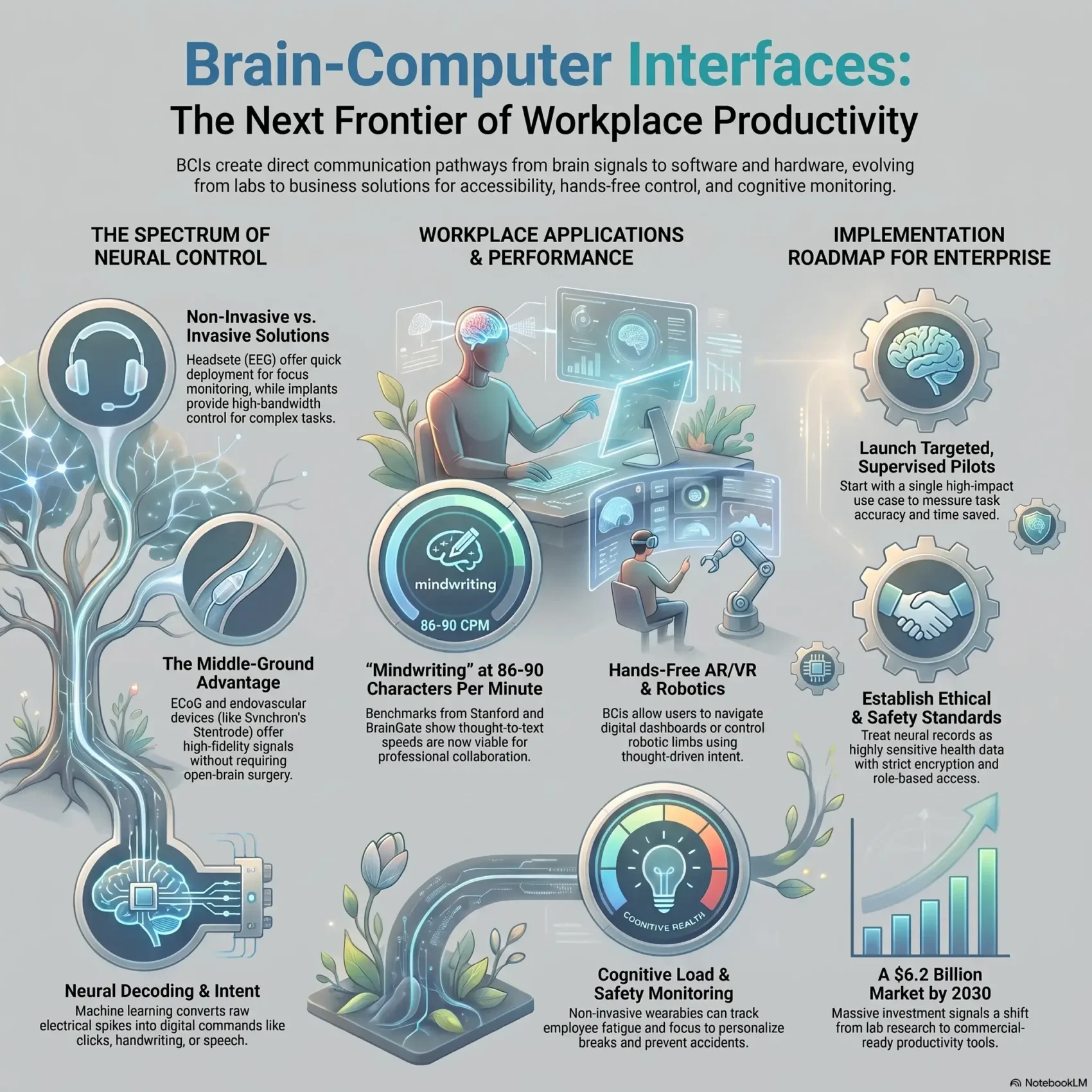
BCIs capture neural signals and decode what the person intends to do. That intent then becomes a click, a typed letter or a command to a robotic tool. The biggest near-term benefit is accessibility: an employee with paralysis or a severe motor condition can operate a computer again.
Think of a BCI as the far end of a spectrum you already use. Badge readers, wearable technology in workplaces and voice assistants all read a signal from a person and turn it into a command. A BCI simply reads that signal earlier, before it reaches a muscle.
Terms you will see in vendor documents
- BCI or BMI: brain-computer interface or brain-machine interface. Both mean the same thing.
- EEG: electroencephalography, which measures brain activity through sensors on the scalp.
- ECoG: electrocorticography, a thin sensor sheet placed on the surface of the brain under the skull.
- Electrodes: the sensors that pick up electrical activity.
- Channels: the number of separate signals a device records. More channels usually means more detail.
- Decoding: the machine-learning step that turns raw signals into intent.
A simple rule of thumb: the closer the sensor sits to the neurons, the cleaner the signal, and the more invasive the surgery.
From EEG to today: a brief history
Modern neural control builds on a century of research.
Hans Berger, EEG and Vidal’s challenge
In 1924, Hans Berger recorded human brain activity from the scalp and identified alpha waves, a rhythm of 8 to 13 cycles per second. That showed brain activity could be measured without surgery.
In 1973, Jacques Vidal at UCLA coined the term brain-computer interface. He challenged researchers to use EEG signals to control external devices and later showed simple cursor control.
Key milestones in animal and human studies
In the 1990s and 2000s, labs led by Nicolelis, Donoghue, Schwartz and Andersen showed that monkeys could steer cursors and robotic arms using signals from the brain’s motor areas. Those methods shaped how researchers decode movement today.
- The BrainGate consortium has run clinical trials of implanted BCIs since 2004, two decades before Neuralink’s first patient.
- BrainGate participants have controlled cursors and robotic arms by thought.
- Current studies focus on speech decoding, limb control and stroke rehabilitation.
How brain-computer interfaces work
Every BCI follows the same basic chain. Neurons produce electrical activity, sensors record it, and software converts it into commands you can use.
Brain activity in brief
Neurons fire tiny voltage spikes. Groups of neurons also create slower waves called local field potentials. Spikes map closely to a specific intended movement. The slower waves reflect broader states, such as alertness.
Sensors
Non-invasive tools sit outside the head. EEG measures scalp voltages, MEG measures magnetic fields, and fNIRS uses light to track blood flow in the brain. Invasive options sit closer to the source: ECoG rests on the brain’s surface, and microelectrode arrays go into brain tissue.
Decoding and closed-loop control
Decoding uses machine learning to translate signals into intentions, such as moving a cursor, writing letters or forming words. Research teams at Stanford and UCSF have decoded handwriting and speech at speeds that patients can use in daily life.
Closed-loop systems add feedback. The user sees the result, adjusts, and the software updates its model. Over time, user and system adapt to each other, which improves accuracy and reduces the need to recalibrate.
Practical takeaway: match sensor quality to the control you need. Typing speed and precise movement require high-fidelity signals. A simple on/off switch does not.
Non-invasive, partially invasive and invasive options compared
Each approach trades signal quality against risk. That trade-off decides what you can do with it at work.
Non-invasive headsets and wearables
EEG headsets are the only category you can deploy at work today without a clinical partner. Setup is quick and the physical risk is low.
The downside is signal strength. The skull weakens and blurs the signals, which limits fine movement and fast typing. Realistic uses are simple switch control, attention or fatigue indicators, and research.
Invasive implants and microelectrode arrays
Implanted arrays sit in brain tissue and capture detailed signals. They enable precise cursor control, robotic arm movement and speech decoding.
The trade-off: they require brain surgery, recovery time and long-term clinical follow-up. These are medical programs, not IT projects.
Surface arrays and devices placed through blood vessels
ECoG arrays rest on the brain’s surface without penetrating it. They often strike a good balance between signal quality and risk.
Endovascular devices take a different route. A surgeon guides the sensor through a blood vessel until it sits next to the motor cortex, the area that controls movement. This avoids opening the skull.
- Speed of deployment: headsets now, implants only through clinical partnerships.
- Surgical factors: skull access, tissue contact, recovery time and infection risk.
- Operations: calibration, maintenance and training needs differ sharply between device types.
Leading BCI technologies and devices in 2026
This vendor snapshot helps you understand who is doing what and how far each company has come.
Neuralink
Neuralink’s implant records from 1,024 electrodes spread across flexible threads, which a surgical robot inserts into the brain. After FDA clearance for human studies in 2023, the company reported 21 enrolled participants across four countries by January 2026. Participants use the implant at home to control a cursor and keyboard.
Separate studies test robotic-arm control and speech. Neuralink’s Blindsight vision implant holds FDA Breakthrough Device designation, a status that speeds up regulatory review, but it is not yet in routine human use.
Synchron
Synchron’s Stentrode is placed through the jugular vein into a blood vessel on the surface of the motor cortex, so no open-brain surgery is needed. Its COMMAND study followed six patients for 12 months with no device-related serious adverse events. Together with earlier Australian patients, about ten people have received the device.
In November 2025, Synchron raised $200 million to fund a pivotal trial, the large study it needs before applying for full FDA approval. The company was also the first to integrate natively with Apple’s BCI HID protocol. An ALS patient in its trial controlled an iPad by thought using Apple’s built-in Switch Control feature. ALS is a disease that progressively destroys the nerve cells controlling muscles.
Paradromics, Precision Neuroscience, Blackrock and CorTec
- Paradromics: its Connexus implant uses roughly 420 tiny electrodes. The FDA approved its Connect-One study in November 2025, and the first participant was implanted in June 2026. By September, she was communicating in real time through decoded speech and text.
- Precision Neuroscience: its Layer 7 thin-film array rests on the brain’s surface. In April 2025, it received FDA 510(k) clearance, a route for devices similar to ones already on the market. The clearance covers implantation for up to 30 days, for example to map the brain during surgery. It is not a permanent BCI approval.
- Blackrock Neurotech: maker of the Utah array, the hardware behind much of the BrainGate research.
- CorTec: received FDA Breakthrough Device designation for its Brain Interchange system in stroke rehabilitation in April 2026.
Non-invasive players
Neurable builds consumer EEG headphones, such as the MW75 Neuro, that estimate focus during everyday work. At the other end of the funding scale, Merge Labs raised $252 million in a January 2026 seed round led by OpenAI to develop non-invasive interfaces. Investors are clearly no longer betting only on surgery.
Workplace applications you can pilot today
Small, supervised pilots are the fastest way to learn whether neural tools help real tasks. Start with one clear goal, such as reliable clicking, basic typing or device control. That keeps early projects low risk and measurable.
Hands-free computer control for accessibility
Non-invasive headsets can give employees with motor impairments or temporary injuries a way to click and type without their hands. This fits naturally into a broader remote work accessibility program instead of standing alone as an experiment.
Because Apple’s BCI HID protocol runs through built-in accessibility features, setup increasingly looks like configuring assistive technology rather than building a custom system. Headsets deliver far less precision than implants, so set expectations accordingly.
Communication aids
Spellers let a person select letters or words by focusing attention, and handwriting decoders turn imagined pen strokes into text. Offer these as voluntary assistive services with clear privacy controls.
Robots and smart environments
In research settings, BCIs already control robotic arms, exoskeletons and drones. If your real interest is physical support rather than digital control, exoskeletons in the workforce are far more mature. Workplace robots also deliver gains without touching neural data.
Hands-free control of screens, lights or AR and VR applications is another option. Compare the effort with smart glasses at work, which reach similar outcomes with off-the-shelf hardware.
- Define success metrics: click reliability, words per minute, task time and user comfort.
- Plan IT needs: device pairing, wireless management and operating-system accessibility settings.
- Choose the device type by use: headsets for quick pilots, clinical partners for anything implanted.
BCIs in healthcare and return to work
The most mature BCI results come from medicine. They matter to employers because they shape how people with severe injuries or illness can return to work.
Stroke and spinal cord injury
UCSF researchers have decoded intended speech from ECoG signals, and Stanford researchers have turned imagined handwriting into text. For people recovering from stroke or spinal cord injury, those advances can mean using spellers, cursors and robotic aids to resume job tasks. For the wider business context, see HealthTech trends and digital health opportunities.
Return-to-work pathways
Build programs in which clinicians, HR and caregivers agree on the device, the training schedule and workplace accommodations. Short, frequent training sessions help users gain reliable control faster than long, infrequent ones.
Monitoring fatigue and focus
Some headsets estimate fatigue or attention levels. In theory, that could help schedule breaks or rotate tasks in safety-critical roles.
Before you buy hardware for this, consider scheduling design. Working with ultradian rhythms and 90-minute cycles addresses fatigue with no sensors, no consent forms and no regulated data. Monitoring also raises the legal issues covered below.
- Privacy first: require opt-in consent, strict role-based access and occupational-health safeguards.
- Success metrics: return-to-work milestones, communication speed, error rates and comfort.
- Device choice: medical-grade systems when clinical control is required; consumer wearables only to inform workplace adjustments.
Implementing a BCI pilot: a practical roadmap
A focused plan keeps costs down and shows quickly whether a system adds value.
Use case, stakeholders and success metrics
Pick one high-impact use and a small group of willing participants. Set measurable outcomes before you start.
- Define the primary use and target metric, such as task accuracy, words per minute or time saved.
- Involve IT, accessibility, HR, legal and facilities early, with clear roles and timelines.
- Prefer commercially supported devices over research toolkits unless you have engineering support.
People, policies and training
Plan session lengths, training frequency and who supports users when something breaks. Performance usually improves over weeks as user and software adapt, so allow enough time.
Policies come first. Set eligibility rules, make participation voluntary and document accommodations from day one. Your existing wearable tech policy is a good starting template. Neural data is a stricter version of the same problem, not an entirely new one.
- Prepare plain-language information for participants and managers.
- Review metrics weekly and adjust based on feedback.
- Expand to more sites or use cases only after the targets are met.
Data, privacy and security: protecting brain data
Before any pilot, map what neural data flows through your systems and who can see it. Neural data can reflect intended movement, speech or mental states such as fatigue. Treat it like health records.
Why neural data is sensitive
Brain signals can reveal intentions and passing mental states that a person never chose to share. That raises the stakes for storage, breaches and consent.
Vendor practices have often been weak. A 2024 Neurorights Foundation review found that 29 of 30 companies selling neurotechnology products online had access to users’ brain data with no meaningful limits. Nearly all of them could also share it with third parties. Read the contract before you sign.
Encryption, governance and access control
Document where data lives: on the device, in transit and in storage. Use strong encryption and role-based access, and log consent and every data access. The controls you built for biometric authentication at work transfer well. A structured privacy compliance framework helps you map overlapping rules to one set of controls.
- Follow HIPAA, the U.S. health privacy law, when occupational health staff or patient data are involved.
- Check vendors’ update practices and incident response plans.
- Store identities separately from signal data to reduce re-identification risk.
- Tell employees clearly what you collect, why and for how long.
Neural data laws you now have to plan around
Four U.S. states now treat brain data as a protected category, and more are debating it.
The four enacted state laws
- California: the California Consumer Privacy Act (CCPA), as amended in 2024, includes neural data in “sensitive personal information.” Consumers can limit how it is used and shared.
- Colorado: neural data counts as sensitive data under the Colorado Privacy Act, which requires consent before it is collected or processed.
- Montana: SB 163 took effect on 1 October 2025. It covers “neurotechnology data” and requires law enforcement to obtain a warrant before accessing it.
- Connecticut: SB 1295 took effect on 1 July 2026. It covers central nervous system activity, so it reaches BCIs and EEG headsets rather than general wearables.
What is still coming
As of spring 2026, bills were pending in Virginia, Alabama, New York, Illinois and Vermont. California is also considering a second measure aimed at workplace surveillance. That one matters most if you are thinking about fatigue or focus monitoring.
At the federal level, the proposed MIND Act would direct the Federal Trade Commission (FTC) to study neural data and recommend national standards. It has not advanced beyond committee.
Outside the United States
Chile amended its constitution to protect “neurorights” in 2021, and its Supreme Court applied those protections against a consumer neurotechnology company in 2023. In the EU, the AI Act has banned AI systems that infer employees’ emotions at work since February 2025, with narrow exceptions for medical or safety reasons. A headset that claims to read stress or mood can fall under that ban. See our EU AI Act compliance guide for details.
The federal gap
No federal neural data law exists in the U.S. as of September 2026. HIPAA covers neural data only in medical settings, and most consumer neurotechnology falls outside it. That leaves the FTC’s general power over unfair or deceptive practices as a thin backstop.
In practice, your obligations depend on where your employees work. For the wider picture, see how data privacy rules apply to employee data and how future of work legislation is expanding into monitoring and algorithmic management.
Safety, ethics and fairness in BCI deployments
Safety, ethics and equal access are the guardrails for any neural device program. They start with plain-language consent and continue through long-term follow-up.
Informed consent and long-term safety
For implants, explain the surgical risks clearly: infection, scarring and gradual signal loss over time. ECoG and blood-vessel approaches reduce these risks but do not remove them.
Participants need to know the benefits, the alternatives and the maintenance plan. Build in scheduled check-ups and fast support for device problems.
Where BCIs cross into surveillance
A device that reports fatigue or attention is a monitoring tool, whatever the vendor calls it. The debates around AI employee monitoring and ethical considerations of AI in the workplace apply here with more force, because the signal comes closer to thought.
A useful test: if you would not be comfortable showing an employee exactly what their data says about them, do not collect it.
Fairness, accessibility and dignity
Design selection and training so the program does not favor only well-resourced users. Cover costs where possible, and choose metrics that reflect different needs. Programs built around neurodiversity in the workplace show how to support people without turning accommodation into a performance review.
- Set up an ethics review with clear rules for pausing or ending participation.
- Provide caregiver training, maintenance plans and fast technical support.
- Explain risks and safeguards in everyday language.
U.S. regulation and reimbursement
Before you pilot any device, find out its regulatory status and who pays for surgery, maintenance and upgrades.
FDA pathways in plain language
- Breakthrough Device designation: faster, more interactive FDA review for technologies that address serious unmet needs.
- Investigational Device Exemption (IDE): permission to test an unapproved device in human clinical studies.
- 510(k) clearance: permission to market a device that is substantially similar to one already legally sold.
- Premarket approval (PMA): the strictest route, required for high-risk devices such as permanent brain implants.
The key point for 2026: designations and study approvals are not commercial approval. Every permanent BCI for movement or speech is still investigational in the U.S. Synchron’s pivotal trial could lead to the first PMA application for such an implant, but that outcome still lies ahead.
Coverage questions
Insurance coverage is unsettled. Ask who will pay for surgery, device replacement and long-term maintenance.
- Ask vendors for study evidence and realistic timelines.
- Request documentation and required training for clinical staff.
- Talk early with insurers and plan administrators about coverage for eligible employees.
Benchmarks from published studies
Published trials give you realistic reference points. All of the figures below come from implanted systems, not headsets.
Speech and handwriting
In a 2021 BrainGate study published in Nature, a participant typed about 90 characters per minute by imagining handwriting. In 2023, Nature published two speech studies: a Stanford team reached about 62 words per minute, and a UCSF team using ECoG reached about 78 words per minute. For comparison, natural conversation runs at roughly 150 to 160 words per minute.
Everyday consumer devices
In Synchron’s trial, an ALS participant controlled an unmodified iPad through Apple’s standard accessibility tools. That is a very different proposition from a custom lab demo, because it shows BCIs can work with the software employees already use.
- Targets: use study speeds as an upper reference and expect much lower speeds with headsets.
- Training: plan for calibration and weeks of practice.
- Hardware: compare channel counts and electrode types across devices.
- Reliability: measure error rates before choosing workflows such as messaging or navigation.
Technical challenges and active research
Three trade-offs shape where the field goes next: signal quality, durability and decoding.
Signal quality versus accessibility
Implanted electrodes give the best control but require surgery. Non-invasive methods are safer and easier to roll out, yet their signals are weaker and noisier.
The gap in detail is large. Synchron’s Stentrode has 16 electrodes, while Neuralink’s implant has 1,024. Sixteen is enough for point-and-click control. It is not enough for rich speech decoding, which is why Synchron is developing a higher-channel device.
Durability and biocompatibility
Rigid electrodes can damage surrounding tissue, and the body can form scar tissue around them, which weakens signals over time. Manufacturers are responding with flexible threads, better coatings and softer materials. Open questions remain about device lifetime and replacement.
AI in decoding
Better AI models improve how signals are filtered and interpreted, which increases speed and reduces recalibration. Practical hurdles remain: consistent manufacturing, reliable wireless links, battery safety and long-term evidence for regulators.
Market outlook and investment signals
Money is arriving faster than products.
Market size estimates vary widely, because research firms define the category differently. Some include medical EEG equipment, others count only BCIs. Compare methodologies before you quote any single figure in a business case.
Funding signals are clearer. Synchron raised $200 million in November 2025 to prepare its pivotal trial and commercial launch. Merge Labs raised $252 million in January 2026 for non-invasive work. Capital is flowing to both ends of the invasiveness spectrum.
Adoption will come in layers. Accessibility pilots with headsets come first. Implants for speech and advanced control will follow as pivotal trials report results and regulators decide.
- Near term: non-invasive pilots are possible today, within the legal limits described above.
- Medium term: the first full approvals for implanted BCIs depend on pivotal trials that are only now starting.
- Procurement view: treat headsets as accessibility purchases and implants as clinical partnerships.
If you are interested in measuring brain responses for research rather than control, neuromarketing covers the consumer-behavior side of the same instruments.
BCI vendor evaluation checklist
Start with how a device balances safety against signal quality for your users.
Safety, signal quality and data controls
Compare electrode type, channel count and placement: scalp, brain surface, blood vessel or brain tissue. Those choices shape both risk and performance.
Ask for evidence: FDA status, peer-reviewed studies and real-world outcomes. Check how the company records consent, encrypts data and keeps audit trails. Ask directly whether it sells or shares neural data.
Integration, support and total cost
Review wireless connectivity, battery life, software interfaces and operating-system compatibility, so IT work is predictable. Ask about service levels, on-site support, training and spare parts.
- Add up total cost: hardware, accessories, software licenses and staff time.
- Review roadmaps and replacement cycles to avoid being locked into a dead platform.
- Confirm compliance with the state neural data laws and, for EU staff, the AI Act.
- Write pilots and contracts around clear success metrics and shared risk.
Conclusion
Here is where this leaves you in 2026.
Brain-computer interfaces range from consumer headsets to implants on or inside the brain. Clinical studies now show real-time speech, handwriting-to-text and thought-controlled computers, and Apple has made neural input a recognized category. Still, no permanent implant is commercially approved. Your realistic options this year are carefully governed headset pilots for accessibility, or waiting.
Next steps: choose one accessibility use case and run it under explicit consent and data rules. Before the first headset arrives, check the neural data laws where your employees work. Write the policy before you start the pilot.
For the adjacent interface shift you can use today, explore AR and VR workspaces.
Found this useful?
Make SmartKeys a preferred source on Google, and our articles will surface more often in your Top Stories, AI Overviews, and AI Mode.
Add as Preferred Source