Tools
Tools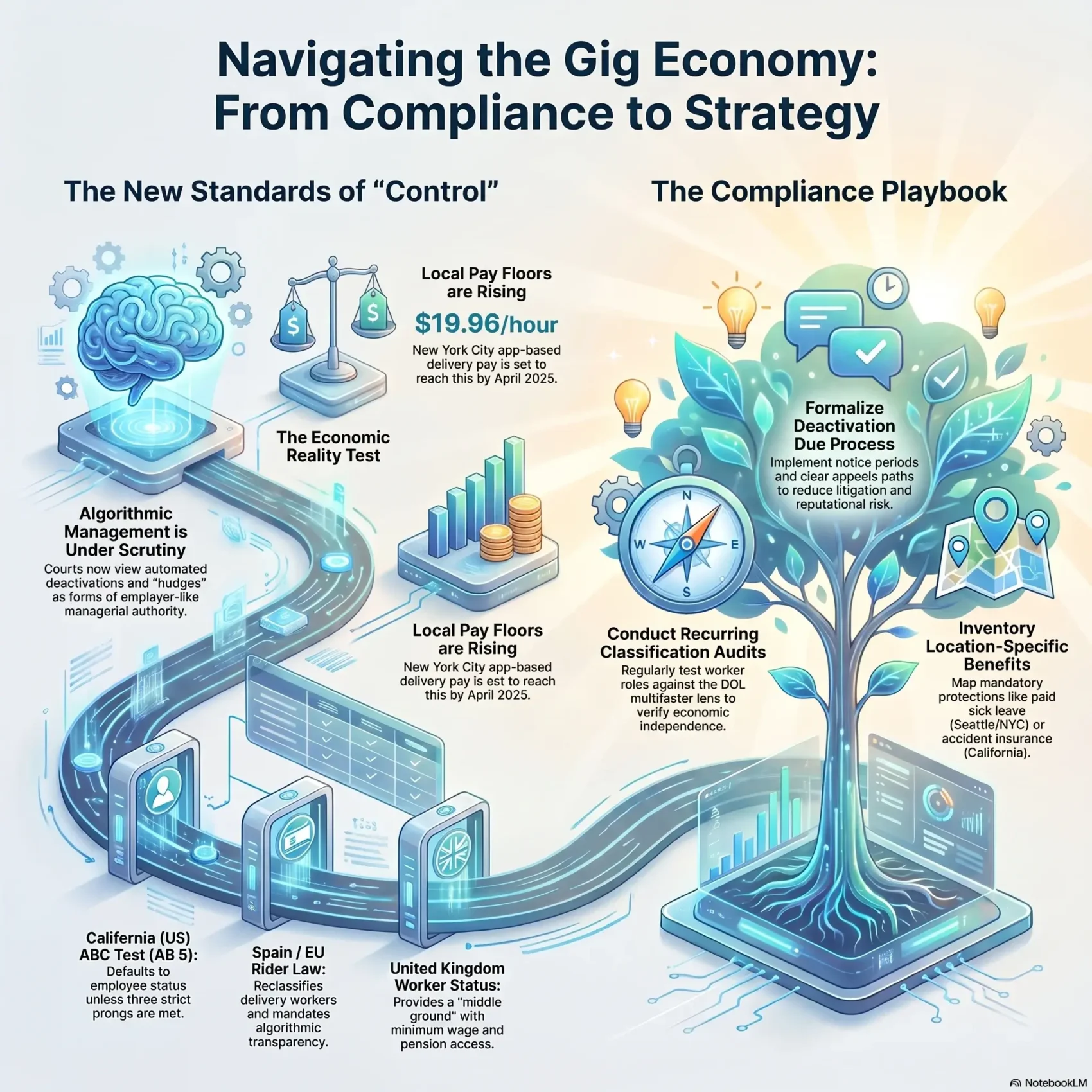
You face a turning point in how your business hires and manages on-demand talent. Over the last decade platforms grew fast and courts and lawmakers pushed back.
The UK moved first in court, with a 2016 tribunal and a 2021 Supreme Court decision that strengthened rights for ride-hail drivers. The EU updated minimum standards in 2019, and Spain’s 2021 Rider Law reclassified delivery riders and required algorithmic transparency.
In the United States, California passed AB 5 in 2020 and voters approved Prop 22 the same year; the California Supreme Court later upheld Prop 22 in Castellanos on July 25, 2024. Federal guidance from the Department of Labor restored a multifactor FLSA test that looks at economic dependence. Cities like New York and Seattle set pay floors for app-based delivery workers.
What this means for you is clear: status and classification choices are strategic, not just administrative. They affect cost, pricing, and brand trust, and they shape the protections you must offer workers and contractors under shifting law and market expectations.
Key Takeaways
- Regulatory shifts have moved classification from back-office to strategic priority for your business.
- Global models vary: EU rights-based rules, Spain’s Rider Law, and a mixed U.S. federal/state patchwork.
- Status choices affect wage, benefits access, and exposure to labor claims.
- Algorithmic control and deactivation policies are new areas of legal risk to monitor.
- City pay floors and federal FLSA tests now intersect with daily workforce decisions.
Why gig economy rules are shifting now—and what it means for your business
Pandemic-era demand put app-based couriers and drivers in the spotlight, revealing big gaps in legal protections. When delivery and ride services were essential, many people doing the work stayed outside basic employment safeguards.
From “essential” to invisible: the pandemic’s spotlight on platform work
The crisis showed how dependent cities and customers became on these services, even as many workers lacked sick pay, benefits, or clear status.
This mismatch invited scrutiny from courts and lawmakers in the United States and abroad.
Algorithmic control and the rise of hybrid labor models
Platforms use ratings, acceptance nudges, dynamic pricing, and automated deactivations. Scholarly work calls this a form of managerial authority.
“Platform control can be algorithmic and real,” — UK Supreme Court, Uber BV v. Aslam
For your company, that means rethinking policies, data access, and appeal processes to limit legal risk while keeping flexibility.
- Identify where your model intersects with deactivation, pay transparency, and scheduling nudges.
- Update documentation so algorithmic decisions are auditable and defensible.
- Consider stronger protections as a competitive benefit, not only compliance.
gig economy regulation: the core issues you need to track
In practice, the legal tests look past labels to the real-world balance of control and dependence.
The employee vs. independent contractor dilemma
The courts (U.S. v. Silk, Darden) and the DOL use an economic reality approach. They check who sets prices, who bears risk, and whether the work is integral to your business.
Flexibility, control, and risk: what truly drives worker status
Control now includes algorithmic nudges, ratings, pay-setting, and deactivation risk—not just hands-on supervision.
- Why classification matters: it shapes wages, benefits eligibility, tax liability, and exposure to back pay and penalties.
- Key indicators: profit/loss opportunity, investments, permanence, integral tasks, and independent initiative.
- Practical risks: poorly drafted contracts that mandate shifts or forbid multi-apping can undercut your intended status.
Actionable step: run regular worker classification audits tied to business changes and seasonal peaks. Allocate risk clearly in contracts and operations to reduce litigation exposure.
The federal landscape: DOL’s multifactor test and the Fair Labor Standards Act
The U.S. Department of Labor now evaluates worker status through a multifactor lens focused on economic dependence. This shift restores a broad Fair Labor Standards Act approach that looks at real-world ties between workers and your business.
Economic dependence under the FLSA: opportunity for profit/loss, control, and permanence
Key factors include opportunity for profit or loss, investments by the worker and employer, degree of permanence, the nature and degree of control, whether the work is integral, and skill or initiative.
How the DOL’s revised rule affects your contractor status decisions
- Make a checklist: translate the multifactor test into role-by-role questions across the United States.
- Track high-risk signals: platform pricing control, route assignment, and incentives often point toward employment-like control.
- Collect evidence: invoices, business registrations, separate tools, and real profit/loss records help justify independent contractor status.
- Plan for obligations: different outcomes trigger FLSA duties—minimum pay, overtime, and recordkeeping—so map operational impacts now.
- Review regularly: set cadence to reassess worker classification when algorithms, policies, or markets change.
Practical tip: you can offer voluntary protections to reduce legal risk without conceding status, but document why those benefits do not alter economic independence.
State-by-state patchwork: where worker classification diverges
Across the United States, state laws now draw very different lines on who counts as an employee or a contractor. That split matters for your hiring, pay, and compliance plans.
California’s AB 5 and the ABC test
Assembly Bill 5 (Jan 2020) codified the ABC test, shifting the default toward employee status unless all three prongs are met. The Ninth Circuit upheld AB 5 on June 10, 2024, validating the state’s stronger labor protections.
Proposition 22 and the Castellanos decision
Voters passed Proposition 22 in Nov 2020 to carve out app-based drivers and couriers. The California Supreme Court’s Castellanos decision on July 25, 2024, preserved that carve-out, creating a separate legal lane for certain platform drivers.
Other states and venue shopping
New York, New Jersey, and Illinois have tightened rules and reclassified some platform workers as employees. Coverage varies, so your multi-state operations can face conflicting duties.
- Practical impact: dual regimes force you to vary contracts, pay, and onboarding by state.
- Risk: venue shopping may lower costs short term but raise legal and reputational exposure.
- Action: map status by state and standardize documentation that fits each law.
Pay floors, wage rules, and overtime risk in the gig economy
Minimum pay laws in cities now shape how you set rates, report earnings, and manage exposure to wage claims. New York City requires app-based delivery workers to earn at least $17.96/hour, rising to $19.96/hour by April 2025. Seattle has similar standards that create local pay baselines you must follow.
New York City’s minimum pay for app-based delivery drivers
You’ll translate NYC’s pay floor into clear operational steps. Update rate cards, fee structures, and earnings statements so drivers see gross pay, tips, and any deductions.
Seattle’s standards and implications for platform pay models
City-level rules force you to compare local floors when designing a national pricing strategy. Expect to adapt incentives, promotions, and surge logic so pay never falls below required levels during slow periods.
Overtime exposure when misclassification is found
Misclassified workers can claim back pay and overtime under the FLSA. Rigid scheduling, batching rules, and strict acceptance thresholds increase that risk.
- Set flexible work-hour policies that preserve contractor traits while meeting local wage protections.
- Keep trip-level records: trips, tips, wait time, and expenses to resolve disputes quickly.
- Scenario-plan cost impacts of misclassification, including retroactive overtime and penalties, and build reserves.
- Communicate pay calculations clearly so workers understand earnings, deductions, and appeals.
Beyond wages: benefits, deactivation, and anti-discrimination protections
Local laws now force companies to do more than set rates—they must define how workers access benefits and contest deactivations.
Paid sick leave is expanding. Washington grants paid sick time to ride‑share drivers, and New York City and Seattle let app-based workers accrue sick leave.
Insurance, compensation, and unemployment
California requires occupational accident insurance for app transportation and delivery platforms.
Washington can trigger workers’ compensation for qualifying drivers. Pandemic Unemployment Assistance showed how unemployment models can include gig workers and sparked debate about permanent programs.
Deactivation, appeals, and anti-discrimination
Seattle and New York City require notice, valid reasons, and an appeals process before deactivation. That due process reduces unfair terminations and litigation risk.
Anti-discrimination and anti-retaliation protections now cover independent contractors in Delaware, D.C., Illinois, Maryland, New York, and Vermont. You must update policies and training so contractors get the same complaint channels and protections as employees where law requires.
- Inventory benefits: map paid sick leave, insurance, and compensation rules by state and city.
- Fix deactivation processes: add notice, reasons, and an appeal path to reduce disputes.
- Align contracts: avoid terms that conflict with local protections and document exceptions carefully.
Global blueprints: EU, UK, Spain, Canada, and Australia
Recent rulings and laws abroad show practical ways to pair platform flexibility with enforceable rights. You can learn from these models as you design policies that scale across markets.
UK precedents and the ride‑hire shift
The 2016 tribunal and the 2021 supreme court ruling found many ride‑hire drivers are legally workers. That means minimum wage, holiday pay, and pension access.
EU and Spain: baseline standards and the Rider Law
The EU set 2019 minimum standards. Spain’s 2021 Rider Law went further, reclassifying delivery riders and requiring algorithmic transparency.
Canada and Australia: hybrid solutions
Canada’s dependent contractor model lets some contractors form collective groups without full employment. Australia shows how negotiated deals can secure pay and safety while laws evolve.
“Algorithmic decisions that shape work demand clear, auditable rules.”
- Lessons for you: prioritize transparency, just‑cause deactivation, and pay clarity.
- Align audits, data access, and appeals so protections travel with your platform.
- Benchmark timelines and years of reform to anticipate the next wave of change.
Your compliance playbook: practical steps to reduce risk now
A practical compliance playbook focuses on repeatable checks, clear agreements, and fast dispute paths you can scale. Start small, then bake these steps into operations.
Classification audits and contract clarity
Run recurring worker classification audits against the DOL multifactor test and state ABC standards. Document findings, remediation plans, and who approved each change.
Draft contracts that describe scope, pricing, tools, and limits on control. Avoid shift mandates, supervision language, or exclusivity that undermine independent contractor status.
Fair compensation, transparent pay, and recordkeeping
Publish clear pay statements and keep trip-level records. Align wage calculations with local pay floors in New York and Seattle so disputes are easy to resolve.
Deactivation due process and dispute resolution
Offer a structured appeals path with SLAs for responses. Clear notices, reasons, and an internal review cut claims and protect your brand.
Leveraging technology and training
Use workforce tech to monitor hours, acceptance prompts, and patterns that affect status or overtime risk. Train managers and support teams on labor law basics and status triggers.
- Tax compliance: automate W-9 collection, TIN validation, and 1099-NEC filings for contractors in the United States.
- Optional protections: consider voluntary benefits like stipends or insurance access to compete for talent while preserving intended classification.
Conclusion
C: You are entering a phase where clearer tests and local pay floors will shape how platforms run their workforce.
, prioritize a compliance roadmap that pairs flexibility with safeguards—cover minimum wage rules, deactivation due process, and anti‑discrimination protections for workers.
Revisit contractor status, refresh contracts, and budget for pay‑floor impacts in places like New York. Align federal frameworks (the fair labor standards approach and DOL guidance) with state laws from Assembly Bill cases to Prop 22 and Supreme Court outcomes.
Use audits, metrics, training, and tech to prove protections, support drivers and independent contractors, and keep worker classification defensible. For a concise trends briefing, see trends briefing.