A wellbeing stipend, often called an employee wellness stipend, is a fixed sum your employer gives you to spend on your own health and lifestyle, from a gym membership to a therapy session to a meal delivery box. It is not insurance and it is not a pre-tax account. It is money, paid or reimbursed by your employer, that you choose how to spend within a published list of categories.
Employers reach for stipends because traditional benefits assume everyone works in the same place. A distributed team does not. An onsite gym is worth nothing to someone three time zones away, and a single mental health vendor may not be licensed in every country your team lives in. A stipend moves the choice to the employee and the administration to a simple list of rules.
The catch is tax. In the United States a wellbeing stipend is almost always taxable wages, which changes both the employee’s take-home value and your payroll work. This guide covers what the benefit is, what current cost and wellbeing data supports, how to set the amount, how to handle tax and receipts, and how to measure whether it worked.
Key Takeaways
- A wellbeing stipend is an employer-funded allowance for health and lifestyle spending, and in the US it is normally taxable income reported on the W-2.
- It is not an HSA, FSA or HRA. Those are regulated accounts for medical expenses; a stipend is broader, simpler and not tax-advantaged.
- Employer health costs are rising fast, which is exactly why a small, predictable stipend is attractive next to a large, unpredictable medical plan.
- Published benchmarks put typical employer contributions in the hundreds of dollars a year, not the thousands.
- Design decisions that matter most: eligible categories, payment cadence, reimbursement or card, and whether you gross up the tax.
- A stipend does not fix workload, staffing or bad management, and presenting it as a fix for those is how wellbeing programs lose credibility.
Why wellbeing stipends are getting attention in 2026
Two pressures meet here: health coverage is getting more expensive every year, and the workforce it covers is spread across homes, offices and countries.
Health costs are climbing faster than budgets
KFF’s 2025 Employer Health Benefits Survey put the average annual premium for employer family coverage at $26,993, up 6% in a year, with workers paying $6,850 of that out of their own paychecks.
The forecast is steeper. Mercer’s survey published on 31 August 2026 expects total health benefit cost per employee to rise 8.2% in 2027, the largest increase since 2003, after the 6.7% employers projected for 2026. Business Group on Health’s 2026 survey found a median expected trend of 9%, falling to 7.6% once plan design changes are applied.
Those numbers explain the appeal of a stipend. A medical plan’s cost is set by claims you cannot predict. A stipend’s cost is set by you: a fixed amount per employee, capped, forecastable, and easy to pause. It buys visible goodwill for a sum you control, which is a rare combination in a benefits budget.
A distributed workforce breaks location-based perks
Perks tied to a building stopped reaching a large share of staff. If your team is remote or split between home and office, the free lunch, the onsite gym and the in-house massage chair reach only the people who happen to come in. A cash-equivalent allowance reaches everyone at the same value, which is also why it travels better across countries than a vendor contract does, and why wellness programs built for distributed teams increasingly start here.
There is a fairness argument too. Two employees on the same salary get very different value from the same on-site perk depending on where they live. A stipend removes that gap, though it introduces a currency one, which the budgeting section below covers.
The wellbeing gap the stipend is meant to address
Gallup’s 2026 State of the Global Workplace report put global employee engagement at 20% and the share of employees thriving in their overall lives at 34%, with the cost of low engagement to the world economy estimated at roughly $10 trillion, or about 9% of global GDP.
Read that carefully. It is a description of a problem, not proof that a stipend solves it. What it does establish is that the gap is large enough to be worth spending money on, and that engagement among remote and hybrid staff is a live question rather than a settled one.
What a wellbeing stipend is, and what it is not
A wellbeing stipend, also called a wellness stipend or a lifestyle spending account (LSA), is an employer-funded, taxable allowance for personal health and lifestyle spending. “Lifestyle spending account” is the term you will see in benefits consulting reports; it means the same thing, usually delivered through a platform that tracks eligible categories.
How it differs from HSAs, FSAs and HRAs
These get confused constantly, so here is the short version:
- HSA and FSA: pre-tax accounts for qualified medical expenses, with IRS rules on what counts. Money goes in before tax. A stipend does not work this way.
- HRA and ICHRA: employer-funded arrangements that reimburse eligible medical costs, and in the ICHRA’s case are tied to an individual insurance policy. Both follow formal plan rules. A stipend has no such structure.
- Health insurance stipend: money toward premiums. A wellbeing stipend is for everything except the insurance itself.
The practical difference is freedom versus tax treatment. A stipend can cover a yoga class, a standing desk or a budgeting app, none of which an FSA would touch. You pay for that freedom with income tax.
Why it is taxable
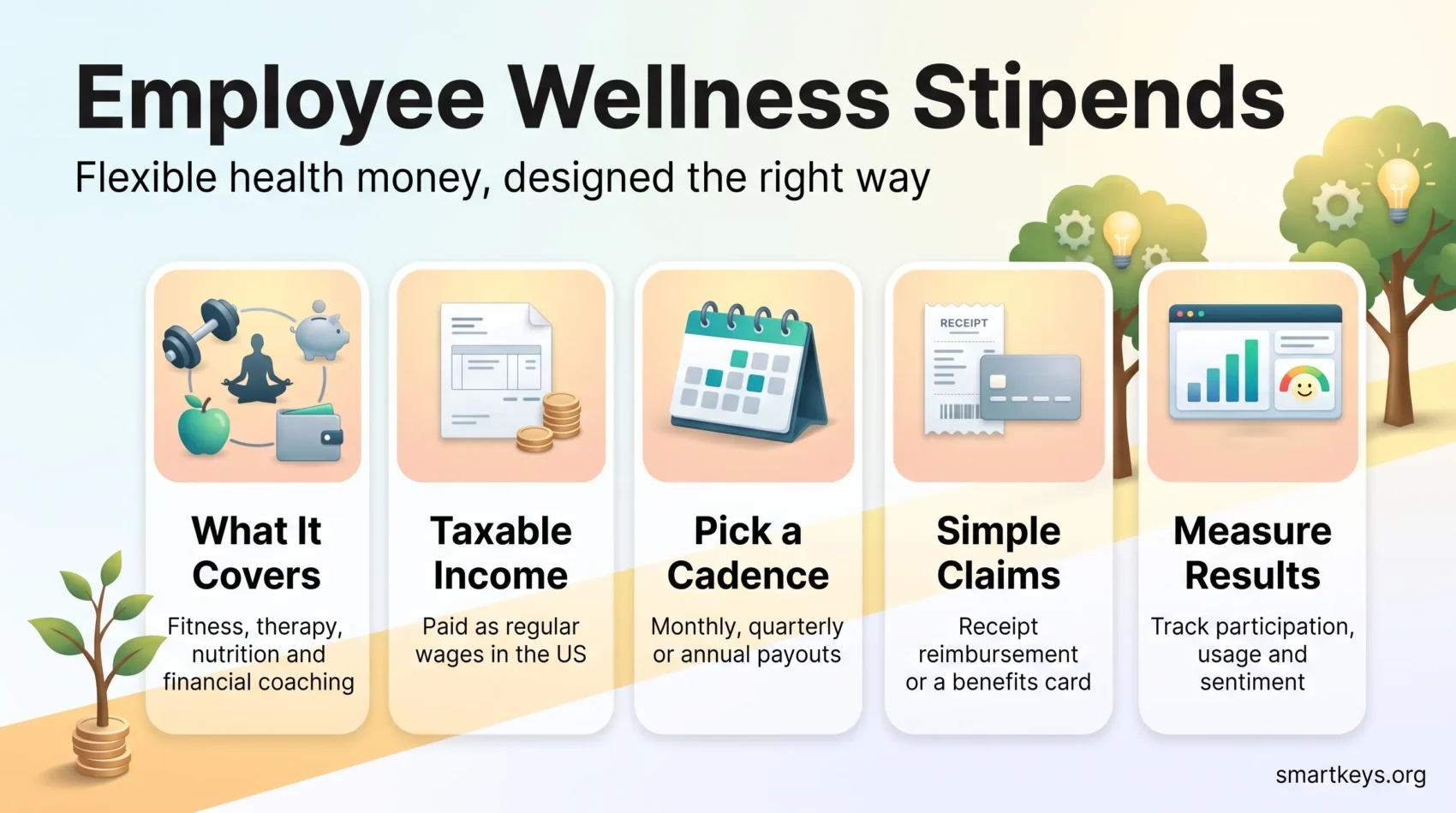
The IRS treats employer wellness payments that are not reimbursements of actual medical expenses as wages. Chief Counsel Advice 202323006, issued in June 2023, addressed employer-funded fixed-indemnity wellness arrangements and concluded that payments made without a corresponding unreimbursed medical expense are taxable and subject to FICA, FUTA and federal income tax withholding.
For your purposes that means the allowance belongs on the W-2 and in payroll, not in a benefits system that quietly bypasses both. Vendors occasionally market structures that promise payroll tax savings on wellness payments; that is the exact pattern the IRS guidance was written about. Check any such offer with your own tax counsel before signing.
What taxation does to the employee’s number
This is the part employees notice, so say it out loud in your announcement. If you give $100 and the employee’s combined federal, state and payroll withholding comes to roughly a quarter of it, they spend about $75. You can either accept that and communicate it clearly, or gross up the payment so the after-tax amount matches the headline figure. Grossing up costs you more per employee but removes the most common complaint about the benefit.
What the evidence actually supports
There is good data on the link between employee health and performance, and much weaker data on stipends specifically causing that link. Keep the two separate when you build your business case, because a leadership team that later discovers the gap will distrust the whole program.
What health and performance data shows
MetLife’s 2026 US Employee Benefit Trends Study, published on 7 January 2026, found that 44% of employees felt holistically healthy. Those who did were reported as 25% more productive and loyal and took 10% fewer sick days. The same study found employees missed an average of 6.1 workdays a year to health issues, that 50% sometimes avoid care because of out-of-pocket costs, and that employees using five or more non-medical benefits were 38% more likely to feel holistically healthy.
Wellhub’s State of Work-Life Wellness 2026, based on more than 5,000 full-time employees surveyed across ten countries between 13 May and 13 June 2025, reported that 89% of workers say they perform better when they prioritize their health. It also found a wide gap between employees with a wellness program and those without: 61% versus 40% rated their overall wellbeing good or thriving, and 77% versus 38% believed HR genuinely cared about them.
Where the argument gets weaker
Every figure above is correlational and most come from survey self-reports, several of them published by companies that sell wellbeing products. Healthier employees perform better; that does not prove that giving them $50 a month made them healthier. Independent research on workplace wellness programs has repeatedly found smaller effects than vendor material suggests.
So make the honest case instead. A stipend is a low-cost, high-visibility signal that you take employee health seriously, it fills gaps your insurance does not, and it gives distributed staff equal value. Forecast it as a retention and attraction lever with a modest, testable effect, not as a health-cost reduction plan. That framing survives scrutiny; the other one does not.
How much to give, and how often
Published benchmarks land far below the figures that circulate in blog posts. WTW research reported by SHRM put the average employer LSA contribution at about $850 per employee per year. Treat that as the middle of the market rather than a target: a few hundred dollars a year is common at small companies, and the largest programs run into four figures.
Ignore the lists of famous-company stipend amounts that circulate online. Most trace back to recruiting pages or vendor blogs, are years out of date, and tell you nothing about eligibility rules, proration or whether the number is grossed up. Benchmark against companies that compete with you for the same candidates, using data you can actually verify, such as job postings and offers your recruiters see.
Choosing a cadence
Three patterns dominate, and each suits a different goal:
- Monthly: best for habit-forming spending such as gym or therapy subscriptions. Highest administrative load, steadiest utilization.
- Quarterly: a middle path. Enough money at once for a real purchase, few enough cycles to keep payroll simple.
- Annual: suits one-off purchases such as a bike or a home gym item. Risks a year-end rush and higher forfeiture if people forget.
Whichever you choose, decide up front what happens to unspent money, how new hires are prorated, and whether anything rolls over. Silence on those three points generates more HR tickets than the rest of the policy combined.
Which expenses to allow
A short, concrete category list drives more usage than a long, abstract one. Name real examples so nobody has to email HR to find out whether their purchase counts.
Most programs cover four or five areas:
- Physical health: gym and studio memberships, classes, personal training, home equipment, and fitness trackers or app subscriptions.
- Mental health: therapy and counseling sessions, meditation and sleep apps, and stress management courses. This is often the highest-value category for people working remotely, where isolation is a real risk.
- Nutrition and recovery: dietitian consultations, meal delivery services, massage, physiotherapy.
- Financial wellbeing: financial coaching, budgeting tools, debt or student loan guidance. Money worries are one of the most commonly reported stressors, so this category earns its place even though it looks least like “wellness”. Telehealth and app-based services have widened what fits in every category here, a shift covered in more depth in our guide to digital health trends.
- Caregiving and family support: optional, but it makes the benefit meaningful for employees juggling work and children rather than only for people with spare evenings.
Exclusions matter as much as inclusions. State clearly whether alcohol, general shopping, family members’ purchases and equipment you already supply are covered. Write the exclusions in the same document as the categories, not in a separate policy nobody reads.
Running the program without creating a second job
Most of the administrative pain in a stipend program comes from decisions nobody made in advance. Settle these before launch.
Reimbursement or card
Reimbursement means employees pay, submit a receipt and get repaid through payroll. It produces clean documentation and needs no new vendor, but the friction of claiming suppresses usage, and people on tight budgets cannot front the money.
A benefits card or platform loads funds the employee spends directly. Usage is higher and the experience is better, but you add a vendor, a fee and a dependency, and the platform still has to feed taxable amounts into payroll correctly.
Small programs usually start with reimbursement and move to a platform once the claim volume justifies the fee. If you go the platform route, an employee experience platform may already include a spending account module you are paying for.
Documentation and payroll
Agree these with Finance and Payroll before you announce anything:
- Which receipts are required, and what counts as sufficient itemization.
- How long records are kept, and where.
- The cut-off date for each tax year, so December claims do not land in the wrong one.
- Who approves what, and the service level for approvals. A two-week approval queue kills a benefit faster than a small budget does.
- Whether you gross up, and how that appears on the payslip.
Distributed and international teams
Currency and local tax rules turn a simple benefit complicated. A fixed dollar amount is worth very different things in different countries, and tax treatment of employer allowances varies widely. Decide whether you pay one global amount, adjust by local cost, or set a regional figure, and document the reasoning the same way you would for pay transparency. Also check whether local vendors exist for your listed categories before you promise them.
Getting people to use it
A stipend nobody claims is not a saving, it is a broken promise that still cost you the setup work.
Four things move participation more than anything else:
- A one-page explanation. What you get, what counts, how to claim, what the tax does to the amount. One page, with examples, linked from wherever your team already looks things up.
- Time to use it. Wellbeing that has to happen at lunch is not a benefit. Teams with real flexibility over their time off and clear boundaries around after-hours contact use these programs far more than teams without.
- Managers who use it visibly. If nobody senior ever mentions a therapy session or a midday run, staff read the policy as decoration. Give managers talking points; they usually just do not know what they are allowed to say.
- Reminders with content. “You have $180 left and it expires on 31 December” works. A quarterly wellbeing newsletter does not.
Be alert to the failure mode here. Offering a stipend while workload keeps climbing reads as an insult, and it is one of the fastest ways to turn a burnout problem into a trust problem. If exit interviews point at staffing and hours, fix those first and launch the stipend afterwards. Structural changes such as a sabbatical policy or a shorter working week address workload directly in a way no allowance can.
Measuring whether it worked
Track a small number of things well rather than building a dashboard nobody opens.
Start with four measures:
- Participation rate: the share of eligible employees who claimed at least once in the period. This is your headline number.
- Utilization: money claimed as a share of money budgeted. A large gap means either the amount is too high or the process is too hard, and those need different fixes.
- Category mix: where the money actually goes. It tells you what your team needs, which is often not what you assumed.
- Sentiment: two or three questions inside the survey you already run. Short, regular engagement surveys are better for this than a once-a-year census, provided you act on what comes back.
Resist attributing retention changes to the stipend on its own. Turnover moves with pay, management, the job market and a dozen other things. What you can defend is a statement like “participation reached 68%, mental health was the largest category, and benefits satisfaction rose six points”. That is honest, it is measurable, and it is enough to justify renewing a modest budget line.
Review the program once a year alongside the rest of your benefits package. Categories that attract almost no claims should be cut or explained better; categories that run dry early may deserve a bigger share.
Conclusion
A wellbeing stipend is one of the cheapest, fastest benefits to launch and one of the easiest to get wrong. Get right the parts that are genuinely in your control: a clear category list with real examples, a cadence your payroll can live with, an honest explanation of tax, an approval process that takes days rather than weeks, and a small set of measures you actually review.
Be equally clear about what it is not. It is not a substitute for adequate staffing, reasonable hours or competent management, and it will not bend your medical cost curve. Presented as a genuine extra that respects where and how people work, it does its job. Pair it with flexible working arrangements and a culture that treats recovery time as legitimate, and the money goes considerably further than it does on its own.
Found this useful?
Make SmartKeys a preferred source on Google, and our articles will surface more often in your Top Stories, AI Overviews, and AI Mode.
Add as Preferred Source