Your path to market starts with knowing how products move from maker to buyer. Intermediaries—wholesalers, retailers, agents, and brokers—still add scale, logistics, and expertise. At the same time, DTC brands like Warby Parker and platforms such as marketplaces let small teams sell directly and control the customer experience.
You’ll get a clear roadmap that shows how revenue and value flow across a network and why your channel choices shape your market footprint. Digital tools like CRM, automation, and AI let you manage partners more precisely and speed sales and fulfillment.
By the end, you’ll know how to match your products and market with the right route-to-customer plan. The guide covers levels of route-to-market, partner agreements, U.S. tactics like franchises and wholesale, and a practical strategy to protect margins and improve the customer experience.
Key Takeaways
- Understand how networks link your products to buyers and how value flows.
- Choose between direct, indirect, or hybrid routes based on goals.
- Use intermediaries for scale and digital tools for control.
- Align route length with pricing, speed, and service goals.
- Build partner agreements that protect brand and margins.
- Track simple KPIs to spot conflict and optimize performance.
Why Distribution Channels Matter Now in the United States
How you place products in the U.S. market directly shapes profit, reach, and the experience customers remember. Your route-to-market affects whether your inventory is available where shoppers buy and how fast orders ship.
Strong partner choices broaden regional access, cut logistics cost, and improve availability — all of which build loyalty. Your company can tap retailer foot traffic or marketplace demand to grow faster than building warehouses or a field team alone.
How paths connect production to profit and the customer experience
Every step you add raises cost and can erode margin, so pick touchpoints that add clear value. Use CRM and analytics to map where your customers buy and where your coverage overlaps.
Aligning strategy with present-day market realities
- You rely on partners to place inventory where U.S. shoppers expect stock and fast delivery.
- The right mix expands market reach quickly while keeping your customer promise on fulfillment.
- Digital commerce lets your business sell direct, but marketing and fulfillment must match local needs.
- Test-and-learn pilots help optimize cost, pricing, and promotions before you scale nationwide.
- Clear goals let you balance profit with service speed across retail, DTC, and marketplaces.
distribution channels
Think of a channel as the pathway that carries products forward and brings money and data back to your team. This view helps you trace where margin is made and where it dissolves.
Core flow: goods move from producer to consumer, revenue flows in reverse, and data from orders and inventory feeds planning and forecasting.
Key players and roles
- Producer / manufacturer: makes the product and sets price and supply.
- Agent / broker: commission-based connector who links buyers and sellers.
- Wholesaler: buys bulk, rebundles, and handles warehousing.
- Retailer: displays, markets, and sells to the end consumer.
- Consumer: completes the cycle with purchase and feedback.
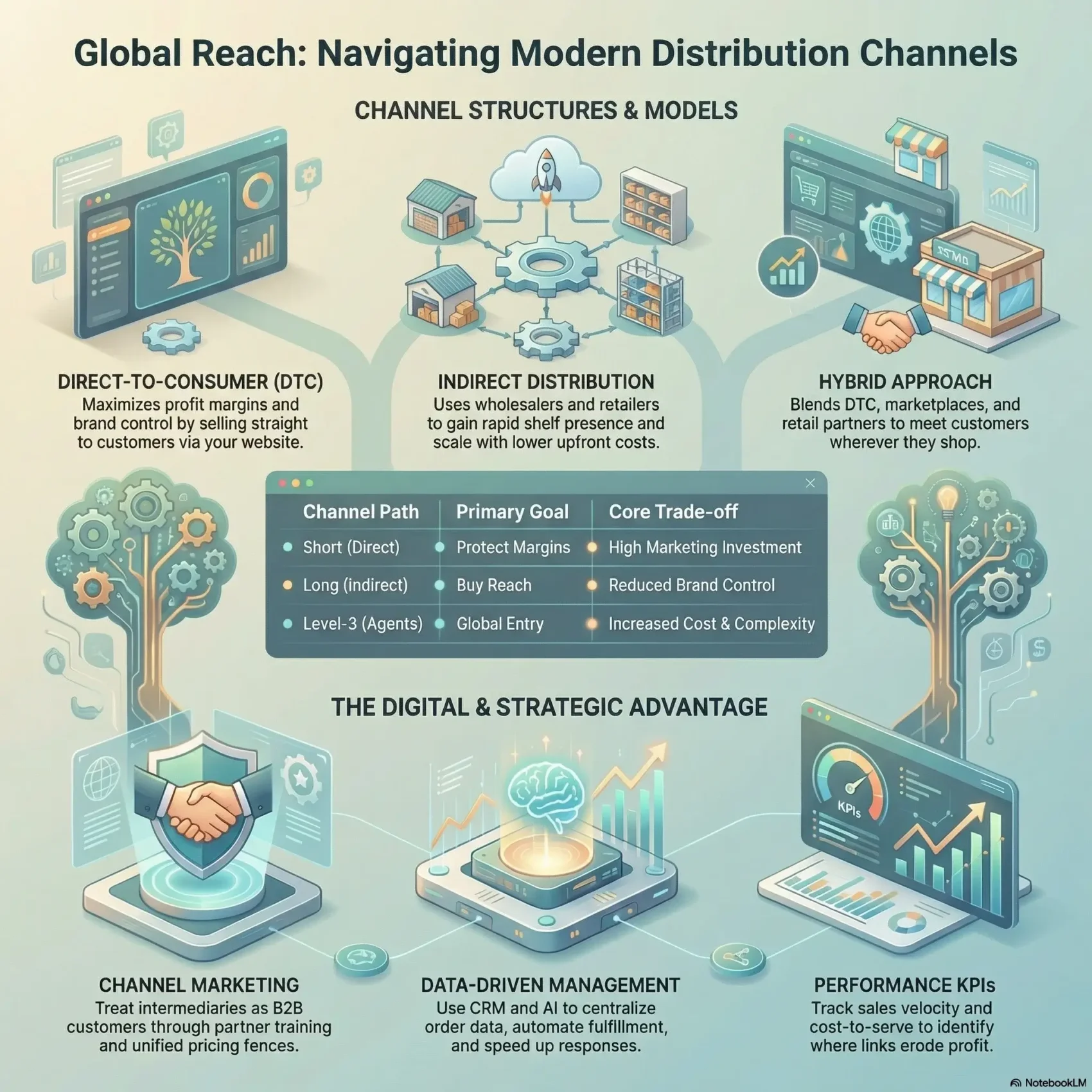
Short paths (e.g., Company > VAR > Customer) speed delivery and protect margin. Long paths (e.g., Company > Distributor > Wholesaler > Retailer > Customer) add scale but increase cost and complexity.
You’ll use data from touchpoints to improve forecasting and spot margin leaks. When you need more control, trim links; when you need scale, add partners. For a practical omnichannel primer, see omnichannel strategies.
Direct, Indirect, and Hybrid: Choosing the Right Channel Structure
The structure you pick—direct, indirect, or hybrid—shapes pricing, reach, and the customer experience. Choose with goals in mind: control and margin, speed and scale, or a blend that balances both.
Direct channels
Direct models sell straight to customers via your site, stores, or field sales. This approach maximizes margin, first‑party data, and brand control.
Tradeoff: you must invest in marketing, fulfillment, and service to scale profitably.
Indirect distribution
Using partners like wholesalers or retailers gives you reach fast. Intermediaries manage logistics, merchandising, and in‑store execution so your team can focus on product and sales.
Benefits: lower upfront cost to enter regions, faster shelf presence, and partner expertise. Expect lower margin and less direct customer data.
Hybrid models
Blend DTC, retail partners, and marketplaces to meet customers where they buy. A hybrid approach captures demand without overextending your resources.
- Match product type to the path: configurable or service‑rich items often do best direct; mass‑appeal goods excel via partners.
- Protect your brand with pricing rules, content standards, and partner training.
- Run small pilots to test conversion, marketing ROI, and operational readiness before you scale.
Channel Levels and Length: From Level-0 to Level-3
A product’s path—from manufacturer to consumer—can be one step or four; each step changes speed and margin.
Level-0: direct-to-consumer and SaaS
Level-0 means you sell straight to consumers. This is common for DTC goods and SaaS subscriptions supported by a subscription system.
Level-1 and Level-2: retailer and wholesaler roles
Level-1 inserts a retailer to expand storefront access and merchandising power.
Level-2 adds wholesalers who break bulk, optimize shipments, and stabilize stock across outlets.
Level-3: agents for multi-region and international markets
Level-3 brings agents ahead of wholesalers and retailers. Agents broker relationships, manage compliance, and reduce market-entry friction for international rollouts.
“Short chains protect margin; longer chains buy reach.”
- You’ll map products to levels by shelf life, support needs, and demand variability.
- Assess how the number of links affects cost-to-serve, lead times, and pricing flexibility.
- Use retailer and wholesaler SLAs to set service levels and stock turns.
Designing Your Distribution Strategy and Go-to-Market
A clear go‑to‑market plan links product features, market need, and the right partners. Start by weighing market size, product complexity, competitor routes, and what your company can realistically support.
Market, product, competitor, and company characteristics to weigh
Assess product service needs, shelf life, and price sensitivity. Look at competitor strategy to spot white space.
Factor in your operations and sales capacity before promising coverage or speed.
Setting SMART goals, target audience, and segmentation
Set SMART goals for coverage, velocity, and margin so everyone knows success metrics.
Define your target audience and segment by behavior. Map each segment to the channel most likely to convert and retain customers.
Selective, intensive, and exclusive approaches
Intensive distribution maximizes availability; selective keeps a tighter retail mix; exclusive preserves prestige and margin.
Channel marketing treats intermediaries as B2B customers—train retailers, provide content, and use pricing fences to prevent conflict.
- Phase your launch to learn fast and limit risk.
- Align inventory and promotions with each market’s buying cycle.
- Set governance, roles, and escalation paths for partners.
The Digital Age Advantage: Data-Driven Channels and CRM
Modern commerce puts data at the center of every channel decision, shrinking guesswork and waste. Digital tools make direct routes more viable and let small teams sell online with enterprise-grade precision.
eCommerce, social commerce, and online marketplaces in your mix
You’ll plug eCommerce, social commerce, and marketplaces into your mix to capture demand where customers already shop. Social networks shape discovery, while marketplaces give instant reach and built-in traffic.
Using CRM and analytics to manage partners, customers, and KPIs
A CRM system unifies customer and partner data so you can track KPIs, partner performance, and customer health in one place. Use an enterprise system to centralize order, inventory, and service records for clearer decision making.
Automation and AI to streamline sales, marketing, and fulfillment
Automation frees your sales and marketing teams from repetitive work so they focus on high-impact engagement. AI can score leads, suggest offers, and speed responses to returns or inquiries.
- Orchestrate campaigns to avoid mixed messages and price erosion.
- Build service workflows to handle returns and post-purchase services consistently.
- Use dashboards to compare acquisition cost, conversion, and repeat rates by source.
“You need clean data and clear playbooks to turn digital tools into consistent margin and faster delivery.”
Working with Intermediaries and Partners
Intermediaries can act as force multipliers when you assign clear roles and guard your brand. Use their reach and local know-how to cut cost and speed delivery, but plan for tradeoffs in pricing and presentation.
Who does what
Distributors extend reach and manage logistics. Wholesalers buy bulk and rebundle for retailers. Retailers sell to consumers and shape shelf presence.
VARs add features; SIs integrate systems; MSPs run services; OEMs supply parts. Use agents to open new markets selectively.
Negotiation and relationship management
- Set terms on cost, service levels, territory, and reporting to protect margin and brand.
- Evaluate companies for coverage, category expertise, and resources before signing.
- Manage the relationship with scorecards, quarterly reviews, and enablement programs.
- Align incentives—rebates, MDF, co-op—to drive partner behavior and guard pricing discipline.
“Clear rules and active management turn partners into reliable extensions of your company.”
U.S. Market Playbook: Channel Tactics and Examples
Build a playbook that makes it easy for retailers and customers to find, buy, and reorder your products. Start by matching each product to the right route in the U.S. market and set clear goals for reach and margin.
Retail partnerships, wholesale routes, and franchise examples
Retail partnerships leverage supermarket and department store reach. Coca‑Cola uses intensive retail distribution to secure mass availability and impulse purchases.
Wholesalers reduce storage cost and broaden access for retailers. Tech makers sell in bulk to wholesalers who service electronics chains and national buyers.
Franchise models like McDonald’s expand fast by using a standardized playbook that preserves service and brand quality across locations.
DTC success and marketplace tactics
DTC plays focus on site experience, conversion, and retention. Warby Parker shows how home try‑ons and brand control can disrupt an established market.
Marketplaces like Amazon give built‑in traffic and fulfillment tools. Win by optimizing listings, earning reviews, and meeting fast shipping badges to boost sales and discoverability.
- Pitching retail: prove demand, align resets and promotions, and secure shelf space with data.
- Wholesale: use bulk terms for products with steady replenishment cycles.
- Franchise: codify operations so local owners scale your services consistently.
- Marketplace tactics: aim for Buy Box wins, fast fulfillment, and strong review scores.
“Compare gross-to-net across routes and tailor your marketing calendar to retail events, DTC launches, and marketplace tentpoles.”
Measuring Performance and Optimizing Your Channel Mix
The right metrics reveal where complexity eats margin and where to invest more. Start with a few KPIs that tie directly to your goals so you avoid noisy reports and focus on results.
KPIs to watch
Use CRM and analytics to track reach, sales velocity, cost-to-serve, margin impact, and stock availability by distribution channel.
- Select KPIs that map to coverage, conversion, repeat rate, and contribution margin.
- Build a unified data layer and system dashboards that report by partner and route.
- Monitor sales velocity and cost so you can spot where an extra link in the chain erodes profit.
Detect conflict and refine strategy
Detect channel conflict early with pricing variance reports, audience overlap checks, and promo collision alerts.
Use partner scorecards, QBRs, and cohort analysis to compare lifetime value across sources and hold teams to clear management targets.
“Measure what matters and use playbooks to move budget and inventory to top-performing routes fast.”
Optimize with small tests: assortments, pricing fences, and service levels. Align incentives so your sales, operations, and retail teams work toward the same profit and service goals.
Conclusion
Your go-to-market choices should prioritize customer access, operational simplicity, and measurable returns. Pick the simplest effective route for your products and audience and avoid extra links that erode margin.
Blend direct, indirect, and hybrid approaches to match how U.S. buyers discover and buy. Use CRM, analytics, and automation to manage partners and measure what matters.
Set SMART goals and KPIs, then iterate the mix from real results and customer feedback. Align pricing, assortments, and service to prevent conflict and protect contribution margin.
Finally, roll out in phases, treat partners as extensions of your business, and keep testing so your distribution strategy compounds growth over time.