You need a clear, practical plan to manage how intelligent systems touch your data, customers, and staff.
Good governance gives your teams structure to align development and deployment with values, legal duties, and business goals.
The wrong approach invites real risks. High-profile failures like Microsoft’s Tay and biased tools such as COMPAS show how quickly trust and brand value can erode without oversight.
This section previews a concise framework for compliance, privacy, and security that helps your organization balance innovation with safe use. You’ll see who should sit at the table—developers, product leads, legal, ethicists, and impacted users—and how processes and standards map to operations.
For practical steps on decision checkpoints and risk controls, explore a focused guide to responsible decision-making here.
Key Takeaways
- Governance gives you the structure to reduce risks while enabling innovation.
- Include stakeholders across functions to ensure resilient oversight.
- Plan for privacy, security, and transparency from design through use.
- Follow regulatory frameworks and policies to support compliance.
- Operationalize standards into processes, tooling, and documentation.
Why AI governance matters right now
You’re under pressure to move fast, but rushing without oversight creates costly blind spots. Quick adoption can hide flaws in systems and let bias travel from test to production.
“Without clear rules and monitoring, models and datasets drift, and trust erodes.”
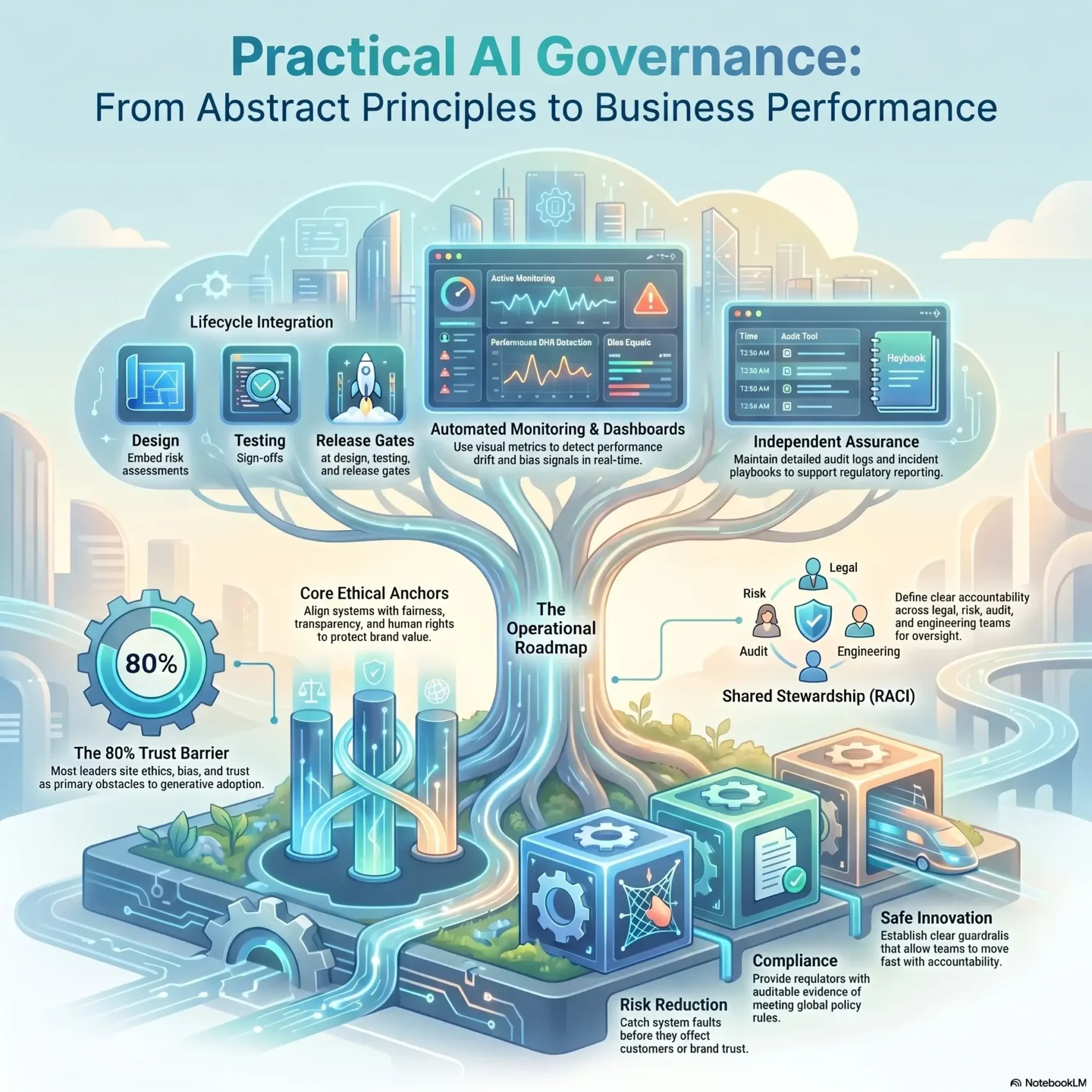
The stats are stark: 80% of business leaders cite explainability, ethics, bias, or trust as major barriers to generative adoption. High‑profile failures such as Tay and COMPAS show how real-world harms damage brands and invite scrutiny.
- Reduce hidden risks: Oversight helps you catch faults before they affect customers.
- Protect data and privacy: Define how teams collect, use, and store information.
- Prove compliance: Evidence and records show regulators and auditors you meet rules.
- Enable safe innovation: Clear guardrails let teams move fast with accountability.
Good governance aligns stakeholders, clarifies responsibility, and keeps systems reliable as conditions change. It’s the practical path to balancing innovation with safety and transparency.
Defining AI governance for your organization
A defined set of controls turns uncertainty into predictable, auditable outcomes.
Start by defining governance as the set of policies, procedures, and oversight that manage intelligent systems across the lifecycle. Cover everything from problem framing and data sourcing to deployment, monitoring, and retirement.
Policies, procedures, and oversight across the lifecycle
Document the checkpoints where you review design choices, run risk assessments, and approve releases.
Specify artifacts such as model cards, data sheets, and risk logs so decisions are traceable and explainable.
Guardrails for fairness, transparency, privacy, and security
Set clear boundaries for acceptable system behavior. Define privacy rules for data handling and access. Embed security controls to protect production systems and customer information.
Balancing innovation with risk management and trust
Operationalize policy by linking it to existing processes and MLOps workflows. Assign stakeholders who own each control to avoid gaps and duplication.
- Lifecycle checks: design review, data validation, acceptance testing.
- Artifacts: data sheets, risk assessments, audit trails.
- Ownership: product, legal, security, and data teams share responsibilities.
With a shared language for fairness and transparency, you let teams experiment while keeping risk management proportionate to impact. That balance preserves trust and keeps your organization moving forward.
Core principles to anchor responsible AI
Set clear ethical anchors so every decision about systems and data points back to shared values. These principles guide choices from dataset design to deployment and monitoring.
Fairness and bias mitigation across datasets and models
Fairness is non‑negotiable. Use diverse data, run bias tests, and apply mitigation techniques so outcomes treat people equitably.
Adopt concrete acceptance criteria for datasets and models before they ship. Track issues found and resolved as a measure of progress.
Transparency, explainability, and human rights by design
Transparency and explainability build trust. Document pipelines, use interpretable methods, and require human review for high‑impact decisions.
Design systems to respect human rights and basic rights such as dignity and due process. Align internal policies with standards like the OECD Principles and consider EU rules for high‑risk uses.
- Operationalize principles into policies and acceptance tests.
- Measure fairness and clarity via surveys and issue logs.
- Refer to global standards to strengthen defensibility.
“Trust comes from clear rules, evidence, and ongoing accountability.”
AI governance model
A practical governance model shows who decides, what evidence you keep, and how controls scale as adoption grows.
You’ll map lifecycle checkpoints into simple, repeatable processes. Embed risk reviews, privacy and security checks, and ethical sign‑offs at design, test, and release gates.
Align that structure to common governance frameworks and legal requirements so auditors and regulators can see coverage. This makes compliance and reporting easier.
- Decision rights: who approves releases and who owns remediation.
- Evidence: documentation, logs, and standards for data lineage and quality.
- Scale: modular steps that apply across teams and systems.
Clarify accountability by assigning owners for documentation, monitoring, incident response, and decommissioning. Use quarterly reviews to learn from audits and production incidents and to refine processes and management practices.
Roles, accountability, and cross-functional ownership
Clear roles and visible ownership keep risk from hiding in plain sight. You need leaders who set tone, fund programs, and demand training across the organization.
Board members, the CEO, and senior leaders create culture by prioritizing resources and insisting on measurable controls. Legal and general counsel assess legal risks. Audit validates data integrity and control effectiveness.
Shared stewards and everyday practice
Assign legal, risk, audit, and data leads as shared stewards. They translate policies into daily processes and verify controls work as intended.
RACI and oversight mechanisms
- RACI clarity: define who is Responsible, Accountable, Consulted, and Informed so teams know who must approve artifacts.
- Oversight mechanisms: governance committees, approval gates, and enforced audit trails keep activity traceable.
- Audit authority: give auditors access to systems, datasets, code, and documentation for independent assurance.
“Document why you make decisions and record variances so your team can learn and improve.”
About 80% of organizations now include a dedicated risk function for oversight. Empower cross-functional stakeholders to escalate early and resolve conflicts between speed and safety.
Risk management and controls aligned to the AI lifecycle
Treat risk as continuous work, not a one-time checkbox during deployment. Your program should start with an inventory and clear risk ratings so teams know what needs close attention.
Model risk management: drift, performance, and robustness
Keep an up-to-date register of every model and its purpose. Schedule periodic validation and stress tests that check robustness and performance thresholds.
Automated monitoring should detect drift, performance slip, and anomalies so you can intervene before outcomes degrade.
Bias, privacy, and security risks with continuous monitoring
Implement continuous checks for bias, privacy, and security risks across data pipelines. Add quality checks, lineage tracking, and access controls to reduce upstream failures.
- Lifecycle controls: inventories, ratings, validation, and monitoring.
- Detection: drift alerts, performance thresholds, and robustness tests.
- Response: pause, retrain, or retire criteria tied to business and safety thresholds.
- Assurance: independent validation, audit trails, and tickets to prove control effectiveness.
“Capture evidence and show reviewers the decisions, the tests, and the fixes.”
Data governance as the foundation for trustworthy systems
Strong data stewardship is the practical foundation that keeps your systems reliable. Treat your information lifecycle as a first‑class concern so decisions rest on clear, measurable facts.
Data quality, lineage, minimization, and retention
You’ll treat data governance as the bedrock, defining quality rules, lineage capture, and retention schedules that reflect business and regulatory needs.
Minimize collection by limiting personal information to what is necessary and documenting purpose limitation. That protects privacy while reducing exposure.
Standardize metadata and documentation so teams can quickly assess suitability for training and lower downstream errors and rework.
Sensitive data protection and access controls
Enforce role‑based permissions, segregation, and logging to prevent misuse of sensitive information. Strong access controls support security and auditability.
Embed validation checks into your processes to catch drift, anomalies, and data quality regressions before they destabilize systems.
- Policies & standards: align retention, masking, and consent rules with GDPR and internal standards.
- Processes: automated lineage capture, metadata catalogs, and periodic reviews keep data healthy.
- Shared responsibility: connect producers and consumers so teams jointly own data quality over time.
“Data health is not an IT project — it’s an organizational habit.”
Global frameworks you can operationalize today
Global standards give you a practical map to turn policy into repeatable work. Start by aligning your controls to proven frameworks so teams know what to build and why.
NIST AI Risk Management Framework: mapping, measuring, managing
The NIST AI RMF offers voluntary guidance to help you map, measure, and manage risk. Map controls to core functions, assign owners, and track progress with dashboards.
OECD AI Principles: human-centric values and accountability
Use the OECD Principles (updated May 2024) to benchmark human rights, fairness, and accountability. They help you translate values into testable acceptance criteria and accountability records.
EU AI Act: risk-based requirements and transparency rules
The EU Act creates risk tiers with strict requirements for high‑risk applications and penalties for noncompliance. Apply those categories to prioritize documentation, testing, and human oversight.
- Map controls to NIST functions so work is trackable.
- Benchmark design against OECD principles for human-centric practice.
- Apply EU requirements to decide where extra transparency and checks are needed.
- Translate requirements into runbooks, checklists, and audit-ready artifacts to show compliance.
“Standards and clear frameworks turn policy into daily practice.”
Regulations shaping compliance in the United States and beyond
Regulatory shifts are reshaping how your teams document, test, and report automated decision processes.
The October 2023 U.S. Executive Order on Safe, Secure, and Trustworthy AI directs agencies to develop standards and guidance you can align to now. That helps you preempt future rules and reduce surprise workloads when agencies publish rules.
Banking precedent matters. SR 11‑7 requires banks to inventory models, validate them, and show they meet intended business purposes. It emphasizes drift management, assumption logs, and clear documentation. You can adapt those practices across other parts of your business.
- Practical takeaways: align internal policies and controls to the Executive Order and SR 11‑7 to make compliance evidence easy to produce.
- Watch international moves — Canada’s Directive on Automated Decision‑Making and China’s 2023 Interim Measures raise expectations on peer review, human failsafes, rights, privacy, and security.
- Assign owners to track regulatory updates and translate requirements into auditable procedures.
“Turn policy signals into checklists, logs, and named owners so auditors and clients find evidence without friction.”
Technical standards and benchmarks to raise the bar
Industry norms and benchmarks raise the bar so your systems meet repeatable quality checks. You’ll use those references to turn abstract expectations into verifiable tests for data, security, and performance.
ISO/IEC JTC 1/SC 42 provides standards for data management, transparency, and security so your development and evaluation activities follow best‑in‑class practice.
ISO, IEEE, and ITU guidance for consistency
IEEE and ITU publish sector guidance and focus groups that help you tailor governance to your industry. That improves interoperability and external assurance when regulators or partners ask for evidence.
Security-by-design, adversarial testing, and resilience
Embed security-by-design by threat modeling systems, securing data pipelines, and validating controls before launch.
- Conduct red‑teaming and adversarial testing to expose weaknesses in models and integrations.
- Strengthen explainability where feasible and document limitations candidly for downstream users.
- Define resilience: degraded modes, fail‑safes, and recovery plans to keep critical services running under stress.
“Standards make testing repeatable, audits clear, and risk management measurable.”
Ethical policies, internal guidelines, and governance best practices
Practical rules and easy guidelines make it simple for teams to do the right thing under pressure. You’ll draft policies that turn principles into daily steps for design, training, and deployment.
Start with a template: state principles, scope, roles, audit cadence, and an incident response plan. Use real examples—SAP’s AI Ethics & Society Steering Committee and Microsoft’s Responsible AI Standard—to see how large firms assign committees and written standards.
Make guidelines clear and short. Spell out documentation expectations, review cadence, and escalation paths so teams can act fast when issues appear.
- Policy to practice: convert values into checklists for acceptable design and data handling.
- Independent review: adopt outside or cross‑functional ethics reviews and community input.
- Accountability: name owners, enforcement steps, and consequences for violations.
- Update cycle: review policies and best practices regularly as risks change.
“Make rules practical, visible, and enforceable so stakeholders know who acts and why.”
Building your AI governance operating model
Build an operating model that turns good intentions into repeatable, auditable practices. Start by assessing where your organization sits on a simple maturity curve. Informal, values-based work evolves into ad hoc policies and then into formal frameworks as risk and scale grow.
From informal to formal maturity
Measure readiness by cataloging who makes decisions, how data flows, and which systems need oversight. A mature approach adds comprehensive risk assessment, ethical review, and ongoing monitoring.
Committees, charters, and decision rights
Set up a governance committee with a clear charter and regular cadence. Document who approves releases, handles exceptions, and accepts risk so stakeholders know when to escalate.
- Assess maturity: define steps to move to formal management and tooling.
- Committee & charter: membership, cadence, portfolio oversight.
- Decision rights: approvals, exception handling, risk acceptance.
- Mapped processes: align engineering, product, legal, and risk.
- Standards: use templates to speed reviews and reduce fatigue.
“Make roles and rules explicit so reviews are fast, consistent, and auditable.”
Finally, track throughput, quality, and time-to-approval to ensure the operating model improves outcomes without creating bottlenecks. Good standards and clear processes keep your data and systems reliable as you scale.
Implementation roadmap and platform integration
A clear, phased plan turns scattered deployments into auditable, repeatable operations. Start with an inventory of systems and core controls, then add visual dashboards that surface health and risk posture.
Dashboards, health scores, and performance alerts
Visual metrics let teams see drift, bias signals, and performance slips at a glance. Build health scores that combine data quality, latency, and accuracy.
Automated monitors should trigger performance alerts tied to thresholds so your team can act before customers notice impact.
Audit logs, open-source toolchains, and seamless integration
Maintain detailed audit trails for training data changes, versions, approvals, and incidents to support reviews and compliance.
Select platforms and open-source toolchains that integrate with your stack to avoid silos and duplicated processes.
- Phased roadmap: inventory, core controls, dashboards.
- Automated monitoring: bias, drift, and performance alerts for rapid response.
- Auditability: logs for data, versions, approvals, and incidents to prove compliance.
- Integration: open-source tool compatibility and CI/CD checks as mechanisms to ensure systems follow standards.
“Make milestones measurable so you can show progress against regulatory expectations.”
Training, culture, and change management across the organization
Building the right skills and habits across teams keeps policy from being paper only. CEOs and senior leaders fund training and set the tone. They create space for honest questions and cross-team collaboration so controls stick.
Role-based education gives engineers, product owners, legal, and audit practical steps to follow. Use short courses, scenario workshops, and playbooks so people know what to do when data or systems behave oddly.
Keep awareness active. Run regular campaigns that highlight ethics, privacy, and security as your portfolio and policies evolve. Make it normal for anyone to raise concerns without fear.
- You’ll offer role-specific training that builds confidence in everyday choices.
- You’ll publish easy-to-find information, checklists, and real examples for teams to use.
- You’ll report completion and effectiveness to leadership so gaps are visible to stakeholders.
Measure and reward participation, and link learning to accountability. Practical training plus clear playbooks turns high-level governance into repeatable practices that protect data and keep systems reliable.
Audits, monitoring, and incident response you can trust
Independent assessments combined with automated monitoring give you early sight of emerging problems. Regular audits review systems, data, and processes so you have a clear record of decisions and outcomes.
Audit plans should spell scope, methods, and acceptance criteria. Findings must map to corrective actions and owners so fixes happen fast.
Independent reviews, continuous assurance, and reporting
You’ll commission independent reviews to validate controls and support compliance claims. Continuous monitoring reports trends and exceptions to leadership and the board.
- Verify evidence: ensure logs, data lineage, and tests back up compliance statements.
- Ongoing checks: automated alerts for bias, drift, security, and data issues.
- Transparent reports: clear summaries of status, risks, and remediation progress.
Escalation paths, remediation, and lessons learned
Define when to pause a service, who to notify, and when to engage legal or communications. Track remediation steps, measure effectiveness, and capture lessons learned so outcomes improve over time.
“Record decisions and the trade-offs you made so auditors and stakeholders see why you acted.”
Use cases and sector examples to learn from
Learning from sector-specific implementations helps you tailor controls to real risks and users.
Generative AI governance in high-stakes environments
Generative systems span text, images, and code and appear across healthcare and finance. In those fields, errors can cause harm or large monetary loss.
You’ll examine how teams add human-in-the-loop checkpoints, transparency disclosures, and stop-gap remediation to reduce risk.
Practical artifacts include test reports, decision logs, and acceptance criteria for models before they reach production.
Public sector directives and enterprise ethics boards
Public rules matter. Canada’s Directive on Automated Decision‑Making requires peer review, oversight, and human failsafes based on impact.
The EU Act demands extra transparency for high‑risk uses. Large firms like IBM set up ethics boards to review products and align releases with stated standards and rights.
- Sector fit: map controls to clinical, financial, or public use cases.
- Practical checks: transparency statements, human review, and incident playbooks.
- Translate to tasks: convert examples into simple checklists your teams can use when they scope and deploy new applications.
“Document the why, the tests, and the human approvals so reviewers see how you reduced risk.”
Conclusion
, Practical controls turn policy into repeatable work so your teams can move fast and stay safe.
You’re ready to implement a program that blends policies, standards, and trusted frameworks into daily routines. Focus on best practices that link oversight to measurable outcomes for data, systems, and user impact.
Align with NIST, OECD, and the EU Act to meet compliance while keeping a pragmatic roadmap for innovation. Rely on audits, monitoring, and ongoing training so this effort stays active, not one-off.
Keep building culture and clear ownership so responsible design becomes how you build, not just what you document.
Found this useful?
Make SmartKeys a preferred source on Google, and our articles will surface more often in your Top Stories, AI Overviews, and AI Mode.
Add as Preferred Source