Tools
Tools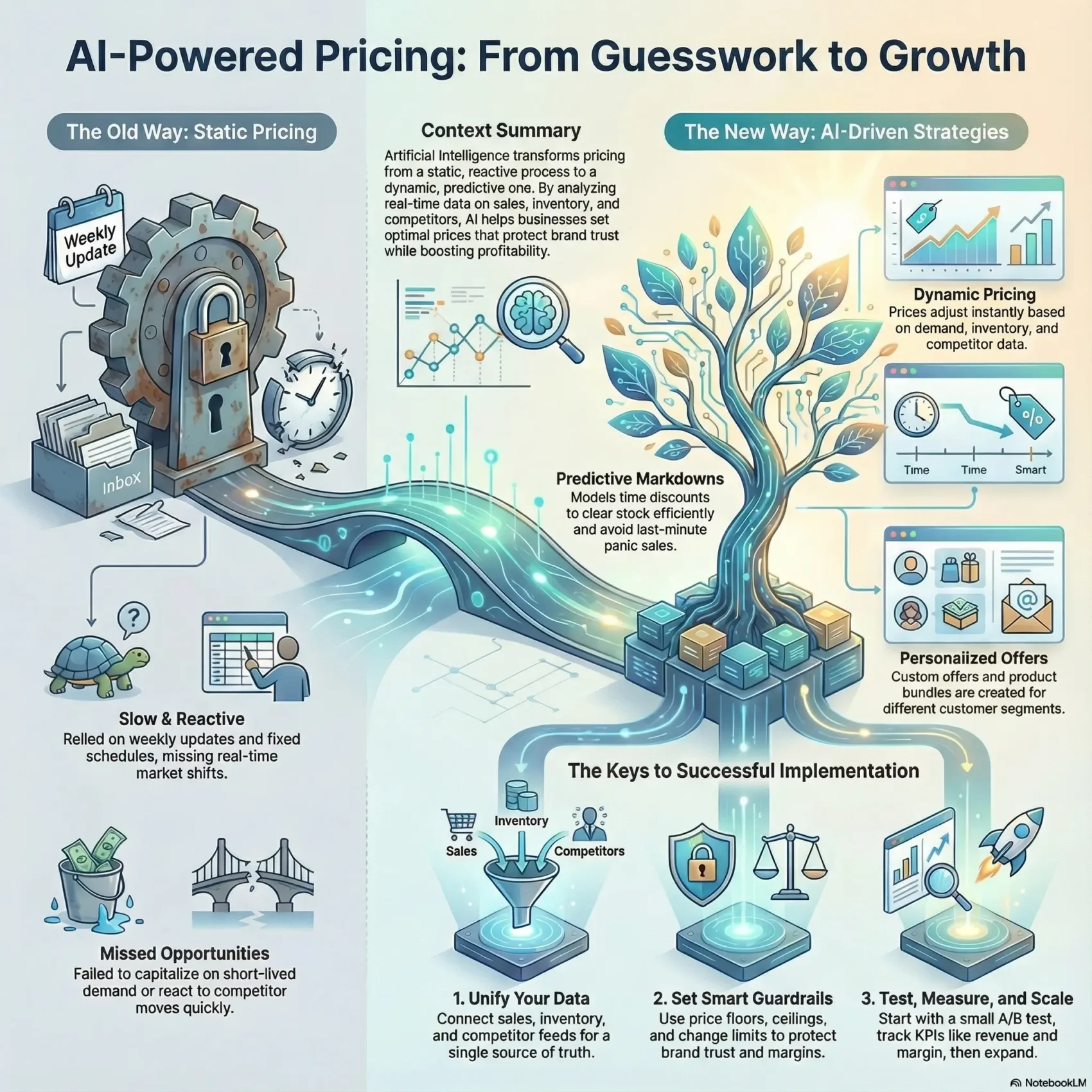
Last Updated on December 9, 2025
Welcome. You face faster markets and tougher choices about price and profit. Data now drives many decisions that used to rely on instinct.
Systems process customer behavior, business metrics, and broader market signals to suggest price points that balance value and profitability, per the U.S. Chamber of Commerce’s CO— (May 06, 2024).
Ben Schreiner at AWS notes data-driven price moves let small firms charge more to customers who gain more, lifting margins.
In practice, tactics like dynamic and personalized pricing—think Uber’s surge—show how fast adjustments beat monthly updates.
This section gives clear, practical steps so you can start small, test, and scale a pricing strategy that protects brand equity while lifting revenue and profit.
Key Takeaways
- You’ll shift from opinion-led price setting to a data-backed approach that reacts in near real time.
- Weekly updates fall short; algorithmic adjustments match digital market trends and inventory moves.
- Focus on dynamic and personalized offers where they fit your category and customers.
- Start with core data sources and expand—don’t wait for “perfect” data.
- Use tests and KPIs to prove revenue and profitability gains quickly.
- For more on predictive models and business use cases, see the predictive analytics guide.
What You’ll Learn to Master AI pricing optimization in today’s market
Understand the core signals and practical rules that guide automated price decisions in fast markets.
What you’ll get: a clear list of the data inputs and factors that drive recommendations. That includes sales and inventory signals, competitor moves, and customer behavior so you can brief stakeholders with confidence.
“Start with the inputs you trust, automate low-risk decisions first, and build guardrails as you learn.”
You’ll also get a simple governance approach that matches your business stage. The guide shows which decisions to automate and which to keep manual.
- A method to prioritize strategies like dynamic pricing, predictive markdowns, and personalized offers.
- How to convert model outputs into actions for merchandising, marketing, and finance.
- Test designs that isolate impact so you can prove value and expand with low disruption.
End result: a repeatable approach that ties recommendations to revenue, margin, and inventory turns so your plan supports growth and keeps customers and brand trust intact.
Foundations: How AI transforms pricing strategy, data, and decisions
Traditional price lists can no longer keep pace with rapid market swings and complex customer behavior. Manual cycles and fixed markdown calendars miss short-lived demand and competitor moves.
From static lists to real-time prices: why old methods fall short
Weekly files and rule-based schedules fail when sales change by the hour. Modern systems spot patterns humans miss and adjust prices in real time across thousands of SKUs.
The data stack that powers modern pricing
Start with core inputs: sales data, inventory feeds, and competitor catalogs. Add customer behavior, geography, seasonality, and demand signals next. These factors feed models and algorithms that learn patterns and suggest actions.
“Collection → processing → model training → testing → deployment → monitoring”
- Example: fixed markdowns use a schedule; dynamic methods time discounts to demand and inventory levels.
- Early success depends on data freshness, SKU coverage, and competitor relevance.
- Use guardrails to protect margins and avoid abrupt price swings for customers.
Are you ready? Build the data and team foundation before you turn on AI
Before you flip the switch, make sure your data and people can support frequent, rules‑driven price moves. Clean, shared data and clear roles cut risk and speed up results.
Unify your data
Connect e‑commerce, inventory, sales analytics, and competitor feeds so everyone sees the same truth.
Start small: sync key SKUs and expand as quality improves.
Redefine roles
Move your team from manual updates to strategy, monitoring, and insights.
- Pricing team: strategy architects and test owners.
- Finance: guard margins and report results.
- Marketing & IT: align promotions and keep integrations healthy.
Configure guardrails
Set floors, ceilings, and daily change limits to protect brand and margins.
“Conservative settings at launch reduce surprises and earn stakeholder trust.”
Set objectives
Document whether you prioritize profitability, revenue, or inventory turns. Clear goals let the system make sensible adjustments over time.
- Establish a management cadence and escalation path.
- Create a lightweight QA and monitoring checklist for data hygiene and tracking.
Implementation playbook: AI-driven pricing strategies you can deploy
Put simple guardrails and a short pilot plan in place so you can test several strategies without risking brand trust.
Dynamic pricing
Use dynamic pricing engines that read competitor catalogs, sales velocity, inventory, seasonality, and weather to update prices in seconds.
Set floors, ceilings, and daily limits so algorithms make fast moves but keep price integrity.
Inventory-aware discounting
Link inventory feeds and demand forecasts to apply the smallest discount needed to move stock.
This prevents broad month-end cuts and protects margins.
Predictive markdowns
Train models on sell-through, seasonality, and competitor cues to time markdowns and cut panic sales.
Personalized offers & contextual bundling
Group customers by value and sensitivity to tailor offers. Use real-time bundles that align product recommendations with live browsing to lift conversion and AOV.
Rollout steps
- Start with one category, define guardrails, and run A/B tests on price levels.
- Review algorithm suggestions daily; approve or override edge cases.
- Document active strategies, KPIs, and exception rules for critical SKUs.
AI pricing optimization in competitive markets: guardrails, trust, and transparency
When your system changes price, how you explain it matters as much as the math behind the decision. You must balance speed with clear rules so your brand stays trusted in a fast market.
Communicate price changes clearly to maintain customer trust and brand integrity
CO— warns that frequent, opaque shifts can erode trust. Sukki Yoon (Bryant University) recommends plain‑spoken messaging and loyalty rewards to offset concern.
Reilly Newman (Motif Brands) points out that awareness—like in travel—helps customers accept variability. Tell customers why price varies and which value drivers apply.
Privacy-by-design: comply with data laws while using behavioral insights
Adopt minimal collection, explicit consent, and an audit trail. Document how behavior and data feed model suggestions and limit use to agreed cases.
- Fair messaging: explain price drivers such as demand, timing, or service level.
- Loyalty perks: reward repeat buyers so price moves feel fair.
- Human review: require manual checks for sensitive categories and high reputational risk.
- Cross-team playbook: legal, marketing, and analytics align on disclosures and model reviews.
“Conservative disclosure and clear thresholds prevent surprise and protect long-term trust.”
Measure what matters: KPIs and tests that prove impact
Make tests your decision engine: watch revenue, margin, and sales velocity to verify what works. A compact measurement plan keeps the team focused and makes your pricing strategy repeatable.
Core metrics to track
Track revenue and margins first. Add sales velocity, inventory turns, and a simple survey of price perception for customer feedback.
Tip: include sales data by channel so you can compare online and in-store moves like electronic shelf labeling changes.
Design experiments that isolate impact
Run A/B tests on price levels, change frequency, and segment strategies. Keep tests small, controlled, and long enough to capture normal trends and seasonal patterns.
- Measurement framework: revenue, margin, sales velocity, inventory turns, and price perception.
- Test rules: avoid overlapping promos, keep sample sizes sufficient, and compare prices and sales data across channels.
- Governance: quantify profitability and document a rinse‑and‑repeat plan for each new strategy.
“Collect data, test in controlled environments, deploy, and monitor for continuous improvement.”
Real-time execution: from insights to price changes without chaos
Build a short loop that turns live signals into controlled price changes across channels. In real time, this lets you keep prices competitive while protecting margins and trust.
Set decision cadences
Define when to accept, override, or escalate recommendations. Create a daily review for broad moves and an intraday queue for quick adjustments. Set explicit levels and max adjustments so the system can adjust prices within safe bands.
Monitor for anomalies
Detect demand shocks, sudden competitor undercuts, and brand-risk situations before they spread. Use anomaly detection to flag events and route them to human review. This prevents runaway changes and price wars.
- Connect price, inventory, and sales data so alerts carry full context.
- Predefine thresholds, queues, and SLAs to cut firefighting time.
- Build dashboards that show where recommendations breach guardrails and what action to take.
- Rehearse playbooks for price wars, supply disruption, and demand spikes.
- Iterate guardrails as the engine proves performance and your confidence grows.
Conclusion
Your next move is simple: pick a category, run a guarded test, and measure what changes.
Early adopters report real gains in revenue and margin when they align clean data, clear roles, and firm guardrails with price engines. Proven tactics—dynamic pricing, inventory-aware discounting, predictive markdowns, and personalized offers—work best together under human oversight.
Keep the customer front and center. Explain why prices shift, reward loyalty, and use behavior data responsibly to build trust.
Start small, prove impact with numbers, then scale the strategy. Control levels, floors, and change limits so algorithms can run while you handle exceptions.