Tools
Tools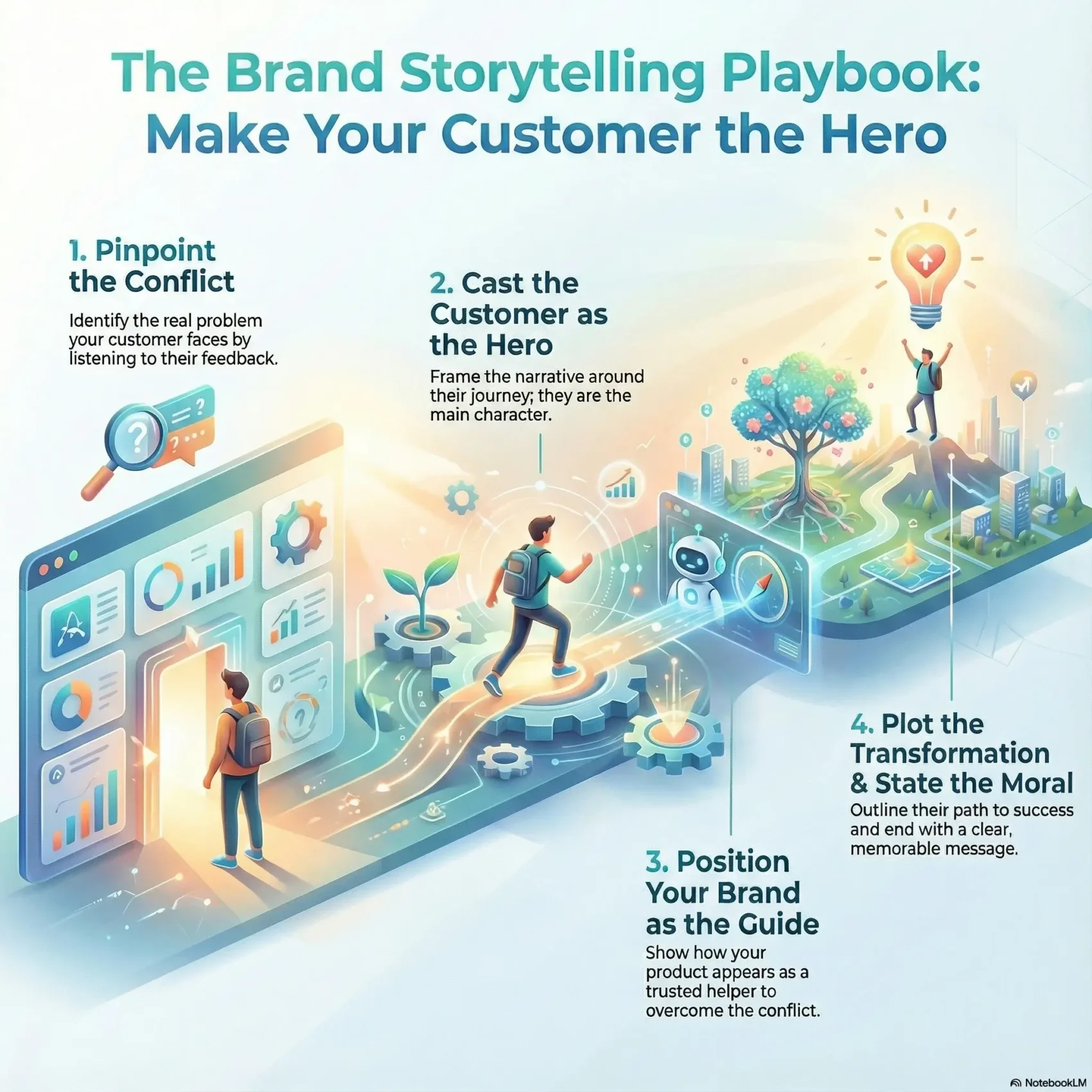
Last Updated on January 21, 2026
You want your brand to cut through noise and create real connection. Today, consumers pick companies that feel human and true. Centering the customer as the main character helps your message land and hold attention without a hard sell.
Great storytelling ties your values to moments people care about. Nike lets athlete experiences lead, while Airbnb puts hosts and travelers first. Those examples show how a clear narrative can guide every part of your marketing.
In this guide, you’ll learn practical ways to shape your story into campaigns and content that move people to act. You’ll see how narrative works as a tool across strategy, creative, and execution so your message stays consistent over time.
Key Takeaways
- Center your customer as the protagonist to build emotional connection.
- Use authentic stories linked to your values to earn attention today.
- Apply narrative across your strategy so the message stays consistent.
- Learn from real examples like Nike and Airbnb for practical ideas.
- Turn your brand story into campaigns people want to watch and share.
What Brand Storytelling Is and Why It Matters Today
A clear narrative starts by linking your values to what people actually feel and want. When you focus on needs, not specs, your message becomes easier to notice and remember.
A clear definition: narrative, values, and emotional connection
Brand storytelling is using a narrative rooted in your values to create emotional connection with your audience. It elevates your company beyond product features and shows why you exist.
Why emotions drive attention, trust, and loyalty
People decide with feeling first, then justify with logic. Positive associations build trust and long-term loyalty when you address what customers want, need, and fear.
“Storytelling drives the journey from awareness to purchase by capturing attention and building empathy.”
- Define the narrative arc that centers your customer as the protagonist.
- Map insights about your audience into concrete moments you can show.
- Maintain consistency so emotional cues compound over time across channels.
For practical alignment with your marketing strategy, see how your message fits into omnichannel tactics like omnichannel strategies. Over time, clear narrative work converts attention into lasting brand loyalty.
The Core Framework: Conflict, Hero, Plot, and Moral
Good narratives begin with a clear, human tension that customers recognize instantly. Pinpoint that conflict in plain language: what keeps your audience up at night?
Pinpointing the conflict your customers actually feel
Map real pain points by listening to reviews, social media comments, and support tickets. Phrase tensions in their words and rank those that offer the biggest relief.
Positioning your customer as the hero and your brand as the guide
Make the customer the protagonist. Show their strengths, limits, and a turning moment where your product appears as a trusted helper, not the lead actor.
Developing a compelling plot that shows transformation
Outline a simple arc: start, breaking point, obstacles, and resolution. Use the Pete & Gerry’s example: three hero profiles solved distinct challenges like organic assurance and transparency.
Identifying the story’s moral to reinforce your message
“A clear moral turns a narrative into a memorable lesson that motivates purchase.”
- Pinpoint conflicts in customers’ words.
- Cast customers as heroes; act as the guide.
- Plot the transformation and state the moral.
Key Elements of a Memorable Brand Story
A memorable story starts when your values show up in real people’s lives. Focus on the human moments that prove what you stand for, not a laundry list of features.
Authenticity and alignment with your company values
Document your values and turn them into snapshots of people and experiences. Show how those values change daily life so viewers see proof, not promises.
Spot authenticity gaps by comparing customer experience to your messaging. Close gaps quickly so trust stays strong.
Consistency across messaging, visuals, and design
Consistent messaging and visuals build recognition as you scale. Use a living style guide, a CMS to manage content, and a DAM to store approved assets.
- Keep templates and tone of voice in one place.
- Train teams on asset use to cut off-brand outputs.
- Tailor the same story to each channel while preserving a core look and mood.
“Consistency in design and message reduces friction and builds trust.”
- Audit your messaging against customer experience.
- Centralize assets in a CMS/DAM workflow.
- Update guidelines quarterly to keep everything current.
Using Brand Storytelling Across Your Marketing Strategy
Make every platform a consistent stage for the moments that matter to your customers. Every channel—from your website and product pages to social media and packaging—can carry a unified message that feels human and helpful.
From website to social media to product and packaging
Map your brand story across pages and packs so people get the same idea whether they read a product label or a post. Use your website to host long-form content and case studies. Use social media for short scenes and calls to action.
Be helpful, not hype-ful: human-first content practices
Focus on utility over claims. Create content that answers real questions, shows how products solve problems, and avoids overpromising. That builds trust faster than flashy copy.
Incorporate your customers: reviews, testimonials, case studies
Social proof moves buyers. Nearly half of shoppers skip a purchase without reviews. Collect quotes, govern them with simple rules, and showcase them across platforms.
- Use a CMS and DAM for consistent asset management.
- Build a playbook for short-form video, carousels, and threads.
- Map content to stages: awareness, consideration, decision, advocacy.
“When customer voices lead your campaign, benefits feel credible and specific.”
Brand Story Types You Can Use to Reach Different Audiences
Your next campaign works better when you match the right narrative to each customer segment. Below are five proven approaches and when to use them so your message lands with the people you want to reach.
Functional stories that highlight product strengths
Use this when customers shop by need. Show clear benefits and fixes. Mavi’s “Perfect Fit” work on broader sizes is a strong example of solving a concrete sizing problem.
Underdog stories that spark empathy
These build sympathy and loyalty. Tell humble beginnings—like Nantucket Nectars’ “With only a blender and a dream”—to humanize your teams and gains.
Lifestyle narratives and influencer collaborations
Invite people into a lifestyle life. Mavi’s “Maviterranean” sold a way of living across markets.
Partner with creators when habits and credibility matter. Gymshark66 showed how athletes co-create content to inspire action.
Social mission stories that show impact
Lead with purpose to connect values and behavior. Dove’s “Real Beauty Pledge” is an example that linked inclusivity to real-world change.
“Match the story type to the stage of the customer journey and avoid mixed signals.”
- Pick functional for consideration and decision stages.
- Use underdog or lifestyle to build affinity in awareness.
- Deploy mission-led narratives to deepen loyalty and advocacy.
Brand Storytelling Examples That Inspire Action
Look at practical campaigns that moved people to act and you’ll find simple, repeatable mechanics. Below are concise, real-world examples you can study and adapt.
Nike’s athlete-centered inspiration
Nike lets athletes lead with emotional scenes and minimal product push. On Instagram they favor useful, problem-solving content that inspires action.
Airbnb’s host and traveler experiences
Airbnb scaled community-focused videos on YouTube (646k+ subscribers) by amplifying real hosts and trips.
Dove’s Real Beauty
Dove built loyalty by challenging norms with inclusive campaigns like the Real Beauty Pledge.
ServiceNow’s Workflow Quarterly
ServiceNow used a premium editorial play to claim thought leadership, supporting growth for a large enterprise.
Gymshark66 and creators
Gymshark turned influencers into co-creators, driving participation and authentic progress narratives.
- Travel Oregon: integrated content that added $50M+ to the state economy.
- Purdue: a content engine where one video reached 28M views.
- Yara: award-winning farmer-led series and strong organic reach.
- Rhino: recycled product campaign raised sales 17% and won awards.
- Pizza Hut: an AI-to-real-world twist that spiked impressions and won a Webby.
“Study these workstreams and copy the mechanics, not the exact creative.”
How to Build Your Brand Story From the Ground Up
Start by naming the single purpose that guides every decision you make. That purpose anchors your values and keeps messaging focused. From there, translate what customers care about into clear narrative beats.
Clarify purpose, values, and audience insights
Document one purpose and two to three core values. Use customer research to turn those values into real problems you can solve.
Craft your narrative arc and messaging pillars
Outline a simple arc: setup, tension, solution, and proof. Build three messaging pillars that map to those beats and to your marketing strategy.
Create a content playbook and brand guidelines
Make rules, not restrictions. Create a playbook that covers voice, visual rules, and approval steps. Use a CMS and a DAM to store approved assets and speed up production.
“A foundational story plus governance turns ideas into repeatable work.”
- Define workflows for your team and asset management.
- Provide templates for messaging hierarchy and claims.
- Link editorial calendars to channel goals and measurement.
Channels, Campaigns, and Content Formats That Amplify Your Story
Pick the right platforms first; then shape campaigns that respect each format’s rules.
Owned platforms: website, blog, email, and CMS
Your website, blog, and email are the foundation. Use a CMS to publish, measure, and iterate.
Acquia recommends treating every page and pack as a chance to reinforce your values and track performance.
Social partners and athletes as co-creators
Make social media work harder with native formats. Collaborate with influencers and athletes to add credibility.
Gymshark66 shows how creators can co-create authentic, shareable content that scales.
Video series, documentaries, and events
Use ongoing video or documentary formats to build depth and trust. ServiceNow’s editorial series proves the value of regular, thoughtful media.
Pair virtual and in-person events to create moments people share.
Digital asset management and campaign planning
A DAM keeps assets consistent, speeds approvals, and protects identity at scale.
- Map owned platforms for measurement.
- Plan a calendar that ties paid, earned, and owned channels.
- Adapt product stories into audience-first content.
“Volvo Penta’s video campaign drove 6.5M+ impressions and strong engagement with modest spend.”
Use this channel checklist and a simple cadence to amplify your brand storytelling with confidence.
Measuring the Impact of Your Story on Attention, Connection, and Sales
Measure how narratives shift attention, shape feelings, and move people toward action. Use clear signals so you can prove the work is earning reach, trust, and revenue.
Awareness and reach: impressions, views, share of voice
Track impressions and share of voice across media and paid channels. Big spikes—like Pizza Hut’s 20M impressions in 48 hours—show attention, while a 78% organic uptick proves earned interest.
Engagement and community: watch time, comments, saves
Monitor watch time, comments, saves, and DMs as early signals of resonance. Volvo Penta’s 6.5M impressions and 725k ThruPlays are useful benchmarks for video formats.
Trust and loyalty: reviews, brand lift, retention
Measure reviews, repeat visits, and brand lift studies to quantify loyalty. Rhino’s recycled campaign drove a 17% sales increase tied to real commitments—an example of trust converting to purchases.
Revenue impact: conversions, assisted attribution, CAC/LTV
Map conversions and assisted attribution to your funnel. Use UTMs, content tagging, and platform analytics to isolate themes. Pair numbers with customer interviews so you know why a story moved people.
- Set KPIs by funnel stage.
- Tag and track with UTMs and analytics.
- Report with a simple template for stakeholders.
“Pair quantitative outcomes with qualitative insight to prove impact and iterate with confidence.”
Brand Storytelling Pitfalls and Best Practices
Protecting your narrative starts with practical safeguards. Inconsistent logos, stale copy, or mismatched imagery create mistrust. Acquia warns that visual drift and outdated assets can undo months of work. You can stop that with the right tools and rules.
Avoiding inconsistent visuals and off-brand messaging
Use a CMS and a DAM as a single source of truth. Store approved assets and lock down old files so teams can’t reuse off-key visuals.
Set simple approval workflows and refresh logos, templates, and claims quarterly to reduce content debt.
Keeping stories people-centric, not product-centric
Lead with people and outcomes. Center customer moments, reviews, and testimonials so credibility beats hype. That approach builds real loyalty over flashy claims about products.
- Make a brief style guide and share it across companies and teams.
- Resist chasing every trend on social media; test before you scale.
- Use a content checklist to check clarity, credibility, and fit.
- Clarity: Is the message easy to read?
- Credibility: Is proof included (review, data, example)?
- Fit: Does it match your campaign goal and target customer?
“Consistency in look and claim protects trust and scales creativity.”
Conclusion
Let practical examples guide your next steps: test one story, measure results, then expand what works.
You’ve seen how a clear, values-aligned brand storytelling approach helps people grasp who you are and why you matter. Use the framework—conflict, hero, plot, moral—to turn insight into repeatable work.
Keep your message people-first and operationalize consistency so your narrative shows up in the right media and in everyday life. Start on one primary channel, track attention to loyalty to revenue, and scale the way that proves impact over time.
Next step: pick a story type, draft a short arc, activate it, and learn fast. Good brand storytelling earns trust and sales when it centers real people and real moments.