Tools
Tools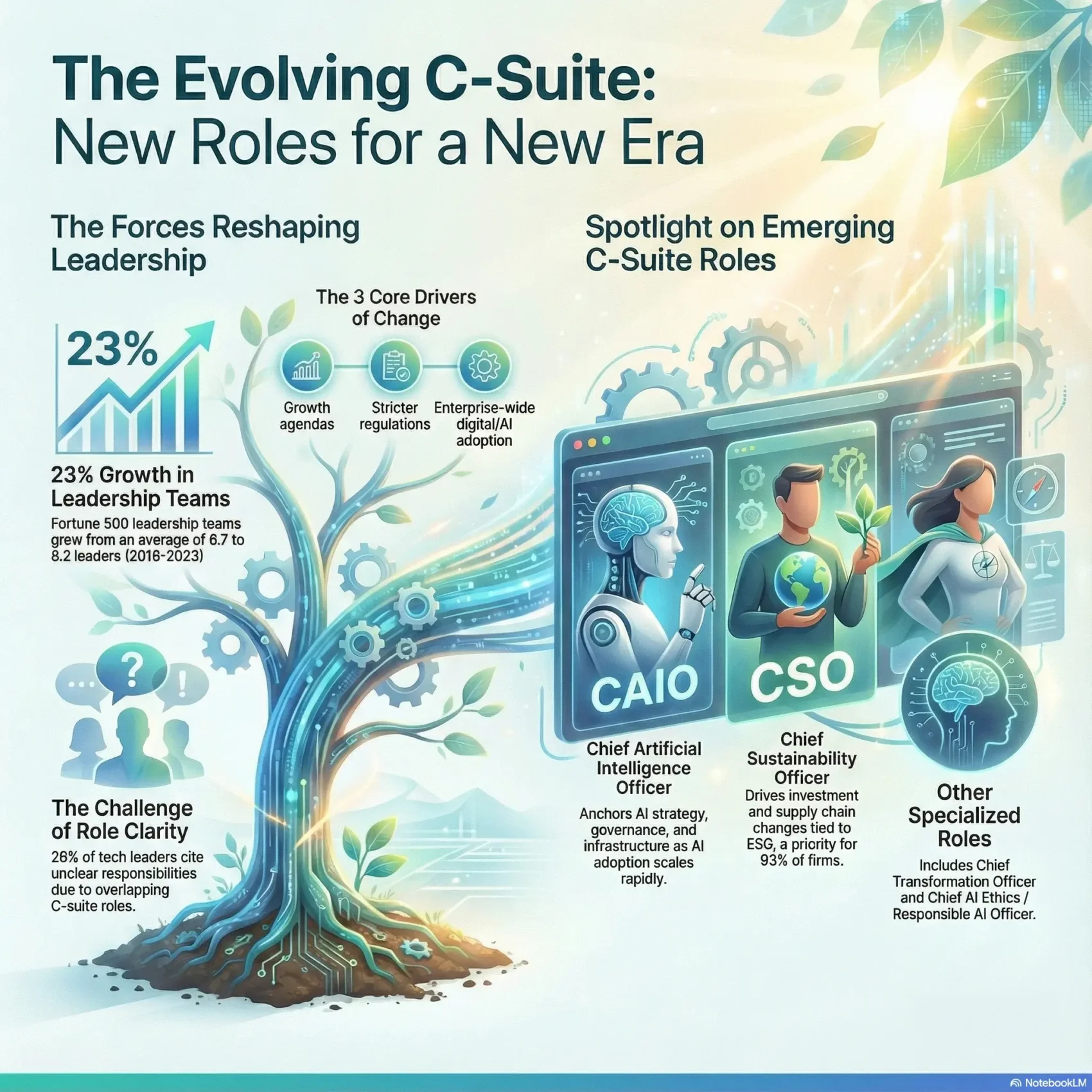
Last Updated on January 23, 2026
You are navigating a time when top teams expand and title maps change quickly. Fortune 500 leadership teams grew 23% from 2018 to 2023, and skill expectations for CFOs, CHROs, and COOs rose by more than 20%.
This shift affects your company and your business strategy. New titles surface not as vanity but as answers to growth, stricter regulation, and company-wide digital and AI adoption. Interviews with leaders show the real hurdles: role clarity, decision rights, and collaboration cadence.
In this report you get data-backed research and clear insights to benchmark your organization. We focus on actionable steps so your leadership can align around outcomes, reduce overlap, and keep the business running while you adapt.
Key Takeaways
- Top teams are growing: use benchmarks to assess your starting point.
- Skills now matter more: established leaders must expand capabilities.
- New titles link to strategy: focus on outcomes, not labels.
- Integration challenges: clarity, decision rights, and cadence must be solved.
- Practical playbook: apply a 90-day approach to move from discussion to activation.
Why You’re Seeing New Executive Titles Today
You are noticing more titles at the top because your company faces faster technology cycles, bigger regulatory demands, and higher customer expectations.
Fortune 500 leadership teams grew 23% from 2018 to 2023, and skill requirements for CFOs, CHROs, and COOs rose by 20%+. That data explains why companies split duties and add focused leadership to keep the business moving.
Boards and leaders also create new positions to signal priorities like growth, sustainability, and AI adoption. When work outgrows legacy mandates, you get new posts that link product, data, security, and experience across the organization.
Practical impact: overlapping accountabilities — think CIO, CTO, CDAO, CISO — make clear decision rights essential. Deloitte found 26% of tech leaders cite unclear responsibilities.
- Clarity: define where each role begins and ends.
- Alignment: map titles to measurable business outcomes.
- Risk reduction: assign ownership for compliance and reporting.
In short, new titles are a tool so your leadership can meet needs today and steer the company toward measurable growth and better customer outcomes.
The State of the C-Suite in the present: Growth, Scope, and New Mandates
You’re seeing more executives join the top team — and each addition changes the playbook. Use the facts below to ground your next decisions before you redesign titles or expand mandates.
What the research says: expanding top teams and skill requirements
Benchmarks matter: Fortune 500 top teams grew ~23% from 2018–2023, moving from 6.7 to 8.2 senior leaders on average.
Demand for skills in finance, HR, and operations climbed 20%+. At the same time, functions such as ESG (+230%), communications (+133%), and legal (+127%) rose to chief level.
“Growth at the top is less about titles and more about delivering new capability across the business.”
How scope creep hits established roles like CFO, CHRO, and COO
Scope creep is real: CFOs now own predictive analytics and scenario planning. CHROs lead workforce redesign and skills development. COOs drive cross-company transformation.
- Strategy & planning: sharper quarterly and annual rhythms protect speed.
- Data ownership: the chief data officer must interlock with CIO/CTO to avoid duplication.
- Leadership development: raise the bar on succession and cross-functional delivery.
What’s Driving the New C-Suite: Growth, Regulation, and Digital Transformation
Boards and executives are reshaping leadership to keep pace with faster markets and higher customer expectations. New senior posts often answer three big pressures: maintaining growth, meeting stricter regulations, and scaling technology across the business.
Keeping pace with the growth agenda and customer needs
You’re adding focused leaders—chief commercial, customer, and growth positions—to unify sales, product, and marketing. These posts aim to sharpen market prioritization and tie activity to measurable outcomes.
Result: clearer go-to-market decisions and faster product-to-customer cycles that preserve momentum.
Navigating regulations, compliance, and board reporting
Regulations—especially EU sustainability directives—force continuous governance, not just annual reports. That raises the bar for assurance and cross-functional coordination with audit, legal, and finance.
Tip: assign clear accountability for compliance so reporting is timely and auditable.
Harnessing data, AI, and technology for enterprise-wide transformation
Data and technology now sit at the heart of strategy. Many organizations link cyber and IT to product teams to lower breach risk and speed delivery.
- Ownership: your chief data officer and tech leaders should co-design secure, customer-focused roadmaps.
- Governance: model oversight and architecture controls protect the business as AI scale grows.
- Execution: a CAIO or equivalent helps rationalize models and convert AI into operating gains—companies run an average of 11 models today and expect 16 by 2026.
“Aligning technology choices with customer outcomes is essential to converting transformation budgets into market impact.”
Use this driver framework to decide which new positions you truly need and which responsibilities can expand within existing posts. For practical skills and planning guidance, see future job skills.
C-Suite Role Spotlights You Should Know Now
Companies are appointing specific officers to own AI, sustainability, ethics, and transformation so work actually delivers results.
Chief Artificial Intelligence Officer
The CAIO anchors AI strategy, model governance, and infrastructure decisions that affect company performance. CAIO positions have tripled in five years and most organizations run about 11 models today, rising to 16 by 2026.
Why it matters: 76% of CAIOs advise other executives on AI choices, so this officer connects engineers to CEOs and business leaders.
Chief Sustainability Officer
The chief sustainability officer now drives investment, supply chain changes, and cost-savings tied to ESG. Stanton Chase found half of companies create dedicated ESG posts and nearly 93% view sustainability as essential.
Result: firms report rising cost reductions and stronger brand value when sustainability is led from the top.
- Chief AI Ethics / Responsible AI Officer: operationalizes fairness, accountability, and auditability to lower legal and reputational risk. Major companies like Salesforce and Microsoft now publish dedicated leadership on this topic.
- Chief Transformation Officer: orchestrates strategy, culture, and technology so digital transformation becomes measurable business impact rather than isolated projects.
“These officers succeed when given decision rights, budgets, and clear collaboration cadences with CIO, CTO, CISO, CDAO, CFO, and CHRO.”
Decide whether to hire a new officer or expand an existing remit based on maturity and goals. For practical job profiles and templates you can adapt, see AI job descriptions.
Emerging C-Suite Roles: Where They Fit in Your Leadership Strategy
Tie every title on your leadership chart to a measurable business outcome before you change the org chart.
Start with a clear strategy brief that lists the goals a new post must drive. Do not add complexity for prestige. Your company should pursue outcomes, not just titles.
Aligning titles to business goals, not the other way around
Map each proposed title to explicit goals. Include charter, KPIs, and handoffs up front so responsibilities do not drift.
“When leaders tie a role to one or two measurable outcomes, the organization avoids overlap and speeds decision making.”
- Match reporting lines to decision rights so execution stays fast.
- Right-size spans of control to prevent overloaded managers.
- Set triggers—regulatory exposure, multi-region reporting, or platform-scale AI—that justify a new officer.
Choosing between creating a new role vs. expanding responsibilities
Use a simple assessment: cost, time-to-impact, talent readiness, and regulatory risk. This helps you pick hire vs. upskill.
- Scale: is the need company-wide or a single function?
- Capability: can internal talent be stretched with training?
- Risk: does governance or compliance demand clear ownership now?
Plan for lifecycle actions. You’ll know when to sunset or merge titles as needs evolve. The aim is a lean organization that delivers measurable business value.
From Overlap to Orchestration: Clarifying Responsibilities and Decision Rights
Clear decision rights turn duplicated effort into coordinated progress across your top team. When you name who owns a domain, work moves faster and confusion drops.
Start by mapping responsibilities for data lifecycle, AI model governance, cybersecurity, and customer experience. Leaders report frequent ambiguity between CIO and chief data officer ownership; 26% of tech leaders struggle to keep responsibilities clear as titles multiply.
Defining ownership for data, AI, security, and customer experience
Assign a single accountable executive per domain and publish charters. Use RACIs and decision-rights matrices so handoffs are documented.
Avoiding silos and unintended role duplication
Set tie-break rules for overlapping mandates. Name an escalation path and a budget owner to prevent repeated debates.
Setting collaboration cadences among CIO, CTO, CISO, CDAO, and CAIO
- Weekly working forums for delivery teams
- Monthly steering meetings for trade-offs and risk
- Quarterly reviews to align roadmaps and incentives
Result: fewer silos, faster decisions, and a leadership team that directs initiatives toward real business outcomes.
Talent and Succession Planning for New Executive Positions
Building a reliable bench requires practical pilots and clear development milestones.
Run small pilots that serve as development labs. Rotate high-potential talent through cross-functional assignments tied to strategic initiatives. This delivers value while you test leadership under real constraints.
Building the bench: pilots, training, and cross-functional development
Sponsor targeted training and coaching to close skill gaps. Pair rotations with stretch goals so learning links to measurable outcomes.
Bridging skill mismatches within legacy teams
Address mismatches with tailored development, selective hiring, and change management. Focus on AI literacy, data storytelling, and regulatory fluency to align legacy staff with new mandates.
Succession pathways for modern CFOs, CSOs, and CAIOs
Design clear succession tracks that combine domain depth and enterprise exposure. Set regular talent reviews and planning rhythms so successors stay visible and ready.
- Pilot-first: use projects to evaluate judgment and outcomes.
- Blend hires and upskilling: accelerate capability without overextending your company.
- Measure impact: track development metrics tied to business results.
“A practical bench reduces risk during transition and sustains momentum across the leadership pipeline.”
Governance That Scales: Board Engagement, Policies, and Risk Management
Scaling governance means giving the board timely signals and front-line teams firm guardrails.
Formal charters and clear RACIs reduce overlap and make responsibilities visible across the organization. EU sustainability rules increase public scrutiny, so your governance needs to be auditable and forward looking.
Formalizing charters, RACI, and board oversight
Create concise charters that state scope, decision rights, and handoffs for new posts. Link each charter to measurable KPIs and to the cadence of reporting your board expects.
Integrating risk, compliance, and ethics into initiatives
Build risk and compliance checks into program design. Give legal, cyber, and audit seats on program teams so issues surface early.
- Define cadence: weekly delivery, monthly steering, quarterly board updates.
- Escalation: clear paths that prevent surprises and speed mitigation.
- Sign‑off: name who approves policies for data, AI, and third‑party risk.
- Assurance: use internal audit and independent review to validate readiness.
“Balanced governance protects growth and keeps leadership focused on outcomes and resilience.”
Metrics, Reporting, and the Evidence of Impact
Good reporting links KPIs to dollars, time saved, and customer value so decisions follow evidence. You’ll set measurable goals that tie transformation, AI adoption, and sustainability work to clear business outcomes.
Setting KPIs for transformation, AI adoption, and sustainability
Define a small set of leading and lagging indicators. Pair financial metrics (cost reduction, revenue lift) with operational ones (cycle time, quality rates).
- Benchmark: use Whatfix-style targets — 20–30% cost cuts or up to 80% faster processes where automation applies.
- AI tracking: model count, time-to-value, and control coverage across the model portfolio.
Regulatory reporting readiness across regions
Map data owners, controls, and evidence trails for disclosures such as the EU Corporate Sustainability Reporting Directive. Prepare templates for multi-region audits.
Communicating results to investors, customers, and employees
Use a single dashboard that feeds board packs and investor updates. Translate complex metrics into plain narratives so your company builds trust and shows measurable success.
“Metrics should defend investment with evidence, not anecdotes.”
- Roles: name data stewards and reviewers to keep reporting repeatable.
- Cadence: weekly delivery checks, monthly executive reviews, quarterly board updates.
Customer, Product, and Market Implications
Translate strategy into offerings your customers will adopt. You’ll turn technology and sustainability plans into tangible products and services that deliver real value. Prioritize features that reduce friction and lower risk so adoption grows fast.
Translating technology and sustainability into services and products
Design with materials, lifecycle, and operational footprint in mind. Integrate sustainability into specs so procurement and consumers see clear benefits.
Result: products that qualify for green purchasing and services that extend useful life, improving customer loyalty and market positioning.
Protecting customer experience while scaling digital initiatives
Connect cyber and IT directly to product teams. Map security requirements into sprint acceptance criteria so launches are safe and on time.
Set SLAs and service standards that keep experience consistent as you move faster. Use leading indicators — time to task completion, defect rates, trust scores — to guide investment and reduce rework.
- Align product roadmaps to measurable growth outcomes and business KPIs.
- Define interfaces between product, security, data, and compliance to avoid last-minute holds.
- Turn regulatory needs into clear features and disclosures customers understand.
“Customer feedback loops should drive backlog priorities so your launches earn repeat usage and referrals.”
When you bind technology, sustainability, and product design, your company wins reliable adoption and steady business growth in the market.
Industry Signals: How Sectors Are Adapting Differently
How your industry treats data, risk, and sustainability will shape which new posts you need first. Regulated, data-heavy sectors like pharma and financial services often formalize compliance and sustainability leadership earlier. That helps them manage long-horizon plans and complex audits.
You’ll see different sequencing across industries. Consumer goods firms may prioritize product and supply-chain sustainability to win market share. Tech companies focus on technology and AI governance to protect growth and speed.
Signals to watch:
- Regulatory change or multi-region reporting needs — hire or centralize compliance sooner.
- High data volume and model deployment — prioritize data and risk leadership.
- Competitor moves on sustainability — convert supply-chain upgrades into a product advantage.
“Industries that pair focused leadership with partner networks scale capability faster and reduce time-to-value.”
Practical takeaway: map your company’s risk and market exposure, then time hires or capability builds to match that environment. Use vendor, startup, or academic partnerships to accelerate capability without overbuilding internally.
Your 90-Day Playbook: Practical Steps to Evolve the C-Suite
Kick off with a short, shared strategy brief that ties proposed changes to clear business outcomes. Use a “zoom out to zoom in” approach: set a long-term horizon, then pick a 90-day window to test and prove ideas.
Start with strategy: define problems, outcomes, and scope
Days 1–30 focus on alignment. Define the problem you’ll solve, target outcomes, and scope across your company.
Map decision rights, draft concise charters, and identify critical interfaces so announcements do not create confusion.
Connect the dots: design collaboration structures and forums
Days 31–60 stand up meeting cadences and forums. Tie KPIs to initiatives and socialize plans with peers to build buy-in.
Practical tip: involve ceos and functional leaders early to reduce resistance and speed approvals.
Activate: pilot initiatives, capability sprints, and quick wins
Days 61–90 run pilots and capability sprints. Use workflow automation to capture early wins and free capacity for strategic work.
Measure time-to-value, cost, and customer experience so you can scale or stop quickly.
“By day 90, you’ll have an operating rhythm, clear roles, and visible results that support broader transformation.”
- Align: problems, outcomes, and scope.
- Design: charters, decision rights, and cadences.
- Activate: pilots, automation, and quick metrics.
Bonus: ship templates for charters, RACIs, dashboards, and a communications checklist for board, investors, customers, and employees. Plan succession planning and leadership development alongside activation so momentum is sustainable.
Risks to Watch: Role Inflation, Fragmentation, and Compliance Gaps
As leadership layers expand, you must watch for hidden costs that outpace value. New titles can add clarity — or they can create extra expense and confusion.
Leaders report real friction when accountabilities overlap. For example, you may see CDO vs. CIO ownership questions. One study found 26% of tech leaders struggle with unclear responsibilities as titles proliferate.
Focus on three practical risk areas:
- Role inflation: curb needless hires with crisp charters that state expected outcomes and budget impact.
- Fragmentation: use decision matrices and single-accountable owners to stop duplicate work and slowdowns.
- Compliance gaps: embed controls and checkpoints so regulation and audit needs keep pace with change.
You’ll also set limits on dual-reporting, clarify who has the final call, and align incentives to reward cross-functional delivery. Watch early warning signs — missed handoffs, duplicate efforts, or conflicting KPIs — and act quickly.
“A tight risk lens helps your company expand leadership capacity without eroding control or trust.”
Result: you balance specialization with integration so leaders stay accountable for enterprise results and your business stays resilient.
Conclusion
Your leadership map should be a tool, not a trophy, so focus on clear accountabilities that drive measurable business outcomes. Define decision rights, set simple cadences, and link each position to one or two KPIs.
Use the 90-day plan to align strategy, design governance, and run pilots that prove value. Train and rotate talent so your company builds depth while keeping execution fast.
Result: executives and teams that turn ambition into repeatable success. With clear governance and focused metrics, your organizations can scale transformation, protect trust, and sustain growth.
Now pick one place to start, align your team, and move from titles to outcomes.