Tools
Tools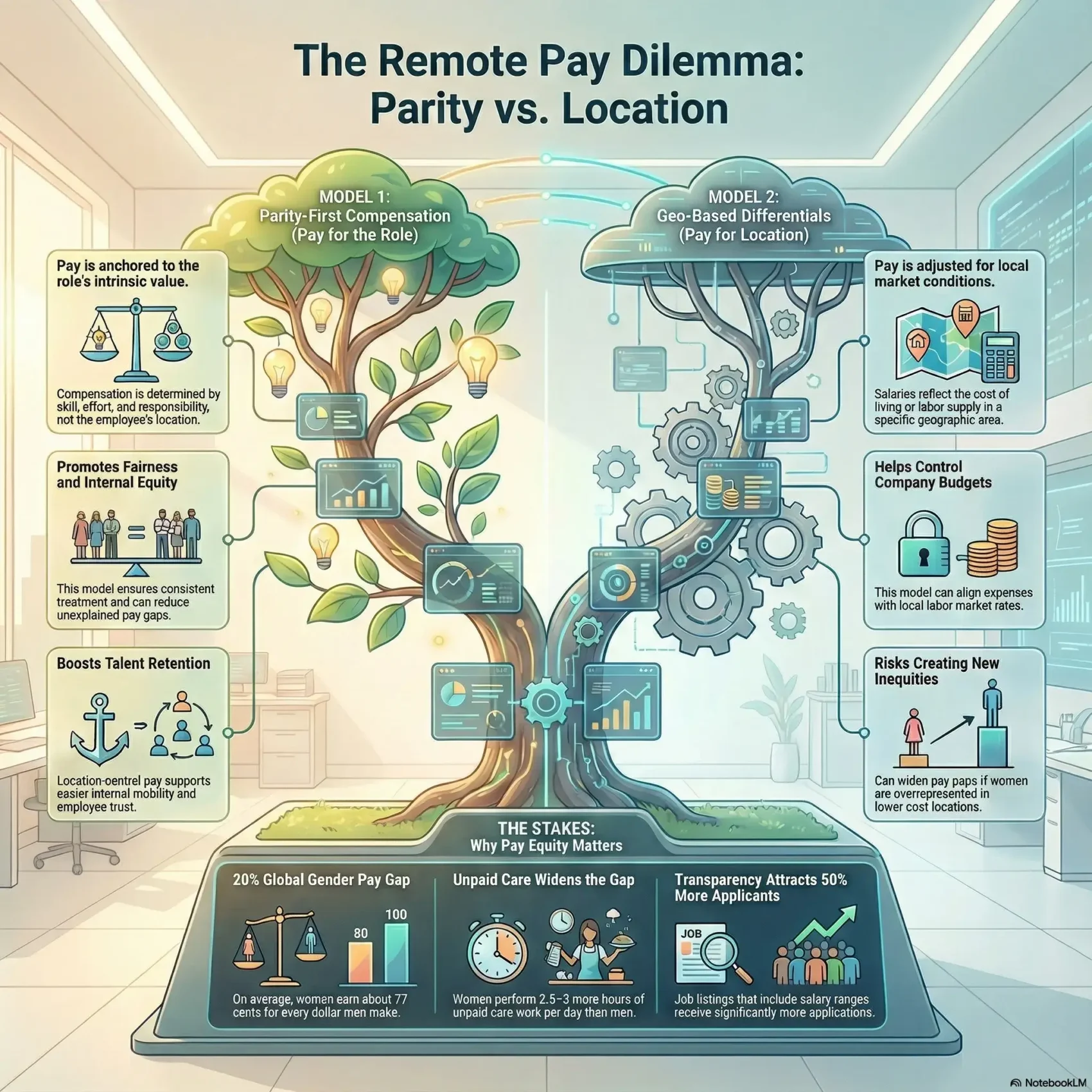
Last Updated on December 25, 2025
The core question isn’t only what you do, but where you do it, and whether salary should reflect job value or local market rates.
The gender pay gap still shapes outcomes. Women historically earned about 77 cents for every dollar men made, and that gap can influence remote salary baselines unless employers act intentionally.
Equal pay for work of equal value is embedded in international rules like the ILO’s convention and in initiatives led by UN Women and the OECD. In practice, teams must balance market data with internal equity to keep offers fair and retain talent.
In this guide, you’ll see how employers weigh benchmarks, transparency pressures, and compliance risks. You’ll also learn how remote work can either widen the gap or help close it, depending on your company’s approach.
Key Takeaways
- Location-based offers affect fairness; ask how roles are benchmarked.
- Women still face a measurable gap that can carry into distributed teams.
- Equal value principles call for consistent role benchmarking across locations.
- Transparency and compliance are shifting employer practices.
- You can use this guide to evaluate your company’s compensation choices.
Understanding pay equity, equal value, and the global context
When job duties diverge but require similar skill and responsibility, you need a clear way to compare value for fair compensation. Equal value focuses on skill, effort, responsibility, and working conditions — not just job titles.
Equal pay for work of equal value: what it really means for you
The ILO standard covers different jobs that match in value. Remuneration includes wages, overtime, bonuses, allowances, equity awards, insurance, and benefits. So your review should look beyond base salaries to total rewards.
Why pay equity matters now: rights, justice, and business impact
Pay equity is a human-rights issue and a business one. Addressing discrimination and structural barriers attracts talent and reduces turnover.
Equal treatment in pay strengthens morale, retention, and long-term sustainability.
Key figures at a glance
Two headline numbers help you see scale: about a 20% gender pay gap worldwide and roughly 77 cents on the dollar for women compared with men. Women also do about 2.5–3 more unpaid care hours per day and face lower pension access later in life.
- Compare roles by skill and responsibility, not by job title.
- Include bonuses, allowances, and benefits when you measure fairness.
- Recognize structural factors like unpaid care and occupational segregation that create persistent gaps.
Actionable idea: Start by mapping core roles with a simple scorecard for skill, effort, responsibility, and conditions. That helps you spot where equal value should lead to equal remuneration across your workforce.
Global pay parity vs. location-based pay: how should remote wages be set?
Deciding how to set remote wages starts with choosing whether role value or local markets drive offers. Your choice shapes fairness, hiring, and long-term retention.

Two models explained: parity-first compensation and geo-based differentials
Parity-first anchors compensation to role value and internal equity. This model promotes consistent treatment and can reduce unexplained pay equity gaps.
Geo-based differentials adjust wages by cost of living or local labor supply. That helps control budgets but can introduce regional gaps over time.
Trade-offs for workers and employers: fairness, hiring, retention, and costs
- Fairness: parity-first supports equal pay and internal equity; geo-based can skew outcomes for women and underrepresented groups.
- Hiring: transparency in job listings boosts applicant volume by ~50% and can help employers attract talent.
- Compliance: U.S. laws vary by state, so document criteria and decisions to manage legal risk.
Documenting your factors—skills, responsibility, and market data—makes compensation decisions explainable and defensible.
Compliance and transparency shaping your pay decisions
New reporting rules are forcing companies to tie compensation practices to clear disclosures and measurable metrics. You’ll need to turn internal analyses into audit-ready statements that stakeholders can trust.
EU trends: Pay Transparency Directive and CSRD expectations
The Corporate Sustainability Reporting Directive (CSRD) now asks over 50,000 EU firms — and thousands of non-EU companies — to report on gender equality and equal pay for work equal value. ESRS 1 and 2 expect you to explain how you measure gaps and the impacts on women and other groups.
United States focus: EEOC priorities and evolving laws
The EEOC’s 2024–2028 plan highlights advancing pay equity and targeting practices that enable discrimination. Increasing state-level transparency rules mean you should document decisions and keep records that defend your approach.
Global reporting realities: centralized vs. localized approaches
Centralized reporting improves consistency and dashboards for tracking a gender pay gap and remediation actions. Local execution helps you meet country-specific employment and sector rules.
Map CSRD and transparency deadlines to your reporting calendar and build governance so employers can attest to metrics and outcomes.
See CSR reporting trends for practical guidance: CSR reporting trends.
Global pay parity and the gender pay gap: connecting principles to outcomes
Structural barriers in work and care routines help explain why women still earn less than men in many industries. You’ll see how research and policy translate equal value principles into outcomes that matter for your workforce.
Why the pay gap persists: unpaid care, occupational segregation, and bias
Unpaid care is a major factor. Women do about three more hours of care per day than men. That extra time limits continuous work, training, and promotion.
The motherhood penalty and time out of the workforce reduce wages and lifetime earnings. Women are overrepresented in informal employment and lower-paid sectors like care and education.
- Care and time: Fewer paid hours and uneven schedules lower long-term pay.
- Occupational sorting: Sector dynamics concentrate women in lower-paid roles and jobs with weaker benefits.
- Bias and rules: Hiring and evaluation practices can create unexplained disparities that hurt pay equity.
“Equal value reviews must look beyond titles to the factors that determine pay and progression.”
Policies like New Zealand’s Equal Pay Amendment show how equal pay for work equal value can drive systematic reviews. You’ll use these insights to spot which job design, scheduling, or evaluation fixes can close the gap in your organization.
Your employer playbook: practical steps to design fair, compliant remote pay
Build a simple, repeatable process that turns vague concerns about fairness into clear actions. A routine audit helps you find both raw differences and adjusted gaps that matter.
Be proactive: measure raw and adjusted gaps and address unexplained disparities
Measure regularly. Use multiple regression to separate factors like role, experience, and location so unexplained disparities stand out. Budget targeted adjustments to close those gaps, including the gender pay gap where it appears.
Prevent new inequities: standardize offers, promotions, and salary ranges
Standardize job postings, promotion criteria, and range bands. That reduces drift and ensures decisions are consistent, traceable, and defensible.
Be transparent with intent: decide what to share, with whom, and when
Decide a transparency stance that fits your culture and legal needs. Note that job posts with ranges get about 50% more applications and that many workers value openness when they choose employers.
Communicate and measure: train managers, track progress, and ensure accountability
- Train managers with FAQs and scripts so conversations are accurate and empathetic.
- Set governance, owners, KPIs, and timelines to show measurable progress.
- Use pre-approval tooling for offers and promotions to stop bias in real time.
Commit to time-bound reviews and clear reporting so equity work becomes sustained progress.
Conclusion
The simplest path is clear: choose a compensation model, measure often, and act on the data.
You face a long journey—closing the global gender gap at current rates could take centuries—so steady, evidence-led steps matter now.
Make transparency and routine audits your tools. Set salary ranges, publish how you set them in dollars and cents, and use equal value reviews to spot unexplained differences that hurt women and men.
When employers link policy to action, you get measurable progress: better hiring, stronger retention, and real equity for workers. Treat change as ongoing, not one-off, and keep reporting what you learn.