Continuous performance management means running performance work as a repeating cycle instead of a once-a-year event. You set goals, hold short check-ins while the work happens, and review progress in small, frequent doses.
Nothing about it is exotic. A manager and an employee agree on what good looks like this quarter, talk for twenty minutes every week or two, and write down what was decided. It gets attention because the alternative works badly. Gallup finds that just 14% of employees strongly agree their performance reviews inspire them to improve, and only two in ten say their performance is managed in a way that motivates them.
This article is a practical roadmap: what early adopters learned, where to start, which rhythms to set, how to prepare managers, what to look for in a tool, and which rules apply when software helps make the call.
Key Takeaways
- Replace the annual appraisal with a repeating cycle of planning, check-ins, and short reviews.
- Frequent feedback tracks closely with engagement: Gallup reports 80% of employees who got meaningful feedback in the past week are fully engaged.
- A single manager’s rating says a lot about the manager. Short, documented check-ins and input from more than one person make it fairer.
- Managers are the bottleneck. Fewer than half have ever been trained to manage.
- Pick a tool that keeps goals, check-in notes, and reviews in one place.
- If AI helps score or rank people in the EU, new obligations apply from December 2027, and some uses are already banned.
Why the annual review stopped working
The annual appraisal asks one meeting to do four jobs: set goals, give feedback, decide pay, and plan development. That is too much freight for sixty minutes in November.
The practical failure is timing. If a project goes sideways in March, a note in the November file helps nobody. The moment to fix it has passed, and the employee spent eight months repeating a habit no one flagged.
Gallup’s numbers back that up. It reports that 48% of employees are reviewed once a year and another 26% less often. Only 29% strongly agree their reviews are fair, and 26% that they are accurate.
Some of that is memory. A manager writing a review in November mostly remembers October. Psychologists call this recency bias: recent events get weighted more heavily than earlier ones, so a year of steady work can be overshadowed by one rough fortnight.
A bigger problem is the rater. Research by Steven Scullen, Michael Mount and Maynard Goff, cited by Deloitte in Harvard Business Review in 2015, found that 62% of the variance in performance ratings came from the individual rater’s quirks. Actual performance explained just 21%. Put simply, a rating often tells you more about the manager than about the employee.
The process is also expensive. When Deloitte added up the forms, meetings and rating sessions, it found they consumed close to 2 million hours a year.
None of this means reviews should disappear. It means the review should summarize a year you already documented, rather than invent one from memory.
What early adopters learned
Adobe was one of the first large companies to drop the annual review, in 2012. It replaced it with a regular “check-in” between manager and employee on three topics: expectations, feedback and development. There is no required form. Adobe reported saving about 80,000 manager hours a year. Within two years, voluntary resignations fell by about 30%, while involuntary departures rose by roughly 50%. That second number is the interesting one: weak performance got addressed in weeks instead of waiting for the next review cycle.
Deloitte went a different way. It kept a short assessment but moved it to the end of each project or quarter. Managers answer four forward-looking questions about what they would do with the person, for example whether they would promote them today. Team leaders are expected to check in with each team member weekly.
Two caveats apply. These are company-reported results, not controlled studies. And dropping ratings entirely is not the only option. Many organizations keep a simple rating because pay and promotion decisions need one. What matters is that the rating rests on documented conversations rather than on memory.
What continuous performance management actually means
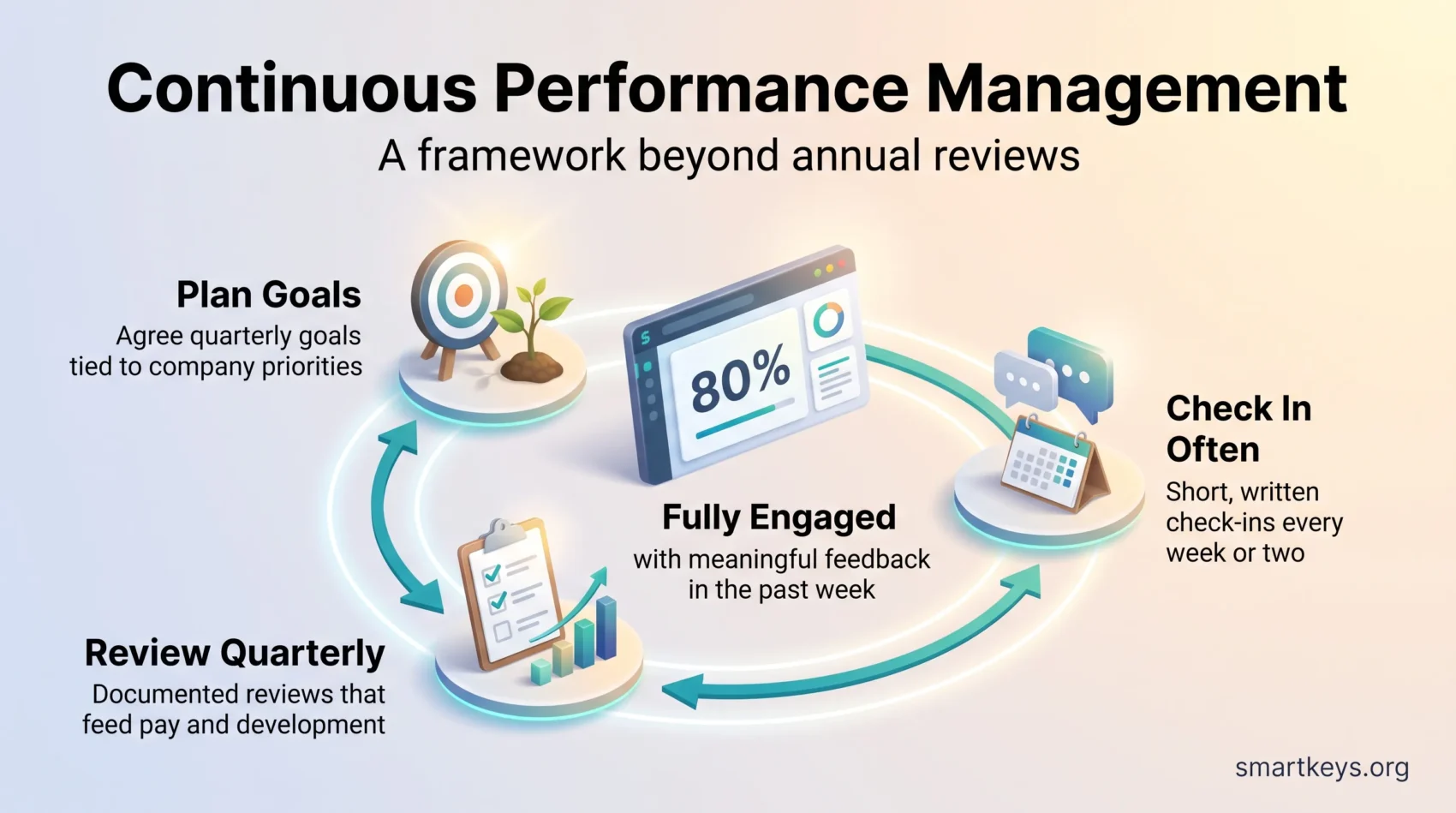
The approach replaces one big conversation with many small ones, then keeps a written trail so they add up to something. Three activities repeat on their own clock:
- Planning: agreeing what this person is accountable for over the next quarter.
- Checking in: short conversations while the work is live, to unblock and adjust.
- Reviewing: a documented assessment several times a year that feeds pay and development decisions.
How frequent feedback turns managers into coaches
The word coaching gets used loosely, so here is the practical difference. Rating tells someone where they landed. Coaching tells them what to try next, while there is still time.
Gallup’s data on feedback frequency is unusually clear. Among employees who received meaningful feedback in the past week, 80% are fully engaged. Those whose manager gives daily rather than annual feedback are 3.6 times more likely to strongly agree they are motivated to do outstanding work.
“Meaningful” carries weight in that finding: feedback tied to specific work, given close to the event, and pointed at what happens next. Frequency alone does not do it.
Forward-looking conversations instead of backward-looking ratings
Short goal cycles let you change targets when the business changes. A sales target set in January for a product that shipped late in April is not a performance problem. It is a planning artifact, and an annual cycle has no way to retire it. This is where managing by results rather than hours becomes practical: once goals are revisited every few weeks, output is visible without anyone counting keystrokes.
The benefits you can realistically expect
Be careful with benefit claims here. Most published figures come from software vendors describing their own customers. The points below have independent research behind them.
Engagement rises when feedback is frequent and specific
This is the best-evidenced benefit. Gallup’s 80% figure is a correlation rather than proof of cause, but it holds across years and countries. Our overview of employee engagement trends covers what else moves the number.
Fewer surprises, which helps retention
The expensive resignations are the ones nobody saw coming. Regular check-ins surface the warning signs early: a stalled project, a promotion that keeps slipping, a workload that quietly doubled. Acting on those is cheaper than replacing the person, and central to any talent retention strategy.
Daily work that actually connects to company goals
Here is what that abstraction looks like in practice. A support team agrees a quarterly goal of cutting first-response time from six hours to two. In the weekly check-in, the manager sees one queue causing most of the delay. The fix is a routing rule, not a pep talk. Without the check-in, that finding waits until the quarter is over.
Gallup also found that only three in ten employees strongly agree their manager involves them in setting goals, and that those who do are four times more likely to be engaged. Involvement is one of the few levers here with a measured effect.
Pay and promotion decisions you can defend
A documented year of check-ins gives you evidence when someone asks why a rating landed where it did. That matters more as pay transparency rules spread, and it pairs with performance-based pay models, which fall apart without a defensible record. It also helps with proximity bias, the tendency to rate people you see in person more favorably than remote colleagues.
Build your performance management cycle
Build a simple rhythm and let it repeat. Complexity kills these programs, not ambition.
Planning: connect individual goals to company objectives
Take the person’s core responsibilities and the two or three company priorities they can actually influence, then write goals that sit at the intersection. Break longer projects into milestones you can reach in weeks. A goal with no checkpoint before month three gives you nothing to talk about.
Checking in: short, regular, and written down
Keep check-ins short and frequent rather than long and rare. Twenty to thirty minutes every week or two works for most teams, and our one-on-one meeting template gives you a structure to start from.
Write two or three lines afterwards: what was decided, who owns it, when it is due. People skip this part, and it is the part that makes the review honest six months later.
Review: short, frequent, and tied to decisions
Run reviews quarterly or twice a year rather than annually. Because the check-in notes already exist, the review becomes a summary rather than an act of recall. Say plainly which decisions it feeds: pay, promotion, project assignment, development budget. Reviews that feed nothing get treated as paperwork, and deservedly so.
Four goal types worth separating
- Job goals: the core duties of the role, tied to whatever you already measure.
- Project goals: time-boxed outcomes, split into milestones.
- Behavior goals: how the work gets done, such as responsiveness or handling disagreement.
- Development goals: skills for the next role, not this one. These are first to be dropped under pressure, so protect them.
Development goals need somewhere to lead. An internal talent marketplace gives people a visible next step.
Five pillars of a system that holds up
- Feedback in the flow of work. A note in the project channel after a client call beats a bullet point recalled in October.
- Goals that move when the business moves. If changing a goal takes three approvals, nobody will, and the team spends the quarter chasing a target everyone knows is wrong.
- Managers who coach rather than only rate. This is where most programs stall, and it gets its own section below.
- Visibility without bureaucracy. Workforce analytics tools show where check-ins have quietly stopped, usually the first sign a rollout is failing.
- A culture where feedback is normal. The mechanics only work if people can say difficult things without it becoming an incident, which is what a real transparency culture buys you.
One addition helps with the rater problem described earlier: input from more than one person. In 360-degree feedback, peers, direct reports and sometimes clients add their view to the manager’s. It works best for development conversations and for roles where the manager rarely sees the work directly. Keep it short, a handful of questions a few times a year, or people start filling it in on autopilot.
How to roll it out without disrupting the work
Start by finding out what already happens. Some teams run good weekly one-on-ones already; others have not had a real conversation in a year. Ask, look at calendars, and list the tools in use. You are usually formalizing something that partly exists.
Design it with managers, not for them. They will tell you where a check-in adds value and where it becomes a tax. Ignoring that is the fastest route to a program people quietly abandon.
Give people templates, not scripts. Short templates for one-on-ones, goal setting, and feedback requests lower the cost of starting. Scripts make the conversation feel staged, and people can tell.
Pilot, measure, then scale. Run it with two or three teams for a quarter, track whether check-ins happen and goals get updated, then fix the obvious problems before rolling it out.
“Start small, measure usage, and adjust. Processes stick when they help people do better work.”
Prepare your managers, or none of this works
The manager is the whole delivery mechanism, and most have never been trained for it.
Gallup found that fewer than half of managers worldwide, 44%, have received any management training. In the same research, teaching managers coaching techniques raised the share performing well from 20% to 28%, and training lifted manager thriving from 28% to 34%.
That context matters in 2026. Gallup’s State of the Global Workplace put global employee engagement at 20% in 2025, with manager engagement down nine points since 2022, to 22%. Asking a stretched, untrained manager to add weekly coaching without support is how these programs fail.
Training needs to cover four things: giving feedback about observable behavior rather than personality, running a one-on-one that is not a status update, handling disagreement about a rating, and writing notes that still make sense in six months. Short repeated practice beats one workshop, which is why AI-simulated difficult conversations have become a common rehearsal tool.
Set a cadence and hold it
A workable default: weekly check-ins for priorities and blockers, a deeper one-on-one each month for growth, and a documented review each quarter. Adjust the intervals to your team, but publish them so nobody has to guess. If your team is distributed, remote leadership adds a wrinkle: you lose the corridor conversation, so the scheduled one carries more weight.
Choosing a performance management tool
The job of the tool is narrow: keep goals, check-in notes, feedback, and reviews in one place, so nobody reconstructs the year from email.
What to insist on
- Goals and check-in notes in the same system, linked to each other.
- A review workflow that pulls in what was already written.
- A connection to your HRIS, the system of record for employee data.
- Mobile access and an interface managers open without being chased.
- Reporting that shows adoption by team, not just company-wide averages.
Many employee experience platforms now bundle this alongside surveys and recognition. That can be simpler than a standalone tool, or it can mean paying for modules you never switch on. Pilot before you sign.
Where AI helps, and where it needs care
Most vendors now offer AI that drafts feedback, summarizes check-ins, or suggests goals. Drafting and summarizing carry little risk, and AI performance coaching tools go further by prompting managers before conversations. Scoring or ranking people is different. Once software influences who gets promoted, you are in algorithmic management territory, with the legal and trust questions that follow.
The 2026 rules you should know
In the EU, AI used for performance evaluation, worker monitoring, promotion, and termination decisions counts as high-risk under the AI Act. Those obligations were originally due from 2 August 2026, but the Digital Omnibus, which entered into force on 27 July 2026, deferred them to 2 December 2027.
Two things already apply. Emotion recognition in the workplace has been prohibited since 2 February 2025, so tools that infer mood from voice or facial expression are out regardless of the deferral. And staff who work with these systems must be trained to understand their limits.
The practical read: you have time to prepare, not permission to skip it. Our guides to AI in employee monitoring and employee data privacy go deeper.
Common pitfalls
Keeping the annual mindset with a new calendar. The most common failure is a team that meets weekly and still talks only about what already happened. If the conversation never reaches “what will you do differently next week”, you have added meetings without changing anything.
Check-ins that end without an owner. A check-in that produces no decision is a status update. Close each one with an action, a name, and a date.
Underestimating the manager gap. Given that fewer than half of managers have been trained at all, one workshop will not close it. Budget for office hours, playbooks, and someone to ask when a conversation goes badly.
Ratings that mean different things to different managers. One manager’s “meets expectations” is another’s “needs work”. Write definitions with examples, then hold a short calibration session before ratings are final.
Adding load without removing any. Weekly check-ins on an already full calendar are just another meeting. A meeting audit makes a sensible companion project.
How to tell whether it worked
Pick a few measures before you start, so you are not arguing about the scoreboard afterwards.
- Adoption: what share of scheduled check-ins actually happened, by team.
- Goal hygiene: how many goals were updated mid-cycle. Zero updates means the goals are decorative.
- Sentiment: whether people say they know where they stand. An employee NPS or two-question pulse survey is enough.
- Retention: regretted turnover, tracked over a year rather than a quarter.
- Development: whether development goals were completed, or quietly dropped.
Give it three quarters before you judge it. The first cycle is people learning the format, not the format working.
Conclusion
Continuous performance management is not a philosophy. It is a cycle of planning, checking in, and reviewing, run often enough that problems surface while you can still act on them.
The evidence for frequent, specific feedback is solid. The evidence that a new tool fixes performance on its own is not. Start with the cadence, train the managers who run it, and pick software that records what happened rather than deciding what it means. Pilot it with a few teams, then fix the format before you scale. For the wider picture, our 2026 HR trends overview is a useful companion.
Found this useful?
Make SmartKeys a preferred source on Google, and our articles will surface more often in your Top Stories, AI Overviews, and AI Mode.
Add as Preferred Source