Tools
Tools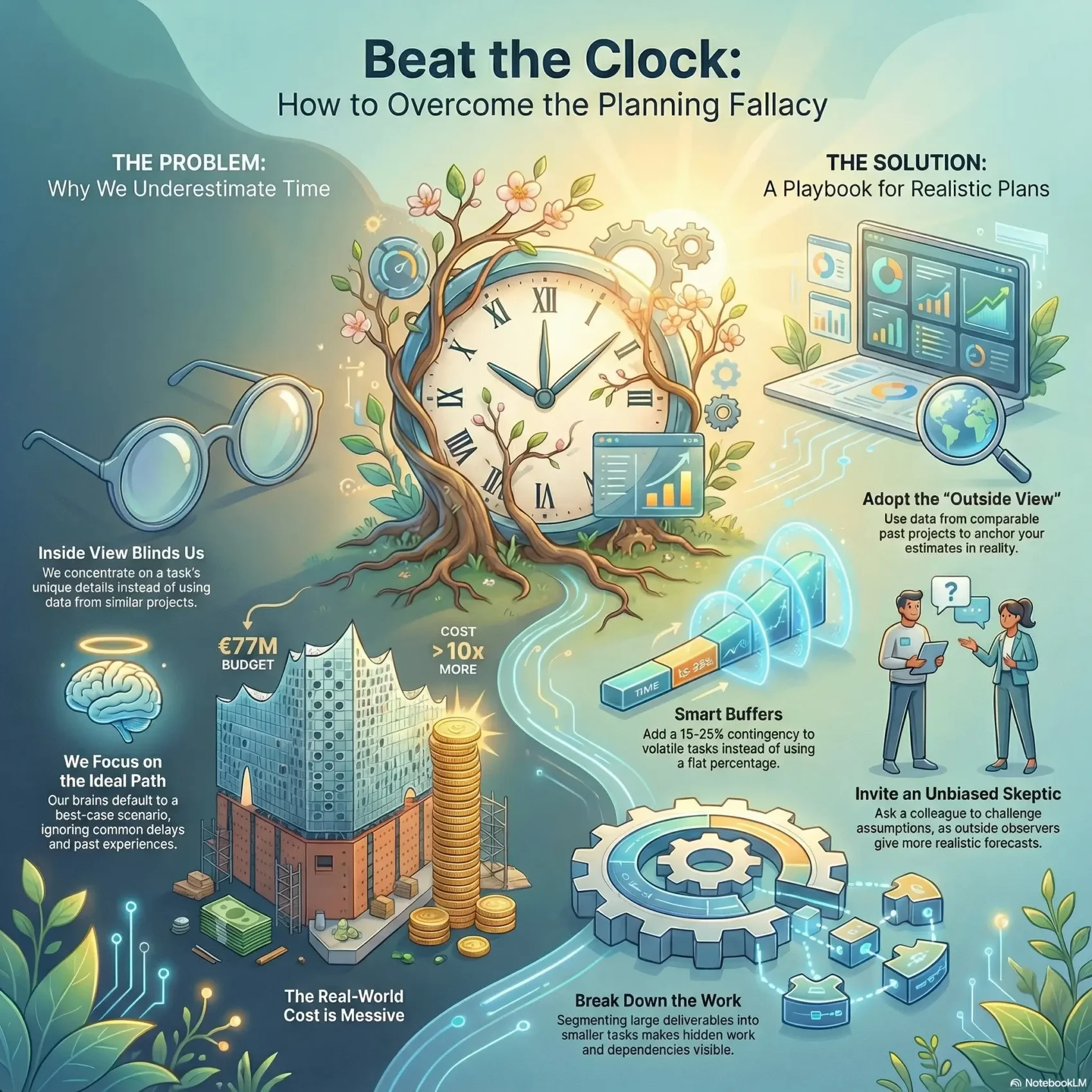
Last Updated on February 19, 2026
The planning fallacy names a common trap: you expect tasks to take less time than they actually do. Daniel Kahneman and Amos Tversky first described this pattern in research that shows people and teams keep underestimating timelines and costs.
Outside observers often give longer estimates than the person doing the work. That gap creates missed deadlines, budget overruns, and stress across any project you run—from a class assignment to a multi-team business effort.
In this article, you’ll get clear, practical insights and steps to stop automatic optimism. You’ll learn why this bias appears, how to use past results to build better plan ranges, and what guardrails help teams deliver on time.
Key Takeaways
- The planning fallacy leads people to set overly optimistic schedules.
- Researchers show repeat underestimation causes common delays and cost creep.
- You can use past project data to create realistic forecast ranges.
- Simple guardrails—buffers and peer review—improve plan accuracy.
- Applying these steps helps your business finish more work on time.
Understanding the planning fallacy and its psychological roots
When you map a task, your brain often focuses on the ideal path and skips common delays. Daniel Kahneman and Amos Tversky framed the phenomenon as a clash between case-specific optimism and base-rate reality.
Definition: In their classic work, daniel kahneman amos researchers showed people underestimate completion times even when similar projects took longer.
Much of this comes from optimism bias, which pushes you toward a best-case scenario. Buehler, Griffin, and Ross found people remain optimistic even after contrary evidence.
Social factors matter too. Experimental social psychology studies link Dunning-Kruger and positivity effects to overconfidence. Sanna et al. showed temporal framing and group dynamics make teams pick shorter horizons.
- Outside vs. inside view: observers give longer estimates because they use base rates.
- Social origins: incentives to sound decisive can skew dates earlier.
“People plan as if obstacles won’t appear.”
Where you see it in everyday work and life
You see this bias when a student swears a paper will be done in three days despite past work taking about a week. That classic example shows how people ignore what actually happened before and hope for a faster result this time.
From student papers to software projects: why “this time will be different”
In school, last-semester evidence often gets shrugged off. You tell yourself the paper will be quick, then ask for an extension when research and edits pile up.
At work, software teams promise a clean sprint and still face integration snags, code review delays, and testing that take complete cycles to finish. Outside observers usually give longer, more realistic horizons.
- Home projects often double budgets—people plan best-case costs and miss supplier or cleanup steps.
- Common blockers include waiting on feedback, context switching, and underestimated debugging.
- Flag phrases like “quick win” or “just a tweak” as signals you might underestimate time.
When you map these everyday examples back to one pattern, you get a practical reality check for future estimates.
Why smart people and strong organizations still underestimate time
You often fall into a trap when the specifics of a task feel more real than what happened before. That inside view highlights unique steps and optimistic assumptions. It makes you ignore useful base rates and past data from similar efforts.
Inside vs. outside view: ignoring relevant past data and base rates
The inside view focuses on the current path and its ideal flow. The outside view uses base rates from comparable projects and can prevent repeated misjudgment.
- You’ll learn to check historical data before locking dates.
- Outside observers often give longer, more realistic horizons.
- Use a reference class to ground your forecasts.
Choice-supportive bias, motivated reasoning, and anchoring at play
People remember wins and downplay misses. This choice-supportive bias makes you repeat the same approach.
Motivated reasoning helps teams keep narratives that match desired outcomes. Anchoring locks estimates to an initial, often optimistic, date.
Group planning fallacy and temporal framing effects
When teams agree on a short timeline, social pressure makes it hard to push back. Experimental social research shows wording like “only X weeks” reduces perceived effort and raises risk-taking.
“Surface uncertainty in your plan language to avoid locking into unrealistic dates.”
- Bring an outside estimator to counterbalance optimism.
- Call out anchors and test alternative start dates.
- Make uncertainty explicit in decisions and timelines.
The business impact: budgets, white space risk, and stalled execution
When deadlines slip, the damage shows up in budgets, team morale, and missed market windows. You translate optimism into real cost when dependencies are ignored and estimates drift.
Urgent vs. important work and the Eisenhower Box problem
The Eisenhower Box shows how urgent, low-value tasks can consume your week. You end up firefighting instead of protecting critical reviews and vendor lead times.
Use an outside check to keep important work visible and avoid a half full mindset that trims necessary buffers. See a short primer on the matrix Eisenhower Box.
How white space risk hides missing plan elements
White space risk is when essential items—permits, licenses, third-party approvals—aren’t on the timeline at all.
Those gaps create stop-the-line delays that stall execution and erode stakeholder trust.
Cost and schedule overruns from Elbphilharmonie to home renovations
The Elbphilharmonie was set for 2010 with €77M; it opened in 2017 at roughly ten times that budget. Home projects show the same pattern—typical budgets near $19,000 but actuals around $39,000.
These examples prove how projects escalate when you underestimate time and skip real contingency. Use pre-mortems and dependency mapping to surface hidden work and quantify the impact on cost, schedule, and delivery.
Self-diagnosis: signs your estimates are overly optimistic
You can spot overly optimistic estimates by watching how risks are described—or avoided—when a task is scoped.
Listen for language like “quick,” “just,” or “shouldn’t be hard.” These words often hide work and signal a soft buffer in your plan.
Flag any vague buffer phrasing. If a buffer is unspecified or labeled “just in case,” it usually means hidden tasks or missing owners.
- You skip risk identification because “it won’t happen this time” — a classic sign of optimism.
- You compress steps that historically took longer, assuming faster handoffs without process changes.
- You rely on heroics or productivity spikes instead of steady, repeatable methods.
- You underestimate review cycles, stakeholder availability, or vendor lead times.
- Your language treats risk responses as optional instead of tasks with owners and dates.
Use simple research and past data to compare predicted versus actual durations. Run a short pre-mortem to surface the weakest spots before kickoff.
One practical change: add 15–25% contingency to volatile items and set thresholds for when to escalate an estimate review. Small steps like this give you immediate, measurable insights into the real problem and improve future estimates.
Proven methods to counter the bias and plan better
Start by swapping hopeful guesses for evidence-based ranges drawn from projects like yours. Use techniques that force you to check reality, not just optimism.
Adopt the outside view with reference class forecasting
Reference class forecasting asks you to find comparable projects, gather base rates, and anchor estimates to real outcomes.
This method reduces overconfidence and aligns your plan with what similar work actually required.
Use historical data and industry benchmarks as guardrails
Collect past data and express timelines as ranges, not single-point dates. Benchmarks give you a realistic distribution for time and cost.
Set review gates that update forecasts with execution data so your estimate improves as work unfolds.
Plan for Murphy’s Law: buffers for time, cost, and risk
Translate Murphy’s Law into practical buffers. Allocate contingency based on volatility, not a flat percentage.
Document explicit assumptions and trigger conditions that require plan changes to avoid quiet drift.
Invite an unbiased skeptic to gut‑check your timeline
Ask an unbiased colleague to challenge assumptions and surface blind spots. Outside reviewers often give more conservative, useful forecasts.
“Good estimation uses history, clear assumptions, and a healthy skeptic.”
- Use reference classes and base rates to anchor dates and budgets.
- Build guardrails from historical data and industry norms.
- Apply variable buffers tied to risk and execution signals.
- Institutionalize skeptic reviews and weekly burn-up checks.
Make tasks smaller and commit to actions that stick
When you chop a deliverable into short tasks, you reduce unknowns and speed execution. Small pieces are easier to estimate and schedule. They also make hidden work visible.
Task segmentation to improve time allocation
Break large work into clear steps with a definition of done. This pulls out setup, approvals, and data cleanup that often get missed.
Assign owners and durations for each segment so shared work is trackable. Use checklists to anchor recurring steps and lower variance across sprints.
Implementation intentions to close the intention-action gap
If-then plans convert vague aims into concrete triggers. For example: “If it’s 9 a.m., then I start code review.”
“Forming specific start cues raises the chance you take complete actions on time.”
- Segment work and name the process for each step.
- Set daily start triggers and calendar holds to protect focus.
- Run a short pilot and compare predicted versus actual times.
Experimental social studies such as Koole & Van’t Spijker (2000) and Forsyth & Burt (2008) show studies improve follow-through. Use these methods to counter the planning fallacy and boost reliable execution.
Let past projects guide future timelines
Look to recent deliveries to shape realistic timelines for what comes next. The best predictor of timing is how similar work actually finished, not how you hope it will go.
Build a simple reference library of past projects with start and finish dates, scope notes, and major blockers. Extract median and 80th percentile durations so your next plan uses a realistic range instead of a single optimistic date.
Normalize scope by mapping features or work packages so you compare like with like. Use outside observers’ longer estimates and research-backed patterns to sanity-check your instincts.
- Capture deltas between plan and actuals to see where you were off.
- Write assumptions beside each estimate so you can test them later.
- When internal history is thin, lean on industry benchmarks or predictive analytics and update those figures as your data grows.
Share these insights with stakeholders and fold lessons into your templates. Make this a lightweight habit and you’ll steadily reduce schedule risk across every new project.
Building organizational rigor around planning and execution
A repeatable rhythm and clear ownership turn vague timelines into reliable outcomes. You need structures that make estimate quality visible and shared across your organization.
Accountability, visibility, and cadence for realistic plans
Design an operating cadence with weekly reviews and monthly retros. This makes accuracy a shared responsibility, not an afterthought.
Give executives, managers, and teams one source of truth so everyone sees status, risks, and dependencies the same way.
Leveraging plan management software to align people and data
Use plan management software to connect people and data, creating real-time views of progress and blockers. That drives faster, better decisions for your business.
- Assign clear owners for milestones and decision points to lock accountability.
- Set standards for estimates, buffers, and change control across portfolios.
- Capture execution metrics—variance, throughput, predictability—to improve future execution.
“Make accurate forecasting a habit, and reward learning over aggressive targets.”
Case-based playbook: anticipating dependencies and external risks
Real-world transitions often hinge on a few fragile dependencies that you can map ahead of time. In one case, a business moved a process about 2,000 km and relied on employee travel. An airport workers’ strike cut flights for weeks and turned a tight timeline into a major disruption.
Business process transition: travel constraints and contingency paths
Only 40% of employees could travel while 60% sat idle after being offboarded. Negotiations ran nearly eight weeks. The transition slipped by a month and profits fell roughly 15% due to downtime and extra costs.
- Map critical dependencies: travel, equipment, and systems access.
- Stage work to avoid concentrating all tasks in one risky window.
- Keep flexible staffing pools to redeploy idle employees.
Designing scenario plans and response triggers for fast pivots
Design scenarios for likely disruptions like labor actions. Predefine responses—alternate transport, remote training kits, and extra IT capacity—so you can act fast.
- Set a trigger (for example, one week of reduced capacity) to pivot plans.
- Track external indicators such as negotiations and integrate them into your risk monitoring.
- Run tabletop exercises so decisions are practiced, not improvised.
Apply this playbook across your organizations so each project learns from the case and reduces future exposure to the planning fallacy.
Conclusion
Treat each timeline as a hypothesis you can test and refine with real data.
The planning fallacy is a robust tendency to underestimate completion time, cost, and risk across contexts. Advances experimental social psychology and business research explain why your brain defaults to optimism and how you can counter it.
Use the core playbook: the outside view, historical benchmarks, task segmentation, explicit buffers, and skeptic reviews. These steps improve estimate realism and strengthen execution on every project.
Make one next move: audit an upcoming plan against base rates and start a running log of predicted versus actual durations. Track your time take and time take complete to sharpen forecasts.
With steady, simple habits you’ll align stakeholder expectations, lower surprises, and see measurable gains in predictability. Better planning is a learnable skill—apply these insights and watch results follow.