Tools
Tools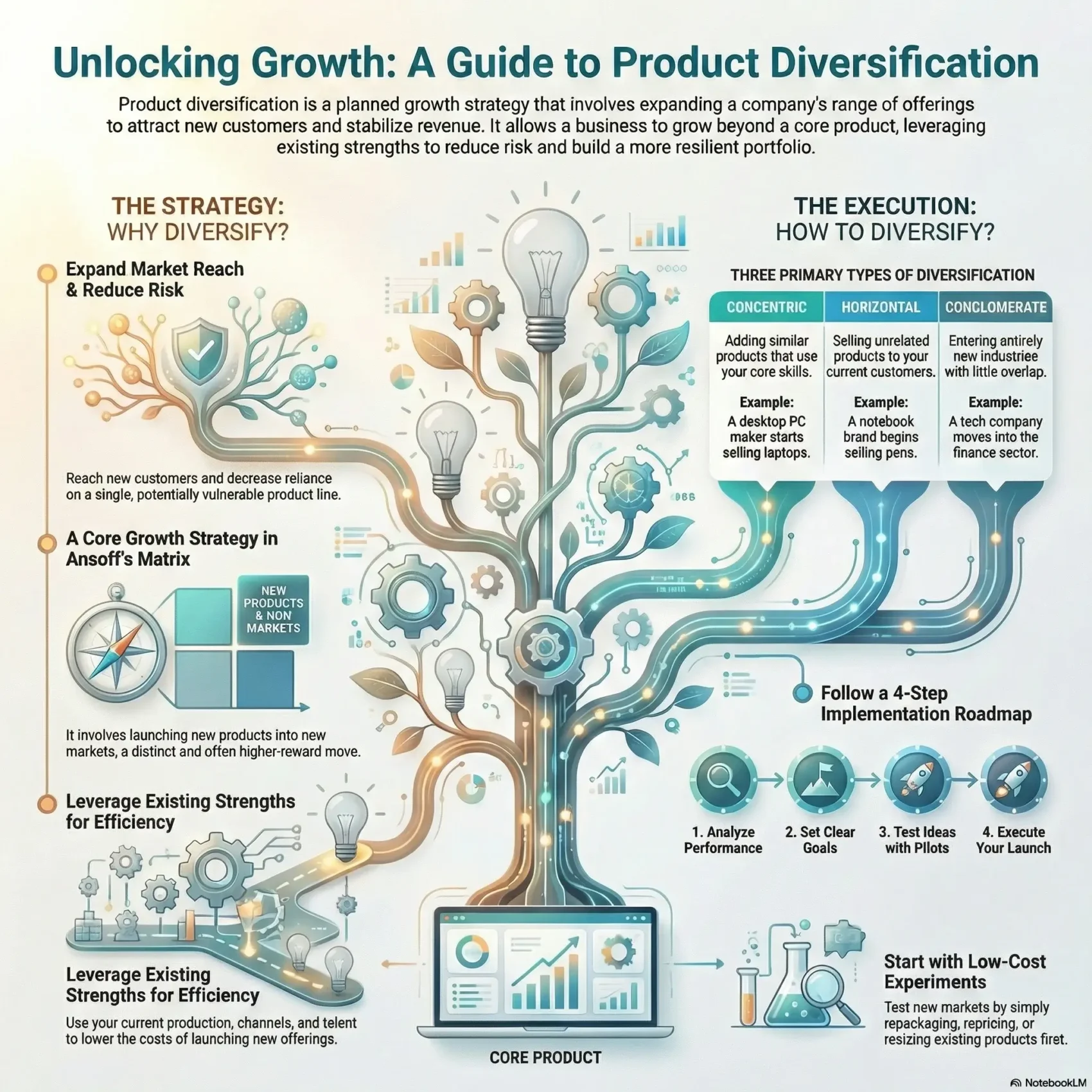
Last Updated on February 27, 2026
Product diversification helps you expand your company’s range to attract new customers and boost revenue when you plan and execute a clear strategy.
It sits inside Ansoff’s growth framework alongside market penetration and product development, giving you a practical path to steady growth without overreliance on a single offering.
When a company broadens its offerings, it can stabilize income, use existing capabilities more fully, and strengthen the brand with complementary lines.
In this guide, you’ll get a short roadmap that covers related and unrelated moves, geographic expansion, and tactical steps like repackaging, extensions, and pricing changes you can apply now.
Key Takeaways
- Learn a clear definition of diversification and why it matters for market reach.
- See how the approach fits within Ansoff’s Matrix and your overall strategy.
- Discover practical tactics to broaden offerings and attract new customers.
- Understand metrics to track revenue mix, margin lift, and portfolio resilience.
- Find real-world models and simple decision filters to test new moves.
Why diversify now: market reach, growth, and risk reduction
Reaching new segments and spreading revenue sources is a key move for companies scaling beyond a niche. You expand your market and speed up growth while lowering the chance that one slow line threatens the whole business.
There are clear benefits:
- You reach more customers and broaden your revenue mix, so one drop in sales won’t derail the whole portfolio.
- You strengthen the brand by adding complementary offerings that deepen loyalty and coherence across lines.
- You use resources more efficiently by applying existing production, channels, and talent across new areas.
- You improve bargaining power with suppliers and channels as scale and relevance grow.
- You stay adaptable to trends, seasonality, and regulatory shifts, reducing overall risk.
Practical takeaway: diversify with clear tests. Pilot a few ideas, track revenue and customer overlap, and scale the ones that lift margins and resilience. This approach helps you grow in the market without overextending resources.
Product diversification: definition and core concepts
Adding new lines or variations lets your company tap fresh customers and lift revenue without abandoning what you already do well. This strategy grows sales volume by bringing new offerings to market and by extending your existing product line.
At its core, this is a planned growth approach. You expand purposefully to reach new segments, increase profitability, and spread risk across more revenue streams.
What it is and how it expands your product line and market
You expand your range with variations, tiers, or entirely new services to capture adjacent customer needs.
Well‑executed development keeps your core strengths and uses current channels to lower launch costs.
Business-level vs. corporate-level moves
Business-level moves extend into adjacent sections of your industry. For example, a SaaS company adding workflow tools stays inside its market and serves current customers better.
Corporate-level moves mean entering new industries altogether, such as a tech firm moving into education or finance. These require more resources and a clear alignment with company goals.
- Align choices with capabilities and market data.
- Decide whether to bundle services or spin them out for clarity.
- Check channel readiness, support load, and pricing before scale-up.
Product diversification in the Ansoff Matrix
The Ansoff chart maps four growth paths so you can weigh risk and reward before committing resources to a new move.
Where this fits: The matrix lists market penetration, product development, market development, and diversification. Use it to decide whether to deepen sales with current customers or to expand into new segments with new offerings.
How it differs from other growth moves
Product development focuses on new or improved items for your existing market. Market development adapts current offerings to reach new audiences.
Diversification, by contrast, usually pairs new products with new markets. That means you often need fresh capabilities, broader research, and tighter cross-team coordination.
- Risk: diversification carries higher uncertainty and may require new hires or partners.
- Resources: it calls for separate roadmaps and different KPIs than a feature upgrade.
- Sequencing: use feasibility and ROI to balance safe bets and bolder moves.
Example: a feature upgrade for loyal customers is product development; launching a new category for a new segment is diversification. Use the matrix to pick the right approach for your current growth stage.
Types of diversification you can deploy
Choosing the right expansion path lets your company match risks with resources and tap new revenue streams. Below are practical routes you can consider, with quick examples and trade-offs.
Concentric moves: related extensions
Concentric expansion means adding similar products or services that use your core skills.
A desktop PC maker adding laptops is a classic case.
Horizontal moves: unrelated items for current buyers
Horizontal choices let you sell different goods to the same customers via trusted channels.
Think of a notebook brand launching pens to leverage retail shelf space and buyer loyalty.
Conglomerate moves: new industries
Conglomerate bets place you in fundamentally new fields with little overlap.
They spread risk across industry lines but demand sharp governance and capital discipline.
Related, unrelated, and geographic comparison
“Related moves often reduce execution risk; unrelated bets require stricter review.”
- Related: leverages shared capabilities (example: Honda’s engine use across categories).
- Unrelated: broad portfolio coverage for risk management.
- Geographic: replicate store or operational models to enter new markets at scale.
Practical tip: weigh capability fit, channel readiness, and portfolio goals when you pick a path. These strategies help you expand with clearer odds of success.
Practical diversification strategies you can execute today
Tactical tweaks — from sizing to branding — often unlock fresh demand faster than launching a brand-new line. Use low-cost experiments to test what sticks before you invest in major development.
Redesigning packaging or your digital landing pages can make the same product appeal to new use cases or age groups. Small visual changes improve shelf impact and click-through without changing core features.
Repricing and channel-specific positioning
Set tiered prices for specialty retailers and online channels. A slightly elevated price with premium placement can open access to higher-margin stores.
Renaming and rebranding
Adapt the name to local languages and norms to boost recall. A clear, localized brand name helps you enter new regions with less friction.
Resizing SKUs and extensions
Offer bulk SKUs for wholesale and small counts for convenience retail. Add new styles, colors, or feature upgrades to meet taste and budget differences.
- Tip: align packaging, messaging, and channels to match the customer you want to reach.
- Use brand extensions to add higher and lower tiers that protect reputation while adding new buyers.
Approaches to growth: new markets vs. new products
Choosing the right approach begins with a clear test: will entering new markets or building new products serve your growth goals faster?
New markets extend beyond geography. Consider age groups, personas, business size, economic tiers, and moves from B2C to B2B. Segment by these groups to find the best match for your capabilities.
Validate a market by adapting packaging, messaging, and minor feature changes. Run small pilots and measure uptake, churn, and customer feedback before scaling.
Finding and validating new markets
Start with lightweight research: surveys, interviews, and channel tests. Target one segment at a time and use clear success metrics.
- Age & persona: tailor tone and channels to fit lifestyle and media habits.
- Business size: adjust pricing, SLAs, and onboarding for SMBs vs. enterprises.
- B2C to B2B: shift packaging and service levels to meet business needs.
Building new products for your current customer base
Prioritize ideas with direct customer demand. Use structured feedback loops and R&D checkpoints to shape development.
Right-size your development effort to the learning required. Start with MVPs, collect input, and iterate. This approach grows share of wallet while keeping risk low.
From niche to diversified: your implementation roadmap
Start by mapping where your current offerings win and where they stall, then build a tight roadmap from that evidence.
Analyze performance and fit
Assess sales trends, return rates, and customer feedback for each product line. Look for SKU-level wins and weak spots.
Use simple dashboards: sales velocity, margin, and repeat rate per offering. This shows where to invest or cut.
Set clear objectives
Define measurable goals: increase sales volume, expand your customer base, and lift profitability.
Attach numbers and timelines so you can judge success and decide when to scale or stop.
Market and competitor scans
Run competitive analysis, trend scans, and TAM/SAM sizing to prioritize bets. Capture unmet needs and fast-moving niches.
Test, validate, iterate
Use surveys, interviews, and small pilots to validate ideas before full development. Pilots shrink risk and sharpen positioning.
Go-to-market and execution
Design launch plans that align communication, packaging, promotions, and partnerships to each segment.
Allocate resources: assign owners, timelines, and success criteria. Add stage gates to learn fast and decide when to scale, pivot, or sunset.
- You’ll assess the product line with sales and feedback data.
- You’ll set goals for volume, customers, and margin improvement.
- You’ll prioritize moves using market scans and trend signals.
- You’ll validate concepts via testing and pilots before launch.
- You’ll craft go-to-market plans that match channels and partners.
For channel playbooks and cross‑channel coordination, review a practical guide on omnichannel strategies to align your launches with customer touchpoints.
Integration paths: horizontal and vertical strategies
Integration lets you buy or build adjacent capabilities to win scale and control key margins. It’s a common growth strategy for businesses that want faster access to channels or inputs.
Horizontal integration
Horizontal moves mean merging with or acquiring rivals to lower rivalry and gain economies of scale.
Famous examples include Exxon‑Mobil and BP‑Amoco, where consolidation widened market reach and cut overlap.
Be blunt: many M&A deals fail. Over 60% erode shareholder value and 70–90% struggle, often due to culture clash or overpaying.
Vertical integration
Vertical plays move you upstream to suppliers or downstream to customers to control production, distribution, and margins.
Historic example: Carnegie Steel controlled mines, rails, and mills. Modern firms like Apple run retail stores to protect the brand experience.
Key risks and safeguards
- Risks: culture fit, integration complexity, overpaying, and operational complacency.
- Safeguards: disciplined valuation, cultural due diligence, clear synergy targets, and a post‑merger integration plan.
- Outcome: when you balance value targets with tight execution, an integration strategy can increase bargaining power and protect end‑to‑end quality.
Real-world examples to model your strategy
Concrete examples from major firms show how timing, capital, and capabilities shape successful growth.
GE, Disney, and Tata Group
GE moved from electricity into aviation, healthcare, digital, venture capital, and finance. That shift shows how an engineering core can be applied across an industry mix while keeping scale.
Disney expanded from animation into parks and film/TV production, which kept the creative brand central while opening new revenue streams.
Tata Group grew from steel into hotels, aviation, autos, and energy, showing controlled multi‑industry expansion across diverse markets.
Berkshire Hathaway
Berkshire shows how an unrelated portfolio can add stability. Its holdings span insurance, utilities, apparel, retail, and rail.
The lesson: disciplined capital allocation and operational oversight can make an eclectic portfolio work.
Honda and Zippo
Honda leveraged a core skill in small, reliable engines to enter motorcycles, cars, ATVs, lawn mowers, and boat motors. This is a clear example of capability leverage across related products.
Zippo stretched a rugged brand into knives, flashlights, and writing tools to offset a shrinking lighter market while preserving identity.
- You’ll learn patterns: capability leverage, market timing, and capital discipline.
- Use these examples as a pragmatic playbook to test moves in your company and markets.
Decision filters and risk controls
Before you commit capital, run potential moves through strict filters to protect value.
Start with three simple tests to screen ideas. Porter’s Three Tests ask whether an industry is attractive, whether entry costs can be recovered, and whether the move makes both units better off.
Porter’s Three Tests in action
First, judge industry attractiveness by applying Five Forces. Second, estimate entry costs and payback timelines—remember Philip Morris paid 4x for 7Up and struggled to recoup that cost. Third, ask if the combined businesses create real synergies.
Applying Five Forces
- Rivalry intensity — will competition squeeze margins?
- Supplier and buyer power — can you secure inputs and pricing?
- Threat of new entrants — how easy is market entry?
- Threat of substitutes — will alternatives limit growth?
M&A reality check
Be candid: over 60% of deals erode shareholder value and 70–90% fail to meet goals. Common causes are overpaying and poor cultural fit.
- Build investment cases that list synergy paths, integration plans, and measurable value milestones.
- Protect downside with staged funding, option-style pilots, and clear divestment triggers.
- Align governance so your diversification strategy gets independent scrutiny like any major capital bet.
“Use objective tests and staged investments to preserve resources and improve the odds of success.”
How to measure diversification success
Measure what matters. Start with clear, repeatable KPIs so you can tell which moves add value and which drain resources. Use short review cycles to learn fast and act.
Revenue mix, customer acquisition, and margin lift
Track shifts in revenue mix to confirm you reach new customers and segments with the right offers.
Measure sales volume growth, segment-level acquisition, and margin lift at both line and portfolio levels.
Resource utilization, economies of scale, and portfolio resilience
Monitor throughput and resource usage to prove the move improves efficiency, not waste.
Document savings from consolidated procurement, logistics, and shared services that lower unit costs.
- Track revenue mix and segment acquisition to validate market reach.
- Measure margin lift to validate pricing and channel choices.
- Monitor resource utilization and throughput for operational gains.
- Document economies in procurement and shared services for cost advantage.
- Assess portfolio resilience to see how shocks in one market affect the whole business.
“Connect outcomes to investments with clear KPIs, dashboards, and a steady review cadence.”
Conclusion
Conclusion
Wrap up your roadmap by turning hypotheses into short pilots that prove market fit and financial payoff.
Use clear goals, simple tests, and tight timelines. Apply Ansoff’s Matrix, Porter’s Three Tests, and Five Forces to vet each move.
Renaming, repackaging, repricing, and resizing help tailor offerings to real customer needs. Track revenue mix, margin lift, and resource use so the company scales what works.
Learn from examples, keep governance strict, and align owners to the launch plan. For channel alignment, review omnichannel strategies to coordinate touchpoints and speed adoption.
Do this and you’ll convert thoughtful diversification into steady growth and durable value.