Tools
Tools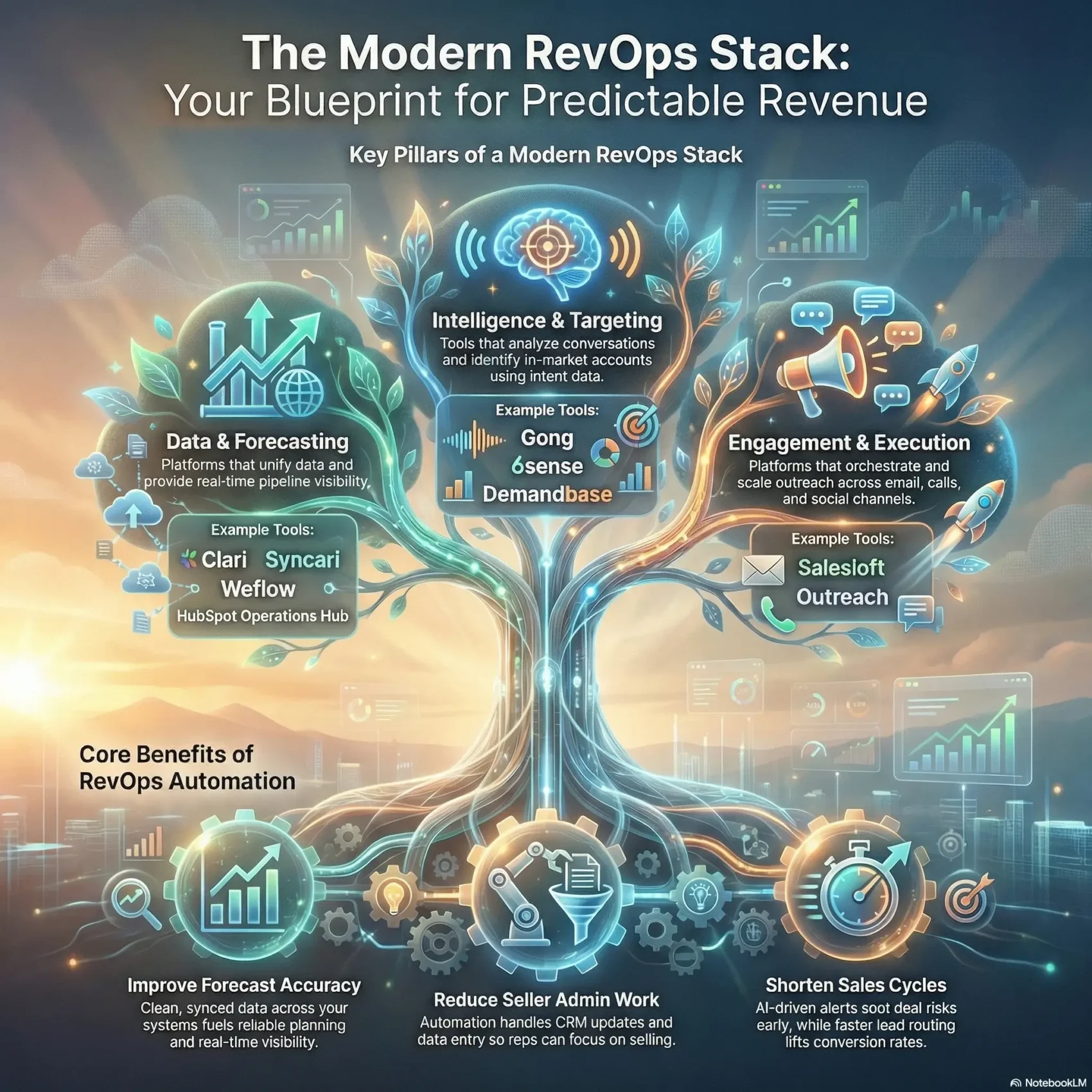
Last Updated on January 28, 2026
You need a clear path to align sales, marketing, and operations so your revenue grows predictably. This guide gives you a concise roundup of platforms that unlock cleaner data, faster forecasting, and smarter outreach.
Modern stacks use AI-driven platforms like 11x, Clari, and Gong to turn calls, emails, and CRM records into actionable insights. Others, such as Syncari and HubSpot Operations Hub, keep multi-directional data in sync so your reps spend less time fixing records and more time selling.
We’ll also show how ABM engines like 6sense and Demandbase lift account prioritization, while Outreach and Salesloft scale engagement across channels. Expect practical notes on integration, data quality, and quick pilots you can run this quarter.
Key Takeaways
- AI-driven platforms cut admin work and surface revenue signals for sales and customer teams.
- Clean, synced data improves forecasting and shortens deal cycles.
- ABM and intent solutions speed pipeline creation for target accounts.
- Pick tools that integrate with Salesforce, HubSpot, and Slack for faster time-to-value.
- Start with small pilots—Weflow for pipeline hygiene or Cognism for verified contacts—to gain momentum.
Why RevOps automation matters right now for your 2026 revenue goals
If your 2026 plan depends on predictable revenue, start by tightening how systems and teams share data.
Clean, synced records across Salesforce, HubSpot, and Slack speed up sales cycles and lift conversion rates. Leaders get timely insights and make faster, higher-confidence decisions week over week.
“Digital workers reduce manual updates and keep CRM data clean, enabling more reliable pipeline visibility and forecasting.”
- Less busywork. Sellers focus on active opportunities, not data entry.
- Better forecasts. Clean data fuels accurate planning and real-time visibility.
- Faster fixes. Spot risks early with alerts and AI-driven signals.
- Compounding ROI. Improved forecasts boost resource allocation and overall growth.
In practice, using digital workers to auto-capture activities and standardize reviews keeps pipeline healthy. That is how you scale consistent performance across regions and roles while protecting your 2026 targets.
The best RevOps automation tools for 2026
For predictable pipeline and cleaner data, consider these proven platform choices for 2026. Each entry gives a short snapshot so you can match features to your biggest bottlenecks.
- 11x — AI digital workers unify enrichment, email/LinkedIn outreach, lead qualification, CRM sync, and forecasting. Integrates with Salesforce, HubSpot, and Slack.
- Clari — Enterprise forecasting, deal health, and real-time pipeline visibility for better weekly reviews.
- Gong — Conversation intelligence with AI coaching, call search, and coaching libraries to lift win rates.
- LeanData / Default — Lead routing, scoring, and scheduling; Default’s inbound plan starts at $665/month for five seats.
- 6sense & Demandbase — Intent and ABM platforms that surface in-market accounts and power targeted engagement.
“Pick platforms that clean data, boost engagement, and make forecasting reliable.”
Revenue intelligence and coaching to improve win rates
You can mine every sales interaction for signals that predict deal outcomes and coach smarter. Gong transcribes and analyzes your calls and meetings, then surfaces conversation insights like engagement, sentiment, and keyword spikes.
Turn calls and meetings into actionable insights with Gong
Gong gives searchable recordings and AI-assisted coaching that help you find patterns across reps and accounts. Use those patterns to build model conversations and training libraries that new hires can mirror.
Use conversation patterns to guide coaching and replication
Mine talk-time ratios, objection handling, and trigger moments to craft weekly coaching plans. Track sentiment shifts and keyword peaks, then assign concise, repeatable actions for your teams.
- Pattern mining. Identify behaviors that correlate with higher conversion and revenue.
- Coaching at scale. Turn sentiment and engagement signals into short, measurable coaching KPIs.
- Replication. Build libraries of model calls so new reps ramp faster and perform better.
Connect insights to pipeline health and forecast confidence
Tag moments and map them to CRM records so conversation signals feed pipeline metrics. Prioritize deals showing strong engagement and flag at-risk opportunities earlier.
“Use conversation analytics to align marketing follow-ups and improve forecast confidence with observable buyer behavior.”
Practical tip: align Gong signals with forecast systems like Clari or InsightSquared so intelligence flows into your pipeline models. For more on business trends and how this fits broader strategy, see business trends in operations.
Forecasting, pipeline, and deal inspection for predictable revenue
Predictable growth starts with reliable forecasts and frequent, focused pipeline check-ins. This section shows how Clari, InsightSquared, and Weflow work together to make weekly reviews fast and meaningful.
Clari’s AI-driven forecasting and deal risk detection
Clari aggregates CRM and activity signals to surface deal health scores and risk flags. Use those scores to run weekly deal inspection and pressure-test commit categories.
InsightSquared for customizable dashboards
InsightSquared offers 350+ dashboards for forecasting, pipeline analysis, and performance tracking.
Map the dashboards you need—stage conversion, forecast vs. actual, and coverage—so your teams focus on real gaps.
Weflow for faster reviews and compliance
Weflow enforces process compliance by automating data capture, required fields, and next-step checks before review. It also sends real-time alerts and feeds Salesforce reporting and analytics.
“Turn inspection into a predictable revenue engine by running a weekly rhythm by segment, region, and role.”
- Set weekly deal inspection using Clari health scores to catch risk early.
- Combine InsightSquared analytics with call signals to validate confidence levels.
- Use Weflow to standardize notes, mutual action plans, and exception handling for long-cycle deals.
- Model coverage and right-size top-of-funnel targets from historical conversion and cycle time.
Clean data hygiene through Weflow improves dashboard accuracy and lifts forecast confidence over time. With a steady rhythm, your sales teams and operations staff can turn inspection into repeatable outcomes that drive revenue.
Account-based marketing and buyer intent for targeted outreach
When you tie account intent to routing and enrichment, outreach becomes timely and relevant.
Use intent signals to move accounts from anonymous interest to qualified pipeline. This lets marketing and sales act fast when a company shows buying behavior.
6sense for intent data and predictive lead scoring
6sense surfaces extensive intent data and predictive scoring so you can spot in-market accounts. Pricing starts around $30,000/year.
Operationalize those signals to prioritize accounts for campaigns and route them to the right reps.
Demandbase for unified ABM and lifecycle engagement
Demandbase unifies account identification, personalized experiences, and engagement tracking across the lifecycle.
Use it to coordinate campaigns and lift conversion by delivering tailored content to buying committees.
Cognism data enrichment to improve targeting and routing
Cognism supplies verified B2B emails, phone-verified mobiles, Bombora intent, and Diamond Data. It integrates with HubSpot, Salesforce, Salesloft, and Outreach and offers a free trial of 25 leads.
Enrichment improves lead scoring, routing, and territory coverage so sellers reach the right persona at the right time.
“Build target lists, map committees, and trigger outreach when accounts surge on high-intent topics.”
- Operationalize intent: identify accounts researching your category, prioritize them for campaigns, and route ownership fast.
- Coordinate teams: align marketing and sales on shared signals, SLAs, and attribution for faster follow-up.
- Measure impact: tie campaigns to sourced pipeline, win rates, and cycle time so you can scale what works.
Sales engagement and GTM execution across channels
Orchestrating sequences across email, calls, and social unlocks faster booking and clearer execution for your GTM teams.
Choose an engagement platform that gives sellers consistent playbooks and clear analytics. Salesloft offers email sequences, analytics dashboards, and automation at roughly $125–$165 per user/month. Outreach provides prospect sequences, follow-ups, and reporting with tiered per-user pricing.
Salesloft vs Outreach: sequences, tasks, and analytics
Both platforms help you run multichannel sequences and orchestrate daily tasks so your sales reps execute repeatable plays.
- Sequences: set cadences for calls, email, and social touchpoints.
- Tasks: automate follow-ups and reminders so reps never miss next steps.
- Analytics: measure reply rates, meeting rates, and conversion to opportunity.
Route, score, and book faster with Default or LeanData
Pair engagement with routing: Default’s inbound plan ($665/month for five seats) handles lead routing, scoring, and scheduling. LeanData matches accounts and automates routing in Salesforce with quote-based pricing.
When routing and engagement are aligned, response times fall and meeting rates climb while intent is highest.
“Align tasks, dispositions, and scheduling with your RevOps process to keep opportunities moving and data accurate.”
Practical actions: A/B test subject lines and send patterns, embed meeting scheduling in forms, and add compliance guardrails for opt-outs and limits. Track the dashboards that matter and feed results back into templates your teams reuse.
Data quality, unification, and analytics in your RevOps tech stack
When your systems speak the same language, your teams move faster and forecasts get real. Clean customer records and reliable analytics let you trust reports and act quickly on changes in pipeline or churn risk.
Syncari for multi-directional sync and clean customer data
Syncari harmonizes records between HubSpot, Salesforce, and other GTM apps with no-code, multi-directional sync. That prevents conflicts, reduces manual fixes, and keeps ownership clear across systems. Pricing is custom, so plan for an implementation that includes governance and mappings.
Coefficient to operationalize live data in Sheets
Coefficient connects Google Sheets with CRMs and analytics so you can run live reports, cloud pivot tables, and instant row alerts. Two-way sync and alerts help your teams act on ad-hoc scenarios. Paid plans start at $59/month for lightweight, actionable analytics.
HubSpot Operations Hub for data quality management
HubSpot Operations Hub adds a Data Quality Command Center, programmable workflows (Python/JS), and data curation for reporting. It ranges from a free tier to Enterprise at about $2,000/month, letting you automate cleanup and standardize field formats.
“Unified data is the backbone of accurate reporting, reliable forecasts, and consistent customer experiences.”
- Governance: set field standards, owners, and SLAs so the stack scales without collapse.
- Recipes: auto-enrich on create, nightly de-dupe, and alerts when critical fields go stale.
- Actionable analytics: push curated metrics back into the systems your customer-facing teams use daily.
Change management matters: document processes, train users, and monitor quality so people trust the data. Clean data amplifies the value of every platform in your stack — better routing, fairer scoring, and clearer insights that help you hit targets.
Customer onboarding, success, and retention workflows
A clear handoff from sales to success cuts churn and boosts early expansion. Use a shared space so your customer and internal teams see the same playbook.
Dock provides digital sales rooms with a template library, content management, order forms, onboarding flows, and a client portal. There’s a free tier (five workspaces), Starter at $49 per person/month, Growth at $59 per person/month plus a $250 monthly platform fee, and Enterprise by quote.
Dock digital sales rooms for smoother handoffs
Use a Dock room as the single source of truth for late-stage sales and onboarding. Include mutual action plans, key documents, order forms, and timelines so the customer knows what comes next.
Leverage engagement insights to reduce time-to-value
Track engagement inside the room to spot blockers early. When your teams see low activity, intervene with guided setup or milestone-based check-ins to keep implementation on schedule.
- Repeatable process: define checkpoints, data handover standards, and who owns each task.
- Accelerate value: use pre-boarding content and guided setup to shorten activation time.
- Close the loop: feed onboarding insights back into playbooks to improve qualification and retention.
“Shared digital rooms make transitions clean and measurable—so customers get value faster and your teams stay aligned.”
Go-to-market planning, territories, and capacity modeling
A clear GTM plan ties quotas, territories, and hiring to live CRM signals so your sales coverage matches market opportunity. Use industry hierarchies and verified records to avoid overlap and to focus companies with the most upside.
Fullcast-style planning: quotas, scenarios, and hierarchy
Fullcast.io links planning to CRM data in real time, letting you build quotas by role or territory and run intelligent scenarios for capacity and coverage.
What you get:
- Real-time quota models tied to live account records so targets reflect actual pipeline.
- Industry hierarchies to segment accounts and balance potential by region.
- Scenario stress tests for seasonality, hiring delays, and productivity assumptions.
Use verified data to size TAM and align resources
Cognism supplies verified contact and firmographic data across EMEA, NAM, and APAC so you can size TAM, prevent overlaps, and route accounts cleanly.
Leaders and managers should model headcount, ramp, and productivity so your teams have realistic targets. Tie planning outputs to routing rules and cadence ownership to minimize reassignments midyear.
“Stress-test your plan with what-if scenarios and set governance rituals—quarterly reviews and midyear adjustments keep the business aligned.”
How to choose RevOps automation tools for your needs
Start with the problem, not the product. Define whether your priority is fixing data quality, improving visibility, or accelerating execution. A clear problem statement keeps purchases focused and speeds time-to-value.
Start with your bottlenecks: data, visibility, or execution
Pinpoint one core need and rank it. If records are messy, prioritize platforms like Syncari or Coefficient that handle data and analytics. If forecasting is weak, consider Clari. If engagement lags, look at Salesloft or Outreach.
Check CRM integrations, automation depth, and scalability
Score vendors on Salesforce and HubSpot integration, API maturity, and whether the platform scales across users and regions. Evaluate implementation effort, vendor training, and ongoing support before signing.
Balance cost, onboarding, and time-to-value
Compare licensing models and expected payback. Plan a small pilot with clear success metrics—reduced data fixes, faster book rates, or improved forecast accuracy—to de-risk decisions.
- Problem-first: define needs and expected outcomes.
- Integration checklist: confirm native connectors to your tech stack.
- Feature map: route, engage, forecast, and analyze gaps.
- Implementation plan: pilot, training, and vendor SLAs.
- Security & governance: permissions, audit logs, and data residency.
“Choose platforms that solve your immediate needs and scale with your teams and operations.”
Conclusion
Close the loop: map each platform to the outcome you need—11x for end-to-end automation, Clari for forecasting, Gong for conversation insights, and LeanData/Default for routing.
Add 6sense or Demandbase for ABM, InsightSquared for dashboards, Weflow for data hygiene, and Salesloft or Outreach for engagement. Use Syncari or Coefficient and HubSpot Operations Hub to keep records synchronized. Productive and Dock support services revenue and onboarding. Cognism fills contact and firmographic gaps.
Start with a strong, clear problem statement, pilot a focused use case, and measure leading indicators. When your stack matches needs, your revops and sales teams convert signals into revenue and sustained growth.