Tools
Tools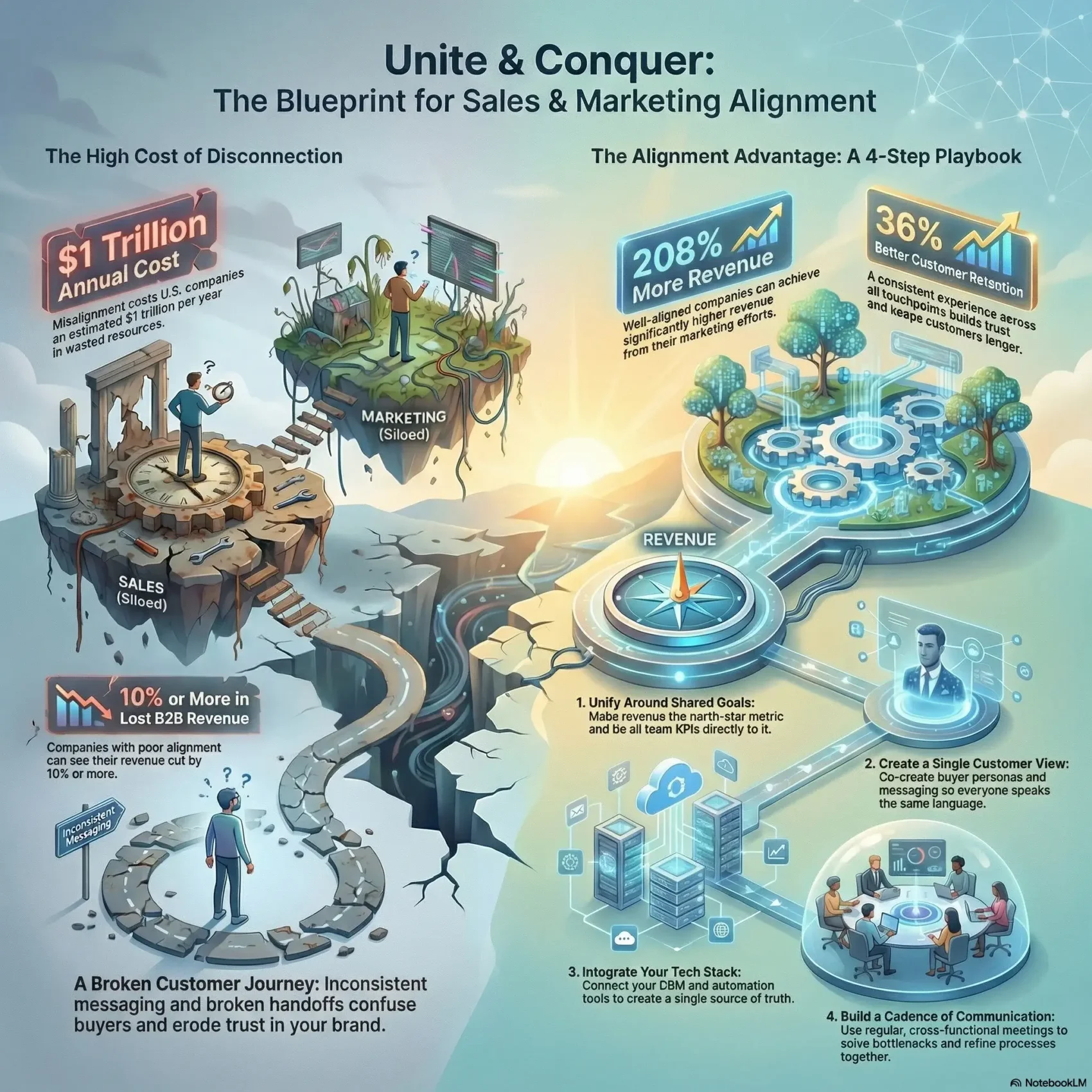
Last Updated on February 17, 2026
You’re about to see why bringing your sales and marketing efforts together matters more than ever. When teams move in one direction, you get clearer goals, shorter cycles, and a smoother buyer experience. This is not a one-time project; it’s a business strategy that drives predictable revenue and steady growth.
Real results follow real coordination. Teams that report good coordination are far more likely to hit targets. Companies that sync their go-to-market work often see large revenue gains and less wasted spend.
In this guide you’ll get a high-level roadmap: shared goals, agreed KPIs, unified messaging, tech harmony, and a steady communication rhythm. Each step shows how to turn separate activities into a single strategy tied to revenue outcomes.
Key Takeaways
- Combining efforts creates a predictable path to revenue and faster deals.
- Shared goals and KPIs turn disjointed work into a clear strategy.
- Technology and consistent messaging make collaboration repeatable.
- Good coordination reduces wasted spend and missed targets.
- This approach embeds cross-team rhythm into your business for lasting growth.
Why Alignment Now: Your Intent, the Market Reality, and What’s at Stake
Buyers now expect a single, seamless experience across every touchpoint. When your go-to-market motion is split, lead handoffs break the journey and customers get mixed messages.
That gap costs you real momentum. Miscommunication creates slow responses, duplicated efforts, and missed opportunities that hurt performance and stall growth.
“A company that coordinates its efforts across channels wins trust faster and converts more consistently.”
Here’s what you’ll gain by bringing teams together:
- Connect your intent to grow with the market’s demand for coordinated experiences.
- Stop using separate playbooks that confuse customers and erode trust.
- Quantify risks: missed leads, slow replies, and wasted resources that reduce performance.
- Create one motion for the whole company so goals and accountability are shared.
In short, unified efforts let you react faster to buyer signals without rework or finger-pointing. The cost of staying split quickly outweighs the compounding returns of coordinated work over time.
The Business Case: Benefits of Alignment and the Cost of Misalignment
When your go-to-market teams move in sync, the payoff shows up in lead quality and faster closes. You get clearer handoffs, less rework, and measurable gains in pipeline velocity. Data backs this up: one study found 25% of reps report better lead quality after syncing teams, and aligned companies can see as much as 208% more revenue.
Improved lead quality, shorter sales cycles, and increased revenue
Better targeting means fewer dead ends. When marketing sources leads that meet agreed criteria, deals move faster. Clean handoffs reduce follow-up gaps and boost conversion per rep.
Result: faster cycles and higher revenue per rep — a clear return on the time invested.
Enhanced customer experience and higher retention
Consistent messaging across channels creates a better buyer experience. Aligned organizations deliver unified touchpoints that raise trust.
That trust pays off: retention can improve by up to 36%, keeping customers longer and improving lifetime value.
Wasted resources, inconsistent messaging, and revenue loss when teams operate in silos
When work is split, you see duplicated effort, mixed claims, and missed follow-ups. These gaps cost real money: misalignment costs U.S. companies roughly $1 trillion a year and can cut B2B revenue by 10% or more.
- Tighter criteria tie lead quality to agreed outcomes.
- Clear handoffs shorten cycles and lift revenue per rep.
- Consistent messaging improves the buyer experience and retention.
- Fixing silos prevents duplicated work and wasted spend.
- Link investments to measurable performance in pipeline and bookings.
What sales marketing alignment Really Means and How to Know You’re Ready
Start by agreeing what “one motion” looks like across teams so work stops overlapping and progress becomes measurable.
One go-to-market motion means your groups operate as a single team with shared goals and shared wins. Marketing sets up opportunities and sales converts them, but both own the same funnel and report the same success criteria.
Readiness check
Audit your current state by looking for three common blockers:
- Silos that create duplicated work and unclear ownership.
- Communication gaps where handoffs lack agreed steps.
- Mismatched metrics that reward different outcomes and slow progress.
What day-to-day looks like
When ready, you’ll see shared dashboards, clear handoffs, and joint planning tied to the same metrics. Communication becomes a trained behavior and a set cadence—not ad-hoc invites.
“You’re still one team… marching towards the same goal,” notes LinkedIn’s Taina Palombo-Price, emphasizing that marketing’s work sets up sales.
Practical steps: separate symptoms from root causes, align leadership on what changes, and enforce the operating model so fixes are lasting. For broader trends and a data-driven view on how teams evolve, see RevOps business trends.
Set Shared Goals and KPIs That Tie to Revenue
Tie every team’s day-to-day work back to the single number that matters most: revenue. Doing so turns vague objectives into clear goals and a simple operating rhythm the whole company can follow.
Pick a small set of high-impact metrics that measure business outcomes, not vanity. Focus on lead-to-customer conversion, pipeline velocity, and CLV/CAC so you see where deals slow and where to invest.
Map ownership across the funnel so accountability is visible and shared, not split by function. Agree who owns each step and which dashboards you’ll review together.
- Make revenue the unifying target and ladder each team’s KPIs to that north star.
- Track conversion rate, pipeline velocity, and CLV/CAC to measure real progress.
- Set a biweekly operating cadence to inspect dashboards, fix bottlenecks, and tune handoffs.
- Align compensation to shared outcomes so incentives support one common motion.
“Use objective data to guide decisions—focus on learning and improving, not blame.”
Co-Create Buyer Personas and ICPs With Sales Input
Co-creating buyer personas brings frontline experience and research into one clear profile. You’ll combine what reps hear in the field with your marketing team’s analytics so buyer profiles reflect real objections and priorities.
Start by capturing concrete pain points, decision criteria, and who sits on buying committees. Document objections and proof points so content and outreach speak the same language your customers expect.
How to build usable personas
- Pair sales reps’ field insights with research and data for a complete picture.
- Record decision criteria, buying committees, and common objections that shape conversations.
- Centralize persona documents so your team accesses one source of truth and consistent phrasing.
- Schedule regular reviews so your ICP reflects changes in market behavior and customer needs.
- Link persona details to content strategy and outreach to make every asset support live conversations.
Result: shared personas turn anecdote into repeatable signals you can measure and act on.
Deliver the Right Leads at the Right Time and Velocity
You win more deals when lead quality, timing, and speed match what reps need. Start by co-defining readiness so both teams know when to act.
Define MQL, SAL, and SQL together with explicit lead scoring rules. Agree on firm criteria so a lead moves forward only when it meets shared thresholds.
Adapt criteria by quarter
Review what the sales team needs each quarter based on pipeline health. You may need different lead types when pipeline is thin versus when it’s full.
Stand-ups to tune handoffs
Run biweekly or monthly stand-ups with BDRs/SDRs and demand gen to inspect handoffs, conversion rates, and common objections in real time.
- Define readiness: MQL → SAL → SQL with scoring rules everyone uses.
- Quarterly tweaks: shift criteria to match pipeline and targets.
- Fast feedback: SLAs for response time and closed-loop reporting so no lead stalls.
- Measure velocity: track conversion and channel performance to protect rep time and keep the sales funnel moving.
“Balance volume and quality — steady velocity beats bursts that overwhelm reps.”
Unify Your Tech Stack: CRM, Automation, and Data Visibility
Centralize customer touchpoints so your company sees the full journey in one place. When every interaction is logged, you remove friction and let real signals guide action.
Start by connecting your CRM and marketing automation to give both teams a single view of contacts and accounts. For example, HubSpot’s CRM can integrate with LinkedIn Sales Navigator to match LinkedIn leads and accounts with contacts and companies. That link saves time and reduces duplicate records.
Standardize definitions for MQL, SAL, SQL, and stage names so your metrics mean the same thing everywhere. Shared definitions stop misreporting and make dashboards trustworthy.
- One source of truth: connect CRM and automation so contact, account, and engagement records are unified.
- Track every interaction: reduce repetitive questions and keep continuity from first touch to renewal.
- Shared dashboards: build real-time views that surface campaign influence, pipeline, and conversion insights.
- Tools and governance: pick the right tools, enforce data rules, and keep your data clean and usable.
- Tighter collaboration: use insights to let marketing optimize programs and sales prioritize outreach.
“When systems share data, people spend less time reconciling and more time advancing deals.”
Keep Messaging Consistent and Equip the Sales Funnel With Content
Stage-tailored content reduces friction and answers the real questions prospects have. Build a simple messaging playbook that keeps your brand voice steady across channels and calls.
Create a unified messaging framework. Codify value props, core proof points, and tone so everyone uses the same words when talking to customers. This saves time and builds trust.
Create a unified messaging framework and brand voice
Make a short, usable guide that lists one-liners, objection responses, and use cases reps can recall on the fly.
Map content to the buyer’s journey: awareness, consideration, decision
Match assets to stage: guides and ebooks for awareness, case studies and webinars for consideration, and demos or ROI calculators for decision. That mapping ensures you always deliver relevant content.
Sales enablement assets that move deals: case studies, demos, ROI tools
Prioritize assets that accelerate deals: concise case studies, objection-handling sheets, demo scripts, and ROI tools that prove value fast.
Central content library for fast access by the marketing team and sales team
Centralize everything in a searchable library with tags for stage, persona, and use case. Set a quarterly refresh cadence and pair content creators with reps so new pieces reflect real conversations.
“When content is easy to find, reps use it — and deals move faster.”
Adopt Targeted Strategies: Define Your Market and Use ABM to Focus Efforts
Targeted account strategies let you stop chasing every lead and start investing in the prospects that matter most. Define a clear market and build three account tiers so your teams know where to focus first.
Move from “spray and pray” to a tiered ABM model. For example, shifting to three tiers helped Alyce open nearly 60% of 50 tier‑1 accounts in one quarter. That kind of focus accelerates pipeline and proves the strategy works.
- Define your market precisely: segment by fit, intent, and potential so prospects are scored consistently.
- Coordinate account lists: prevent overlap and direct effort to the highest-potential targets with shared goals.
- Use ABM insights to tailor content and outreach for the accounts most likely to convert.
- Create joint scorecards that track engagement and pipeline impact by tier to guide next actions.
- Standardize plays per tier and revisit lists quarterly to keep your approach current with buying signals.
“A focused account strategy turns limited effort into measurable growth.”
Break Down Silos With Communication, Cadence, and Candor
A steady meeting rhythm, honest feedback, and shared ownership turn separated groups into one operational unit. You stop passing problems across handoffs and start solving them together.
Start with regular, short stand-ups. Weekly or biweekly meetings keep everyone on the same page. They turn updates into action and surface issues early.
- Recurring cross-functional meetings: review goals, share insights, and remove bottlenecks fast.
- Invite marketers to sales calls: let marketing teams hear real objections so content and enablement fit actual conversations.
- Have hard conversations early: address mis‑targeted accounts and fix the process before problems grow. Alyce used this to correct targeting and improve collaboration between teams.
- Define day-to-day channels: document decisions so context isn’t lost between meetings and people own outcomes together.
“Use meeting time to decide, not just to report.”
Measure, Learn, and Improve: Your Continuous Alignment Process
Continuous improvement happens when you close the loop between results and action. Make measurement part of the routine so your teams turn outcomes into better decisions.
Joint post-mortems to refine lead scoring and campaigns
Run regular post-mortems that bring reps and program owners together to review wins and losses. Use shared data to refine lead criteria and scoring, not opinions.
- You’ll implement joint post-mortems to analyze wins and losses, refining criteria, scoring, and campaigns with data.
- You’ll use shared metrics and dashboards to evaluate performance and align on what to change next.
- You’ll tighten the loop between campaign results and sales outcomes so improvements compound over time.
Invest in training and cross-training to uplevel skills and tools
Train both sides on the tools and processes the other uses. Cross-training builds empathy and speeds problem solving.
- You’ll invest in training and cross-training so both sides master the tools, processes, and strategies that fuel alignment.
- You’ll define a continuous improvement process that turns insights into prioritized experiments and documented learnings.
- You’ll treat alignment as an ongoing capability that drives predictable growth, not a one-time project.
Make dashboards your single source of truth. Shared analytics help you spot trends, test strategies, and scale what works. For a data-driven view on how teams evolve, see RevOps business trends.
“Measure what moves the business, then iterate quickly.”
Conclusion
Use these steps to turn separate efforts into a single, repeatable motion that drives measurable revenue.
Sales marketing alignment ties daily work to shared goals so your teams deliver better leads, shorter cycles, and clearer next steps. Agree on shared KPIs, co-created ICPs, and firm lead definitions. Unify data and build a simple content library to keep messages consistent.
Make alignment a team sport: set a cadence, assign owners, and set a short timeline for the first plays. When your teams plan, measure, and improve together, customers feel the difference and growth follows.