Tools
Tools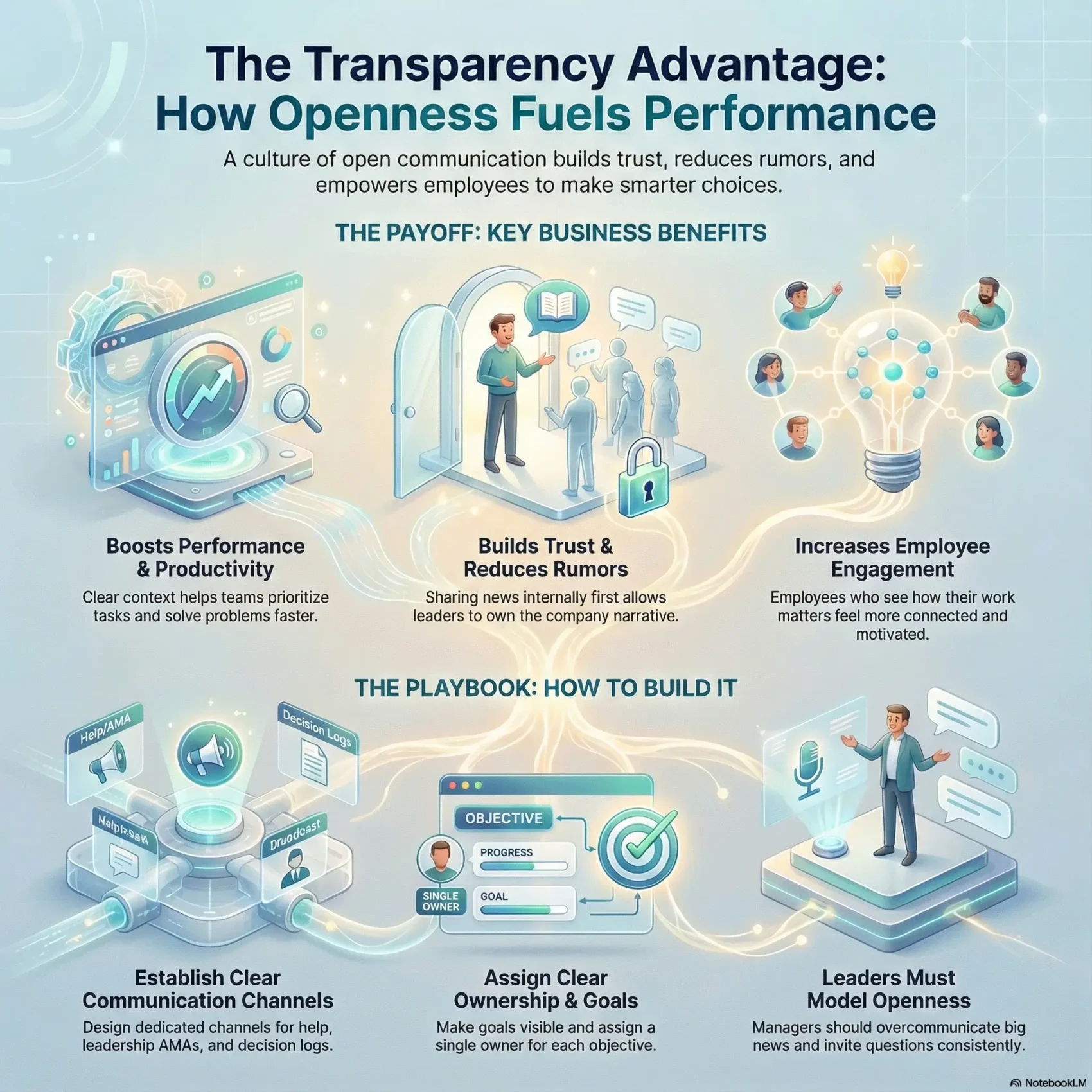
Last Updated on January 17, 2026
You’ll learn why openness is more than a motto — it’s an operating system that links your business goals to real human outcomes. When leaders share clear strategy, up-to-date information, and honest news, people see how their work matters.
Open communication helps reduce rumor mills and builds trust across the company. It gives employees the data and guidance they need to make smart decisions each day.
Good transparency also improves collaboration and job satisfaction. Managers who state goals, offer feedback, and explain choices raise engagement and loyalty. You’ll see practical examples like salary ranges, surveys, and public Q&A sessions that lift morale.
This guide previews simple frameworks you can apply with little friction. You’ll learn what works, what to avoid, and how to bring workers into the story early so your workforce feels safe, informed, and aligned.
Key Takeaways
- Open communication links strategy to day-to-day work.
- Clear goals and feedback boost employee engagement.
- Sharing news early builds trust and reduces rumors.
- Use structured channels—surveys, reports, Q&As—for consistency.
- Avoid over-sharing sensitive information without context.
- Leaders who explain the “why” strengthen alignment.
What Transparency Culture Means at Work Today
When goals are visible and ownership is clear, people at every level can connect daily tasks to company strategy. That clarity turns vague direction into concrete steps you can follow each day.
Clear goals, visible ownership, and open information flows
Make objectives easy to find and align them top to bottom. Post company goals, then show how team and individual targets ladder up. Assign owners so employees know who to ask when things stall.
Set norms for where employees get up-to-date information and how updates are shared. Use consistent channels for day-to-day questions and for bigger decisions. Regular manager updates should surface milestones and blockers.
People now expect context and the “why” behind changes. They want near-real-time answers and a chance to offer ideas. That means leaders must communicate more often and teams must practice clear handoffs.
“Define who is responsible, how progress is tracked, and where people find answers — then everyone moves faster.”
- Assign owners to boost accountability without blame.
- Document decisions so the workforce sees the rationale and next steps.
- Follow ethical rules — for example, inform stakeholders promptly about sensitive incidents while meeting regulations.
For more on how organizations adapt these norms, see recent CSR trends that influence how companies handle information and worker expectations.
Why Transparency in the Workplace Matters for Trust and Performance
When people get clear, timely updates, they spend less time guessing and more time solving real problems. That shift raises engagement and improves team productivity, which shows up in better performance for the whole organization.
You’ll link openness to measurable outcomes: higher engagement, stronger collaboration, and fewer stalled projects. Gallup and market studies show when employees lack context they disengage; clear news and answers reverse that trend.
From engagement and retention to productivity and collaboration
Open sharing gives workers the context they need to prioritize. That reduces duplicated work and speeds problem-solving. Teams coordinate faster and customers notice better delivery.
Reducing rumor mills and aligning on the company narrative
Share big news internally first or within minutes of public posts to cut speculation. Invite questions and answer them honestly so leaders can own the narrative.
“When employees can ask questions and get real answers, trust grows and performance follows.”
- Benefit: faster decisions and clearer priorities for employees and managers.
- Benefit: ongoing feedback reduces surprises and improves outcomes for people and customers.
- Example: timely updates keep teams aligned and save time otherwise lost to rumor and rework.
Trust and Transparency: Getting the Balance Right
You build trust when leaders pair honest information with clear norms about how it’s used.
Deloitte frames trust as the product of capability, reliability, humanity, and openness. Use those four factors to check whether your company treats people fairly and keeps promises.
The four factors of trust and where openness fits
Use the four factors as a simple diagnostic: does your leadership show competence? Are systems reliable? Do leaders act humanely? Is the right information shared at the right time?
Proactive vs. reactive vs. forced approaches
Proactive sharing (Patagonia, Asana) builds accountability. Reactive disclosures meet legal demands, like pay-range rules. Forced exposure — surveillance without consent — creates high turnover and harms morale.
When privacy—not more visibility—builds greater trust
Sometimes restraint protects people. Set guardrails that explain what you share, who sees it, and why. That way your workers know the rules and leaders can make fair decisions without causing harm.
- Assess capability, reliability, humanity, and openness.
- Choose proactive or reactive disclosure based on intent and risk.
- Prohibit monitoring without informed consent to reduce turnover risk.
- Codify a repeatable way leaders decide what to share and when.
Building Communication Infrastructure That Scales
Design channels that turn scattered queries into fast, visible answers for your organization. A deliberate channel map helps employees find information, reduces repeat questions, and boosts team productivity.
Designing channels for day-to-day help, AMAs, and live Q&A
Set up dedicated #help- channels for operational questions (for example, #help-finance). Run regular AMAs where leadership answers big-picture questions. Host live forums for complex topics that need real-time discussion.
Time-bound triage: acknowledge, commit, resolve
Standardize a simple process: acknowledge questions quickly, commit to a response timeframe, and resolve openly. This visible workflow tells employees when to expect answers and reduces follow-ups.
Setting expectations for behavior and accountability in public forums
Default to public channels so colleagues can learn from past exchanges and onboarding speeds up.
Discourage anonymity unless safety requires it. Redirect heated threads into scheduled sessions with subject-matter experts, then post a summary for the whole company.
- Channel architecture: #help- for daily ops, an AMA channel, and a live forum for deep dives.
- Public-first: make information discoverable to improve productivity across teams.
- Behavior norms: mirror your company code and hold people accountable for respectful discourse.
- Measure and iterate: track usage patterns to spot gaps and optimize the process over time.
“When leadership shows up consistently in AMAs and meetings, questions become part of the workflow, not a distraction.”
Embedding Accountability, Goals, and Decision Documentation
Visible ownership turns vague responsibilities into trackable progress. When you make owners and goals explicit, your teams move faster and blockers get resolved the same day.
Assigning owners and aligning work to company objectives
Assign a single owner for each objective and task so accountability is clear. List owners in your project tool (for example, Asana) and tie each card to a top-level goal.
This shows how individual work supports company priorities and helps workers see the impact of their role.
Documenting decisions and the “why” behind them
Create a lightweight decision record: the choice, options considered, trade-offs, and the reasons behind it. That short history saves time and reduces repeated debates.
Capture key information and link decisions to metrics so teams learn how choices affect performance.
- Make goals discoverable in tools so leaders and the organization can scan progress without extra meetings.
- Keep daily rituals like standups to declare priorities and remove blockers.
- Scope sensitive information—default to open documentation while protecting private data.
Managers and Leaders as Models of Culture Transparency
How managers communicate daily shapes whether employees feel informed and valued. You rely on managers as the bridge between leadership and front-line workers.
Overcommunicate big news, hold consistent check-ins. Establish a cadence so employees hear from your company first. Quick context and a Q&A slot cut rumor and build trust.
Overcommunicating big news and holding consistent check-ins
Set brief, regular meetings where managers listen and clarify expectations. Use these forums to answer questions and reduce surprises.
Ongoing performance feedback and candid career conversations
Give feedback often instead of saving it for annual reviews. Ongoing input reduces bias and boosts performance.
- Map growth paths in one-on-one meetings so each employee sees next steps.
- Equip leaders to admit mistakes and share lessons to model collaboration.
- Hold managers accountable for a safe space where workers can ask for help.
Betterworks 2023: employees satisfied with career development are much more likely to be engaged and productive.
Transparency Culture and Technology: Data, AI, and Worker Privacy
New tech can make work more visible in useful ways — and also create real harm if you use it the wrong way.
Beneficial use cases versus surveillance risks
You can deploy AI for coaching, safety wearables, and aggregated insights that help workers and customers. For example, an AI-enabled CCTV program cut safety incidents by 80% in three months at a British distribution center.
But forced monitoring acts like surveillance and nearly doubles turnover. That trade-off is a real risk for organizations that ignore worker sentiment.
Bidirectional transparency and informed consent
Bidirectional openness means worker data is visible and employees can share their own context. You must explain what you collect, who sees it, why it helps, and how long you keep it.
Document consent and publish outcomes so people see shared value instead of feeling policed.
Avoiding information overload and “productivity theater”
Too many dashboards slow decisions and burn out teams. Curate metrics, set update cadences, and name the few indicators that matter for timely action.
- Separate high-value uses (coaching, safety) from invasive monitoring.
- Declare explicit “never” uses (no punitive keystroke tracking).
- Create a feedback channel so workers can challenge data practices and request changes.
“Use AI to augment—not police—work, and publish results so trust grows as new tools arrive.”
How to Measure Transparency’s Impact on Your Organization
Signals and KPIs: trust, engagement, performance, and safety
Start with a compact scorecard that tracks trust, engagement, performance, and safety. Define how you will collect each piece of information and who owns the metric.
- Trust: response times, follow-through, and clarity of updates.
- Engagement: survey participation, channel activity, and meeting attendance.
- Performance: outcome metrics tied to documented decisions and public goals.
- Safety: incident rates and corrective actions tied to worker feedback.
Closing the loop: sharing survey results and actions
Run regular employee and worker surveys and publish the results. Show the actions you will take and the timeline so people see how feedback informs decisions.
“Publishing results and next steps signals you listened and will act.”
Correlate openness practices with outcome data to spot what actually improves performance. Segment by tenure, role, and team so you know where to focus. Finally, publish a simple dashboard that tracks progress over time, stages improvements, and celebrates wins tied to your transparent practices.
Real-World Practices and Examples You Can Adapt
Practical examples show how small policy changes produce big gains in fairness and clarity. Use these steps to make your information useful for workers and customers.
Salary ranges, annual reports, and conflict resolution
Adopt salary range disclosure in job postings to reduce pay gaps and meet laws in several U.S. states. Publish an annual report that shares results, key decisions, and lessons that matter to employees and customers.
Formalize a conflict resolution process that is easy to follow, timely, and fair. That way workers know how to raise issues and expect prompt action.
Goal visibility, progress updates, and employee surveys
- Visible goals: post milestones so teams can help remove blockers.
- Public progress: share regular updates in a repeatable way—what happened, why it matters, what’s next.
- Ongoing feedback: run surveys and publish results so feedback informs company decisions and improves performance.
Borrow simple examples—Patagonia’s supply disclosures or Asana’s board minutes—to shape your own disclosures. Use these practices as a low-friction way to improve trust and outcomes across your organization.
Conclusion
Make openness a habit: pick one high-impact change, run it, and measure what happens to embed culture transparency in your teams.
Start small and communicate clearly. Publish a triage process or post salary ranges for a new job to show intent. These concrete steps signal that information flows the right way.
Thoughtful transparency builds trust and delivers real business benefits: faster decisions, fewer distractions, and better work for your people and customers.
Leaders set the tone but everyone plays a part. Invite ideas, test changes, and repeat what works so your organization learns and scales good habits.
Take one step today. A single visible win will encourage workers, reassure employees, and begin compounding trust across your organizations.