Tools
Tools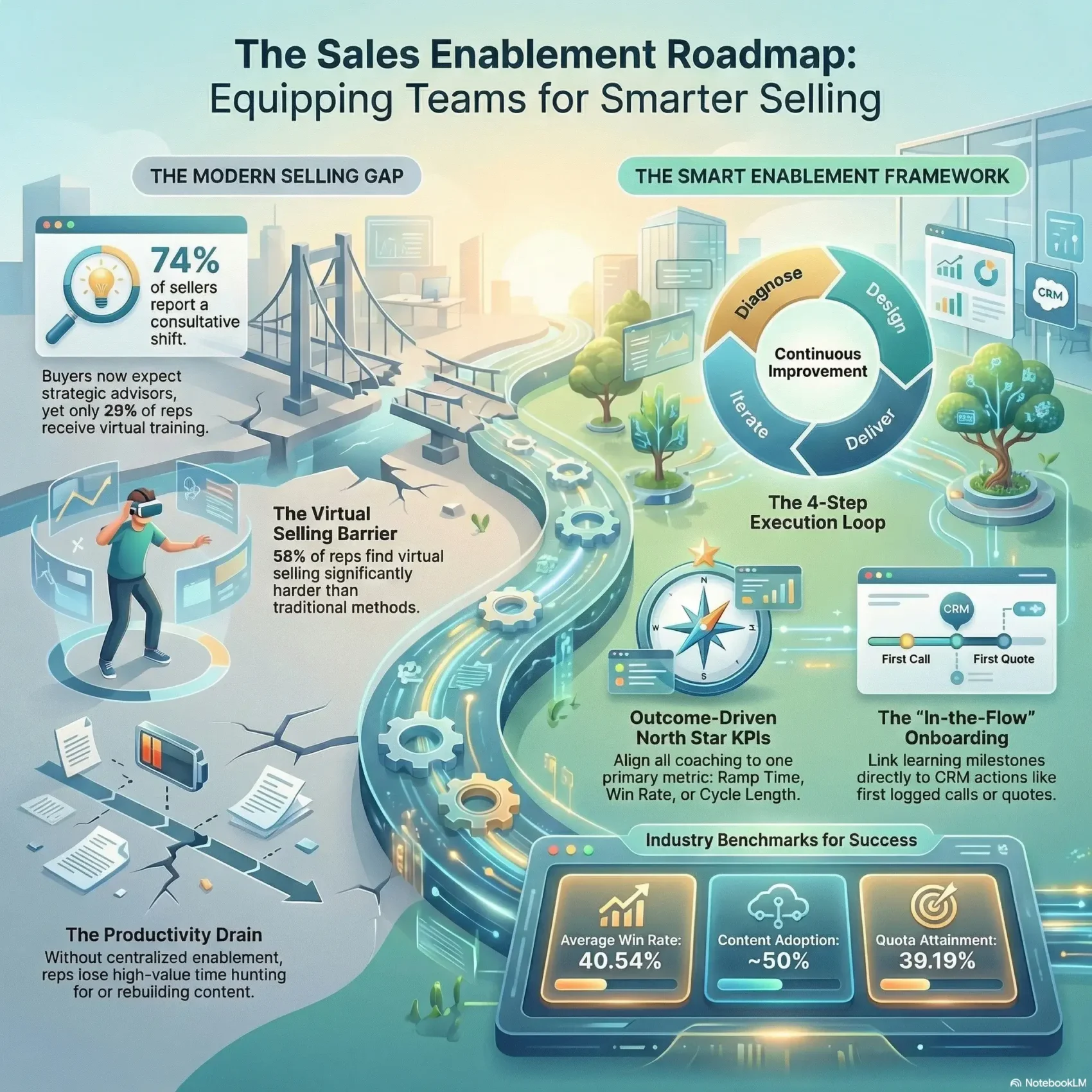
Last Updated on April 27, 2026
You need a clear view of how modern sales enablement brings content, coaching, training, and tools together to help your team ramp faster and sell with confidence.
The shift to hybrid selling and more consultative buyer conversations has changed the game. Leaders now must show measurable impact on revenue, not just activity. That means connecting training to real behavior change and short-term wins like higher win rates and shorter cycles.
This introduction walks you through why companies treat enablement as essential, how marketing and your team can share one clear story, and what goals you should track to prove business impact.
Along the way you’ll see practical steps to move from slide decks to targeted, behavior-focused programs, and a link to broader RevOps trends that connect these ideas to go-to-market strategy: RevOps business trends.
Key Takeaways
- Enablement blends content, coaching, and tools to drive measurable revenue results.
- Hybrid selling requires targeted training tied to clear KPIs.
- Marketing and team alignment create consistent buyer experiences.
- Track ramp time, win rate, and cycle length to prove impact.
- Use simple processes and data to make enablement durable.
Sales enablement
Define it simply: it’s the function that gives your sales reps the knowledge, content, coaching, training, and tools they need to move conversations forward and win with confidence.
What it is and why it matters now
You need a repeatable approach that raises productivity and standardizes the process across your team.
Leaders care about measurable impact — faster ramp time, higher win rates, and shorter cycles — not one-off certificates.
How it empowers reps
- Coaching plus training: coaching helps reps apply learning in real deals, not just pass tests.
- Content and marketing alignment: marketing creates and refines the assets reps actually use with customers.
- Tools and process: simple tech guides the next best action in the flow of work.
Distinguish this from sales training (single-topic skill work) and from operations (systems and backend process). Use a tight plan—plan, deliver, reinforce—to keep your enablement strategy focused and scalable.
Why sales enablement matters right now
Remote-first interactions and budget scrutiny are forcing reps to be both strategic advisors and efficient executors. You face hybrid buyers, complex committees, and tighter resources that stretch your team’s capacity.
Hard data shows the gap: 74% of sellers say their work is now more consultative, 58% report virtual selling is harder, and only 29% received training for online channels. Those gaps slow deals and sap productivity.
From hybrid selling to doing more with less: today’s pressures on sellers
You must get sellers confident in virtual rooms while keeping time on high-value conversations. When reps hunt for content or rebuild presentations, each minute adds to cycle time and lost momentum.
The payoff: alignment, consistency, and efficiency across revenue teams
Good enablement connects teams: marketing, product, and finance deliver one clear story so customers hear a consistent message. That alignment cleans handoffs, speeds responses, and cuts deal slippage.
- Cleaner handoffs: faster execution across the pipeline.
- Less wasted time: sellers focus on conversations that matter.
- Data-driven fixes: targeted coaching and content reduce stalls and boost revenue.
“Pandemic-driven shifts made virtual enablement essential for stabilizing performance.”
Investing now pays off quickly: better conversations, cleaner pipelines, and more confident reps who can close more deals in less time.
Core principles of a modern enablement strategy
Modern enablement rests on a few simple, practical principles that keep your team customer-focused and productive. These rules shape programs so content, coaching, and tools deliver value at the right moment.
Buyer-centric and seller-friendly by design
You anchor your sales enablement strategy in the buyer journey so every asset and coaching moment maps to real customer needs.
Design for sellers: reduce clicks, simplify templates, and make the next best action obvious.
Data-driven and just-in-time learning in the flow of work
Use data to prioritize what works. Engagement and pipeline signals tell you which content and learning move deals.
Deliver bite-size guidance inside daily tools so learning happens in the flow, not in long classroom sessions.
GTM alignment across sales, marketing, and customer success
Align teams around one process and message. When marketing and product feed clear assets into the workflow, handoffs become predictable.
- Build a content loop: test, measure, and refine based on real deals.
- Use analytics and AI to personalize coaching and reinforce process in real time.
- Treat process as a helpful guide that nudges behavior, not extra red tape.
“Modern programs use analytics to decide what to keep, cut, or change so your approach keeps pace with the market.”
Setting the right enablement goals and KPIs
Identify a single KPI that ties learning and content to revenue outcomes. Pick one primary objective—ramp time, win rate, average deal size, or sales cycle length—and make it the north star for your work. A focused target helps your team prioritize coaching and content that actually move deals.
Choose a primary KPI
Pick one and stick with it for a quarter. Options include:
- Reduce ramp time so new reps hit quota faster.
- Lift win rate by improving value-based conversations.
- Grow average deal size through targeted positioning.
- Shorten the sales cycle to move revenue faster.
Translate goals into behaviors and metrics
Define the specific actions you will coach. For example, fewer discount mentions and more value framing should link to higher win percentages.
Use practical metrics—content usage, win rate, and quota attainment—to validate progress. Benchmarks from industry data show content usage at ~50% and win rates around 40.54% as useful guides.
“Define thresholds upfront, assign owners, and review quarterly so you can adapt fast.”
From strategy to execution: your sales enablement process
Execution demands a tight cycle: diagnose, design, deliver, and iterate. Start with one clear objective and map the behaviors that will move that KPI. This makes your work measurable and meaningful to reps.
Diagnose gaps, design programs, deliver, and iterate
Run a four-step loop: choose the enablement goal, define the behavior change, build training and content, then adapt and repeat. Keep modules short and tied to live opportunities so coaching lands in the flow of work.
Use call analysis to spot discounting patterns and coach reps to reframe conversations around outcomes. Tools that surface keyword shifts (for example, from discount to value language) let you validate behavior before revenue moves.
Behavior shaping: moving from discounting to value-based selling
Make the change specific: reduce discount mentions and increase value messaging. Mirror the sales process in your content so reps know which asset to use at each stage.
“Tie every module to a KPI and measure keyword and conversion shifts so you can repeat what works and retire what doesn’t.”
- Diagnose where deals stall and design focused interventions.
- Tie training to live deals so coaching is practical and repeatable.
- Allocate resources realistically and track performance signals to prove behavior change.
For deeper behavioral tracking, consider behavioral analytics tools to close the loop between coaching and performance: behavioral analytics.
Onboarding and continuous sales training that sticks
Onboard in the flow of work so new hires learn while managing live opportunities. Tie milestones directly to CRM actions—first logged call, first qualified meeting, first quote—to measure progress in real time.
Onboard in the flow of work to reduce ramp time
Design short, task-driven lessons that trigger at key CRM events. This cuts ramp time without lowering quality.
Bite-size learning and certifications to boost retention
Swap long content dumps for micro-modules and quick assessments. Use short certifications to confirm core knowledge before reps move to the next stage.
Coaching that scales: peer modeling and AI feedback loops
Peer modeling helps new hires copy top performers by watching real calls and messaging. Add AI feedback to give instant guidance on pitch clarity and objection handling.
- Work-linked onboarding: learning tied to CRM milestones.
- Micro-modules: short lessons completed between calls.
- Scaled coaching: peer examples plus AI-driven feedback.
“Companies report faster time to productivity with virtual onboarding and peer modeling.”
Sales enablement tools: building your high-impact tech stack
Pick tools that mirror how your team works, not the other way around. Start with platforms that reduce busywork and surface the next best action. That keeps coaching practical and content useful in real deals.
CRM as your data backbone for visibility and automation
Your CRM centralizes customer data and milestones. Use it to automate alerts, flag at-risk opportunities, and show where the team should focus.
Platforms for content, coaching, and workflows
Pick a single platform to host content, guide step-by-step playbooks, and push micro-lessons into the flow of work. That makes adoption simple and consistent.
Conversation intelligence and call coaching
Record calls to surface keywords, coachable moments, and behavior changes. Objective metrics help managers turn raw data into one-on-one coaching plans.
Learning management for ongoing growth
Layer an LMS for certifications, gamification, and tracking. Integrate it so training shows up where reps work and learning becomes part of the process.
- Integrate tools: minimize context switching so content and coaching live in your CRM.
- Align tech with process: prompts and templates should mirror your motions.
- Iterate: add or trim tools as your needs evolve to keep the stack high-impact.
“A focused stack turns data into coaching and helps teams move forward together.”
Content that moves deals: enablement content strategy
The smartest content strategies map assets directly to buyer signals and rep actions. Your goal is a library that helps reps win by making the right resource obvious at the right moment.
What to create: customer stories, demos, battlecards, and more
Build focused assets: customer stories, product decks, demos, datasheets, and competitive intelligence. These pieces should be short, stage-specific, and tied to how a rep moves a deal.
Tip: Keep one-pagers and battlecards simple so sales reps can use them live.
Activation: serve the right content at the right time
Surface assets in the flow—when a rep creates a quote, schedules a meeting, or prepares a proposal. Automation reduces search time and keeps momentum.
Measure adoption: about 50% of teams track content adoption. Use that metric to decide what to keep or retire.
Driving adoption and consistency in messaging
Partner with marketing to refresh positioning and close the loop with usage and win data. Standardize naming and tags so reps find resources in seconds.
- Equip sellers with competitive insights to handle objections confidently.
- Track content performance so you invest in what customers and reps actually use.
- Sunset stale pieces to prevent confusion and preserve messaging clarity.
“Content adoption ensures consistent positioning and messaging across teams.”
Alignment in action: sales, marketing, and enablement teams
You get faster, more consistent outcomes when teams have clear roles and a simple loop for content and coaching. Start by deciding who makes assets, who uses them, and who measures impact.
Roles and responsibilities across enablement teams and leaders
In smaller companies, multiple departments share this work. In larger orgs, a dedicated enablement team owns the roadmap and standards.
Define the role of each group so requests move quickly and managers focus on coaching and completion. That keeps new processes from getting stuck on email chains.
- Marketing owns messaging and asset creation.
- The enablement team curates, tags, and measures content usage.
- Front-line managers ensure adoption through coaching and reviews.
Closing the loop between content creation, usage, and outcomes
Set a simple process: marketing creates, reps use, your team measures, then everyone iterates. Use shared data so decisions come from results, not opinions.
Make wins visible: surface successful assets and retire what underperforms. Run regular alignment reviews so product and market shifts update the library fast.
“Alignment improves consistency and productivity across teams.”
Enablement vs. training vs. sales operations vs. revenue enablement
When teams know who owns content, coaching, and systems, work moves faster and priorities stay clear.
Where each function adds value—and how they work together
Sales enablement equips the field with content, coaching, and programs that reps use in live deals.
Training focuses on developing specific skills—pitching, negotiation, objection handling—usually through short modules or workshops.
Sales operations runs the process and systems engine: CRM, reporting, and automation that keep the machine humming.
- Content owners create assets based on field requests and win data.
- Trainers turn gaps into targeted sessions and practice labs.
- Ops ensures analytics and workflows put the right asset in front of the rep.
“Clear handoffs reduce duplicate work and make it obvious who will act next.”
When to expand into revenue enablement for end-to-end impact
Move to a revenue-wide model once you need one message across sales, marketing, and customer success.
This broader approach aligns content and process so each customer touchpoint supports conversion and retention.
Set simple intake and rhythms: a single request form, triage by priority, and a weekly review to route work to the right team.
- Define SLAs so requests don’t stall.
- Use dashboards so management sees outcomes and investment ROI.
- Align content development to field data, not ad hoc asks.
Result: faster sales cycles, higher conversion at each stage, and a repeatable process that keeps your teams focused on revenue.
Implementing enablement: a practical roadmap you can use
Start with a clear roadmap that ties training and content to measurable business outcomes. A short plan keeps leaders aligned and helps you prioritize limited resources.
Align with the C-suite on business goals and budget
Secure one goal—ramp time, win rate, or cycle length—and match the budget to the expected impact. Executive buy-in makes it easier to get manager time and hold the project accountable.
Listen to the field: diagnose with data and call reviews
Use CRM signals and call recordings to find real blockers. Quantify gaps so your work targets behaviors, not instincts.
Build solutions: programs, content, and coaching plans
Design short programs that map to funnel stages. Create concise content, role-play coaching, and workshop formats that reps can use in live deals.
Deliver, reinforce, and iterate with analytics-driven insights
- Deliver simply: push micro-lessons into daily workflows.
- Reinforce often: manager check-ins and quick refreshers keep changes alive.
- Iterate with data: measure usage, behavior shifts, and outcomes to refine efforts.
“Start small, prove impact, then scale—teams without a dedicated headcount can still show quick wins.”
Document wins and phase work so your team can execute without burnout. With clear roles and tracked results, scaling this sales enablement strategy becomes straightforward and credible.
Measuring impact and optimizing performance
To prove program value, you must link what reps do to concrete outcomes and track it consistently. Start with a small set of indicators that show whether learning and content change behavior and move revenue.
Leading and lagging metrics: usage, adoption, attainment, and cycle time
Balance leading signals like content adoption, call behaviors, and training completion with lagging results such as win rate and sales cycle length.
- Content usage ~50% and win rates ~40.54% give context for adoption.
- Track quota attainment (39.19%), pipeline growth (28.38%), and cycle length (29.73%).
- Measure time to quota, selling vs. admin time, and conversion rates.
Correlate training completion and behavior change to revenue
Link course completion to observed behavior shifts on calls and in CRM. When training maps to fewer discount mentions and more value framing, you can see the impact on win and average deal size.
Dashboards, benchmarks, and cadence for reviews
Build simple dashboards managers use in weekly reviews. Benchmark quarter over quarter and compare against peers where possible.
“Use dashboards to correlate training, content usage, and deal outcomes so you can scale what works and retire what doesn’t.”
Conclusion
Close the loop: focus on business value, behavior change, and automation-powered tools so your program proves impact quickly.
You end with a practical playbook that helps companies turn learning into measurable wins. Commit to a clear strategy, one primary goal, and tight content that maps to the buyer.
Keep coaching timely, keep content concise, and keep your stack simple so reps spend more time with customers and less on admin.
Measure what matters, iterate fast, and celebrate quick wins while building durable capabilities. When teams align around a single process, you get higher win rates, shorter cycles, and predictable growth.
Result: a reliable sales enablement engine that raises productivity and keeps your business ready for what’s next.