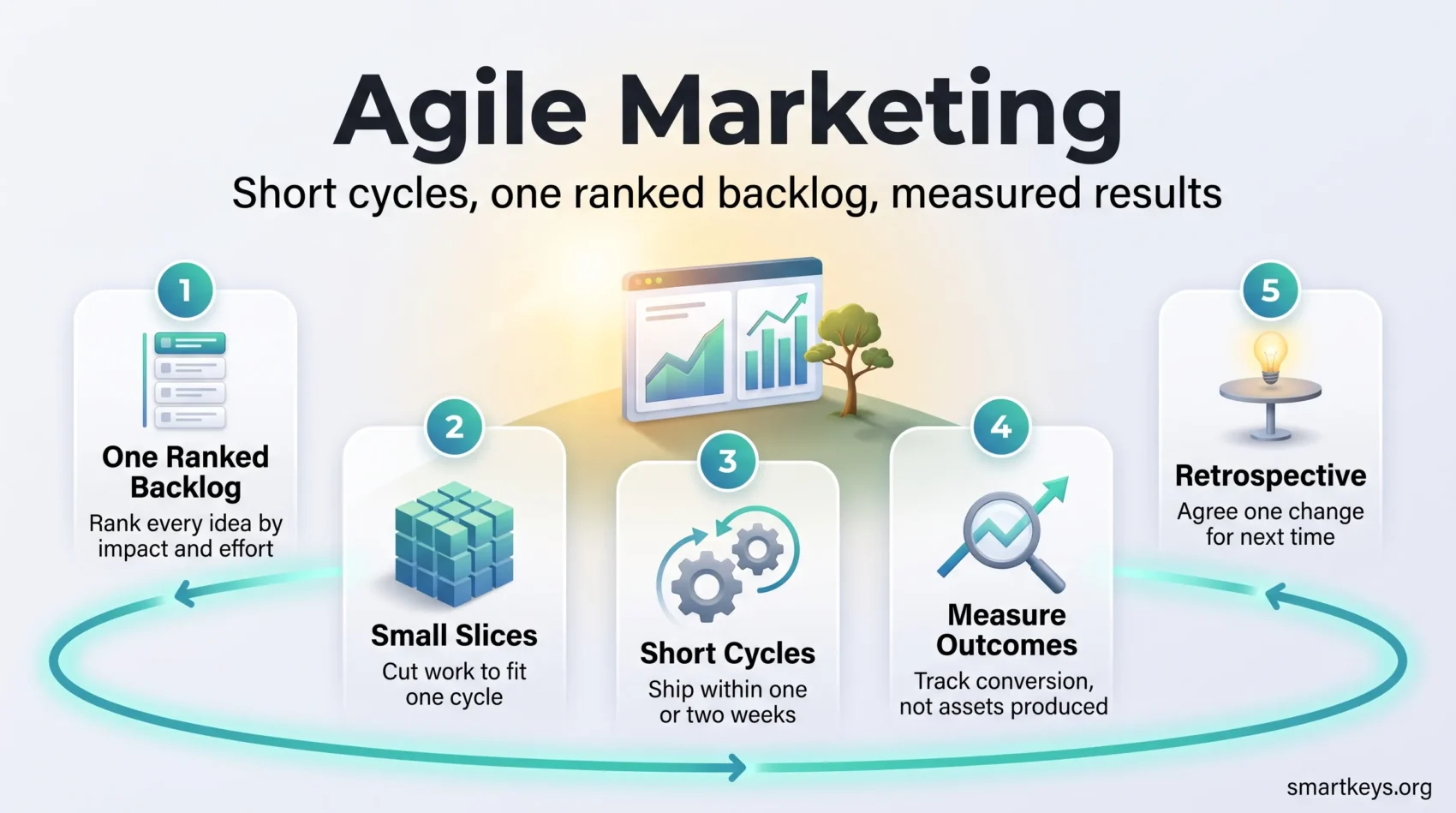
Agile marketing is a way of running marketing work in short, repeated cycles instead of one long annual plan. The team keeps a single ranked list of work, pulls a small slice of it into a fixed block of time, ships it, checks what happened, and decides what to do next based on that result.
That is the whole idea. The rest of this guide is detail on how to run it without adding meetings.
It is not just new names for old meetings. Renaming your Monday status call a “standup” changes nothing. What changes results is the sequence: rank the work by expected value, cut it into pieces small enough to finish in two weeks, and let the outcome of each piece decide the next one.
The approach is more common than it looks and less universal than the marketing press suggests. In the 2026 State of Agile Marketing Report from AgileSherpas, 25% of surveyed marketers said they currently use agile methods, 25% had used them in the past, 27% had never used them, and 23% did not know what agile marketing is.
Key Takeaways
- Agile marketing replaces the annual plan with short cycles and a ranked backlog of work.
- Scrum, Kanban and Scrumban are three ways to structure those cycles. Pick the one that matches how work arrives.
- Limiting how much work runs at once is the single change teams report as hardest and most useful.
- Measure outcomes such as conversion and retention, not the number of assets produced.
- Adopting the tools without changing how decisions are made is the most common failure.
- Start with one pilot campaign, not a department-wide rollout.
Why Marketing Teams Moved Away From the Annual Plan
The old setup was workable: a handful of channels, a budget agreed in autumn, and a calendar that mostly held. That version of the job is gone. A mid-sized team now runs paid search, several social platforms, email, organic content, partner activity and increasingly AI answer engines, each with its own format and pace of change.
Two things break the annual plan in that environment. First, the plan is written before you know which of those channels will still perform in month seven. Second, approval chains built for four campaigns a year become the bottleneck when the team wants to ship forty tests. Among marketers not using agile methods, 46% named slow approvals and bottlenecks as a challenge, according to the same 2026 AgileSherpas report.
Generative AI has sharpened the problem rather than solved it. Producing ten variants of an ad is now cheap. Deciding which of the ten deserves budget still needs a testing rhythm and someone empowered to call it. Teams that already work in short cycles are further along here: 39% of agile marketers reported AI fully integrated into their work, against 13% of non-agile teams.
If your team recognises the symptoms below, the annual plan is probably the constraint:
- Campaign ideas sit in a queue for weeks because nobody can say which of them is most important.
- Half the quarter’s work is unplanned requests that arrived after the plan was signed off.
- Results arrive after the campaign ends, too late to change anything.
This is the same shift that agile practices spreading beyond IT departments brought to legal, finance and HR teams over the past decade.
What Agile Marketing Actually Is
Plain definition: you keep one ranked list of possible work, take the top items into a short delivery cycle, finish them, look at the result, and re-rank the list.
Four ideas sit underneath that:
- Evidence over opinion. A test result outranks the loudest person in the room.
- Small releases over big launches. A landing page you can ship on Thursday teaches you more than a campaign that launches in March.
- One shared queue over parallel silos. Content, paid and design work from the same ranked list.
- Outcomes over output. The team is judged on what changed for customers, not on how many assets it produced.
Here is what that looks like in a real week. A B2B team wants more demo bookings. Instead of a quarter-long campaign, they write three hypotheses, each one sentence about what they expect to happen, and build the cheapest version of each: a new pricing page headline, a shorter demo form, one webinar. All three go live inside two weeks. The form change lifts bookings, the headline does nothing, the webinar fills but converts poorly. The next cycle builds on the form and drops the rest. The team learned three things instead of one.
None of this needs new software. It needs someone to own the ranking and a leadership team willing to hear that an idea did not work.
What Marketers Borrowed From Software Teams
The vocabulary comes from software. The Agile Manifesto was written in 2001 by seventeen software developers, and the two frameworks that followed, Scrum and Kanban, were designed for engineering teams. Marketing borrowed the parts that transfer and left the rest.
The parts worth taking
The visible board. Every piece of work sits in a column: to do, in progress, in review, done. Anyone can see the state of everything without asking. A personal kanban board uses the same idea for one person’s workload.
The short cycle. Work is cut into slices that fit inside a fixed window, usually one or two weeks. Cutting the slice is the skill. “Relaunch the website” does not fit. “Rewrite and test the pricing page headline” does.
The limit on work in progress. A WIP limit is a cap on how many items may be in the “in progress” column at once. Five items in progress and none finished is worse than two finished. Agile marketers in the 2026 report named WIP limits as the hardest practice to hold to, which is also why it is the one worth holding to. The reasoning is the same as working in short focused sprints at the individual level.
The retrospective. A short meeting at the end of each cycle where the team names one thing to change next time. Not a post-mortem, and not a status update. One change, tracked.
The parts that do not transfer
Software teams estimate work in story points and track velocity across many sprints. Marketing work is less uniform, so those numbers are noisier. Use them as a rough capacity check, never as a performance target. The moment velocity becomes a target, teams inflate estimates and the number stops meaning anything.
Choose Your Framework: Scrum, Kanban or Scrumban
Pick the framework that matches how work arrives at your team, not the one with the best conference talks.
Scrum: fixed sprints
Scrum organises work into sprints, fixed blocks of usually two weeks. At the start the team agrees what it will finish. At the end it shows the work and holds a retrospective. Scope is locked during the sprint.
Choose it when your work is mostly planned, stakeholders can wait two weeks for a decision, and you want predictable checkpoints.
Watch out: if urgent requests arrive weekly, locked scope becomes a fiction and the team quietly abandons the sprint.
Kanban: continuous flow
Kanban has no sprints. Work flows across the board continuously, and WIP limits control how much runs at once. When a slot frees up, the team pulls the next highest-ranked item.
Choose it when requests arrive unpredictably, priorities change mid-week, or your team serves many internal stakeholders. Support-style and always-on channel teams usually fit here.
Watch out: without a scheduled review, Kanban teams can go months without stepping back to look at results.
Scrumban: the practical middle
Scrumban keeps the rhythm of Scrum, standups, a review and a retrospective, but pulls work continuously with WIP limits instead of locking a sprint scope. For most marketing teams moving from ad hoc to structured work, this is the easiest starting point, because it adds rhythm without demanding that the outside world stop interrupting you.
“Start with the practice that removes your biggest bottleneck, not with every ritual at once.”
Set Up the Team: Roles and Rhythms
Two roles decide whether this works.
Who owns priority
One person, often called the Product Owner or backlog owner, decides the order of the list. Not a committee. They talk to stakeholders, weigh requests, and put them in sequence. If three people can reorder the backlog, the team will be told three different things are most important in the same week.
A second person, the facilitator or Scrum Master, keeps the meetings short, chases blockers, and protects the team’s focus time. On a small team this can be a part-time responsibility rather than a job.
Everyone else does the work. The useful pattern is a cross-functional group, meaning one team that holds the writing, design, paid and analytics skills a campaign needs, so a piece of work does not have to be handed to another department to finish. Aligning marketing and sales around shared goals matters here too, since a demand-generation backlog that sales does not recognise will keep getting overridden.
The meeting rhythm
- Daily standup, 10 to 15 minutes. What moved, what is next, what is blocked. Not a status report to a manager.
- Review, end of each cycle. Show finished work to stakeholders and collect reactions while changes are still cheap.
- Retrospective, team only. One improvement, agreed and written down.
- Backlog refinement, weekly, 30 to 45 minutes. Re-rank the list and add enough detail to the top items that someone could start them tomorrow.
That is roughly three hours a fortnight. If your team already spends more than that on status meetings, this is a reduction. Applying the same discipline to your other meetings, as the guide to running meetings that produce decisions describes, usually frees more time than the new rhythm costs.
Plan the Work: One Backlog, Ranked
A backlog is one list of everything the team could do, in priority order. One list, not one per channel. The moment there are three lists, nobody can see the real trade-off between a paid experiment and a content piece.
Quarterly goals give the list direction. Cycle-level planning keeps it flexible. The quarter says “increase trial-to-paid conversion”; the cycle decides which three things you will try this fortnight to move it.
Building the list
Capture everything in one place: team ideas, stakeholder requests, experiment concepts, maintenance work. Then rank by expected impact against effort. Three columns are enough: impact, effort, and how confident you are in the estimate. Elaborate scoring models mostly move the argument rather than settle it. If you want a more formal method, the overview of task prioritization frameworks such as RICE and MoSCoW compares the common options, and the Eisenhower matrix works for the urgent-versus-important calls.
Detail only the top of the list. Items five places down do not need acceptance criteria yet, because half of them will never be built.
Sizing the slices
Right-size each item so it can finish inside one cycle. This is the practice that most often gets skipped, and skipping it is why teams end up with a sprint full of half-finished work.
A useful test: can you name the thing you will look at to know whether it worked? “Improve brand awareness” fails. “Publish the comparison page and measure organic entrances and demo clicks after 14 days” passes.
Leaving room for interruptions
Reserve capacity for unplanned work, typically 15% to 25% depending on how much your team gets pulled into requests. Then track how much unplanned work actually arrives. After three cycles you will have a real number, and that number is the most persuasive thing you can show a stakeholder who keeps adding urgent items.
Run the Work: Cycles, Flow and Interruptions
Commit to less than you think you can finish. Base the commitment on what the team actually completed in the last three cycles, not on what it hoped to complete.
Keep planning short: about one hour per week of cycle length, so two hours for a two-week sprint.
Handling urgent requests without breaking the cycle
Agree the policy before you need it. Three options work:
- Swap. Something urgent comes in, something else comes out. The requester sees the trade-off.
- Reserved capacity. The buffer described above absorbs it.
- Fast lane. A separate board lane with a strict WIP limit of one or two items, for genuine emergencies only.
Whichever you choose, record what was displaced. Interruptions that leave no trace look free to the people causing them.
Removing blockers
The facilitator’s main job is unblocking. Legal review sitting for six days, a missing asset, an approval waiting on someone on holiday: these are the things that stretch a two-week cycle into five. Track how long items sit in the review column. If that number is larger than the time spent building, the bottleneck is approval, not production. Being explicit about handoffs, in the way clear written communication at work describes, removes a surprising share of these delays.
Measure What Matters
Pick one outcome metric and two leading indicators per initiative. More than that and the team optimises for whichever number is easiest to move.
- Outcome: conversion rate, revenue per visitor, retention, or qualified pipeline.
- Leading indicators: click-through rate, trial starts, time on page, reply rate.
- Flow metrics: cycle time, meaning how long a single item takes from start to done, and throughput, meaning how many items finish per cycle.
Report flow metrics next to business metrics, never alone. Cycle time alone rewards shipping small, unimportant things fast.
Instrument before you launch, not after. If the tracking is not in place when the test goes live, you will spend the next cycle arguing about whether the result is real. This is where a clean data foundation pays off, and why building a first-party data strategy has become a prerequisite rather than a nice-to-have. Teams that run this loop consistently do test more: 90% of agile marketers in the 2026 report said they use experimentation and testing, against 74% of non-agile marketers.
For ROI, keep the model simple. Measured lift multiplied by value per conversion, minus the cost of running the test. Executives distrust elaborate attribution models, and reasonably so. The approach in making decisions from data rather than instinct applies directly.
The Tool Stack
Start with three things: a board, a place for the backlog, and analytics that the team can read without asking an analyst.
The board can be Trello, Asana, Jira, Notion or a whiteboard. The choice matters far less than whether everyone actually updates it. If you are comparing options, the head-to-head reviews of Asana versus Trello and Trello versus Jira cover pricing and limits in detail.
Automation and CRM matter for the testing loop, because they decide how quickly you can launch a variant and see what it did. Platforms in common use include HubSpot, Adobe Marketo Engage and Salesforce. Our reviews of HubSpot Marketing Hub and Adobe Marketo Engage go through what each tier includes, and the Salesforce versus HubSpot comparison covers the CRM side.
Two cautions. A tool cannot make a priority decision, so buying a board before agreeing who owns the ranking changes nothing. And keep the stack small enough that maintaining it is not itself a job. Templates for recurring work such as webinars and launches remove more friction than another integration; the guide to using templates for repeatable work has practical patterns.
What the Evidence Actually Shows
The honest summary: the reported benefits are real but self-reported, and the large revenue figures often quoted come from a small number of consultancy case studies.
From the 2026 AgileSherpas survey of marketers: 87% of agile users said the approach improved their productivity, 77% said they felt less stressed, and 53% of agile marketers said they help set organisational strategy, against 37% of non-agile teams. Note that these are practitioners rating their own way of working, which tends to run positive.
The widely quoted “20% to 40% revenue uplift” comes from a McKinsey article published in 2016, describing digitally mature marketing organisations that adopted agile practices. The same article reported a North American retailer that quadrupled campaign throughput and doubled digital sales over eighteen months. Treat these as what a well-run adoption can look like, not as an average.
One example of speed rather than a claimed multiplier: in 2020 DoorDash shipped test-kit delivery, restaurant support campaigns and new rating filters within weeks. Revenue that year reached $2.886 billion against $885 million in 2019, a 226% increase, per the company’s Q4 2020 results. Pandemic demand drove most of that. What short cycles bought was the ability to ship the response in weeks rather than quarters.
Where Agile Marketing Goes Wrong
Four failure patterns account for most of it.
Ceremony without authority. The team holds standups and retrospectives but a director still reorders the backlog by email. Nothing improves, and the meetings become overhead. Fix the decision rights before adding meetings.
No WIP limit. Everything is in progress, nothing is done, and the board becomes a list of open tabs. This is the practice teams report as hardest, and the one with the clearest payoff.
Measuring output. Counting assets shipped per sprint produces more assets and no more revenue. If leadership asks for a throughput number, give it alongside an outcome number.
Rolling out everywhere at once. A department-wide change hits every dependency and every sceptic simultaneously. One team, one quarter, one honest write-up is a better path, and the same logic behind continuous improvement in small increments applies. Capacity mismatches with neighbouring departments were named as a challenge by 40% of agile marketers, so expect friction at the boundary and plan for it.
Conclusion
Start with one pilot, not a transformation.
Pick a single campaign or channel. Name one person who owns the backlog. Put the work on a visible board with a WIP limit. Run two cycles of two weeks with a standup, a review and a retrospective. Write down what changed in your outcome metric and what got in the way.
That takes about a month and costs nothing but attention. If the pilot works, the case for extending it writes itself, and if it does not, you have learned something specific rather than abandoning a department-wide programme. Teams already working this way tend to be further along on using AI in marketing, because a testing rhythm is exactly what makes cheap variant generation useful rather than noisy.
Found this useful?
Make SmartKeys a preferred source on Google, and our articles will surface more often in your Top Stories, AI Overviews, and AI Mode.
Add as Preferred Source