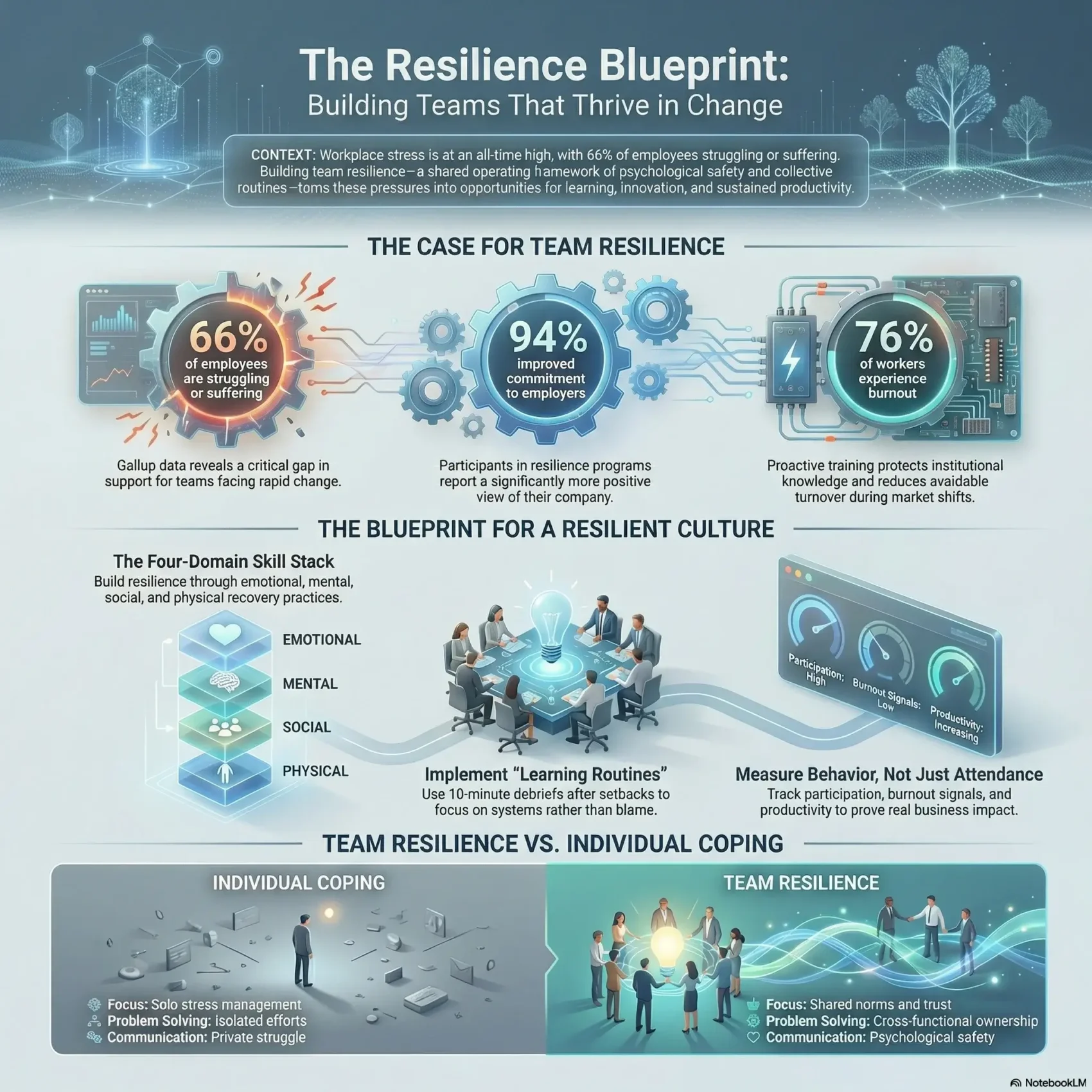
Resilience at work means handling pressure, adapting to change, and turning mistakes into learning moments. Gallup reported 55% of employees were struggling and 11% were suffering, showing a clear gap in support. You need simple, practical approaches to help your people stay effective when things shift.
Well-designed programs boost well-being, productivity, and innovation. The AHA found 94% of participants improved their view of their employer after joining resilience programs. Big names used smart methods: Google’s Search Inside Yourself focuses on attention and self-knowledge, while Siemens Healthineers offered meditation, breathing, and expressive writing during COVID-19 with strong recommendations.
In this article, you’ll see why a focused program reduces disruption, how leader habits and culture turn learning into routine, and how to map a step-by-step blueprint from needs assessment through evaluation. By the end, you’ll be ready to launch a building resilient initiative your employees feel and your leaders model.
Key Takeaways
- Resilience helps employees adapt and learn from pressure.
- Data shows many staff need better support to thrive.
- Well-crafted programs improve engagement and retention.
- Leader practices and culture make results stick.
- You’ll get a practical blueprint to start and measure success.
- Real-world examples show what works in diverse workplaces.
Why resilience at work matters now: your path to help teams bounce back
Right now, many workplaces face rising stress and burnout that quietly erode focus and performance. Gallup reported 55% of employees were struggling and 11% were suffering, while other research found 76% feel burnout sometimes and 28% feel it often or always.
Building resilience helps your people adapt without losing momentum. Resilient groups keep quality and speed when priorities shift, and they recover from setbacks faster.
“94% of participants in resilience programs reported a more positive view and commitment to their employer.”
Use short workshops and focused resilience training to normalize conversations about stress, give practical tools, and invite timely feedback.
- Quick routines like check-ins reduce uncertainty and protect performance.
- Clear, empathetic leadership communication surfaces risks early.
- Show the business impact—retention, productivity, and customer results—to make success measurable.
What team resilience is and how it differs from individual resilience
How a unit responds under pressure is shaped by its norms, roles, and how members talk to one another. Team resilience is a shared operating framework: a common mindset, clear roles, and routines that turn stress into learning.
Shared mindset and operating framework
Psychological safety and trust let people speak up without fear. Google’s Project Aristotle showed this is the foundation for effective groups. When trust is present, problems surface early and solutions scale faster.
From coping alone to thriving together
Shift from solo coping to co-creating solutions by mapping roles, handoffs, and feedback loops. Clear norms for decision-making and escalation stop the same mistakes from repeating.
Foundational skills
Develop emotional intelligence, a growth mindset, and practical problem-solving. These skills help members stay calm, learn from experiences, and act with purpose. Microsoft and other firms found empathy and EQ improve collaboration and adaptability.
- Shared norms and clear roles make the whole greater than individual parts.
- Routines like quick check-ins normalize asking for support early.
- Structured feedback closes loops and improves future responses.
The business impact of building resilient teams
When organizations focus on durable workplace habits, they protect performance during disruption. That focus turns stress into manageable steps and creates measurable business wins.
Reducing stress and burnout to protect well-being and focus
Fewer stress-driven mistakes mean higher quality and fewer reworks. You get steadier output and lower burnout risk when people learn practical coping patterns.
Sustained performance and agility through change
Adaptable groups pivot faster when strategies shift. This agility keeps delivery timelines intact and preserves customer trust during market moves.
Stronger engagement, retention, and culture fit
Employees who feel supported stay longer. That reduces avoidable turnover and protects institutional experience your customers rely on.
Innovation and effective collaboration under pressure
Collaborative problem-solving grows when members share mental models and propose solutions instead of escalating every issue. Innovation follows when uncertainty is treated as opportunity, not a roadblock.
- Connect to outcomes: fewer mistakes, lower burnout, steadier performance, faster delivery.
- Leadership benefits: clearer pipelines as more people show calm decision-making and strong communication.
- Customer impact: earlier course-correction and consistent delivery even when work is messy behind the scenes.
“94% of participants reported a more positive view of their employer after resilience programs.”
How to design your team resilience training program
Begin by turning clear questions and data into focused goals. Use interviews, employee surveys, manager one-on-ones, and people analytics to pinpoint real challenges at work.
Conduct a needs assessment to target real challenges and goals
Collect multiple inputs: stakeholder interviews, pulse surveys, and manager notes. Translate findings into two or three measurable goals your program will solve.
Choose delivery formats and cadence that fit your workplace
Mix live workshops, microlearning, webinars, gamification, and coaching across weeks. Pick a cadence people can sustain so learning becomes routine rather than a one-off.
Develop materials and pilot before scaling
Create short videos, hands-on exercises, role plays, checklists, and case simulations. Pilot with a diverse group, gather honest feedback, and iterate on pacing and resources.
- Measure what matters: observed behavior change, supervisor input, and outcome metrics — not just attendance.
- Reinforce in day-to-day: nudges, leader prompts, scripts, and integration into development and performance management.
- Document and repeat: keep resources current and review quarterly so the program stays aligned with changing challenges.
“Start small, measure impact, and expand with evidence.”
Team resilience training curriculum: skills, activities, and formats
A practical curriculum links clear skills to short activities so members can act under pressure. Start with core abilities across four domains, then pick formats that fit your day-to-day work.
Emotional resilience: self-awareness, self-control, and flexible thinking
Teach self-awareness and quick regulation techniques. Use reflection prompts and brief breathing resets in a 20–30 minute session.
Mental resilience: reframing, goal-setting, and problem-solving
Run reframing drills, strengths mapping, and rapid solution sprints. These activities hone perspective and practical problem-solving under stress.
Social resilience: trust, inclusion, and team-based coping strategies
Build trust with structured dialogue, buddy systems, and clear escalation paths. Encourage members to share real cases so learning sticks.
Physical resilience: energy, sleep, and recovery practices
Include short modules on rest, breaks, and recovery habits. Small rituals—micro-breaks, hydration prompts—support sustained success.
Delivery options: workshops, webinars, group learning, and coaching
Mix in-person workshops, micro-sessions, gamified e-learning, and executive coaching. Pair each session with job aids and peer discussion guides.
- Build a core skills stack: emotional, mental, social, and physical abilities.
- Use targeted activities: role plays, pre-mortems, and solution sprints to practice tools.
- Reinforce between sessions: resources, reflection prompts, and leader follow-ups drive adoption.
Leader practices that build a resilient culture
Leaders shape daily norms more than any policy ever will. Small, consistent actions by leadership create a safe place where people bring up risks and learn fast.
Create psychological safety with transparent communication and feedback
Lead with transparency: share context, invite questions, and ask for feedback regularly. Google’s Project Aristotle found psychological safety was the top factor in effective groups.
Recognize progress, set realistic goals, and align on purpose
Celebrate small wins often — recognition can boost engagement dramatically. Use clear goals and capacity plans like Intel’s OKRs to make progress measurable and fair.
- Model curiosity, not blame, after setbacks.
- Build support into your management routines with structured debriefs and escalation paths.
- Coach team members in practical skills like reframing and calm communication under pressure.
Hold leaders accountable for creating space to practice new behaviors in meetings. Connect daily work to purpose so employees feel why their efforts matter to customers and the business.
For more on practical leadership skills that prepare people for change, see future leadership skills.
From ideas to action: team routines that strengthen resilience daily
Small, repeatable habits turn ideas into action and keep performance steady. Use brief, focused practices so your people can learn fast and bounce back after a miss.
Debriefs and post‑mortems that turn setbacks into learning
Run short debriefs after milestones and misses. Focus on decisions, signals, and systems—not fault. IBM’s post‑mortems show how capturing experiences without blame speeds organizational learning.
Use a simple prompt set: what happened, what signs we missed, and what we’ll try next. Rotate facilitation so more people gain facilitation skills and ownership of outcomes.
Cross‑functional collaboration and ownership to solve problems faster
Create time‑boxed “risk rounds” to surface questions and early warnings before they become blockers. Spotify’s squads model proves that pairing domain experts with fresh perspectives accelerates solutions.
- Quick debriefs: 10–20 minutes after key events to apply lessons fast.
- Post‑mortem focus: capture experiences and system fixes, not blame.
- Small pilots: add a short warm‑up or energy check to existing ceremonies.
- Measure impact: track handoffs, cycle time, and quality to refine strategies.
“Psychological safety and clear ownership let groups surface hard questions and learn faster.”
Close every routine with clear owners, timelines, and measures so the group sees progress and stays committed to continuous improvement.
Measure what matters: tracking the impact of resilience training over time
To show real return, you must measure how programs change behavior and outcomes over time. Start with a concise plan that links the program to clear business outcomes so your work is credible and actionable.
Key metrics: participation, sentiment, burnout, and performance signals
Define a short list of indicators. Track participation rates and the quality of engagement. Add sentiment scores and early burnout signals to spot risk.
Include outcome measures such as satisfaction, retention, cycle time, and productivity so leadership can see impact on work and success.
Methods: surveys, observations, and people analytics
Use mixed methods to validate findings. Combine participant surveys with direct observations and supervisor interviews.
People analytics can reveal stressors and performance gaps that surveys miss. Compare pilot cohorts to scaled groups to find the best formats and resources.
Continuous improvement cadence: quarterly reviews and refreshers
Run quarterly reviews to refresh content, prune low-value elements, and double down on what works. Share simple dashboards with leadership and employees so wins stay visible.
- Ask focused questions that reveal behavior change (how often debriefs run, escalation rates).
- Include short experience stories that show real-world success and learning.
- Keep dashboards to 2–3 measures per leader so progress is easy to act on.
“Measurement itself is a development tool — reviewing progress makes teams more aware and better able to improve.”
Conclusion
You’ve seen how rare fully resilient groups are, yet clear practices make a big difference. Examples from Google, Microsoft, SIY, and IBM show that a shared mindset, simple routines, and disciplined debriefs create measurable gains in collaboration, empathy, and performance.
Start small: pick one routine to try this week, schedule your first review, and invite the group to co-own the work. Use short resources and prompts so practice continues between workshops and longer sessions.
Keep goals visible and share outcomes with leaders so progress turns into sustained development. With steady support and clear measures, your people will bounce back faster, reduce burnout risk, and deliver consistent results.
Found this useful?
Make SmartKeys a preferred source on Google, and our articles will surface more often in your Top Stories, AI Overviews, and AI Mode.
Add as Preferred Source