You manage people, and the hardest talks shape team morale and performance. Modern organizations now treat soft skills as core to business success, alongside technical ability. Big names like IBM, Microsoft, McDonald’s, and PepsiCo use platforms that personalize learning and deliver real-time feedback.
Traditional programs often miss personalization and engagement. Simulation-based approaches let you practice tough manager conversations before they happen. Role-play scenarios, VR modules, and microlearning paths turn abstract concepts into clear behaviors you can use in 1:1s and team meetings.
Expect measurable outcomes: analytics dashboards track progress, real-time cues improve communication, and collaborative platforms tie development to business results. Explore tools—from microlearning and VR to AI-augmented course platforms—and pick what fits your culture and goals.
For hands-on VR options, check resources like VR employee training to see how immersive practice boosts confidence and consistency across the workplace.
Key Takeaways
- Simulations help you rehearse difficult conversations with realistic feedback.
- Personalized learning paths make development practical and measurable.
- Role-play and VR beat passive content for engagement and retention.
- Analytics link development to business outcomes and stakeholder trust.
- Choose platforms that match your culture—microlearning, VR, or collaborative tools.
Why simulate tough conversations with AI right now
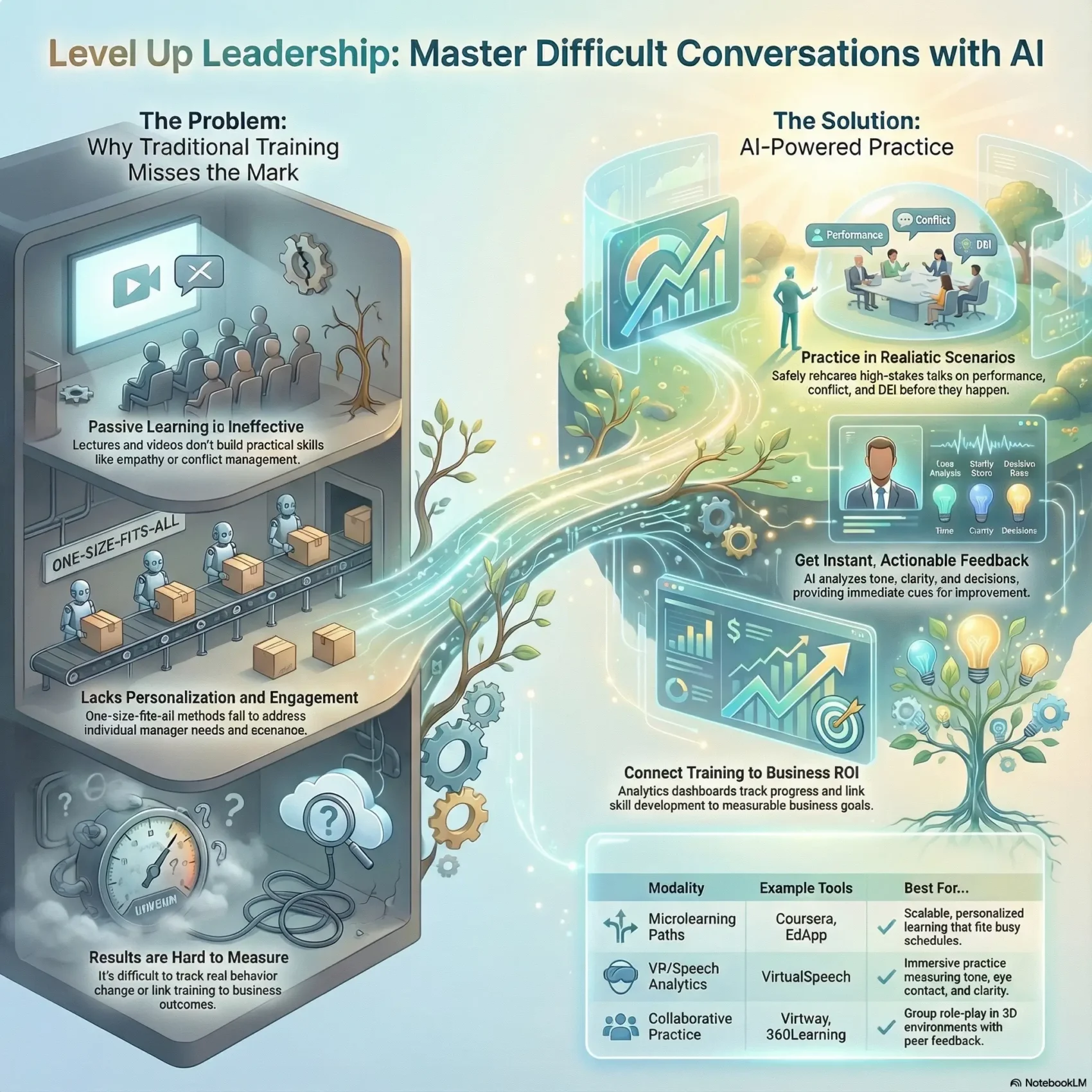
Practicing hard conversations in realistic settings turns abstract advice into repeatable behavior. You move from passive learning to active practice by using scenarios that mirror real workplace situations. That shift makes it easier to transfer what you learn into real meetings.
From theory to practice: why role plays beat lectures
Reading and videos rarely build behaviors like empathy or conflict management. Role plays and realistic scenarios force you to respond, adapt, and notice tone and timing. Immersive 3D platforms report higher participation, stronger retention, and more confidence than flat, static content.
You get instant, relevant feedback on what you say and how you say it. That feedback, plus recordings and analytics fed to an LMS, creates measurable outcomes across your teams.
- Better engagement through realistic scenarios that replace one-size-fits-all methods.
- Lower risk by practicing sensitive topics—performance, conflict, and DEI—before they affect employees.
- Scale and consistency since AI helps create timely, personalized scenarios without heavy manual effort.
For broader trends in HR and workplace learning, see HR trends.
AI soft skills training: a step-by-step method you can use today
Decide the scenario and the exact outcomes you want. Pick the conversation type (performance, conflict, or coaching) and list measurable success criteria. These become your target for practice and progress.
Define the outcome
Choose what “good” looks like. Set clear metrics: tone, clarity, decision points, or next steps.
Select the modality
Match needs to format. Use 2D chat for scale, VR/3D for presence, or a blended coach-led approach.
- Coursera and EdApp support learning paths and microlearning.
- VirtualSpeech and Virtway add presence and recording for review.
Run, record, reflect
Run short practice loops. Capture each attempt and get real-time feedback so you can reflect right away.
Iterate and level up
Adjust difficulty, personas, and constraints. Use platform dashboards and tools to track progress and guide development.
Tools that power realistic simulations and feedback
The right combination of platforms turns practice into measurable performance.
Pick tools to match clear goals: Coursera and EdApp deliver personalized learning paths and microlearning that fit busy schedules. Coursera recommends paths across leadership and emotional intelligence. EdApp breaks content into short modules with instant feedback so you can repeat and improve.
VR and analytics for delivery
VirtualSpeech simulates high-stakes communication. It measures eye contact, vocal tone, and body language to give real-time feedback on delivery.
Immersive 3D group practice
Virtway supplies multi-user 3D environments where learners practice together. Sessions can be recorded and sent to an LMS for review and audits.
Enterprise platforms and mentoring
360Learning helps you scale content creation and peer review across companies. Didask converts your existing content into tailored scenarios with virtual mentoring and dashboards backed by artificial intelligence for faster development.
- Match tools to goals: use Coursera and EdApp for learning paths and microlearning.
- Simulate delivery: use VirtualSpeech for measurable communication upgrades.
- Boost engagement: choose Virtway for immersive, recorded practice.
Designing scenario-based practice for difficult manager conversations
Well-crafted practice scenarios let you rehearse the hardest talks safely. Start by picking the high-impact areas where conversations matter most. Keep runs short, focused, and tied to clear outcomes.
High-impact scenarios to prioritize
You’ll focus on performance coaching, conflict mediation, and DEI sensitivity. These are common high-stakes moments in the workplace where outcomes affect morale and retention.
Building realism: personas, goals and branching
Define personas, goals, and constraints so each scenario feels authentic. Add branching outcomes that mirror policy choices and leadership expectations.
Scaffold from basic to advanced level by tightening time, information gaps, and emotional load. Use prompt libraries and content templates to scale consistent scenario quality.
Coaching cues to watch during practice
Include cues for tone, pace, empathy, and clarity so managers get focused feedback they can act on immediately. Leverage interaction analytics and reflection prompts to make each attempt a compact learning experience.
- Include channel variations (live, chat, email) to strengthen real-world transfer.
- Map scenarios to competencies for clear skills development and assessment.
- Use simulations and recorded transcripts to push feedback into your LMS for review.
Measuring effectiveness and ROI with data you can trust
Measure what matters so your programs show clear business value and real learner progress. Start with a small set of KPIs that map to outcomes you care about.
KPIs to track: pre/post performance, engagement, and business outcomes
Track pre/post assessments, engagement rates, and behavior change tied to business goals. Use role-based metrics so managers see the knowledge and skills that move the needle.
Using real-time analytics to identify gaps and personalize learning
Real-time dashboards flag needs fast. You can personalize paths, push targeted modules, and record interactions. Transcripts and metrics flow to your LMS for review and compliance.
Case signals: IBM, Microsoft, McDonald’s, and PepsiCo’s programs
Companies like IBM (Your Learning), Microsoft (MySkills), McDonald’s (Global Learning Portal), and PepsiCo (GoLearn) use artificial intelligence to scale measurement. Combine quantitative data with transcripts and scenario notes to build a clear ROI story.
- Define KPIs that show impact.
- Use real-time analytics to close gaps.
- Report results in business terms: fewer escalations and faster resolution.
Implementation playbook for your organization
Successful rollouts pair a narrow pilot with strong manager enablement and data guards. Start small, learn quickly, and scale only after you validate outcomes that match your needs.
Choosing platforms that fit budget, culture, and tech
Shortlist platforms against your tech stack and security rules. Look for solutions that integrate with your LMS and analytics layer.
Evaluate 360Learning for collaborative content creation, Didask for scenario generation and mentoring, and Virtway for immersive group practice. Balance cost with measurable outcomes.
Change management: access, enablement, and ethics
Build an enablement plan so teams and employees can access simulations and get help fast.
Address privacy and fairness up front. Embed ethics reviews, transparent data policies, and consent flows into your rollout.
- Pilot with a defined cohort and validate against business needs.
- Align procurement with IT and L&D for smooth integration.
- Equip managers with facilitation guides and coaching prompts.
- Maintain a content operating model and steady-state support (office hours, community channels).
Conclusion
Begin by choosing one clear conversation to practice; focused pilots deliver fast, measurable gains. Pick a single skill and one scenario, run short practice loops, and collect feedback so you see real change quickly.
Combine microlearning for quick hits, immersive simulations for depth, and mentoring for ongoing development. Companies such as IBM, Microsoft, McDonald’s, and PepsiCo show this approach scales while linking learning to business outcomes.
Next step: pick one skill, one pilot group, and one platform. Iterate with data, address access and ethics early, and expand what works to support employees and teams across your organization.
Found this useful?
Make SmartKeys a preferred source on Google, and our articles will surface more often in your Top Stories, AI Overviews, and AI Mode.
Add as Preferred Source