You’re about to get a practical roadmap to build a product-led approach that turns users into paying customers faster. This guide focuses on delivering real value, not chasing vanity metrics.
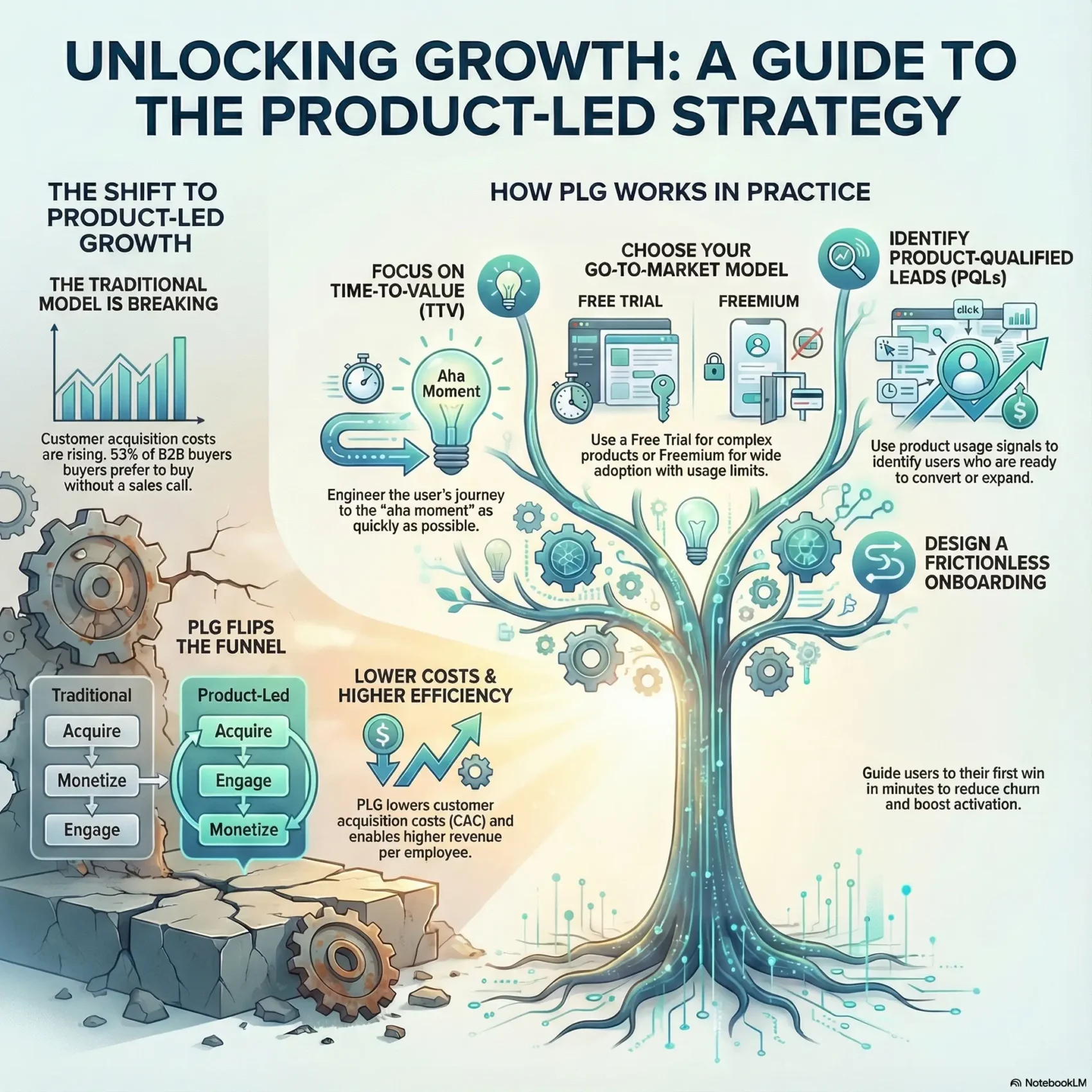
The B2B market now favors consumer-grade experience. Buyers self-educate and 53% would rather buy without a sales call. At the same time, acquisition costs have risen sharply, so paid channels are less reliable.
Product-led growth aligns your team—marketing, sales, design, and engineering—around the product as the main acquisition channel. Users try your software, hit time-to-value quickly, and upgrade inside the product.
We’ll show how simple, delightful products from Zoom, Slack, and Calendly pull in users and convert them with low friction. You’ll get a step-by-step plan to improve onboarding, activation, PQLs, pricing, and a 12+ month implementation path.
Key Takeaways
- You will follow a practical, second-person roadmap focused on value and fast time-to-value.
- Buyers now self-educate; your product must deliver a clear first win.
- Rising acquisition costs make a product-first approach more sustainable.
- Align teams around the product to lower friction and convert users inside the software.
- The guide covers activation, onboarding, PQLs, pricing, metrics, and a 12+ month plan.
Why product-led growth matters in the present SaaS market
Buyers expect your software to feel as simple and fast as their favorite consumer apps. That shift forces you to treat the product itself as the main seller.
The consumerization of B2B means users compare your product to the best consumer experience. More than half of buyers prefer to buy without a sales call, and personalization can raise conversion and ROI.
The consumerization of B2B and the rise of self-education
You must win users with a first-run experience. If people don’t find value quickly, 21% will open once and abandon, and 71% churn by 90 days.
- Users expect immediate utility and clear value.
- Self-education reduces reliance on traditional sales.
- Usage data becomes your best signal for customer intent.
Budget pressure, higher CAC, and lower willingness to pay
Acquisition costs have climbed markedly; ad CPMs rose sharply and ProfitWell reports CAC up 55% over five years while willingness to pay fell 30%.
“67% of SaaS companies faced software budget cuts in 2023.”
Product-led growth and a plg mindset let you lower costs by converting and expanding users inside the product. Your teams—marketing, sales, and CS—can lean on real product value to drive sustainable results.
What is product-led growth and how it flips the traditional model
Today the quickest path to customers is letting users experience your product and decide for themselves. Product-led growth makes the product the primary vehicle for acquisition, activation, retention, and expansion.
Engagement before monetization means you invite people to try a freemium tier or a time-boxed free trial so they reach a first win before paying. That flip changes the order from acquire → monetize → engage to acquire → engage → monetize.
From sales-led to selling to users
Instead of selling first to executives, you sell to the people who use the software. Users discover value, advocate internally, and create bottoms-up demand.
Your sales team becomes a sales-assist: they jump in after usage signals show intent. Meanwhile, marketing, product, engineering, and CS align through a product-led prism to optimize the user journey.
- Compare trial vs freemium to see which model gets users to the aha moment fastest.
- Track activation events and engagement metrics to time outreach.
- Make the product do the heavy lifting while people amplify results.
“Let users prove value first; the product then becomes your best salesperson.”
The business case: benefits you can measure
Concrete, measurable benefits make the business case for a product-led approach easy to defend to leadership. You’ll tie product moments to dollars, showing how faster time-to-value shortens sales cycles and improves unit economics.
Shorter time-to-value and faster sales cycles
When users reach an aha moment quickly, motivated buyers move from first touch to paid in days instead of months. Track TTV and activation lifts to quantify the impact.
Lower CAC and higher revenue per employee
Shifting manual touchpoints into the product reduces costs and raises efficiency. Ahrefs reached roughly $40M ARR with about 40 people, illustrating higher revenue per head.
Dominant engines: wider top-of-funnel and global scale
Free trials and freemium widen your funnel and capture users earlier in research. That expands acquisition without hiring regional sales teams, letting the product scale globally.
- Measure: TTV, free-to-paid conversion, ARPU, and retention cohorts.
- Use sales as a targeted assist for enterprise deals after product intent is clear.
- Start now—rising paid media costs and lower willingness to pay make this approach essential.
Core principles that power PLG success
Focus on a few design choices and you’ll shortcut the path from signup to loyalty. These core principles help you engineer fast wins, set natural scarcity, and make sharing part of the product experience.
Time to Value (TTV): engineer the eureka moment
TTV is the time until a user reaches an aha moment. If you charge before that moment, conversion drops. Wait too long and you give away value.
Define TTV for your highest-value segments and map the one or two activation events that predict conversion. Then redesign early flows to guide users there fast.
Align scarcity with value: when free ends and paid begins
Limit access where it creates urgency. Gate features or capacity that correlate with TTV so upgrades feel natural, not punitive.
Viral loops: build for sharing, not begging for referrals
Design collaboration and sharing as core features. Products that are worth showing spawn organic advocacy without incentives.
“Make the product do the inviting; your teams then amplify what works.”
- Pick a North Star tied to user value and measure it every sprint.
- Prioritize the 20% of segments that drive 80% of usage and revenue.
- Run continuous experiments to shave seconds off TTV and lift conversion.
Choosing your model: freemium vs free trial
Picking the right access model decides how quickly new users find value in your product. The choice affects acquisition, support costs, and how you measure conversion.
When to use a time-boxed free trial
Use a free trial when your product is complex but delivers a clear win within 14–30 days or with usage caps. Trials work best if most users can reach the aha moment in that window.
Time-boxed trials let you showcase premium features without long-term support overhead. Set the length based on observed time-to-value and watch trial-to-paid conversion closely.
Three freemium archetypes: features, capacity, support
Freemium persists with limits. Pick one archetype that maps to your core value:
- Feature limits: offer basic tools but gate advanced features (Slack-style).
- Capacity caps: free storage or usage up to a threshold (Dropbox-style).
- Support tiers: basic self-serve vs paid priority support (Heap-style).
Each model trades off costs and expansion paths. Align gates with the moments that predict upgrade intent.
Mix-and-match models and paywall strategy
You can combine models — a perpetual freemium core plus short premium trials for advanced features often works well. Set paywalls just after the aha moment so upgrades feel natural.
“Place the paywall where users have already seen real value.”
Measure: trial-to-paid conversion, freemium activation rate, and upgrade velocity by feature or capacity gate. Plan enterprise overlays for accounts needing security, SSO, or procurement help.
Designing an experience that converts: activation and onboarding
The best onramps focus on the few actions that deliver a real win in minutes, not hours. Map your user journey from sign-up to that first success and make the path obvious.
Map the journey to the aha moment. Identify the minimal steps that prove value. Capture those steps as activation milestones you can track and optimize.
In-app guidance that adapts to goals
Design goal-based onboarding that asks one simple question: what does this user want to accomplish? Use checklists, tooltips, and template galleries to guide them toward that goal.
Contextual messaging belongs where users work—inside the product and at the right moment. Short prompts and empty-state education reduce confusion and boost activation.
Remove friction and measure every step
Simplify sign-up, cut unnecessary forms, and defer non‑critical setup until after activation. Small reductions in friction often yield the biggest lifts in conversion.
Instrument each key event with analytics and session replay tools like Mixpanel, Heap, or FullStory so your team can spot bottlenecks and iterate fast.
- Define activation metrics by segment and measure activation rate.
- Run experiments on copy, defaults, and progressive disclosure.
- Use collaboration invites, sample data, and templates to accelerate early wins.
Feed results back to product, marketing, and sales-assist so onboarding improvements become a continuous loop. For more context on aligning outreach and product signals, see social media insights.
Go-to-market alignment: marketing, product, CS, and sales
When teams center the product in every campaign, your go-to-market motion becomes far more efficient. You make the product the lead magnet, and your marketing work shifts from push to pull.
Product-led marketing: your product as the lead magnet
Use free tools, templates, and interactive demos to capture demand. Let users try, share, and invite others so word of mouth fuels acquisition.
Marketing then becomes the amplifier: you drive awareness and segment audiences based on real usage signals. That lets you target messaging to users who already saw value.
Sales-assist, not sales-only: where humans add leverage
Let the product qualify intent and reserve sales time for complex deals. Your sales reps step in when PQL signals show legal, security, or procurement needs.
Set shared goals across teams: activation, PQLs, conversion, and expansion. When everyone tracks the same milestones, handoffs are faster and outcomes improve.
- Design CS to scale: automate routine education and focus human effort on high-value customers.
- Use in-product milestones to trigger contextual outreach with full usage context.
- Run cross-team cadences to review journey metrics and prioritize experiments that lift engagement.
“Make the product do the inviting; your people then add the right help at the right time.”
Implementation roadmap: your 12+ month PLG plan
Start with a clear, timebound roadmap that turns product ideas into measurable milestones. This plan breaks the year into focused phases so your team can ship quickly and learn from real data.
Phase one: foundation (months 1–3)
Instrument analytics, define the activation event, and pick freemium or a free trial. Build a minimal self‑serve onboarding flow so users reach the aha moment fast.
Phase two: optimization (months 4–8)
Remove friction and shorten time-to-value. Implement PQL scoring and stand up a cross-functional team to run weekly experiments that lift activation and conversion.
Phase three: scale (months 9–12)
Localize product-led channels, test pricing and packaging, and add retention plays like usage alerts and expansion paths. Track metrics that predict expansion and renewal.
Phase four: advanced PLG (months 12+)
Layer advanced loops: AI personalization, predictive analytics, and proactive success interventions. Use feature flags, experimentation tools, and in-app messaging to accelerate iteration.
- Process: instrument data, define the aha, choose a model, build self-serve in Q1.
- Teams: run experiments, share metrics, and prioritize backlog by user value.
- Success: define phase-level metrics so you know when to double down.
“Move fast, measure often, and let product signals guide your marketing and sales assists.”
PLG metrics that matter: from AARRR to North Star
Clear, focused metrics tell you where the product is actually creating value. Use a compact measurement set that links user behavior to revenue and retention. Keep tracking tight so your team can act quickly.
Acquisition, activation, revenue, retention, referral
Adopt a PLG-tuned AARRR: acquisition = sign-ups to free trial or freemium; activation = percent of new users who hit a defined value moment; revenue = MRR, ARPU and expansion; retention = ongoing usage and payments; referral = invites and shares.
ARPU, expansion revenue, and customer lifetime value
Track ARPU and CLV to judge monetization health. Expansion revenue should aim for ~30%+ as a leading indicator of product-led commercial traction. These metrics reveal quality beyond headline MRR.
Define and align on a North Star metric
Pick one North Star that ties to sustained user value—for example, weekly active collaborators or projects completed. Align teams to move that number and segment activation and retention by cohort, channel, and plan.
- Monitor time-to-value as a leading activation signal.
- Compare free trial vs freemium on acquisition quality and downstream revenue.
- Use product data to score PQLs and feed sales-assist.
“Measure the moments users reach real value; then optimize to make those moments faster and more frequent.”
Building qualified pipeline with PQLs
Not every signup is equal. Focus on users who reached clear product value so your acquisition work turns into qualified opportunities. A product-qualified lead (PQL) is a user or account that hit a meaningful value moment—like Slack’s usage limits or a key outcome completed in a trial.
Identify value moments that predict customer intent
Define the exact events that matter: frequency, depth, multi-seat activity, or outcome completion. Combine these product signals with firmographic fit so you spot accounts most likely to convert or expand.
Score, route, and time your outreach
- Scoring: blend usage, feature adoption, and company fit into a numeric score.
- Routing: send high-intent PQLs to sales-assist; nudge self-serve users with in-product prompts.
- Timing: reach out after a value moment, not before—complement product nudges with short, contextual outreach.
Use tools and data pipelines to surface PQLs in your CRM with context: trial stage, features used, and blockers. Set SLAs for follow-up, measure conversion by signal strength, and loop sales and CS feedback back into the model. This keeps you focused on engaged new users, not vanity sign-ups, and helps companies scale expansion efficiently.
Pricing, packaging, and paywalls for conversion and expansion
Charge where users already see clear wins — that single move lifts conversion and shortens the path to revenue. Align tiers to outcomes, not just a list of features. When people hit the product value moment, they understand what paying will unlock.
Design tiers around user value and usage
Structure plans by the outcomes users care about: collaboration seats, storage capacity, or advanced controls. Show which features move each tier from useful to essential.
Hitting the TTV sweet spot before you charge
Time-to-value matters. Place paywalls immediately after the aha moment so a freemium or free trial proves product value first. Zoom’s 40-minute cap and Dropbox’s storage limits are good examples.
Upgrade paths, FOMO, and in-product prompts
Make upgrades obvious and low-friction. Use contextual prompts when users hit limits, highlight premium benefits, and surface success stories to create healthy FOMO.
- Tier design: map features to outcomes and usage.
- Paywall timing: charge after TTV, not before.
- Revenue levers: add-ons and usage-based pricing for expansion.
“Place the paywall where users have already seen real value.”
PLG growth loops, tools, and examples to model
Study how simple sharing and clever defaults turned individual users into whole teams overnight. You’ll see repeatable patterns across real products that you can copy and test quickly.
Examples matter: Slack used freemium and invites, Zoom scaled with a 40-minute free tier and easy onboarding, Calendly spread via shareable links, Notion shipped templates and collaboration, and Typeform won with beautiful forms. These companies built loops that create both new users and deeper engagement.
Instrumentation and the practical tools stack
- Analytics: Mixpanel or Heap to track activation and funnels.
- Session insight: FullStory for UX blockers and friction.
- Experimentation: Feature flags and A/B frameworks to iterate safely.
Design loops that seed initial use with templates, sample data, and opinionated defaults so the value product appears immediately.
“Make sharing, templates, and integrations do the heavy lifting; your team then measures, learns, and scales the best loop.”
PLG growth strategy
Adopting a product-first approach asks every team to work from the product experience outward. You’ll need a clear process that ties product moments to customer outcomes and keeps teams aligned on one North Star.
A step-by-step approach to adoption across teams
Start small: pick one high-value segment and map its journey to the aha moment.
Then instrument the product, define TTV, and set shared KPIs. Run weekly experiments and route high-intent accounts to sales-assist.
Clarify roles: product owns activation, marketing amplifies demos and templates, CS drives success, and sales intervenes after clear signals.
Common pitfalls to avoid and how to course-correct
Watch for these traps: charging before the TTV, treating the model as a free-only tactic, or letting teams stay siloed.
- Diagnose leaks with data and prioritize fixes that cut time-to-value.
- Ruthlessly prioritize high-impact segments; ignore vanity sign-ups.
- Define guardrails so sales doesn’t reintroduce friction and product still addresses enterprise needs.
“Make the product the lead, and let your people add targeted help when the signal is clear.”
Conclusion
The clearest path to predictable revenue is obsessing over the moments users call “useful.”
Lead with product-led growth and organize teams around measurable user value. Map time-to-value for your highest segment, then remove one friction point this week.
Remember: faster activation, thoughtful paywalls, and targeted sales assists shorten trials and improve retention. Align metrics, run quick experiments, and iterate on onboarding.
When your product becomes the main channel for discovery and conversion, companies scale more reliably in today’s market. Commit to a North Star, celebrate small wins, and keep testing.
Do the work: map TTV, fix one blocker, and watch cohorts improve—then repeat. This is how product and customer success compound value and sustain long-term growth.