Tools
Tools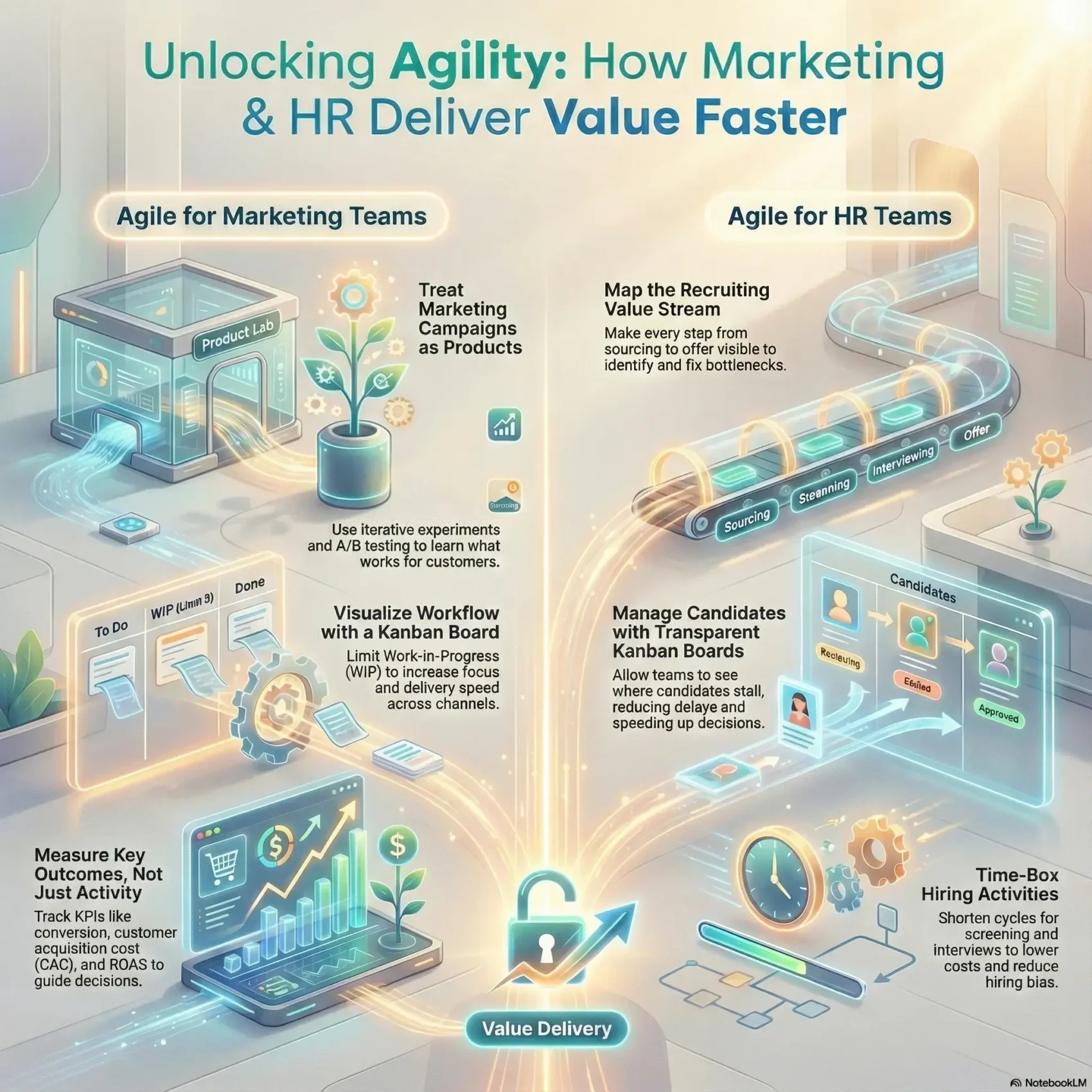
Last Updated on January 18, 2026
You work in a fast-moving company and need ways to deliver real results faster. This introduction shows how teams outside software adopt a new mindset to focus on value and cut waste.
Lean ideas from Toyota — like just-in-time delivery and stopping the line to fix quality — inspire modern project management across departments. Marketing campaigns and HR programs can become products you iterate on, not single-run efforts.
When your teams visualize work with boards, run short cycles, and prioritize customer needs, you reduce rework and lift outcomes. This approach borrows from development practices like sprints and A/B testing to create flow and continuous improvement.
Read on to learn how companies connect daily work to customer value, adapt management practices, and set realistic expectations for learning and change.
Key Takeaways
- Practical shift: Treat campaigns and hiring programs as iterative products.
- Value focus: Prioritize work that moves the needle for customers.
- Visual work: Use boards and short cycles to reduce waste.
- Quality built in: Apply stop-the-line thinking to prevent rework.
- Cross-team tools: Scrum and Kanban techniques translate cleanly to creative and people ops.
- Realistic adoption: Plan training and set stakeholder expectations early.
Why agile beyond IT matters now for your organization
Customers expect rapid improvements, so your project management must shorten the path from idea to delivery.
You face complex work across teams and systems. Visualizing work and limiting multitasking helps teams keep pace. This also improves flow and predictability for your customer outcomes.
Shorter launch windows force you to plan small slices of value and validate quickly. Change in markets and competition creates constant pressure. That makes agility an operational need, not just a buzzword.
Strong management practices align budgeting, staffing, and project timelines so organizations can deliver value consistently. Use feedback loops to adjust roadmaps based on real customer signals.
- Reduce risk with incremental releases and tighter learning cycles.
- Build cross-functional teams that ship useful work often and learn fast.
- Measure outcomes to keep management focused on value and business impact.
Foundations of agility: Lean principles, Agile values, and systems thinking
Start by seeing work as a chain of customer outcomes, not a list of tasks. That mindset helps you define value and remove anything that does not help the customer.
Lean’s focus: deliver value, cut waste, and build quality in
Lean places value at the top and relies on leadership, systems thinking, and process integrity. You emulate Toyota by empowering people to stop the line and fix defects at the source.
Translating values and principles to business services
The Agile Manifesto’s values shift to services as collaboration, quick feedback, and small batches. Keep documentation right-sized and insist that every step advances customer value.
Systems thinking: value streams and optimizing flow
Use systems thinking to map value streams from request to fulfillment. Target bottlenecks, shorten queues, and optimize the whole system rather than isolated parts.
- Define value from the customer’s eye before work starts.
- Map processes to find waiting, rework, and handoffs.
- Build quality checks into each process step to lower costs of fixing defects.
Scrum and Kanban in Digital Marketing: delivering value faster with focus and flow
Marketing can act like a product team: ship small experiments, measure results, and learn quickly. Use Minimal Viable Marketing to run testable campaign slices that reveal what works for your customers.
Define “marketing as a product” and use Minimal Viable Marketing to iterate
Frame campaigns as products and deploy tiny bets on offers and creatives. Test with A/B experiments and scale winners.
Build a marketing backlog, time-box with sprints, and prioritize by customer value
Create a prioritized backlog based on expected customer impact. Time-box sprints to keep focus and speed up delivery.
Visualize work with Kanban, limit WIP, and manage cross-channel dependencies
Put all in-flight tasks on a Kanban board. Limit WIP to reduce switching and increase throughput. Make dependencies explicit so email, paid, social, and web teams don’t block each other.
Measure outcomes with KPIs: conversion, CAC, ROAS, velocity, and A/B testing insights
Set crisp KPIs—conversion, CAC, ROAS, and velocity—and use A/B insights to decide what to scale or pause. Standardize dashboards and tools so results move from experiments into repeatable development and higher performance.
“Ship small, learn fast, and scale what truly moves value.”
- Reuse winning assets and automate repetitive tasks.
- Enable cross-functional collaboration across creative, analytics, and media.
- Leverage 360-degree customer data to prioritize the highest-value experiments.
Scrum and Kanban in HR: from recruiting pipelines to people operations
Hiring is faster when you treat each candidate step as part of a continuous value stream. Map the recruiting flow from sourcing to offer so every handoff and wait time becomes visible.
Map your recruiting value stream and manage candidates with Kanban transparency
You map your recruiting value stream end-to-end to make stages measurable. Use a Kanban board so teams see where candidates stall and why.
Transparency helps hiring managers, HR, and finance reduce unnecessary approvals and speed decisions.
Time-box hiring activities to reduce cycle time and cost of hire
Time-box outreach, screening, and decision windows to lower cycle time and cost. Short windows force focus and reduce bias from long waits.
Set clear SLAs for interview rounds and offer approvals so your process stays predictable and fair.
Align with product roadmaps; use systems thinking to synchronize staffing and demand
Join quarterly roadmap planning so hiring cadences match real project peaks and skill needs. That prevents hiring the wrong resources at the wrong time.
Apply systems thinking to avoid local optimizations that slow onboarding or compliance. Create working agreements across HR, hiring managers, and leadership to deliver value faster.
“Prioritize requisitions that move the needle and empower people with standard templates and rubrics.”
- Map stages to measure wait time and throughput.
- Visualize candidates to spot bottlenecks fast.
- Time-box to cut cost and improve quality.
- Synchronize hiring with roadmaps and demand.
- Standardize templates and leadership support for consistent experience.
Scaling collaboration, transparency, and leadership to sustain agility
Scaling collaboration starts when everyone can see priorities, blockers, and progress in plain sight. Use clear boards and dashboards as your daily signals so teams stop chasing status updates.
Information radiators and Gemba: make work, risks, and status visible
Information radiators like Kanban boards expose backlogs, risks, and real status. This visibility helps teams spot bottlenecks and act fast.
Practice Gemba by going to where value is created. Observe, ask, and fix issues at the source so problems do not travel across teams.
Leadership behaviors, culture, and empowerment that enable continuous improvement
Leaders shape culture with clarity, integrity, and empathy. When you model these behaviors, you build trust and invite continuous improvement.
Empower frontline staff to stop the line when quality dips. That respect for people reduces rework and raises overall performance.
“Make work visible, go see the work, and enable people closest to the problem to solve it.”
- Align principles and values to operating rhythms so ceremonies serve outcomes, not process.
- Create simple systems for feedback and experiments; make improvement part of daily work.
- Measure flow and customer outcomes, not vanity metrics, to drive real change.
- Support change with coaching and communities of practice so organizations learn from each other’s wins and misses.
For practical guidance on decentralized teams and sustaining collaboration across distributed groups, see decentralized teams and the future of.
Roadmap to adoption: processes, tools, and metrics that deliver value
Begin with a focused pilot so you can prove changes quickly and limit disruption. Start small to test roles, ceremonies, and tooling in a real project context.
Start small: pilot teams, clear roles, sprint/flow cadences, and retro-driven improvements
Set a single pilot team and define clear responsibilities. Choose a sprint cadence or continuous flow that matches your work.
Institutionalize learning with short retros after each cycle so the team owns incremental improvements.
Track flow and performance: cycle time, throughput, WIP, quality, and customer satisfaction
Measure cycle time to find delays, and track throughput to see progress. Limit WIP so work moves faster and quality rises.
Use lightweight dashboards and select tools that increase transparency without adding overhead. Align finance, legal, and shared services to value streams to cut handoff delays.
- Launch a pilot to refine roles and ceremonies before scaling.
- Choose cadence—sprints or flow—to expose delivery risks early.
- Measure cycle time, throughput, WIP, quality, and satisfaction to guide change.
- Use tools that automate toil and support clear reporting.
“Sequence change with a maturity model to manage risk and focus on outcomes.”
Conclusion
Practical shifts in how you plan, measure, and communicate turn common projects into reliable delivery engines.
You can take agile beyond your current scope by focusing on clear value and short feedback loops. Small wins compound over time and help your teams build trust and momentum.
Lean principles that respect people, transparency, and continuous improvement give you a way to define value and tighten value streams. Marketing and HR gain faster learning with Minimal Viable Marketing and Kanban recruiting, so you cut delays and lower cost.
Anchor change with simple metrics, steady management support, and a shared mindset. That way your organization can keep delivering value to customers while adapting to real challenges.