Tools
Tools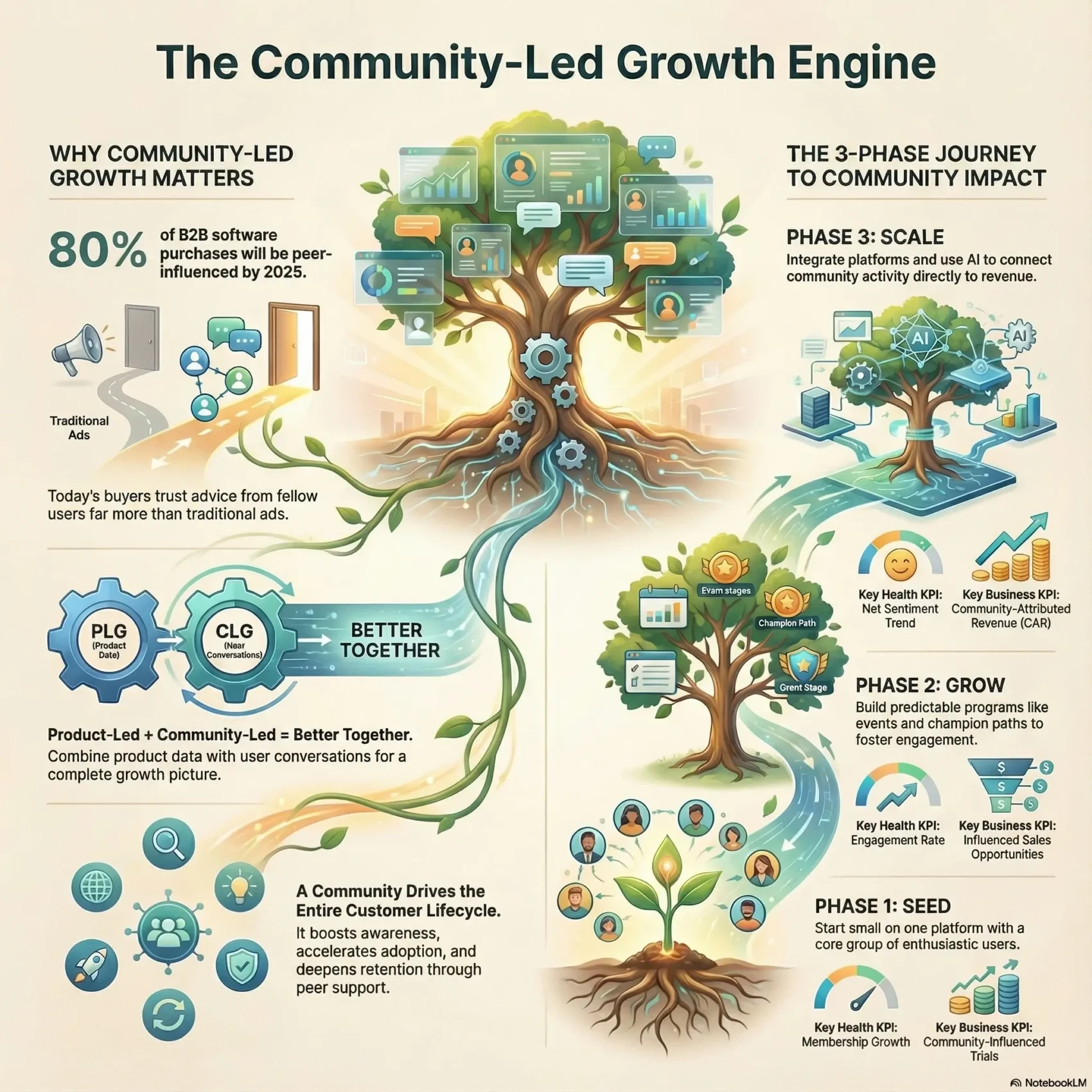
Last Updated on December 13, 2025
You can turn active users into your best marketing channel. Community-led growth helps teams use user feedback and peer support to boost acquisition, engagement, and retention.
Big brands prove it works. Atlassian, Asana, Figma, HubSpot, and Webflow all lean on communities to build durable advantages and influence product direction.
In fact, the 2022 Community Industry Report found that 87% of community professionals say community is critical to their mission, and 82% report rising cross-department interest. That means your product and business teams can tap this energy for measurable results.
Smart platforms layer AI and product data to surface insights from Slack, Discord, Reddit, LinkedIn, events, and telemetry. This creates a single view of members so you can act quickly, improve the experience, and prove impact.
Key Takeaways
- You’ll learn a clear definition of community-led growth and why it matters for SaaS and B2B companies.
- See how top brands convert member activity into product and business results without over-marketing.
- Understand how AI-powered platforms unify signals across channels to inform product and marketing.
- Map community programs to outcomes like awareness, activation, adoption, and retention.
- Get practical steps to start small, show wins, and build executive confidence.
- Explore related trends and social signals at social media trends.
What Community-Led Growth Means Today and Why It Matters
Today’s buyers trust advice from fellow users and advisors more than traditional ads. Gartner projects that by 2025, 80% of B2B software purchases will happen online, where people lean on peers, advisors, and community influencers.
Why now: shifting buyer behavior and the rise of peer influence
Prospects and customers search Slack, Reddit, and LinkedIn for real use cases before they contact vendors. That peer signal shortens time-to-trust and often replaces early demand gen.
Real-world result: one platform tracked 300+ organizations in its community before those accounts hit CRM, leading to $5M+ ARR and faster deal cycles.
How communities drive awareness, adoption, and retention
Members amplify shareable content for awareness, provide hands-on help to speed adoption, and supply ongoing education that deepens retention.
- Awareness: peer recommendations and public threads raise brand signals across the market.
- Adoption: hands-on help and integrations discovered in conversations reduce friction.
- Retention: continuous feedback loops feed product decisions and keep customers engaged.
Put simply, community is a practical way to turn member activity into measurable impact across your funnel.
community-led growth vs. product-led growth: Better Together
A product-first approach optimizes the tool; a user-first approach optimizes the experience around it. That simple shift changes how you collect signals, set priorities, and align teams.
From solution-first to user-first: the core mindset shift
PLG builds momentum from the solution: signups, in-app funnels, and product-qualified leads.
By contrast, a user-first approach surfaces customer needs in conversations and long-term relationships.
Feedback flows: fragmented inputs vs. organic conversations
In many product motions, feedback is spread across reviews, tickets, and social posts.
Communities create a steady stream of organic questions and answers that a team can triage.
North Star metrics: PQLs vs. CAR and when to use each
PQLs measure product interest and activation. Community-attributed revenue (CAR) links accounts to prior community engagement.
Use both: PQLs for activation tuning and CAR to show the community’s business impact.
Ownership and collaboration across teams
Marketing, product, sales, and customer success should co-own touchpoints and shared goals.
- Align metrics: map PQLs and CAR to the same funnel.
- Route feedback: use a platform to tag and assign signals to owners.
- Close the loop: product teams act on prioritized community input.
Companies like Figma, Asana, and dbt Labs combine motions to improve roadmaps and reduce rework. When you pair product signals with community insight, you get better prioritization, higher conversion quality, and a more human experience for your customers.
Core Components of a Winning CLG Strategy
Start by treating your community as a product: map the member journey from first post to trusted advocate and set clear milestones for each step.
Your community flywheel: from first engagement to advocacy
The flywheel moves people from join → learn → adopt → advocate. Each stage should have small wins that nudge members forward.
Design repeatable touchpoints like onboarding threads, how-to posts, and recognition loops to keep momentum.
Choosing channels and platforms that fit your industry
Pick the platforms your audience already uses. Developers often prefer Discord and Reddit; product teams lean toward Slack and Twitter or LinkedIn.
Prioritize one or two channels first, then add integrations to unify signals across tools.
Content that creates value, connection, and momentum
Create content tracks that balance education, inspiration, and conversation starters. Offer AMAs, office hours, and weekly prompts members expect.
- Resources: docs, templates, and quick wins that show product value.
- Engagement: scheduled events and moderator coverage to keep conversations healthy.
- Scale: identify power contributors early and give clear recognition paths.
Measure and reinvest: track community health (growth rate, engagement, sentiment) and business impact (pipeline influence, retention). Use those insights to refine your strategy and document best practices as you scale.
Finding Fit: Market readiness and defining your community’s purpose
Start by asking: is there an audience that cares enough to show up and talk? Validate demand before you invest in tooling or hiring. Use interviews, social listening, and pilot groups to confirm interest and topics that spark real conversation.
Community-market fit vs. community-product fit
Community-market fit checks whether people care about the topic or category. Run lightweight experiments—podcasts, AMAs, or webinars—to see if traffic and signups follow.
Community-product fit tests whether customers will engage around your product. Look for repeat questions, integrations, or peer-help behavior that tie back to usage.
Top-of-funnel category communities vs. bottom-of-funnel customer communities
Two common types serve different goals. Category communities build awareness and a movement. Customer communities deepen adoption and advocacy.
- Validate demand: interviews + social listening + pilot groups.
- Pick your type: launch a category community to attract new audiences, or start with a customer community to boost retention.
- Layer deliberately: follow Gong’s path—use broad content to seed interest, then introduce meetups and customer-only spaces.
- Define purpose: write a short purpose statement that serves something bigger than your brand and motivates your people.
- Set success criteria: early metrics let you judge fit and iterate quickly without turning the space into a push channel.
“Design for the people you want to serve, not the messages you want to send.”
Building and Launching: How to get started without overengineering
Launch with a small circle of believers. Invite a core group of enthusiastic users who care about your product and will model helpful behavior. This keeps quality high and sets the culture from day one.
Choose one channel to start. Use Slack or Discord for real-time chats, a forum for threaded discussions, or social channels to meet people where they already are. Add structure—welcome threads, office hours, and topic tags—before you add more platforms.
Make participation easy. Share simple guidelines that show what good looks like, how to ask for help, and where to post. Prepare short onboarding content and starter prompts to seed conversation without overengineering your stack.
Appoint a visible owner—even a founder early on—and groom volunteers to host meetups and welcome new community members. Set a realistic cadence that fits your available time and resources.
- Recognition: quick shoutouts, spotlights, and DMs encourage repeat contributions.
- Feedback loop: capture ideas and use them to co-create the community roadmap.
- Document: record what works and retire what doesn’t so you can scale confidently.
Member Engagement That Scales Without Feeling Salesy
When members meet peers who share exact problems, engagement becomes natural and sustainable. Design simple, human-first programs that invite conversation instead of selling.
Designing member-to-member interactions and networking
Match people by role, challenge, or goal with lightweight tools. Gong’s Meetsy and focused meetups like Women in Revenue show how one-on-one connects lead to deeper trust.
Offer role-based circles and AMAs that encourage organic help. These rituals spark repeated interactions and create useful content for others.
Champion programs, recognition, and ambassador pathways
Create a tiered champion path with clear perks: beta access, speaking slots, and insider previews. Recognition turns helpful customers into advocates without pressure.
Inclusive guidelines and a code of conduct that sustain trust
Write clear rules that protect psychological safety and fair debate. Use templates, tags, and calendars to scale programming while keeping the human touch intact.
- Lightweight matching and networking to help peers connect.
- Recurring rituals that encourage conversation within community.
- Spotlights that turn member posts into evergreen learning content.
- Best practices for nudging quiet members gently and respectfully.
Measurement That Matters: From community health to business impact
Measure what matters: tie member activity to clear business outcomes so your community becomes a source of predictable value.
Community health: growth, engagement, sentiment
Track membership size, weekly active members, and engagement rate. Watch average sentiment to spot risks early.
Simple ratios—posts per active member and reply rate—help you see whether conversations are useful or fading.
Business metrics: CAR, retention, expansion
Map community-attributed revenue (CAR) to accounts in your CRM. Track influenced pipeline, ARR from community-sourced deals, and retention or expansion among customers.
One Common Room customer saw 72% of community-led deals close within 90 days versus 42% for sales/marketing-led deals.
KPI cadence and data ops
- Balanced scorecard: blend health (active members, sentiment) with business KPIs (influenced pipeline, expansion).
- Quarterly reporting: highlight wins, candid learnings, and program changes tied to your goals.
- Integrations: sync community signals with CRM and product analytics so dashboards update automatically.
- Feedback loop: use trend analysis to surface feature requests and risk signals you can act on quickly.
Your Community-Led Team: Roles, skills, and cross-functional alignment
Great communities run like well-coached teams: defined roles, fast routing, and shared goals. You need a small, clear org chart that maps who captures member signals and who acts on them.
Community managers, operations, and developer advocates
Community managers and heads of community act as quarterbacks. They route insights to product, sales, support, and engineering. Community operations builds the playbook and automations that keep handoffs smooth.
Developer advocates are critical in software markets. They drive bottom-up adoption, create technical content, and surface product questions back to your team.
Marketing, product, sales, and customer success partnerships
Marketing partners on narratives, content, and events to grow awareness. Product turns member feedback into roadmap priorities.
Set tight loops with sales and customer success so signals become timely outreach, expansions, or save motions.
Executive sponsorship and resource allocation
Secure executive sponsorship early. Leaders provide resources, budget, and visibility. Use examples like Salesforce Trailblazer, Slack organizers, and Notion to show cross-functional models that work in the industry.
- Define roles: catalog responsibilities, SLAs, and handoffs.
- Enable people: training and simple playbooks for internal contributors.
- Plan resources: hiring or upskilling as the community scales.
- Report clearly: tie activity to business outcomes to prove success.
Driving GTM Impact: Lead gen, expansion, and shorter sales cycles
Your community can become a front-line sales signal when multiple colleagues from the same account start asking the same product question. That cluster behavior often reveals net-new leads and expansion paths before they show in CRM.
Turning community signals into qualified opportunities
Translate engagement spikes, intent signals, and org-level participation into tracked opportunities. Tie threads and channel activity to account records so you can score and route prospects quickly.
Using insights to enrich outreach and accelerate deals
Give sales contextual cues: which features members ask about, which integrations interest them, and who’s advocating inside the account. That context makes outreach timely and helpful.
One customer saw 72% of community-led deals close within 90 days.
Reducing churn through proactive sentiment monitoring
Monitor sentiment across posts and social mentions to spot frustrated customers early. Trigger save motions with empathetic outreach and product participation to turn support moments into delightful experiences.
- Translate signals: convert threads into qualified opportunities for your GTM motion.
- Equip sales: supply contextual insights to tailor outreach to each customer’s experience.
- Build expansion playbooks: listen for adoption cues and integration interest inside accounts.
- Implement sentiment monitoring: catch churn risk early and coordinate fast interventions.
- Formalize champions: scale referrals and co-created content to support marketing and customer acquisition.
- Standardize tracking: make community-sourced influence visible and repeatable across reporting.
In practice, you’ll shorten cycles and lift conversion quality when product teams join conversations and sales uses community signals as timing intelligence. The result is measurable business impact and happier customers.
Platforms and the Maturity Curve: Operationalizing intelligent community growth
Operationalizing a vibrant community requires a clear maturity path that ties tools to outcomes. Your platform choices should match the phase you’re in so you don’t overbuild too soon.

Phase one: seeding your community
In the seeding phase you focus on starting conversations and proving value quickly. Keep tooling light and invite a core group of advocates.
- Health KPIs: membership growth, weekly active members, early sentiment.
- Business KPIs: initial community-influenced trials or demos, early retention signals.
- Actions: pick one platform, document starter prompts, and allocate minimal resources to get started.
Phase two: facilitating growth and sustained engagement
Now you build predictable programs—events, champion paths, and role-based circles that encourage repeat interactions.
- Health KPIs: engagement rate, posts per active member, reply rate.
- Business KPIs: influenced opportunities and expansion conversations inside accounts.
- Platform needs: integrate chat, forums, and event tools; add automation for onboarding and recognition.
Phase three: proving impact and scaling programs
At scale, you prove the product and community’s business value with linked data and executive-facing metrics.
- Health KPIs: net sentiment trend and sustained DAU/WAU ratios.
- Business KPIs: ARR attributed to community, retention lift, and closed-won influenced by members.
- Outcome: align goals to market priorities and show how efforts compound over time.
Integrations, data unification, and AI-powered insights
Connect communication apps, social channels, forums, event platforms, and success tools so signals don’t live in silos.
AI/ML can surface high-value interactions and automate triage, linking community activity to product usage and revenue outcomes.
- Unify signals to reduce manual lift and route the right leads to product or sales.
- Use AI to enrich threads, tag intent, and surface patterns across communities.
- Build program templates for each phase so you can scale without reinventing the wheel.
Self-assess your phase, set right-sized goals, and align executives to the maturity curve. That way you connect community, product, and business data to tell a clear story of impact.
Conclusion
When people help each other, your product learns faster and delivers more value. Combined PLG and community-led growth at companies like Asana and Figma shows how user-first communities speed adoption, retention, and expansion.
Use intelligent platforms to unify signals so community activity ties to revenue, product health, and customer success. Start small: pick one program to test, add one integration, and improve one KPI next quarter.
You’ll leave with practical ideas to deepen member value, empower champions, and answer executive questions confidently. Treat community as an engine for business impact, not a sidecar, and measure the outcomes that matter to your goals.