Tools
Tools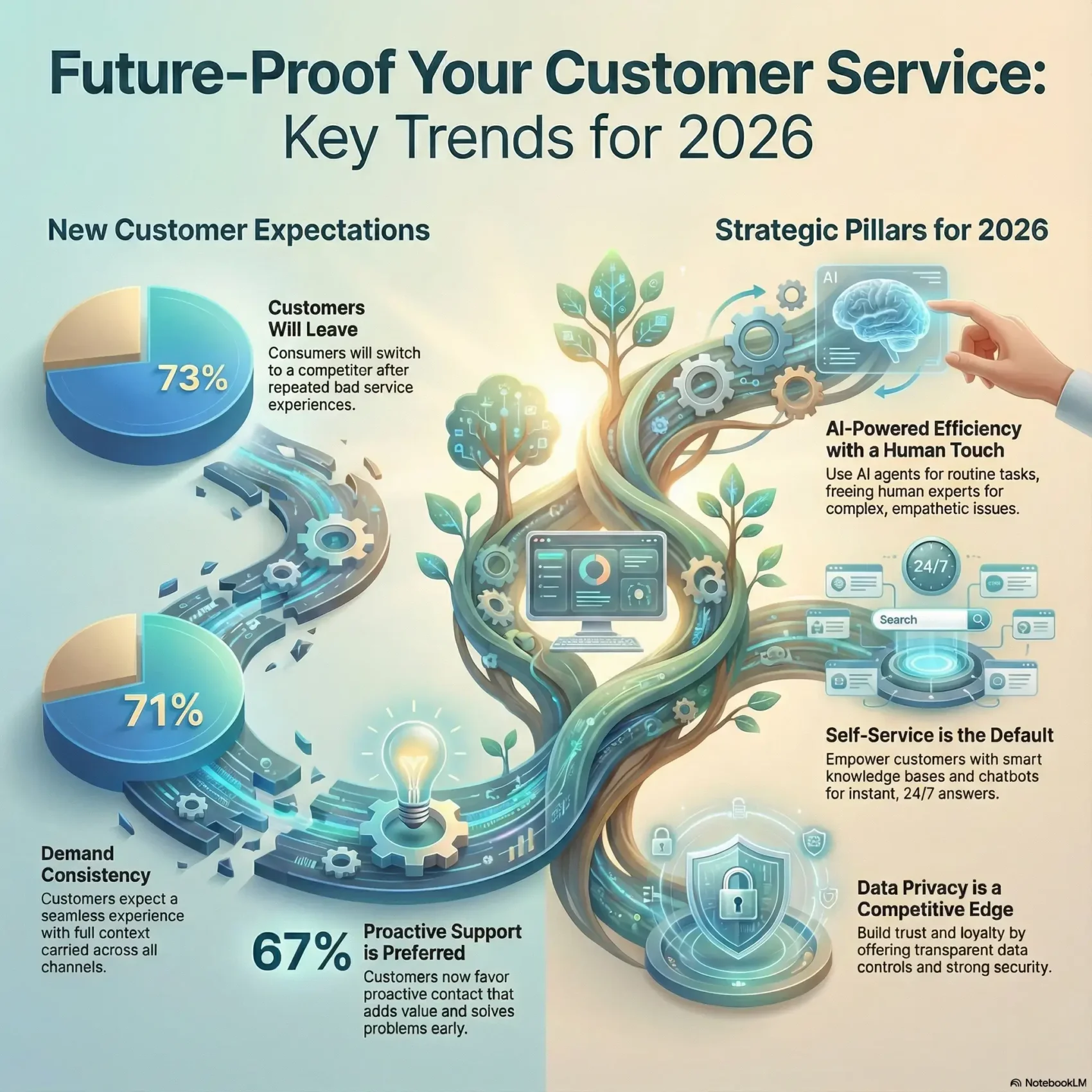
Last Updated on December 25, 2025
Expectations are high: data from Zendesk and Gartner show many people will switch after poor experiences, and most spend more with brands that deliver consistent quality.
That means AI, self-help channels, omnichannel context, and human empathy are practical levers you can apply now. Use real-time context to fix issues before they escalate and save time for both your teams and your buyers.
Prioritize unified data layers, open APIs for extensibility, strong security controls, real-time analytics, and modular AI components. These elements let you integrate voice, chat, and knowledge tools while maintaining agility and protecting user data.oice AI speed answers, while thoughtful human touch points protect trust for sensitive matters. Strong data governance turns privacy into a competitive edge.
Key Takeaways
- Shift to proactive support and full context across channels to cut repeat contacts.
- Make self-service the default for fast answers, with escalation paths when needed.
- Apply AI to scale responses but keep humans for empathy and complex issues.
- Use actionable insights and governance to build trust and boost loyalty.
- Translate trends into a 90‑day roadmap for quick wins and long-term gains.
Why 2026 raises the stakes for customer service in the United States
The stakes in 2026 mean every interaction must move the needle on retention and revenue.
Low tolerance for friction is real: 73% of consumers will switch after repeated bad experiences, and more than half will leave after a single poor interaction (Zendesk). Many silently churn — 56% rarely complain and just walk away (Coveo).
That behavior turns support quality into a board-level topic today. Call volumes may rise up to 20% in the next 1–2 years, adding operational pressure as people demand instant answers and full context (McKinsey; Zendesk).
- Fix repeat-explanations and carry context across channels to save time and reduce churn.
- Invest in data, process, and training so your teams meet expectations at scale.
- Detect silent disengagement proactively — customer satisfaction now predicts retention and revenue.
What customer service trends mean for you in 2026
2026 forces you to turn broad industry signals into clear operational moves that your teams can execute.
Expectations are shifting: customers want proactive outreach, instant answers, and empathetic handling for sensitive issues. Microsoft data shows 67% favor proactive contact, so plan outreach that adds value rather than interruption.
Pick technology by matching tools to your data maturity and team readiness. AI agents and copilots speed routine work. Voice AI improves phone interactions. But you still need humans for complex escalations and trust-building.
How B2B and B2C differ—and where they overlap
Both businesses and consumers value speed, context, and personalization. B2B adds multi-stakeholder workflows and longer lifecycles.
- Centralize information: unified, AI-native platforms deliver real-time insights and cut resolution time.
- Track signals early: predictive data flags issues before they escalate.
- Operational levers: improve knowledge quality, routing logic, and QA to reduce repeat contacts.
AI-driven service takes center stage without losing the human touch
Modern AI shifts from answering tickets to finishing them, while preserving human judgment for complex cases.
Intelligent AI agents can resolve end-to-end flows—password resets, order status, and plan changes—using context to cut handle time and reduce repeat contacts.
Intelligent AI agents that resolve issues end-to-end and boost efficiency
You’ll pick high-volume intents first and let agents handle routine resolution paths. Keep clear escalation paths so sensitive matters go to humans without delay.
AI copilots that help support agents draft faster, higher-quality responses
Copilots draft replies, summarize threads, and suggest next steps so your agents focus on reassurance and complex judgment. This raises response quality and agent satisfaction.
Voice AI and natural-sounding phone experiences consumers actually want
Natural Voice AI contains calls, routes accurately, and improves first-contact resolution. Many customers prefer more lifelike phone interactions when they speed outcomes.
Measuring ROI: revenue lift, deflection, CSAT, and time-to-resolution
- Track deflection rates and time-to-resolution to validate efficiency gains.
- Measure CSAT lift and revenue impacts—HBR shows AI can lift revenue 6–10%.
- Monitor intent coverage and response quality so data and policies stay fresh across channels.
“Pilot the highest-volume intents, expand gradually, and keep transparency about AI handoffs.”
Self-service becomes the default path to fast, satisfying support
Make self-help the first stop so users get instant answers for common needs and your team focuses on complex issues.
Modern knowledge bases your customers will actually use
Structure searchable, personalized content so users find accurate articles fast. Use tags, short how‑tos, and quick videos.
Set owners, review cycles, and analytics to keep content fresh. Track search gaps and fix them with short updates.
Smart chatbots for instant answers—and seamless handoffs when needed
Design bots to resolve high-volume intents and to pass full context to humans when queries need empathy or judgment.
- Match bot tone to your brand and give clear routes to a human.
- Use feedback loops so failed intents feed article updates.
- Measure containment rates and set escalation SLAs.
Voice self-service: IVR, speech recognition, and call containment
Use IVR and speech recognition to identify intent, authenticate users, and resolve simple calls without a queue.
Result: lower cost-per-contact, faster time-to-resolution, and higher satisfaction for users.
For practical guidance on conversational routing and bot design, see the conversational commerce playbook.
Omnichannel consistency is now the benchmark—not a bonus
Omnichannel consistency is no longer optional — it’s the baseline your teams must meet.
You must carry context across chat, email, phone, and social so people never repeat themselves. Data shows 71% of consumers expect that consistency, yet only 29% get it. Make context the single source of truth.
Carry context across chat, email, phone, and social
Architect a unified record that follows each interaction. Include history, sentiment, and recent actions so agents and bots see the same view.
Define escalation rules from self-help to assisted support and preserve full context. That reduces repeat explanations and cuts time to resolution.
Choosing the right channel mix for today’s consumers (including Gen Z)
Match channels to real behavior: volume, CSAT, and resolution rates should guide investment. Remember that 71% of Gen Z now reach out via a live phone call, so keep capacity in synchronous channels.
- Align tone and SLAs across channels so your brand feels consistent.
- Orchestrate intelligent routing by history and urgency.
- Monitor cross-channel journeys to spot drop-offs and close gaps fast.
Personalization at scale meets empathy at moments that matter
Personalization must scale without losing the human warmth that matters in tense moments.
Make data work for people: 76% of customers expect tailored interactions, and brands that deliver personalization report stronger loyalty. Use behavior, purchase history, and past interactions to shape timely recommendations and helpful nudges.
Using data to tailor journeys, recommendations, and support
Turn signals into simple rules that guide offers, education, and in-product help. Leaders say data drives personalization; surface key facts so agents and bots act with context.
Be explicit about value exchange. Tell users what information improves their experience and give clear controls for frequency and channels.
Designing smart escalations where humans deliver reassurance and trust
Not every interaction should be automated. About 90% of customers prefer a human for complex issues, so define escalation triggers for emotional or high-stakes cases.
- Show agents concise insights at a glance so they can calm anxiety fast.
- Keep tone consistent across channels and adapt responses to the moment.
- Test personalization tactics and tie results to retention and resolution metrics.
“Personalization without consent feels invasive; design control into every touch.”
Data privacy and security move from compliance to competitive advantage
Data protection now shapes buying decisions. When you show clear controls and strong defenses, you build trust that converts. Use transparency and a simple value exchange so users feel safe sharing information.
The trust gap: what consumers expect versus what companies believe
There’s a real trust gap: many CX leaders think their systems are trusted, yet consumers disagree. That gap costs revenue—70% of consumers avoid companies seen as weak on security.
Privacy-by-design: consent, transparency, and encryption across channels
Start with consent. Offer granular preferences, explain how data improves the experience, and limit collection to what you need.
Make encryption and access controls standard so information stays protected across every channel.
Staying ahead of attacks with modern controls and continuous audits
Adopt continuous audits, penetration testing, and vendor risk reviews. Train teams to spot phishing and social engineering.
- Measure perceptions of privacy and adjust your strategy.
- Align policies with GDPR and other rules, and communicate compliance without friction.
- Coordinate with security and legal partners to remediate and notify quickly if incidents occur.
“Privacy done well is a differentiator; transparency turns protection into trust.”
Real-time insights and feedback loops power agile CX improvements
If you capture signals as they happen, your teams can fix issues in hours, not weeks.
Set up always-on feedback from short NPS pulses, in-product signals, social listening, and post-interaction surveys. Companies with effective NPS programs grow twice as fast (Bain), so make scores visible and actionable.
Close the loop fast: acknowledge input, log the fix, and tell users what changed. Six in ten agents say lack of data causes negative experiences (Zendesk), so feed frontline teams with concise, time‑of‑need insights.
From NPS to in-product signals: closing the loop visibly and quickly
- Collect live signals and link qualitative comments with scores to spot high-impact issues.
- Track time-to-insight and time-to-action as core CX metrics.
- Share wins across teams so everyone sees how feedback shapes product and support.
Predicting churn and disengagement—and intervening proactively
Analyze patterns and cohorts to predict churn, then intervene with targeted help, education, or offers. Use insights to refine knowledge articles, automation intents, and escalation rules so you cut repeat issues and improve satisfaction.
“Early detection lets you act before disengagement becomes churn.”
Your team is the experience: training and enablement for 2026
Your people shape every interaction — training is how you turn tools into outcomes.
Pair AI with judgment. Design a short program that teaches support agents to use copilots for drafting, summarizing, and data lookups while keeping accuracy and empathy front and center.
Upskilling agents to work with AI tools and new workflows
Start with hands-on labs that mirror real issues and volumes. Use the Zendesk data — 93% of CX leaders see copilots as onboarding accelerators and 90% report positive ROI — to justify initial investment.
Elevating soft skills: empathy, problem-solving, and active listening
Coach active listening, de-escalation, and clarity so tough moments become trust-building ones. Teach agents to guide customers through self-service without sounding scripted.
- Standardize playbooks for common interactions, and let agents personalize within guardrails.
- Measure success with quality scores, time-to-resolution, and satisfaction.
- Use peer reviews and QA automation for fast, constructive feedback.
- Schedule regular refreshers and reserve learning time so training doesn’t get squeezed.
“Support agents using AI feel 20% more empowered — combine tools with human coaching to protect trust.”
Involve agents in knowledge updates so frontline insight improves self-help and reduces repeat issues. Reward behaviors that drive loyalty and plan capacity for learning to sustain gains.
customer service trends you can act on now: your 90-day roadmap
Launch a compact roadmap that prioritizes quick wins, measurable pilots, and platform readiness.
Quick wins: deploy AI assistance, strengthen knowledge, unify context
In the first 30 days, enable AI for high-volume intents and refresh your top knowledge articles.
Unify context across channels so reps and bots see the same history. Set analytics to track deflection, time-to-resolution, and satisfaction from day one.
Build momentum: pilot Voice AI, automate QA, expand personalization
Pilot Voice AI in one queue and measure call containment before scaling. Automate QA to surface coaching opportunities and keep quality high.
Use data signals to trigger targeted guidance and proactive outreach that match users’ expectations.
Platform checklist: data unification, security, analytics, extensibility
Confirm data unification, strong privacy and security controls, deep analytics, and API extensibility. Align stakeholders across support, product, and security to speed decisions.
- Document playbooks, SLAs, and rollout milestones.
- Communicate changes to users so improvements are visible.
- Plan month-by-month buffers and review insights often.
Conclusion
Your roadmap must convert insights into action so interactions become retention drivers, not costs. In 2026, customer service trends demand speed, context, and clear measures that show impact today.
Balance automation with human judgment. Use AI to speed answers and reduce repeat work, and keep people ready for high‑stakes, empathetic moments. Make self‑help the default path and design smooth escalation to live support when needed.
Keep context across channels, make privacy a growth lever, and mine real‑time data for fast fixes. These moves protect your brand and lift satisfaction.
Train your teams, follow the 90‑day roadmap, and measure CSAT, deflection, resolution time, and retention. Iterate often so your approach stays aligned with changing expectations and builds lasting loyalty.