Tools
Tools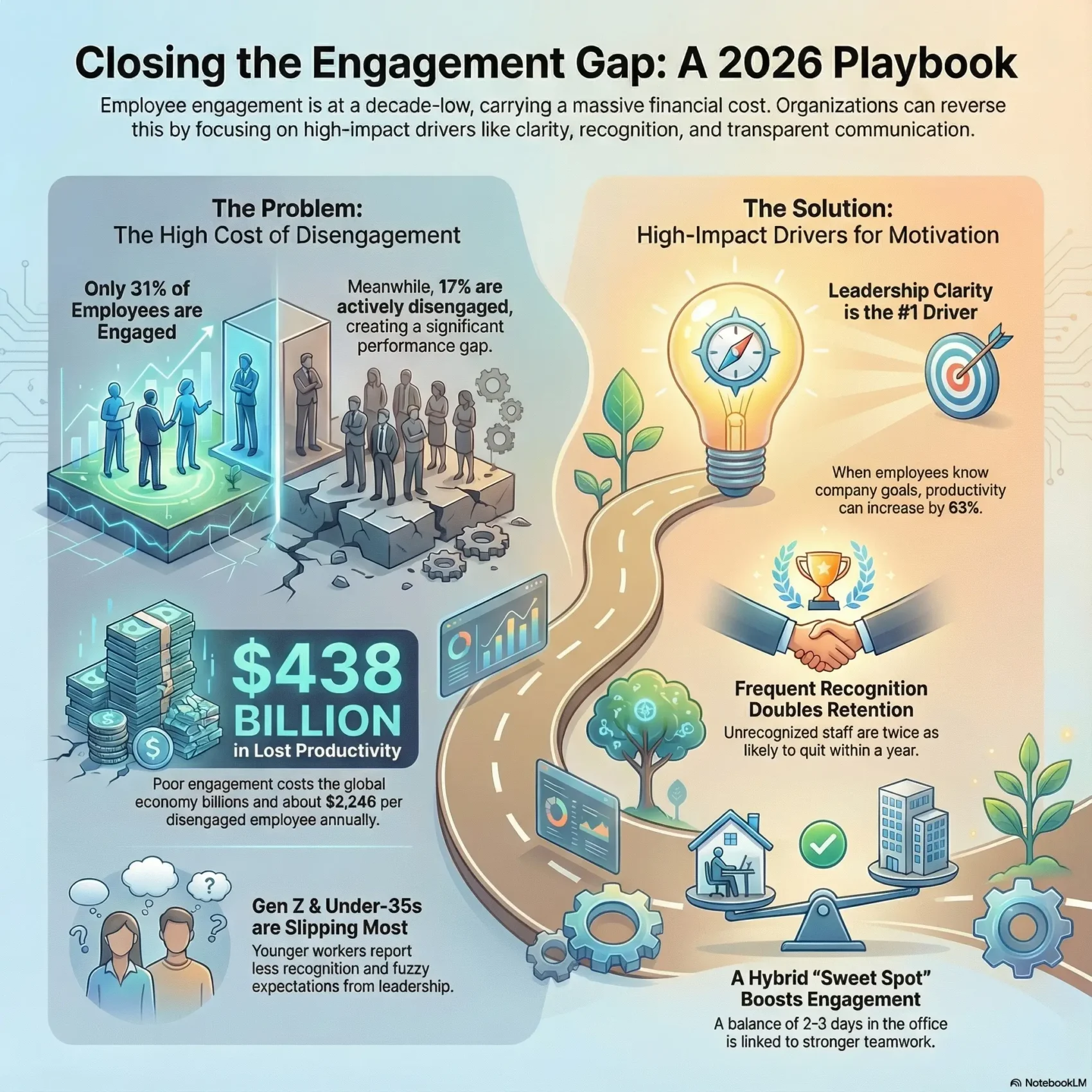
Last Updated on December 15, 2025
You need a clear map of the forces shaping your workplace in 2026. Current data show only 31% of staff feel fully involved, while 17% are actively disengaged. That gap costs business globally — Gallup puts lost productivity at about $438B and roughly $2,246 per disengaged person each year.
Good news: people still find meaning and strong team bonds satisfying. But clarity from leaders and fair workload matter more than ever. Culture Amp flags confidence in leadership and “I know what I need to be successful” as top drivers.
In this piece you’ll get practical insights and plain-English actions. Expect small, high-impact moves in recognition, communication, and leadership clarity that improve retention and performance without overhauling your entire company.
Key Takeaways
- Only about a third of employees feel fully involved; the gap costs real money.
- Leader clarity and clear goals drive the biggest improvements.
- Meaningful work and team bonds remain strengths to build on.
- Address compensation, stress, and workload fairness to reduce burnout.
- Small, targeted changes yield measurable gains without big disruption.
Why employee engagement trends matter right now
Start by cutting through the noise to see which shifts really change outcomes. The latest data show only 31% of U.S. staff feel fully involved, while actively disengaged workers rose to 17%. That gap is expensive: Gallup ties poor participation to $438B in lost global productivity and about $2,246 per disengaged person each year.
Your intent: understand what’s changing and where to focus
You’re here to focus on the changes that most affect performance, retention, and growth. When people know organizational goals, 63% report higher productivity, 59% more motivation, and 54% greater satisfaction with their work.
The cost of disengagement and the upside of getting it right
Disengagement is measurable. It drags morale and the bottom line. But targeted investments in recognition, internal communications, and manager enablement lift results quickly.
- Cut through noise to prioritize high-impact actions.
- Use surveys and timely feedback to spot warning signs early.
- Link actions to clear business outcomes to justify budgets.
- Build a 90-day plan that shows quick wins and longer gains.
The state of engagement in the United States: data you can’t ignore
Start with the hard numbers: the U.S. picture is sharper and more urgent than many managers expect.
In 2024 just 31% of workers were engaged, while 17% were actively disengaged. Gallup ties this gap to about $438B in global productivity losses and roughly $2,246 per disengaged employee each year.
Gallup: Only 31% engaged and $438B in lost productivity
When people know company goals, surveys show big gains: 63% higher productivity, 59% more motivation, and 54% greater satisfaction.
Other lifts include 45% better collaboration and 44% stronger problem-solving—clear proof that simple clarifications move the needle.
Who’s slipping most: Gen Z and under-35s, and why that matters to you
Declines are steepest for under-35s. They report less recognition, fuzzy expectations, and weaker access to tools that let them do their best work.
- Stand still and your company will fall behind in this decade-low market.
- Use short surveys that probe goal clarity, recognition frequency, and tools access.
- Track improvements by age band so Gen Z sees fast, visible gains.
Core drivers in focus: leadership, clarity, and tools that enable great work
Focus on three core drivers that reliably move the needle: leadership confidence, clear goals, and practical tools that remove friction. Culture Amp data show confidence in leaders is the top driver and the phrase “I know what I need to succeed” is growing in importance.
Confidence in leaders as the top driver
Perceptions of leaders have declined since 2020, so rebuilding trust matters. Start with regular updates, explain decisions plainly, and show follow-through. These steps signal reliability and reduce uncertainty.
Clarity of goals and role success
Align team and individual outcomes to company priorities. Set crisp measures of success so everyone can answer, “What does good look like?” When people know expectations, performance and morale improve.
From outputs to outcomes: aligning work to business value
Shift your rhythm from tracking tasks to managing results. Make values actionable by linking recognition to behaviors that support culture. Provide simple toolkits for goal-setting, check-ins, and reviews without adding admin work.
- Rebuild leader trust: consistent updates, clear rationales, visible follow-through.
- Elevate clarity: map individual work to company priorities and measure outcomes.
- Remove blockers: help each team member state what they need and act fast.
Transparent internal communication as a strategic lever
When communication is intentional, people understand priorities and act with confidence. Clear, regular messaging reduces anxiety and builds trust across your organization.
Why it works: 68% of organizations that boosted internal comms in the last 18 months saw higher employee engagement, 73% reported better eNPS, and 72% noted culture gains. That data shows investment pays off.
Explain the “why” to build trust
You’ll build trust faster when you explain the why behind decisions, not just the what. People are more likely to go above and beyond when they understand goals, owners, and timelines.
Invest where it counts
Use a consistent cadence: a CEO-led newsletter, an exec town hall, and a manager cascade that lands messages locally. A regular newsletter from leadership is a simple, high-leverage lever post-COVID.
What people actually want to know
- Top-level goals and who owns them.
- When plans shift and why.
- Tools and resources available to do the work.
- How decisions affect career growth and company performance.
“Short pulse surveys after major announcements help you check understanding and sentiment fast.”
Give managers concise talk tracks and slides so they can localize messages. Centralize policies and FAQs in one hub so nobody hunts for resources.
Track outcomes like understanding of goals and alignment to validate that your communication strategy is moving the needle. For more on building a healthy remote company culture, see remote company culture.
Recognition that moves the needle
A well-timed thank-you can shift someone from doing the minimum to going the extra mile.
Why it matters: half of people report they’re doing the minimum at work, and 22% say they’d try harder with more recognition for extra contributions. Only one in three received praise in the last seven days. Unrecognized staff are twice as likely to quit within a year.
Make praise frequent, specific, and multi-source
Frequent recognition drives discretionary effort. Specific praise links actions to company values and clear outcomes. And when peers, managers, and senior leaders all participate, recognition feels real.
- Give in-the-moment praise and note the impact, not just the activity.
- Mix formats: public callouts, private notes, growth opportunities, and targeted rewards.
- Close the loop weekly with a short ritual like “wins of the week.”
- Track recognition frequency by team using simple surveys to spot gaps fast.
“When people feel seen, performance and retention improve.”
Outcome: do this and you should see measurable lifts in performance, morale, and long-term success.
AI and ML in engagement: personalization without losing the human
Personalization at scale is possible, but it must protect trust and human judgment first.
Organizations use AI to tailor communication, monitor sentiment from pulse comments, and deploy AI assistants so people get answers fast. The model helps send job-specific updates without flooding inboxes.
Practical use cases
- Sentiment monitoring flags hotspots so managers can act before issues grow.
- Tailored communications reduce noise and deliver timely guidance to the right people.
- AI assistants surface policies, benefits, and how-to resources so staff solve problems faster.
Address concerns head-on
Data shows 41% of leaders expect safe adoption challenges. Be transparent about sources, guardrails, and human oversight.
“Start with low-risk pilots, publish a clear AI policy, and keep humans handling performance, career moves, and recognition.”
“Protect trust” by explaining how roles may evolve and what training you’ll offer. Measure whether AI shortens time-to-answer and improves how employees feel without creating surveillance.
Hybrid work models and RTO: balancing flexibility and performance
Finding the right mix of office and remote days can boost collaboration and morale. Data show most people prefer about two to three days in-office. That sweet spot links to higher employee engagement and better team outcomes.
The 2–3 days in-office sweet spot and engagement impacts
Anchor your plan around the 2–3 day window. It gives teams time for focused deep work at home and real collaboration in person.
Why it matters: organizations that aim for this rhythm report stronger teamwork and clearer handoffs. But heavy-handed RTO orders risk turnover: about 37% of staff say they will look elsewhere if in-office mandates rise sharply.
Communicate the “how” and “why” of RTO to retain trust
Explain goals, schedules, and what success looks like before enforcing changes. Clear communication preserves trust and reduces surprise.
“Tell people how decisions support team goals and let managers adapt plans to local needs.”
Equip hybrid teams: tools, norms, and outcomes-based management
Provide collaboration tools, simple meeting norms, and focus-time etiquette so office days add real value.
- Coach managers to measure results, not seat time.
- Set rituals for on-site days: planning, retros, onboarding, and recognition.
- Use feedback loops to adjust schedules, reduce commute friction, and fix room or desk shortages.
Track results: monitor engagement, performance, and attrition across different work models to validate what works for your company.
Well-being, DEI, and belonging: culture as a competitive advantage
Well-being and belonging are no longer nice-to-have perks — they shape how your team performs and stays.
Data show people cite pay, stress, and workload as top complaints; about 25% say they feel overstressed. That matters because companies in the top quartile for racial and ethnic diversity are roughly 35% more likely to beat median returns.
What you can do: rebalance workloads, normalize talks about burnout, and give fast access to mental health resources. Equip managers to spot overload and move tasks before problems grow.
- Link DEI goals to your values and reward inclusive behavior through recognition.
- Use feedback channels to hear underrepresented voices and close gaps quickly.
- Offer flexible benefits that match different life stages and needs.
Outcome: when people feel safe, respected, and connected to mission-level purpose, you’ll see stronger engagement and better performance.
For practical frameworks on inclusion, see diversity and inclusion work.
Building skills, voice, and advocacy: upskilling, feedback, and ambassadors
Upskilling, feedback loops, and authentic advocates give your company a practical path to stronger careers and measurable results. Focus on simple learning paths, visible listening, and manager coaching so talent sees clear returns.
Upskilling and reskilling to future-proof careers
Seventy-four percent of workers want new skills (PwC), and the World Economic Forum estimates 44% of skills will change in five years. Tie training to real projects, coaching, and on-demand resources so people can apply learning the same week.
How to start: map key skills, create short learning sprints, and reward progress with career pathways and recognition.
Voice: surveys, channels, and closing the loop
Use short surveys and open channels to collect feedback quickly. Ask targeted questions, act on top themes, and publish what you changed so people trust the process.
Close the loop publicly—share results, owners, and timelines so feedback becomes visible action, not noise.
Ambassadors as authentic culture carriers
Ambassadors amplify your values. Messages shared by staff get far more reach—about 561% more engagement—and workers usually have larger followings than brands. Pick thoughtful advocates and give them simple toolkits to share wins and learning moments.
Managers as the linchpin of team performance
Managers drive day-to-day adoption. Yet only about 31% of managers are fully engaged. Enable them with clear cascades, outcome-based playbooks, and coaching so teams get steady support.
- Future-proof careers with targeted upskilling tied to evolving roles.
- Build learning paths with on-the-job projects and on-demand resources.
- Run brief surveys, act on results, and report back publicly.
- Empower ambassadors and recognize managers who grow talent.
“When voice, learning, and managers align, career mobility becomes a reliable business advantage.”
Conclusion
Finish strong: turn the data into a short roadmap you can test this quarter. Use the employee engagement trends as a guide, not a checklist, and pick three high-impact pilots.
Start with the core drivers: rebuild trust with clear leadership updates, make recognition frequent and specific, and tie work to measurable outcomes. Use surveys and fast feedback loops to track progress.
Choose hybrid work or hybrid work models that fit your company, equip teams with the right tools and resources, and invest in career pathways and upskilling. When leaders act on voice and values, companies see better performance, lower turnover, and stronger culture.
Small experiments, measured well, create lasting business success.