Tools
Tools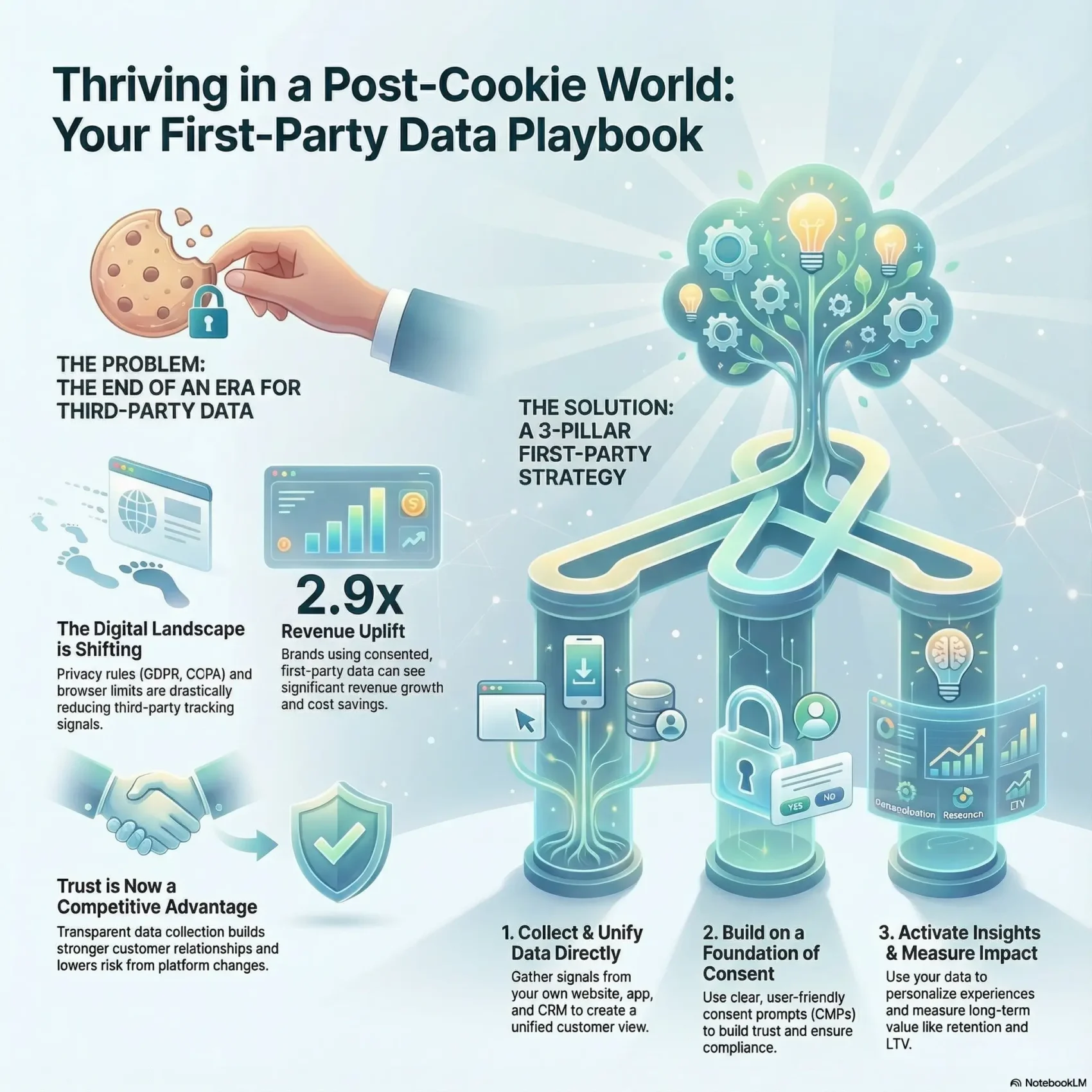
Last Updated on December 13, 2025
Your business can stay resilient as cookies fade. You’ll learn why collecting information directly from your audience builds trust and fuels better marketing. The Customer Data Platform market is growing fast, reflecting how central owned insights have become.
Google’s new approach to cookie controls means you must focus on owned signals and transparent consent. Using this approach can lift revenue by up to 2.9X and cut costs by about 1.5X. That payoff makes a clear case for investing in tools like CDPs, CRMs, and analytics.
This guide gives you a practical roadmap. You’ll get steps for collection, consent, activation, and measurement. You’ll also see how to use third-party and customer data responsibly while keeping privacy and trust front and center.
Key Takeaways
- Owned audience information is more reliable and builds trust when gathered transparently.
- CDP growth shows the market shift toward owned signals and better customer profiles.
- Google’s cookie changes make your owned approach essential for long-term growth.
- Proper tech and governance turn raw inputs into measurable outcomes.
- Privacy-first methods boost opt-in rates and customer lifetime value.
- Expect AI/ML and omnichannel work to speed insights and improve experiences.
Why first-party data matters right now in a post-cookie world
When broad tracking fades, the connections you cultivate directly with customers are what keep performance steady. Privacy rules, browser limits, and platform permissions now shape how you reach people. That makes owned information your most durable asset.
Present-day shifts: privacy, platform policies, and consumer expectations
Regulations like GDPR and CCPA, Apple’s ATT, and tighter browser cookie rules reduce third-party signals. You must make transparent data collection and consent central to your approach.
Smart marketers treat consented contacts as the foundation for personalization and forecasting. Deloitte x Google found 65% of developers are shifting toward trust-based collection. That shift lowers risk from sudden platform changes.
What Google’s evolving cookie plans mean for your marketing
Google’s emphasis on user choice pushes you to earn opt-ins and keep clear practices. Brands using permissioned inputs can see up to 2.9X revenue uplift and about 1.5X cost savings when they rely on quality signals.
“Trust and transparency are now competitive advantages for businesses that act quickly.”
- Align with regulations and you avoid compliance missteps.
- Use consented profiles to stabilize campaigns and budgets.
- Prioritize practical steps that protect short-term performance and long-term growth.
Defining first-party data and how it differs from other data types
When you separate observed behavior from volunteered preferences, you gain clearer insight. That split helps you collect useful signals while respecting privacy and consent.
Implicit signals come from what users do: page views, app sessions, purchases, and click paths. These are passive but powerful for predicting needs.
Explicit inputs (often called zero-party) are what your audience tells you directly: preference centers, surveys, and profile fields. These declarations guide personalization and product choices with clear intent.
How it compares with partner and purchased sources
Your owned first-party data is rooted in consent and provenance. It includes demographics, purchase history, email engagement, and feedback you collect yourself.
Second-party sources are shared by trusted partners and can extend reach. Third-party data is aggregated and resold; it is often less accurate and faces more privacy scrutiny.
- Reliability: Owned inputs rank highest.
- Relevance: Volunteered preferences improve personalization.
- Control: You manage retention, access, and privacy practices.
The business case: benefits of first-party data you can act on
When you own the signals that come straight from your customers, your marketing becomes measurable and repeatable. That clarity turns into faster wins and clearer ROI for the whole business.
Start small and focus on consented inputs that increase relevance and lower waste. Clean inputs feed models that improve personalization and predict who will buy, churn, or upgrade.
Personalization, predictive power, and cost efficiency
Precise audience insights cut media waste and boost return on spend. Teams see better engagement and higher repeat purchases when offers match real preferences.
- Better targeting: models trained on owned signals improve conversion and LTV.
- Lower costs: you spend less on brokers and more on channels that work.
- Stronger trust: permissioned collection aligns with rules and deepens customer relationships.
Google’s findings back this up: organizations that use consented inputs across functions can see up to 2.9X revenue uplift and roughly 1.5X cost savings. Use this as the ROI narrative you can present to stakeholders.
For practical next steps, review social and channel trends at social media trends to spot opportunities where owned signals will pay off fastest.
Building your first-party data strategy
Begin with clear objectives that tie marketing activities to measurable business outcomes like revenue, retention, and reduced churn.
Set measurable goals so teams can track real progress instead of vanity metrics.
Set objectives, map sources, align stakeholders
Inventory sources across your site, app, CRM, email, social, and offline touchpoints to see where customer signals live.
Align marketing, product, engineering, and legal early so definitions, access, and governance are agreed on.
From vision to roadmap: prioritize use cases that move KPIs
- Focus on quick wins: cart recovery, onboarding flows, and churn prevention.
- Phase your rollout: pilot, validate, expand, then scale.
- Plan for tooling: CDPs, CRMs, product analytics, and MMPs keep collection clean and activation efficient.
“Start small, measure fast, and scale what proves value.”
Build consent and compliance into each step. Identify resourcing and dependencies so timelines are realistic and adoption-friendly.
Collecting first-party data the right way
Start by mapping where your customers interact with your brand and which touchpoints reliably yield consented inputs. That map guides how you collect first-party data without adding friction.
Core sources: websites, apps, CRM, email, social, and offline touchpoints
Confirm high-yield sources across web analytics (like Google Analytics), in-app events, your CRM, email platforms, social analytics, and in-store terminals.
Mix online and offline signals so you broaden your signal base and reduce reliance on any single platform.
User-friendly collection: surveys, preference centers, and progressive profiling
Use short contextual surveys and feedback prompts to capture preferences without interrupting users. Preference centers let customers declare choices that power personalization.
Progressive profiling asks for less up front and builds richer profiles over time as users see value. Align tracking with GDPR, CCPA, and platform rules like Apple ATT so collection stays durable and compliant.
- Embed brief on-site prompts and in-app moments that convert curiosity into consented inputs.
- Validate fields to improve accuracy and avoid “just-in-case” collection.
- Keep sources documented so teams can act on clean customer data.
Privacy, consent, and compliance made practical
Practical compliance starts with UX: make choices obvious and easy for your users. Clear wording, simple toggles, and visible benefits help you get lawful, freely given consent across web and app platforms.

Key regulations you should operationalize
You’ll align with GDPR, CCPA, LGPD, PIPEDA and Quebec’s Law 25, plus app-level rules like Apple’s ATT. Each regime demands transparency, purpose limits, and user control.
Transparency and granular consent patterns
Offer choice, not all-or-nothing. Use per-purpose toggles and explain benefits in plain language. Non-discrimination and easy opt-outs build trust and reduce complaints.
Timing and design to improve opt-in rates
Use pre-prompts and contextual asks that show immediate value—like a camera prompt tied to boarding pass upload. Time requests when users need the feature, not on day one.
- Document consent states and sync them across platforms to avoid accidental misuse.
- Create fast flows for access, deletion, and preference changes to keep control in customers’ hands.
- Align legal, product, and marketing approvals so launches don’t stall.
Tooling up: the modern first-party data stack
A healthy tech stack turns scattered inputs into clear customer actions you can act on. You’ll assemble tools that capture, unify, and activate consented signals across web, app, email, and offline sources.
CDPs, CRMs, product analytics, MMPs, and email platforms
CDPs like Segment or mParticle unify identity and feed downstream systems.
Product analytics tools such as Amplitude and Mixpanel reveal behavioral patterns and event funnels.
CRM and lifecycle platforms (Braze, Clevertap) run campaigns and manage relationship management tasks.
MMPs like AppsFlyer tie installs and attribution back to your collection sources.
Choosing interoperable tools to avoid silos and costly migrations
Over 60% of brands struggle to link platforms. To avoid that, evaluate schemas, APIs, identity resolution, and governance before you buy.
- Map flows from event capture to activation so nothing is lost in transit.
- Favor open APIs and shared schemas to reduce duplication and migration risk.
- Define ownership for configuration and ongoing management to keep the stack healthy.
- Start with a starter blueprint that limits redundancy and keeps teams agile.
Procurement criteria should include support for common identities, exportable schemas, and vendor cooperation on integrations. That future-proofs your work and protects your investment.
Data quality, taxonomy, and governance
Treat your event catalog like a product: version it, assign owners, and document expected values.
Start with a shared taxonomy so every team speaks the same language about events, attributes, and user properties.
Event naming, attributes, and documentation best practices
Use consistent naming conventions that include entity, action, and context. For example: product_view, checkout_start, or profile_update.
Document parameters, allowed values, owners, and downstream destinations. Include examples for each event so onboarding is painless.
Keep a versioned event catalog and record historical changes. Track implementation status across iOS, Android, and web to reduce blind spots.
Maintenance rituals: deduping, enrichment, and hygiene cadences
Set regular cadences to remove outdated metrics, merge duplicate profiles, and enrich missing attributes. These routines keep your customer profiles accurate.
Tie governance to consent states and usage rights so your systems honor permissions. Link CRM hygiene with product analytics to keep lifecycle programs relevant and effective.
- Shared taxonomy speeds analysis and reduces errors.
- Clear ownership makes fixes fast.
- Hygiene cadences preserve long-term trust and insights.
first-party data strategy activation across the funnel
Turning owned signals into action means you can deliver timely, relevant experiences that lift conversion and retention. Activation ties segmentation, prediction, and creative testing together so your marketing campaigns react to real user behavior.
Segmentation and personalization that scale
Build segments that update in real time as customers browse, buy, and engage. Use event-driven rules and profile attributes to push tailored offers across email, app, and web.
Keep segments simple at first: a few high-value cohorts let you test personalization before expanding.
Predictive modeling and lifecycle triggers
Train models to surface churn risk, upsell opportunities, and next-best-action. Then wire those signals into lifecycle flows like onboarding, reactivation, and replenishment.
Trigger on intent signals so messages reach users when they are most likely to act.
Creative and content optimization driven by insights
Link creative tests to audience insights so headlines, images, and offers evolve with performance. Track lift in engagement and repeat purchases to judge what works.
“Operationalizing insights across creative and delivery compounds gains faster than isolated tests.”
- Real-time segments that evolve with user behavior.
- Predictive flags for churn and next-best-action to boost LTV.
- Continuous creative tests tied to audience signals and conversion lift.
- Benchmarks for activation quality to measure conversion and repeat rate.
Cross-channel orchestration without third-party cookies
Orchestrating consistent cross-channel journeys now relies on consented identifiers and unified profiles more than ever.

Connect identity across email, web, app, and social so your messages feel like one conversation, not six disjointed pushes.
Email, web, app, and social: creating consistent experiences
Start by harmonizing profiles in a governed hub so each platform reads the same customer signals. That reduces repeated offers and keeps personalization accurate.
Respect privacy by honoring preference signals and consent states when you sync segments to social and ad platforms. Platform policies differ, so map rules before activation.
- Link consented identifiers to deliver timely, relevant campaigns without relying on cookie tracking.
- Document roles and cadences in simple channel playbooks to prevent overlap.
- Measure consistency by tracking response rates and unsubscribe trends to see uplift.
“Consistency across channels raises engagement and reduces opt-outs—when you get identity and governance right.”
Measurement and optimization in a consent-first world
Successful measurement now centers on outcome metrics that reflect real customer value rather than short-term clicks. You’ll lean on durable KPIs that survive privacy shifts and guide funding and creative choices.

KPIs that matter: engagement, retention, LTV, CAC payback
Track engagement depth, not just opens or impressions. Measure time, repeat visits, and feature use to capture meaningful interaction.
Build retention cohorts and model lifetime value to see how experience changes affect revenue over months. Use CAC payback to know when campaigns turn profitable.
Attribution options post-cookies: MMM, incrementality, and platform signals
MMM (media mix modeling) helps estimate channel-level impact without user-level tracking. It’s useful for big-picture budget decisions.
Incrementality testing validates lift from campaigns with randomized holdouts. This gives causal insight for offers and creative.
- Use platform signals and privacy-safe clean rooms where allowed.
- Lean on your consented datasets to reduce noise and bias in models.
- Keep an always-on test plan to validate creative, offers, and channels.
“Focus on outcomes that finance and product teams can trust—LTV, retention, and CAC payback.”
Report in business terms. Translate lifts into revenue and cost impacts so stakeholders act fast. Run weekly health checks and monthly deep dives to keep teams aligned and responsive.
Consent Management Platforms (CMPs) and why they matter
A centralized consent hub keeps user choices consistent across apps, sites, and ad partners. A CMP captures permissions, stores consent states, and shares those signals with analytics and ad tools so you honor preferences everywhere.
How CMPs streamline compliance and preserve UX
CMPs standardize consent by mapping regions, purposes, and vendors into one control plane. That reduces legal risk and keeps your customer experience smooth.
Design the prompt to be clear and contextual. Test timing and wording to raise acceptance rates without pressuring users.
Ad platform requirements and avoiding double prompts
Some ad platforms require certified CMPs for specific app inventory. If you lack one, Google or another provider may show its own prompt. That leads to double prompts and a worse experience.
“Make consent a single, consistent touchpoint so customers keep trust and you avoid platform penalties.”
- Integrate CMP signals into downstream tools to enforce preferences.
- Configure regions, purposes, and vendor lists to match your footprint.
- Document consent logic and create escalation paths for audits.
- Test prompt design and timing to improve acceptance rates.
Using first-party data internally to drive product and CX
Turn customer signals into product upgrades that cut friction and raise satisfaction. Use app events, site behavior, and direct feedback to spot where users struggle and what delights them.
Unified profiles let cross-functional teams act fast. Product, support, and marketing can see the same insights and test fixes in short cycles.
Translate signals into action: prioritize features that reduce steps, simplify onboarding, and increase retention. Use preference inputs to tailor tips and in-app education so new users find value quickly.
- Turn behavioral signals into product improvements that remove friction.
- Personalize onboarding and help by using declared preferences.
- Close feedback loops with support to fix bugs and improve UX faster.
- Surface insights that guide high-payoff roadmap bets.
Build CX playbooks from user segments so messages and experiences match real interactions. Align KPIs across teams so everyone pulls toward the same customer outcomes and relationship management goals.
Using first-party data externally with trusted partners
Partnering with trusted sellers and publishers can expand reach while keeping consumer trust intact. When you share consented signals with a vetted partner, you gain scale without compromising privacy or quality.
Second-party collaborations and media activation
Evaluate partners that add relevant audiences, like event hosts or commerce networks. Make sure contracts spell out consent scope, retention, and allowed uses.
- Guardrails: define consent, retention limits, and permitted use cases to protect privacy and trust.
- Secure matching: use clean rooms or hashed matching so campaigns run without exposing raw PII.
- Commerce and publisher audiences: augment reach with platform audiences but verify provenance and opt-in rates.
- Test for lift: run incrementality tests, not just view or click metrics, to show real campaign impact.
- Partner scorecards: rate partners on quality, compliance, and business impact to guide future buys.
Align creative and offers to the shared audience context so your advertising feels relevant. That improves engagement and protects the long-term value of your customer relationships.
What’s next: AI, machine learning, and omnichannel integration
AI and machine learning are changing how you spot patterns and act on customer signals across channels. Apply models to combine signals from web, app, and in-store systems so you move from lagging reports to near-real-time choices.
Turning data into decisions: faster insights and proactive experiences
You’ll harness ML to pull patterns from disparate sources and act in near real time. That lets you push alerts, recommendations, and gentle nudges when users are most likely to respond.
Use a CDP to unify profiles so personalization scales across email, web, app, and point-of-sale. Tools like ON24 and Tableau help you visualize and operationalize those insights without rebuilding pipelines.
- Automate predictions that trigger onboarding and reactivation flows.
- Unify online and offline signals to keep context as customers move between touchpoints.
- Improve models with continuous feedback loops so recommendations get smarter over time.
- Govern models and set transparent controls so users keep choice and trust.
Future-proof your stack for privacy-first signals as cookies continue to decline. Combine responsible AI governance with practical tooling to make proactive, personalized experiences reliable and repeatable.
Conclusion
Make privacy and practical governance the backbone of how you collect, store, and activate signals. A strong, clear roadmap helps you comply with GDPR, CCPA, and platform rules while keeping customer trust front and center.
Your first-party data strategy turns consented inputs into predictable growth. When you align tooling, CMPs, and governance, marketing teams can personalize without guessing and protect users’ choices.
Activate segments, run incrementality tests, and measure outcome KPIs so campaigns improve over time. Invest in hygiene and interoperable tools to avoid silos.
Do this well and your approach becomes a competitive moat—better experiences for customers and measurable benefits for your business.