Tools
Tools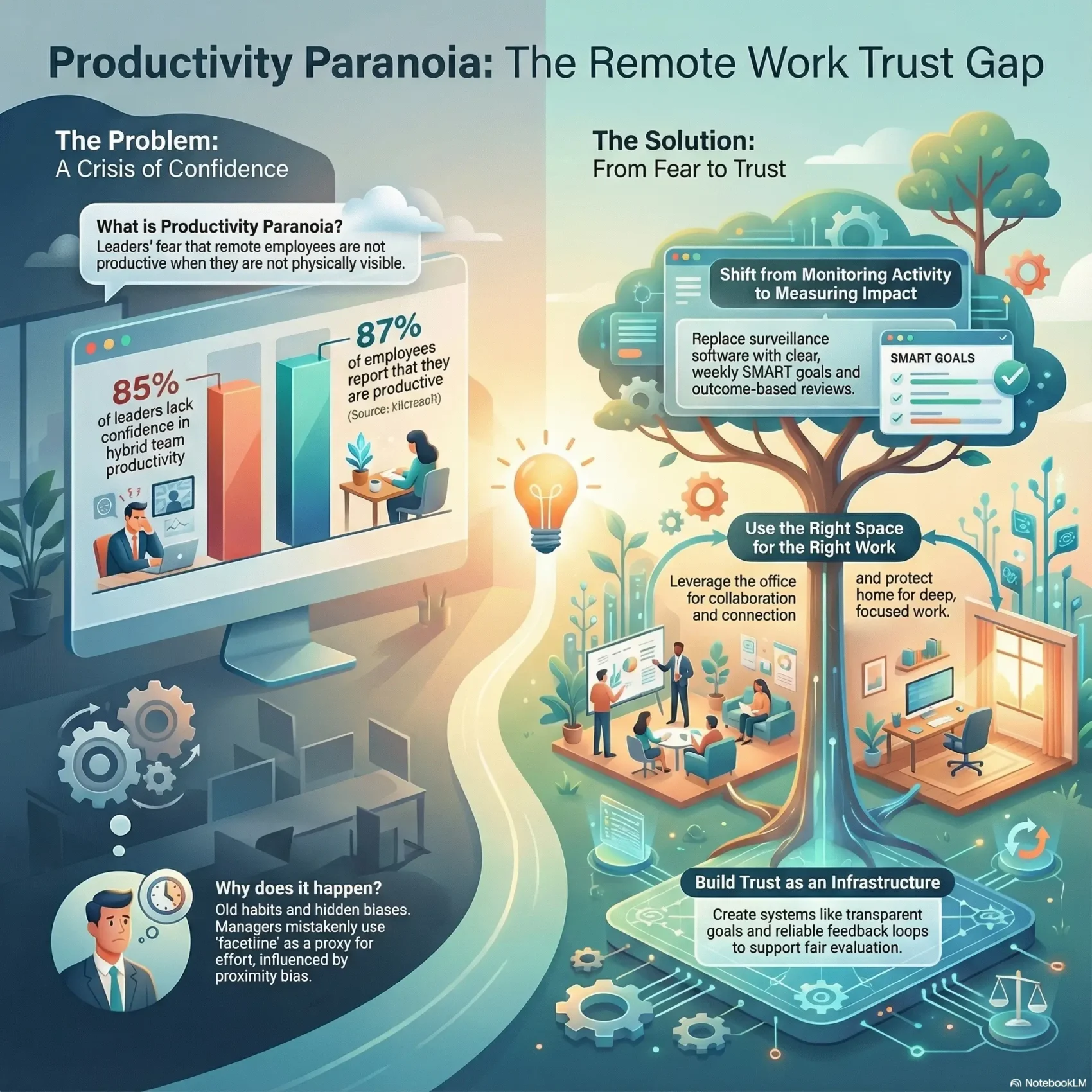
Last Updated on December 1, 2025
You are leading a team in a world where visible hours no longer equal clear results.
Many leaders still watch hallways and conference rooms for signs of effort. Microsoft UK’s Nick Hedderman noted this reliance on visual cues, while Ayelet Fishbach at the University of Chicago said time became an easy proxy during the shift to remote work.
That habit can seed productivity paranoia — doubt that employees and workers are doing the work you expect. This matters because your company’s performance depends on outcomes, not just on who is in the office.
In this piece you’ll see research and survey findings that explain why bosses felt pressure after the pandemic. You’ll also find practical ways to move from fear to trust so your hybrid work and hybrid remote teams can focus, connect, and deliver.
Key Takeaways
- Understand what productivity paranoia means and why it matters for your team.
- Learn how leaders can mistake visible activity for real results.
- See why measuring outcomes beats tracking hours spent at the office.
- Review research that shows workers can perform well outside the office.
- Find steps to build trust and reduce fear while protecting performance.
Why productivity paranoia is back in the headlines
When the shift to hybrid work made mixed schedules normal, it also exposed a widening trust gap between leaders and employees. You see managers asking for clearer signals of effort while their teams insist they are delivering results.
The data helped reignite the story. Microsoft’s September 2022 survey of more than 20,000 workers found 85% of leaders said the hybrid shift made it hard to be confident employees are productive. At the same time, 87% of employees self-reported being productive, yet only 12% of employers had full confidence.
“85% of leaders say the shift to hybrid work made it challenging to be confident employees are productive.”
Other research shows half of business leaders think out-of-sight workers don’t work as hard, and nearly half of companies installed monitoring software to track activity. That reaction often deepens distrust instead of solving the problem.
The hybrid shift exposed a trust gap between leaders and employees
You’ll find older leaders tend to be more skeptical of remote models, which shapes return-to-office policies and week-by-week debates. Misaligned metrics — more meetings, rising logged hours, and screen activity — created noise that masked real outcomes.
What the past tells you now: surveys that shaped today’s debate
- Microsoft and Citrix data show a mismatch between bosses’ confidence and workers’ self-assessments.
- Many companies turned to monitoring software as a quick fix, fueling more suspicion.
- Combined research reframed the story: this is a management and measurement challenge, not just an office vs. home fight.
Productivity paranoia: what it is and why it spreads
The gap between observation and output has become a central issue for modern teams. Productivity paranoia describes the mismatch when employers doubt what employees report about their work.
Definition and scope: the employer-employee perception disconnect
You see the problem when managers equate visible hours with real value. That creates strained conversations about performance and trust, and it can push companies toward counterproductive policies.
Data highlights: Microsoft and Citrix research on confidence and monitoring
Surveys show the scale: Microsoft found 85% of leaders said the hybrid shift made confidence harder, while 87% of employees thought they were productive and only 12% of employers fully agreed. Citrix reported half of leaders suspect out-of-sight workers don’t work as hard, and 48% rolled out monitoring software.
Old metrics, new reality: hours and “facetime” vs. outcomes
Legacy processes trained you to reward presence. But deep tasks often happen at home, while the office supports connection.
- Problem: Time is an easy proxy, not a true measure of impact.
- Risk: Surveillance can erode trust without improving results.
- Path: Focus on outcomes to realign management and restore confidence.
For broader context on remote trends and how leaders respond, see remote work trends.
Inside the manager’s mindset: biases, expectations, and trust
You notice managers favor what they can see when measurement feels fuzzy. That habit creates a lens that shapes how leaders judge effort and results. Small mental shortcuts then steer decisions about raises, promotion, and day-to-day oversight.
Anchoring and confirmation bias: why visibility feels safer
Anchoring makes leaders hang their judgments on presence and visible tasks. Confirmation bias then pushes them to notice evidence that fits that anchor.
MIT Sloan found remote workers often got lower evaluations and fewer raises, even with similar output. That shows how easy it is to misread signals when you favor what you can see.
Proximity bias’s real costs
People you see more often get more credit. That mere-exposure effect can harm fairness and retention across teams.
Managers who reward proximity risk lowering morale for remote workers and creating a long-term performance problem for companies.
Ambiguous goals and trust as infrastructure
Unclear deliverables fuel suspicion. A weekly SMART goal process gives you a simple fix: set explicit outcomes each week and review progress.
- Clear deadlines replace guesses about time and effort.
- Short check-ins keep focus on results, not presence.
- Trust—built on competence, communication, and character—supports reliable performance.
“Trust-rich environments boost energy, engagement, and lower burnout.”
Shift your management process away from watching the office. Use outcome-focused steps to judge employees productive on work that matters. That change reduces fear and rebuilds fair, confident teams.
What the research says about remote and hybrid performance
Evidence from randomized trials and broad surveys gives you a clearer picture of remote and hybrid performance.
Peer-reviewed findings: higher output, lower attrition, longer focused time
Randomized trials found a 13% boost for call-center workers at home and a 50% drop in attrition for some teams.
Hybrid arrangements showed 8% more code and 35% lower attrition in developer studies. Large surveys back this up: Mercer reported 94% of HR leaders saw equal or higher output remotely.
Flow and recovery: why full-throttle cultures underperform
Flow research shows people can be up to five times more effective in deep focus. But constant urgency breaks recovery and creativity.
Workers who never step back burn out faster, which hurts long-term performance and the company’s ability to keep key people.
Office vs. home: leaders’ in-person roles, teams’ need for deep work
The office works best for connection and collaboration. Home often provides the quiet needed for concentrated tasks.
Managers who match place to purpose reduce wasted meeting time and help teams produce more meaningful output.
From tracking activity to measuring impact: software isn’t a substitute for management
Monitoring tools showed small lifts, but they often deepen distrust. Replacing surveillance with weekly SMART goals aligns management with real impact.
- Example: swap daily screen checks for a one-week outcome review.
- Use clear deliverables to build trust and reduce paranoia among bosses and employees.
- Let research guide your policies so your business focuses on results, not visible hours.
Conclusion
strong, you can replace guesswork with a simple routine that keeps your team aligned and calm. Start by defining clear outcomes each week and use short reviews to show real impact, not hours logged.
Commit to measuring impact over presence. Let employees own results, and ask leaders to coach rather than surveil. This reduces productivity paranoia and restores trust.
Apply findings from research: protect deep work at home, use the office for connection, and set weekly SMART goals. For ideas on organizing hybrid groups, see decentralized teams.
Do this and your managers, employers, and workers will focus less on visibility and more on meaningful work.