Tools
Tools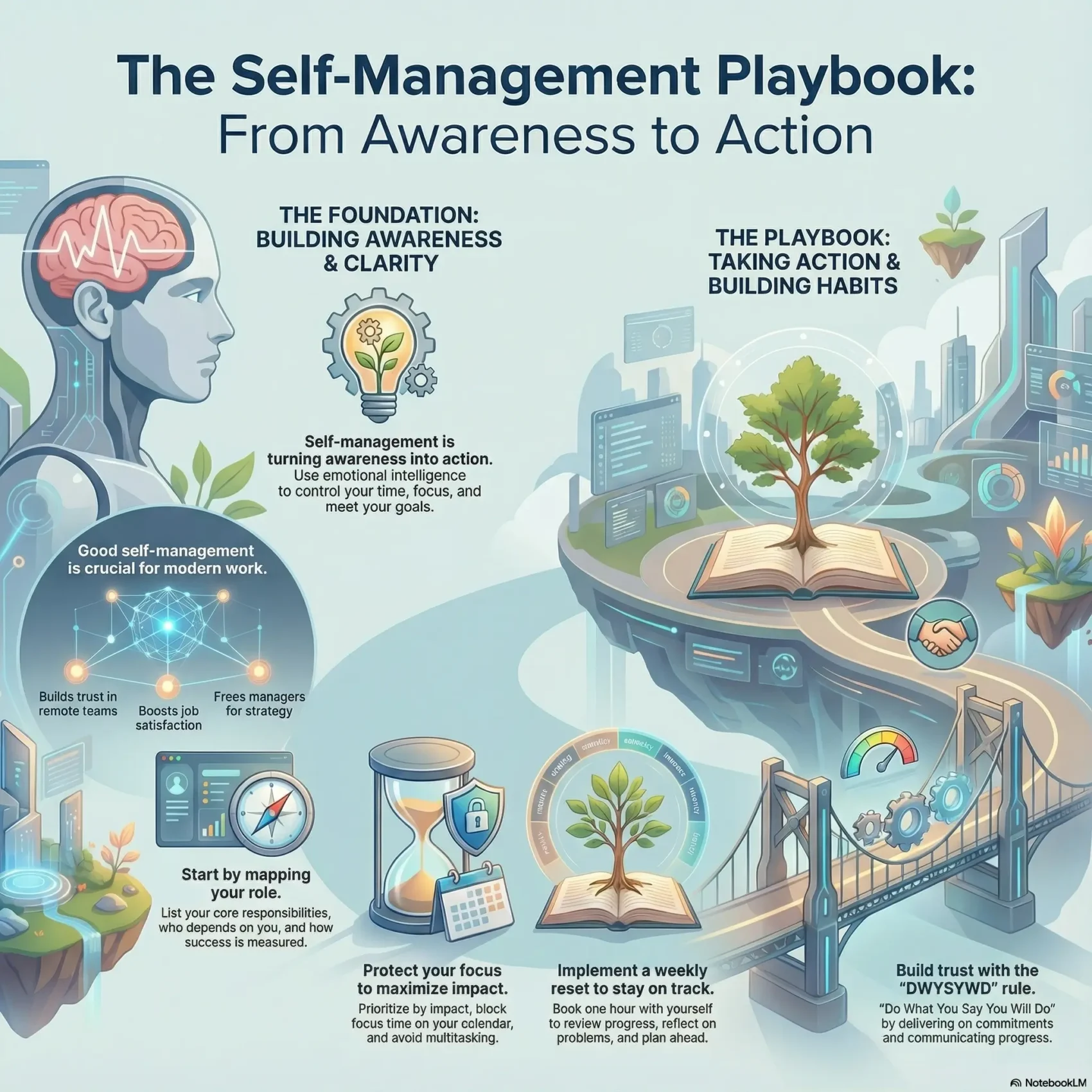
Self-management is your practical skill for staying on task, meeting goals, and keeping order in a busy work life.
It draws on emotional intelligence and simple routines to help you make steady progress toward career success. You’ll learn ways to control your time, protect focus, and avoid burning out.
Do what you said you would do becomes a guiding rule: set clear priorities, plan the next steps, and show visible progress to those who depend on your work.
We’ll cover practical skills—time management, stress handling, adaptability—and a weekly reset that keeps things in the right order. You can also use goal-setting tools like SMART goals to align daily tasks with company strategy and boost productivity.
Key Takeaways
- Clear routine: a weekly reset keeps priorities visible.
- Focus over frenzy: avoid multitasking to protect quality.
- Align goals: link day-to-day work with larger success metrics.
- Build skills: practice time and stress management regularly.
- Show progress: DWYSYWD strengthens trust and accountability.
Why self-management matters right now
When priorities shift, your ability to stay organized and accountable makes a measurable difference to team outcomes.
In today’s workplace, empowered people keep projects on schedule and avoid costly handoffs. Good self-management boosts job satisfaction, tightens intra-team communication, and frees managers to focus on strategy.
In hybrid or remote setups, planning your day and reporting progress builds trust and reduces oversight fatigue. That matters for business continuity during uncertainty and for long-term talent retention.
- Adapt faster: stay effective under change without burning out.
- Raise standards: clear responsibilities cut bottlenecks and lift team performance.
- Protect time: set achievable goals and make trade-offs that preserve productivity.
- Grow faster: practicing these skills turns good intent into repeatable outcomes for the business.
Practice aligning daily tasks to objectives and ask for input at key moments. That habit helps you deliver reliably and makes success predictable for your team.
What self-management is and how it drives your work and life
At its core, this skill helps you notice feelings and thoughts, then steer them into useful actions at work and home.
Definition grounded in emotional intelligence and self-regulation
Self-regulation—often called self-management in workplace guides—means you spot emotions and decide how to behave.
You use awareness of your thoughts and desires to choose responses that support goals.
That makes emotional intelligence practical: you move from feeling to deliberate behavior.
When individuals control emotions and behaviors, the whole organization benefits.
Your ability to manage time, make decisions, and stay accountable improves project delivery and overall performance.
- You stay composed under pressure and make better choices for the team.
- Consistent execution builds trust because others see reliable follow-through.
- Small daily habits compound into faster development on complex goals.
In short, this part skill is learnable. With practice you align daily actions to goals and help your team finish work on time.
Get clear on yourself first: awareness, role clarity, and baseline
Begin by knowing exactly what you own, who relies on it, and how success is measured. This clarity makes choices easier and reduces wasted time.
Map responsibilities, dependencies, and measures
List your core responsibilities. Name stakeholders who depend on each task and the deadlines that matter.
- Responsibilities: write 3–5 regular tasks tied to objectives.
- Dependencies: note who must provide input and when.
- Measures: define one or two metrics that show success.
Spot self-defeating behaviors
Watch for patterns like procrastination, perfectionism, or a refusal to delegate. Notice when they show up—during big projects, tight deadlines, or unclear briefs.
Capture your thoughts in the moment you feel stuck. That habit helps you interrupt the pattern and choose a different behavior next time.
Assess your starting point
Rate your current baseline across three quick areas: composure under pressure, adaptability to change, and results focus.
- How well do you protect focused time each day?
- How fast do you pivot when objectives shift?
- How clearly do you report progress when things change?
Do a weekly self-review: note one management skill to improve, one behavior to keep, and one small checkpoint for the next week. This keeps your organization practical and steady.
Build the core self-management skills that move the needle
Practical techniques help you protect focus, reduce stress, and make faster decisions at work. Use a handful of repeatable habits and simple systems to shift how your day unfolds.
Time management
Prioritize by impact, block focus time on your calendar, and decline nonessential asks. Avoid multitasking; batch similar tasks to save time and mental energy.
Stress management
Tie tasks to meaningful goals and take short breaks. Use brief mindfulness pauses to reset and maintain composure under pressure.
Adaptability and decision-making
Rehearse how you’ll pivot when priorities change. Define decision criteria, gather enough data, and pick the next best step instead of stalling.
Self-discipline and motivation
Connect work to purpose so intrinsic motivation fuels consistent effort. Practice one management skill per week until it sticks.
Communication and organization
State goals, deadlines, and risks clearly so your team can coordinate. Keep one task list, a clean calendar, and a simple file structure to preserve order.
- Quick wins: rank tasks, block time, and batch work.
- Daily reset: short review to protect focus and track progress.
- Growth: pick one behavior to practice for steady development.
From goals to outcomes: align, plan, and track what matters
Make your goals practical: map the outcomes you want and choose the next small action that moves you there. Start by tying each item on your list to a measurable business result so daily work contributes to broader objectives.
Set SMART goals that ladder to team and business objectives
Set SMART goals—specific, measurable, achievable, realistic, time‑bound—and show how each links to team objectives. This kind of goal setting clarifies why the work matters and helps everyone see how small wins compound into growth.
Strategic planning: work backward from the desired future state
Work backward from your target. List milestones, required resources, and risks in order. Then pick the next clear action that moves the project forward.
Priority-setting: protect focus time and sequence critical tasks
Block focus time on your calendar for high‑impact tasks and communicate trade‑offs early. Use simple time management rules: do the hardest task first and sequence things that unlock other work.
Goal tracking: make progress visible and adjust with data
Track progress in one place with lightweight tools and dashboards. Review data in brief weekly check‑ins, celebrate small wins, and decide what to stop, start, or continue. Visible tracking improves productivity and performance so you can adapt quickly.
Self-management at work: show your value every day
Show your value every day by turning small commitments into visible outcomes for the team. That practice builds trust faster than perfect plans and helps you stand out in the workplace.
Be accountable: DWYSYWD and communicate progress early
Do what you say you will do (DWYSYWD). Commit thoughtfully, finish work on time, and flag risks the moment they appear.
Short, regular updates focused on goals, blockers, and next steps keep others aligned and speed decisions.
Elevate team performance: know when to seek input and enable others
Balance deciding with asking others for help. Ask for the smallest viable help so the project keeps moving while you build your ability to solve similar issues later.
Offer clear options with trade-offs to coach up and across. That clarity helps your team make faster, better-aligned choices and keeps tasks in the right order.
Lead yourself in hybrid environments: autonomy, cadence, and clarity
Set a predictable cadence for check-ins, protect deep time for focused work, and document agreements across time zones.
Model composure during change: translate shifting priorities into a new plan and help teammates reset without losing momentum.
- Prove reliability: commit, deliver, and signal risks early.
- Communicate concisely: status, blocker, next step.
- Enable others: seek input wisely and offer trade-offs.
- Hybrid rules: cadence, protected time, written agreements.
For ideas on leadership development that complement these behaviors, review guidance on future leadership skills.
Tools, techniques, and habits to sustain effective self-management
Small, repeatable rituals and the right tools stop distraction and help you move from ideas to done.
Weekly meeting with yourself: review, reflect, and reset
Book a one-hour weekly meeting with yourself to review progress, problems, and plans. Use a 10-minute daily checkout on hectic days to keep momentum.
Mindfulness and self-care: sleep, exercise, and present-moment focus
Treat sleep, nutrition, and movement as core habits. Aim for about seven hours of sleep and short walks to cut stress.
Practice 5–10 minutes of mindfulness twice a day to steady your thoughts and emotions. These small resets restore clarity and energy.
Anti-procrastination tactics: break work down and start small
Beat procrastination by splitting work into the smallest next step and starting there. Momentum often comes after the first minute.
Systems that stick: calendars, task boards, and goal dashboards
Use simple tools—a calendar, a task board, and a single goal dashboard—to make priorities visible. Keep systems light so you actually maintain them.
- Manage time by batching similar tasks and scheduling deep work at your peak energy.
- Reduce stress with short breaks, a glass of water, or a brief walk.
- Keep routines small and consistent so skills and development become automatic.
Your self-management playbook: repeatable steps you can use today
Use a few simple steps to make your time, tasks, and priorities predictable and visible. This short playbook gives you practical ways to plan, act, and show progress without extra meetings or fuss.

Clarify objectives and role expectations with your manager
Start by agreeing on clear outcomes, measures, and role boundaries. Ask what success looks like and which goals take priority.
Keep your promises (DWYSYWD) and be careful what you say yes to. Clear expectations let you plan confidently and protect focus.
Choose one behavior to practice daily and track it
Pick a single behavior—like a 90-minute focus block—and do it every day this week. Track it so consistency builds into a habit.
Use a simple plan: outcomes, milestones, risks, and the next three actions. Then schedule the first action so the plan becomes real.
Focus on what you can control and act like a player, not a victim
When you’re stuck, ask, “What’s the smallest thing I can do in the next 10 minutes?” Small wins keep momentum.
Propose solutions, set boundaries, and practice quick decision-making to strengthen management skills. Replace old behaviors—procrastination → start small; perfectionism → ship an MVP—and review that list daily.
“Act like a player: control what you can, propose options, and make progress visible.”
- Clarify objectives with your manager.
- Practice one behavior daily and track it.
- Use a short plan template and schedule the first task.
- Share a two-sentence weekly update: status, risk, next steps.
Conclusion
Close the loop on your week by using data, brief reflection, and a single concrete next step. That habit turns insight into consistent progress and keeps your priorities in order.
Emotional intelligence helps you spot which behaviors block momentum and which move projects toward success. Practice focused time, clear communication, and one weekly check to build those management skills.
Effective self-management is measurable: composure, adaptability, and results focus improve with deliberate practice. Commit to one action today—schedule a focus block, list three goals, or share a short status—and let small wins drive team and organizational growth.