Tools
Tools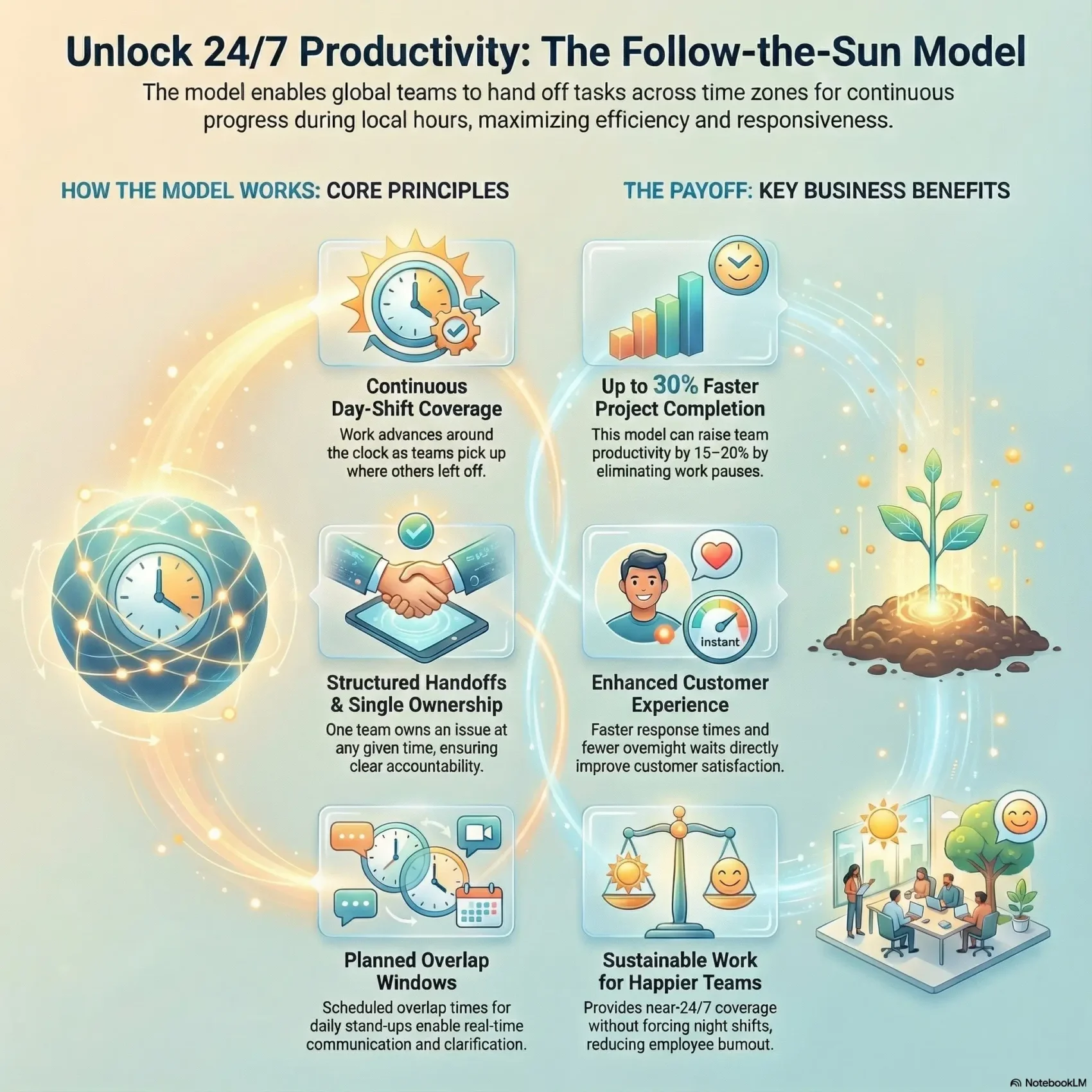
You run a service or support team that must move work forward while the clock keeps turning. This approach hands tasks from one region to the next so issues stay live during local day shifts.
Smaller firms can adopt the same model with remote reps or staggered starts — you don’t need multiple global offices. Real examples help: Prezi covers 18 hours daily with teams in San Francisco and Budapest, and Zuora stitches together near-continuous support across Colorado, California, and Beijing.
Dashboards and tools make virtual handoffs smooth. With clear ownership, shared processes, and regional leadership, your teams keep context and reduce rework. The result: faster response times, better customer outcomes, and a scalable way to manage work across time zones.
Key Takeaways
- The model moves work across time zones so customer needs progress during local business hours.
- Small teams can use remote staff or staggered starts to get broad coverage.
- Real-world examples (Prezi, Zuora) show practical coverage and handoff tactics.
- Shared dashboards, training, and regional leaders keep service consistent.
- This approach speeds response and reduces delays without forcing night shifts.
What Follow-The-Sun Scheduling Means Today and Why It Matters
Modern companies hand tasks between regions so customers get help during their local business hours. This sun model is a global approach where one owner moves work forward during their daytime and then passes ownership on.
The model matters because customers expect timely, consistent service no matter where they are. You can meet that expectation without forcing night shifts by using planned overlap windows and clear handoffs.
In practice, companies place teams across Americas, EMEA, and APAC and rely on shared tools and repeatable processes. That shared knowledge keeps support and development work from stalling when one site signs off.
- Single-owner at a time keeps accountability for customer issues.
- Overlapping windows improve real-time communication and reduce context loss.
- The approach scales from staggered starts to full 24/7 coverage, letting you choose hours that match demand.
When you prioritize handoff hygiene and simple collaboration practices, customers see seamless care instead of fragmented updates. That outcome is why this model is becoming standard for global service teams.
Core Principles of the Follow the Sun Model Across Time Zones
A simple framework keeps global work moving: assign clear daytime owners, standardize handoff notes, and reserve overlap windows for questions. These core principles reduce rework and keep customers unaware of shift changes.
Continuous day-shift coverage
Keep work advancing by letting teams in different zones pick up where others left off. As one team signs off, another begins—so productive hours stack instead of stall.
Structured handoffs and single ownership
Make sure one team owns an item at any given time. Use a checklist with status, blockers, next steps, and priority so nothing is missed during transfer.
Planned overlap windows for real-time communication
Schedule short overlap times each day to resolve open questions. Lengthen these windows for complex projects and shorten them for routine work.
- Use shared tools (ticketing, version control, reporting) to keep context.
- Update artifacts—tickets, logs, code branches—at every handoff.
- Define processes and documentation standards so the model becomes routine.
Business Benefits You Can Realize with Follow-The-Sun Scheduling
When teams in different regions move work without pauses, your projects finish faster and customers see progress around the clock.
Faster response times and shorter cycle times cut delays. Properly implemented, this model can reduce project completion time by up to 30% and raise productivity by 15–20% by removing pauses between workdays.
That faster flow translates into earlier releases, quicker resolutions, and lower time-to-market for product improvements.
Happier teams and consistent service
You can offer near-24/7 customer support without forcing overnight shifts. Day-only shifts improve employee well-being and retention while keeping service steady for customers.
Passing work to a fresh team often brings new perspectives, but it only pays off with clear documentation. Structured handoffs prevent duplicated effort and preserve momentum.
- Measurable gains: faster response times and reduced time-to-market that impact your business outcomes.
- Better customer experience: fewer overnight waits raises CSAT and NPS.
- Sustainable work: daylight-only coverage minimizes burnout and keeps teams productive.
In complex environments, these benefits compound: fewer escalations, shorter queues, and clearer metrics for leaders and managers to quantify. That makes the model a practical way to boost both operational performance and the customer experience.
Are You Ready? How to Assess Your Teams, Customers, and Time Zone Needs
Assess demand by plotting customer contacts across hours and regions to reveal coverage gaps. Start small, then let analytics guide expansion. When you are a small company, begin with a strong FAQ, Help Center, or a remote rep rather than opening new offices.
Map demand by region and hour
You’ll map where and when your customers contact you most. Capture regions, peak hours, issue types, and average response time.
Choose coverage model
Decide between full 24/7/365 or extended hours with staggered shifts. Use ticket volume by hour to see whether extended support or round-the-clock service fits your growth stage.
Right-size your solutions
Weigh self-service, adding a remote rep, or opening extra locations. Staggered starts can extend coverage inside one country before you invest in new sites.
“Start where demand is highest and scale with proof, not guesswork.”
- You’ll segment customers by needs to match live help vs. self-service.
- Benchmark your industry to set realistic SLAs and targets.
- Check that your management and tooling support clean handoffs before wider rollout.
How to Implement the Follow-The-Sun Scheduling Model Step by Step
First, decide the coverage pattern—three ~8-hour hubs or a two-location starter that extends daytime support. Pick the design that fits your demand, staff, and growth plan.
Design your global workflow
Choose classic Americas-EMEA-APAC for near-continuous coverage or start with two locations if you need a simple workflow. Map peaks by hour and assign clear ownership for each handoff.
Build reliable handoffs
Use checklists, status logs, and priority buckets so every team knows what to pick up first. Document escalation paths and paging rules to keep critical work moving.
Standardize processes and tools
Adopt shared ticketing, project tracking, version control, and a searchable knowledge base. Consistent artifacts make across multiple teams auditable and reversible if needed.
Plan overlap and leadership
Schedule 1–2 hour overlap windows for daily stand-ups and quick clarifications. Assign team leads in each region to own escalations, training, and performance management.
- Run a pilot, validate outcomes, and iterate before wider rollout.
- Define success metrics per project phase to track progress.
- Train teams on playbooks so work and knowledge transfer stay consistent.
SOPs and team productivity help you lock in reliable handoffs and repeatable management practices.
Tools and Software Stack to Power Handoffs, Collaboration, and Visibility
A tightly integrated tech stack makes handoffs visible and saves hours of repeated context gathering. Choose a mix of cloud software that logs ownership, timestamps transitions, and keeps searchable records.
Centralized knowledge bases and detailed work logs help context survive every transfer. A single, searchable repository stops teams from digging through siloed files and reduces rework.
Cloud project management and async communication
Cloud project systems should show who owns each item and when it moved. Add async tools—threaded messages, video summaries, and structured updates—to cut meeting load while boosting clarity.
- You’ll standardize on a searchable knowledge base and detailed work logs so context survives every handoff.
- You’ll use time zone visualization to see who’s online and which locations are active for quick overlap planning.
- You’ll add automated notifications, escalation rules, and dashboards that surface SLAs and queue health across multiple regions.
- You’ll ensure your software stack supports version control, audit trails, and consistent naming so knowledge is easy to find.
Final tip: pick tools that integrate well to avoid duplicate entry, and set clear governance so every team has the right access at the right time.
Common Challenges and How You Overcome Them in Different Zones
The biggest barriers in multi-region work are cultural cues and unclear handoffs, not lack of tools. You can fix most issues with simple rituals and clear artifacts.
Communication and culture matter. Face-to-face meetings are rare across distant sites, so rotate meeting times so one zone isn’t always inconvenienced. Train teams on language norms, feedback styles, and decision habits to reduce isolation.
Handoff friction
Daily handoffs bottleneck when understanding is low. Use standardized templates, short video summaries, and a checklist that shows blockers and next steps.
Measure handoff quality with simple metrics: follow-up rates, time-to-acknowledge, and rework counts. Peer reviews of handoff packets catch gaps before they hit customers.
- You’ll anticipate communication gaps and plan rotating meeting times.
- We’ll equip teams with templates and video summaries to prevent rework.
- You’ll define fallbacks for urgent work and validate understanding at each handoff.
- We’ll run incident reviews to refine processes and keep collaboration healthy as the model scales.
“Small rituals and clear documentation turn zone differences into predictable handoffs.”
Real-World Examples, Metrics, and Benchmarks to Guide Your Model
Practical examples show how disciplined handoffs and the right tools deliver measurable gains for customers and teams.
Zuora uses staggered starts across Colorado, California, and Beijing to provide true 24/7/365 coverage. One team owns each issue during its local day and passes updates via private ticket comments.
Prezi links San Francisco and Budapest to cover about 18 hours per day with minimal extra headcount. Both companies keep work moving with shared knowledge, templates, and software logs.
“Discipline in handoffs and measurable metrics turn overlap into faster progress and fewer reworks.”
- Track: cycle time, follow-up question rates, and handoff quality (rework).
- Validate: customer response times and SLA attainment to prove impact.
- Report: project-level measures—blocked time, throughput, and progress per day.
- Monitor: team satisfaction as a health metric for sustainable support.
- Use: workflow dashboards and software issue logs for before/after ROI analysis.
You can expect productivity increases of ~15–20% and time-to-completion drops up to 30% when handoffs, processes, and tools are disciplined. Use these benchmarks to set realistic goals for your company.
Conclusion
You can decide if this follow sun model fits your company by testing a small pilot that relies on standardized tools, overlap windows, and clear handoffs.
The payoff is real: teams often see 15–20% productivity gains and cut completion times up to 30% when handoff friction drops. That improves customer experience and keeps the clock moving on work without forcing night shifts.
Look ahead to AI-assisted transitions and real-time translation to boost collaboration and communication across zones. Build regional management, measure handoff quality, and iterate so your service and support scale with confidence.