Tools
Tools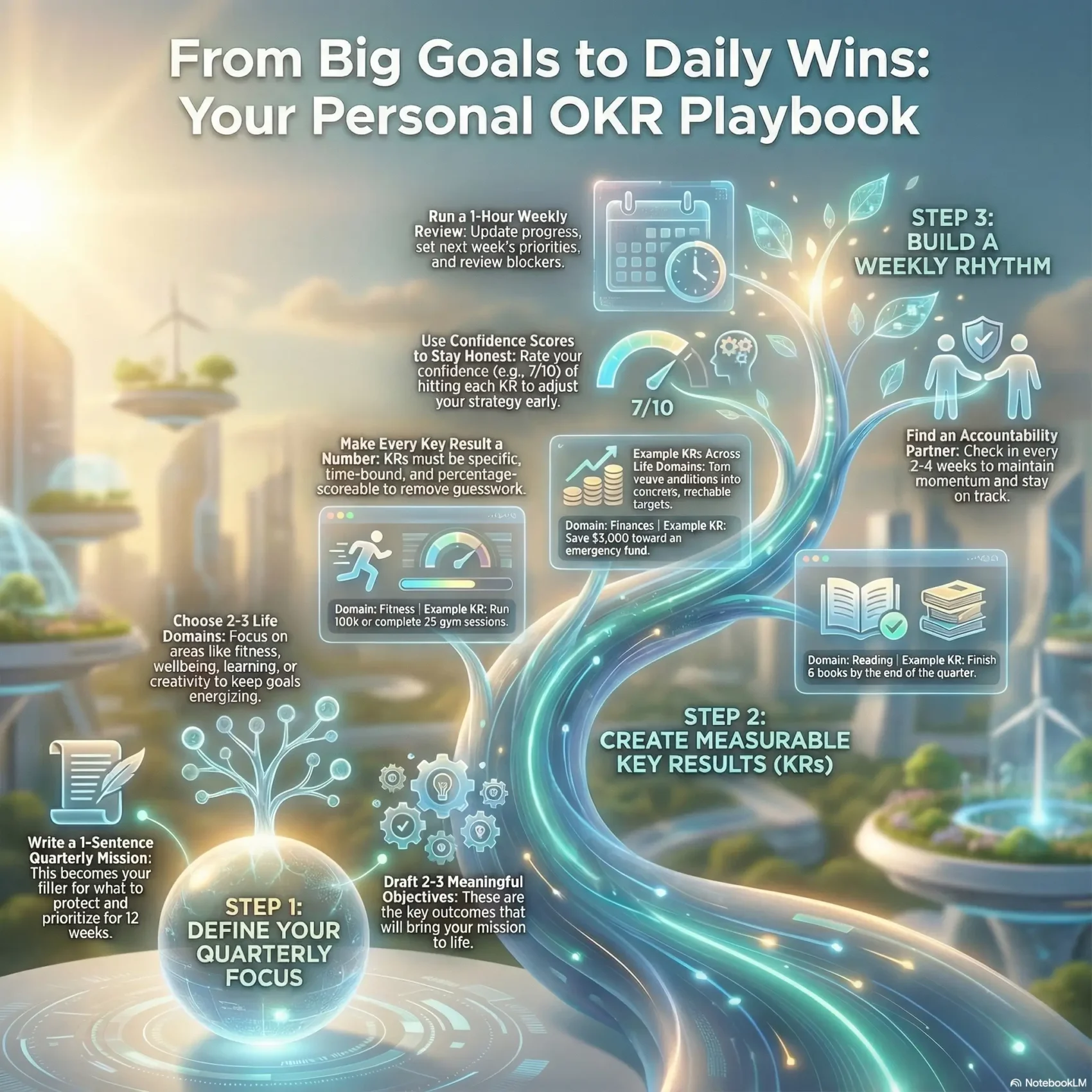
Last Updated on December 1, 2025
Turn big intentions into steady momentum. You’ll learn a clear framework that links long-term goals to the daily tasks that move you forward. This system was used by practitioners like Christina Wodtke and adapted by James McAulay to shape quarter-long missions for life and work.
Start small, check in weekly, and measure what matters. Draft one objective for the quarter, add measurable key results, and keep a single source of truth in Notion or Google Sheets. Weekly reviews and short accountability check-ins keep progress visible and prevent drift.
With simple examples—like running 100k or going to the gym 25 times—you’ll see how objectives key results turn fuzzy ambition into measurable steps. The result is a lightweight routine: one document, one review, one clear path to success.
Key Takeaways
- You’ll learn a practical framework that links big-picture goals to daily tasks.
- Run the system each quarter with weekly check-ins to keep momentum.
- Write measurable key results so progress becomes visible and motivating.
- Use one document and one routine to keep this lightweight and repeatable.
- Apply these steps to both life and work without adding complexity.
What personal OKRs are and why they work for your life, not just work
Think of this method as a life dashboard: big aims paired with concrete metrics you can update regularly. Set one clear objective and attach a few measurable key results. Then review weekly and score progress so you can pivot early.

Objectives and Key Results in plain English
Objective: what you want. Key results: how you prove progress.
Keep KRs numeric and scoreable. For example, an objective like “Improve fitness” links to KRs such as “Run 100k” or “Go to the gym 25 times.” Use percentage or confidence scores (7/10 mid-quarter) to stay honest.
The difference between personal goals and workplace performance
These OKRs are for your life, not a company scorecard. Unlike individual performance OKRs at work, your set should protect priorities you’d otherwise drop.
“Personal OKRs guide your life and protect what won’t get done otherwise.”
- Teams at companies use okrs to align many people.
- Your approach should stay lightweight, human, and tied to real constraints.
- This method traveled from Andy Grove and John Doerr to tech firms, but you can tailor it to your world and years ahead.
Set your mission, then craft objectives that fit your quarter
Begin the quarter with a single-line mission that draws a clear line between your time and your goals. That sentence becomes your filter for what to protect, schedule, and say no to over the next 12–13 weeks.
Pick 2–3 life domains—fitness, wellbeing, learning, or creativity—so objectives feel energizing, not extra tasks. Choose areas that map to real moments in your day.
Write a clear quarterly mission to anchor your focus
Use one line like James McAulay’s example: a mission that answers, “What do I need to protect this quarter?”
Choose life areas to improve: fitness, wellbeing, learning, or creativity
Limiting domains keeps your energy useful. Each domain should tie to concrete actions you can take this week.
Turn the mission into 2-3 meaningful objectives
Draft two or three objectives that are outcome-focused and realistic for the quarter. Ask, “What won’t happen unless I protect it?”
“Narrow your aims to the few objectives that will fail without deliberate protection.”
- Write a one-sentence mission that guides how you use time this quarter.
- Pick domains that make the goals feel personal and doable.
- Convert the mission into 2–3 clear objectives and map each to daily moments for easy action.
Draft measurable Key Results that you can actually track
Make each result a number and a deadline so you know exactly how the quarter ends. Clear, numeric KRs remove guesswork and let you assign a straight percentage to each item.
Make every KR specific, time-bound, and percentage-scoreable
Write KRs as counts, totals, or dates: “Run 100k,” “Save $3,000,” or “Finish chapter by week 8.” Then give each KR a percent complete each week. This weekly score keeps progress visible and avoids surprises at the end of the quarter.
Tie your KRs to identity and purpose so you stay motivated
Why matters. Link a KR to who you want to be—meditate to become calmer, read to be the curious person you value. That identity tie keeps you going when time is tight.
Examples: fitness, reading, finances, and home projects
- Fitness: Run 100k, cycle 500k, or 25 gym sessions.
- Reading: 20 pages daily or 6 books completed by quarter end.
- Finances: Save $3,000 or hit a 15% reduction in discretionary spending.
- Home: Organize three rooms or finish one major repair by week 10.
Focus on what won’t get done unless you protect it
Avoid KRs for work already in motion. Pick outcomes that need deliberate effort. Use a simple system—spreadsheet or wall calendar—and a weekly confidence score (e.g., 7/10) to adjust tactics before the quarter ends.
“Protect the efforts that won’t happen on their own.” – Christina Wodtke
Build a weekly-to-quarterly cadence to connect goals to your days
A steady weekly rhythm turns broad aims into the small actions you actually do each day. Treat the week as the unit that bridges the quarter and your calendar. A regular check-in keeps momentum and makes success predictable.
Close out the last quarter: grade, reflect, and learn
At quarter end, give each objective a quick grade and capture two lessons: what helped and what drained you. Summarize health metrics like energy, pain, or mood so you spot patterns over months.
Run a Weekly Review to prioritize actions and track progress
Spend about an hour each week updating confidence scores per key result, logging last week’s P1/P2 priorities, and setting next week’s top actions. Tools like Todoist make this review fast and repeatable.
Use confidence scores and health metrics to stay honest
Color-coded health flags and a simple confidence number keep you realistic. Share a short status with a coach or peer to keep the habit alive and to treat this as life management, not micromanagement.
- Do a one-hour weekly session to convert plans into scheduled days.
- Close each quarter with a grade and notes for the next months.
- Track simple metrics so you can adjust before the quarter ends.
personal OKRs in practice: explore vs. exploit and hypothesis OKRs
Some quarters ask you to experiment; others ask you to scale what’s already working.
Explore means testing new paths. You run small experiments that give clear signals fast. Exploration helps you find better strategies in an uncertain world.
Exploit means doubling down on routines that move the needle. When results are repeatable, you shift resources to accelerate growth.
When to explore new paths vs. exploit what works
Use exploration when you don’t yet have reliable evidence. Use exploitation when metrics are stable and worth scaling. Over the years you’ll alternate seasons of both.
Write hypothesis objectives and prove them with KRs
Phrase an objective as a hypothesis: e.g., “I can be happy and financially viable writing while teaching part-time.”
“Measure what proves or disproves the idea.”
- Pick 2–3 decisive key results: drafts completed, audience metrics, teaching income.
- Run a quarter-long test, log outcomes weekly, and adapt actions like hiring help or changing scope.
- Balance tests with the ongoing work that funds your life so you don’t stall momentum.
Use this framework to turn uncertainty into structured experiments that yield clear results you can act on for years.
For a focused method to convert experiments into short sprints, see focus sprints.
Tools, systems, and accountability to stay on track
Choose a few simple tools that make weekly updates feel effortless, not like extra work. A clean tracker keeps your goals visible and reduces friction when you update each week.
Pick a simple tracker: spreadsheet, Notion, or calendar
Use one place for scores, next tasks, and health notes. James McAulay offers templates for Notion and Google Sheets that make this painless.
Find an accountability partner and check in every 2–4 weeks
Share the sheet with someone you respect. A standing check-in every few weeks keeps momentum and can include a small bet to raise the stakes.
Add risks and blockers to your weekly update
Include a short Risks & Blockers section in your Monday note like Christina Wodtke’s status emails. That makes it easy to spot what needs help in the coming days.
- Simple system: Notion, Google Sheets, or calendar for fast updates.
- Regular check-ins: 2–4 week meetings with a partner or small team.
- Weekly template: progress, next tasks, confidence, risks.
- Protect crystal projects: time-block an hour each week to update and plan.
Conclusion
Turn a quarterly mission into a steady stream of weekly actions that compound into real change. Commit to a simple okrs routine: one mission, a few objectives, and measurable key results you review each week. Use that hour-long weekly review to translate goals into small tasks you can do today.
Expect busy weeks and setbacks. Christina Wodtke urges forgiveness and a quick return to the process. James McAulay’s story shows how repeated quarters and consistent review create major results over years.
Start now with one objective and one example KR. Share progress with someone you respect, track just enough to learn, and grade at quarter end. Over months and years, these tiny actions remake your life and bring the success you want.